

1. Search Result
Search Result
Results for "

Amorphous

" in MedChemExpress (MCE) Product Catalog:

27

Inhibitors & Agonists

5

Biochemical Assay Reagents

4

Peptides

6

Natural
Products

1

Isotope-Labeled Compounds

1

Oligonucleotides

Cat. No. Product Name Target Research Areas Chemical Structure
  • HY-B1620E

    PVP K60; Polyvidone K60; Povidone K60

    Biochemical Assay Reagents Others
    Polyvinylpyrrolidone K60 is one of the polymers in pharmaceutical preparations. Polyvinylpyrrolidone K60 promotes amorphous dispersion and inhibits crystallization of the drug .
    Polyvinylpyrrolidone K60
  • HY-W145522

    Biochemical Assay Reagents Others
    Pullulan (Pullulan standard 5800) (Mw 362-480 kDa; Mn 100-200 kDa) is a class of orally active and water-soluble linear glucosic polysaccharide. Pullulan can be isolated from the polymorphic fungus Aureobasidium pullulans. Pullulan is composed of maltotriose repeating units linked by α-1,6 linkages and is an amorphous slime matter. Pullulan is widely used in food, environment, pharmaceutical, manufacturing, and electronics .
    Pullulan, Viscosity(10%):15-180mPa.s
  • HY-N7046

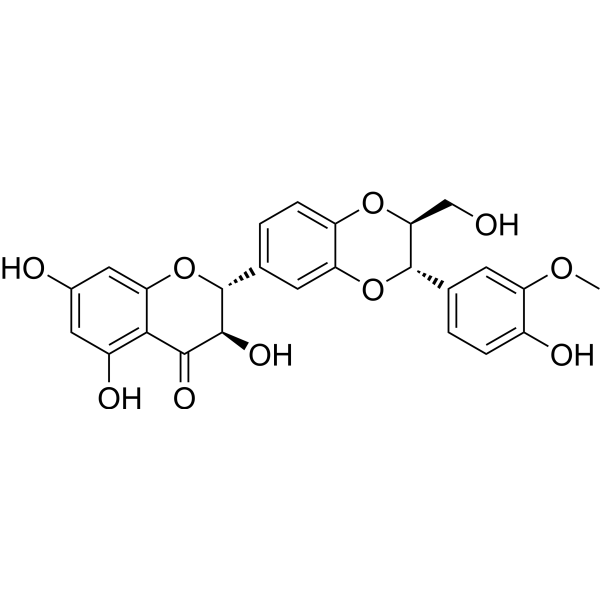
    Silibinin B

    Amyloid-β Apoptosis JNK p38 MAPK Neurological Disease Cancer
    Silybin B (Silibinin B) is an orally active amyloid-β aggregation inhibitor and ATR pathway activator that can cross the blood-brain barrier. Silybin B inhibits Aβ fibril formation and promotes amorphous aggregate formation, while activating the ATR-mediated DNA damage repair pathway and inhibiting JNK/p38 MAPK signaling. Silybin B can reduce Cisplatin (HY-17394)-induced neuronal DNA damage and apoptosis. Silybin B has anti-oxidative stress, cell cycle regulation and neuroprotective activities. Silybin B is mainly used in the study of Alzheimer's disease and Cisplatin chemotherapy-related neurotoxicity .
    Silybin B
  • HY-NP009

    Bacterial Infection Neurological Disease
    α-Lactalbumin is a globular whey protein that exists in milk. α-Lactalbumin binds Ca 2+, Mg 2+, Mn 2+, Na +, K + and Zn 2+ ions; among these, Ca 2+ binding enhances protein stability, while Zn 2+ binding reduces stability and induces aggregation. α-Lactalbumin forms amyloid fibrils, amorphous aggregates, nanoparticles and nanotubes depending on external conditions. α-Lactalbumin exhibits bactericidal and antiviral activities. α-Lactalbumin has anxiolytic and antidepressant activities, and its effects are enhanced under stress conditions .
    α-Lactalbumin
  • HY-W243408C

    Limestone, 99%

    Environmental Pollutants Biochemical Assay Reagents Others
    Calcium carbonate, 99% (Limestone, 99%) is a calcium carbonate salt and also a mineral. Calcium carbonate, 99% serves as a thickener and acidity regulator .
    Calcium carbonate, 99%
  • HY-P11111

    Drug Derivative Others
    QP5 is an Amelogenin (HY-P71627)-derived peptide. QP5 binds to hydroxyapatite and demineralized enamel surfaces, temporarily stabilizes amorphous calcium phosphate (ACP), and regulates the crystallization of hydroxyapatite. QP5 promotes remineralization of artificial enamel caries in vitro, and acts synergistically with fluoride to enhance enamel caries remineralization. QP5 can be used in studies related to enamel caries and early enamel caries .
    QP5
  • HY-P10861A

    Tau Protein Neurological Disease
    RI-AG03 acetate is a proteolytically stable tau aggregation inhibitor that crosses the blood-brain barrier and exhibits oral efficacy. RI-AG03 acetate inhibits tau aggregation and promotes the formation of alternative amorphous aggregates that are non-amyloidogenic. RI-AG03 acetate mediates cellular uptake through direct membrane penetration and macropinocytosis, and its conjugation with cell-penetrating peptide sequences (CPPs) enhances the binding of cells to liposomes. RI-AG03 acetate suppresses aggregation-dependent neurodegenerative and behavioral phenotypes, and extends the lifespan of Drosophila models of tauopathy. RI-AG03 acetate can be used for research on tau-related diseases such as Alzheimer's disease .
    RI-AG03 acetate
  • HY-154739A

    Biochemical Assay Reagents Others
    Amorphous silica can be used as an excipient, such as viscosifier, suspending agent, tablet disintegrating agent, adsorbent dispersing agent as liquid in powders. Pharmaceutical excipients, or pharmaceutical auxiliaries, refer to other chemical substances used in the pharmaceutical process other than pharmaceutical ingredients. Pharmaceutical excipients generally refer to inactive ingredients in pharmaceutical preparations, which can improve the stability, solubility and processability of pharmaceutical preparations. Pharmaceutical excipients also affect the absorption, distribution, metabolism, and elimination (ADME) processes of co-administered drugs .
    Amorphous silica
  • HY-P10861

    Tau Protein Neurological Disease
    RI-AG03 is a proteolytically stable tau aggregation inhibitor that crosses the blood-brain barrier and exhibits oral efficacy. RI-AG03 inhibits tau aggregation and promotes the formation of alternative amorphous aggregates that are non-amyloidogenic. RI-AG03 mediates cellular uptake through direct membrane penetration and macropinocytosis, and its conjugation with cell-penetrating peptide sequences (CPPs) enhances the binding of cells to liposomes. RI-AG03 suppresses aggregation-dependent neurodegenerative and behavioral phenotypes, and extends the lifespan of Drosophila models of tauopathy. RI-AG03 can be used for research on tau-related diseases such as Alzheimer's disease .
    RI-AG03
  • HY-177551

    Checkpoint Kinase (Chk) Cancer
    CHK1-IN-14 is a free base form of CHK1 inhibitor. CHK1-IN-14 can be used in research on resistance to chemotherapy and radiotherapy .
    CHK1-IN-14
  • HY-141460

    Ile-Ala; L-Isoleucyl-L-alanine

    Biochemical Assay Reagents Others
    H-Ile-Ala-OH (Ile-Ala; L-Isoleucyl-L-alanine) is a linear aliphatic dipeptide and self-reactive cyclization reagent that self-assembles into amorphous films or spherical structures from specific solvents. H-Ile-Ala-OH also serves as a precursor for the synthesis of the cyclic peptide cyclo (L-isoleucyl-L-alanine) (HY-N9251). H-Ile-Ala-OH undergoes solid-state cyclization when heated above 206 °C, and its initiation temperature is closely related to the size of side-chain substituents .
    H-Ile-Ala-OH
  • HY-W112090

    PdTFPP; 5,10,15,20-Tetrakis(pentafluorophenyl)-21H,23H-porphine palladium(II)

    Fluorescent Dye Others
    Palladium meso-tetra(pentafluorophenyl)porphyrin (PdTFPP) derives from palladium(II), acting as a fluorescence-quenched optical probe and high-performance oxygen concentration sensor with outstanding photostability and antioxidant capacity. Palladium meso-tetra(pentafluorophenyl)porphyrin exhibits reduced luminescence intensity as dissolved oxygen concentration rises. Palladium meso-tetra(pentafluorophenyl)porphyrin can be applied for real-time monitoring of live-cell respiration, hypoxic tissue imaging, and nanofibrous organic semiconductors in photodetectors for ambient oxygen detection .
    Palladium meso-tetra(pentafluorophenyl)porphyrin
  • HY-172673

    GCGR Metabolic Disease
    GLP-1R agonist 31 (Compound 1) is an amorphous glucagon-like peptide-1 receptor (GLP-1R) agonist .
    GLP-1R agonist 31
  • HY-161249

    Pantetheinase Inflammation/Immunology
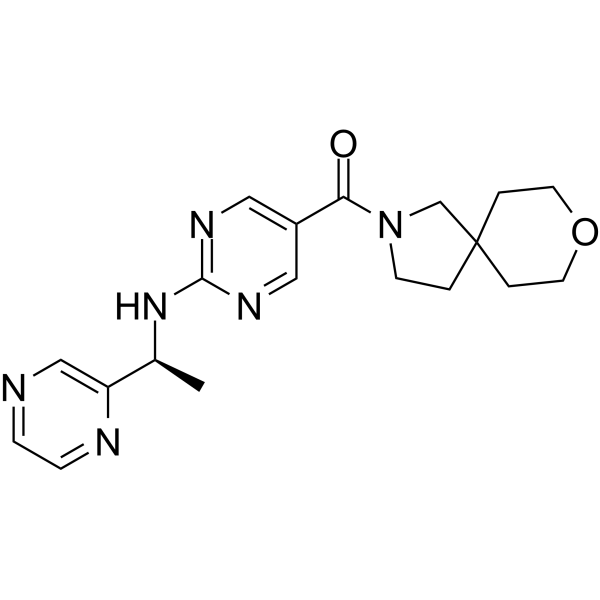
    Vanin-1-IN-4 (compound (S)-1) is vanin-1 inhibitor with a chiral methyl substituent, with profils as potent drug-candidate but exist as an amorphous solid .
    Vanin-1-IN-4
  • HY-172383

    Biochemical Assay Reagents Others
    Polysuccinimide, an amorphous polymer, is a polyimide precursor. Polysuccinimide can be used for the production of degradable polymers .
    Polysuccinimide
  • HY-158569

    Endogenous Metabolite Others
    SAR114137 is a highly effective drug with potent biological activity. SAR114137 exhibits altered amorphous content characteristics during physical processing of the crystalline active pharmaceutical ingredient. The amorphous API content of SAR114137 is significantly reduced when processed by different jet grinding techniques. SAR114137 exhibits good chemical stability in pharmaceutical formulations .
    SAR114137
  • HY-N6095

    Endogenous Metabolite Others
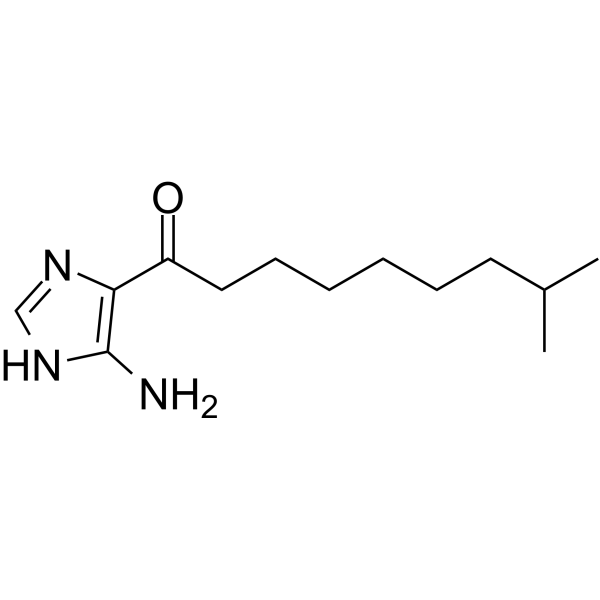
    Nocarimidazole A is a white amorphous solid alkaloid with ultraviolet activity that can be isolated from marine actinomycete Nocardiopsis .
    Nocarimidazole A
  • HY-N8150

    Others Others
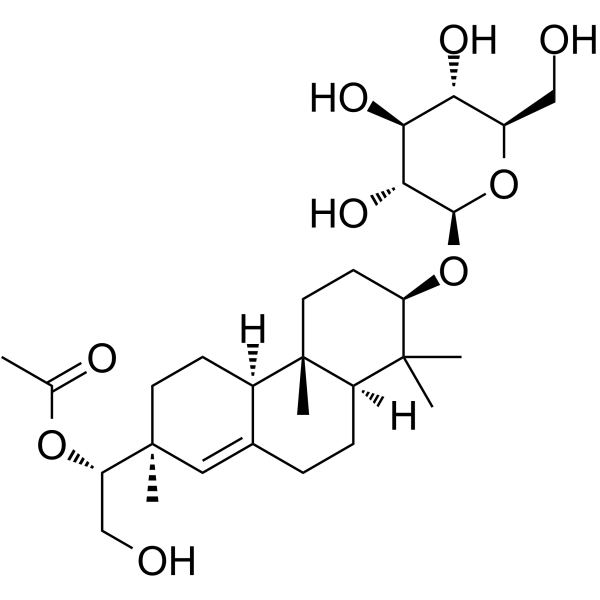
    Hythiemoside B is isolated as a white amorphous powder. Hythiemoside B is an ent-pimarane glucoside isolated from the aerial part of Siegesbecikia orientalis L. (Asteraceae) .
    Hythiemoside B
  • HY-P10661

    Biochemical Assay Reagents Others
    L-KYFIL is a pentapeptide that is amorphous on its own. When mixed with D-KYFIL, it transforms from fibrous hydrogels into plate-like networks, resulting in changes in mechanical properties and forming a crystalline state. The mixture can protect L-KYFIL from proteolytic degradation. L-KYFIL can be used to study stereocomplexation behavior of peptide sequences and in the development of biomaterials .
    L-KYFIL
  • HY-N7046R

    Silibinin B (Standard)

    Reference Standards JNK Amyloid-β p38 MAPK Apoptosis Neurological Disease Cancer
    Silybin (Silibinin B) (Standard) is the analytical standard of Silybin B (HY-N7046). This product is intended for research and analytical applications. Silybin B (Silibinin B) is an orally active amyloid-β aggregation inhibitor and ATR pathway activator, that can cross the blood-brain barrier. Silybin B inhibits Aβ fibril formation and promotes amorphous aggregate formation, while activating the ATR-mediated DNA damage repair pathway and inhibiting JNK/p38 MAPK signaling. Silybin B can reduce Cisplatin (HY-17394)-induced neuronal DNA damage and apoptosis. Silybin B has anti-oxidative stress, cell cycle regulation and neuroprotective activities. Silybin B is mainly used in the study of Alzheimer's disease and Cisplatin chemotherapy-related neurotoxicity .
    Silybin B (Standard)
  • HY-N7046S

    Silibinin B-d3

    Isotope-Labeled Compounds Amyloid-β Apoptosis JNK p38 MAPK Neurological Disease Cancer
    Silybin B-d3 (Silibinin B-d3) is a deuterated Silybin B (HY-N7046). Silybin B (Silibinin B) is an orally active amyloid-β aggregation inhibitor and ATR pathway activator, that can cross the blood-brain barrier. Silybin B inhibits Aβ fibril formation and promotes amorphous aggregate formation, while activating the ATR-mediated DNA damage repair pathway and inhibiting JNK/p38 MAPK signaling. Silybin B can reduce Cisplatin (HY-17394)-induced neuronal DNA damage and apoptosis. Silybin B has anti-oxidative stress, cell cycle regulation and neuroprotective activities. Silybin B is mainly used in the study of Alzheimer's disease and Cisplatin chemotherapy-related neurotoxicity .
    Silybin B-d3
  • HY-N17929

    Amyloid-β Neurological Disease
    Doliroside A is an Aβ42-binding agent with an IC50 of 26.57 μM for Aβ42. Doliroside A binds to Aβ42 nuclei and oligomers to form stable complexes, suppresses Aβ42 fibrillation, and redirects Aβ42 into off-pathway, amorphous oligomers. Doliroside A can be used for the research of alzheimer’s disease (ad) .
    Doliroside A
  • HY-182769

    Thyroid Hormone Receptor Inflammation/Immunology
    TRβ agonist-4 is an orally bioavailable, liver-targeted selective agonist of hTHR-β (EC50=6.0 nM), with a 105.3-fold selectivity over THR-α. TRβ agonist-4 exists in multiple crystal forms, including Form A, Form B, Form C, Form D, Form E, as well as an amorphous form. TRβ agonist-4 can be used for research related to non-alcoholic steatohepatitis (NASH) .
    TRβ agonist-4
  • HY-114613

    Amyloid-β α-synuclein CGRP Receptor Amylin Receptor Neurological Disease Inflammation/Immunology
    D-Trp-Aib is a dipeptide and amyloid-β inhibitor with a Kd of 29.6 nM. D-Trp-Aib triggers formation of non-toxic, non-β-sheet, amorphous amyloid β clusters from misfolded amyloid β monomers and toxic amyloid β oligomers, and reduces toxic amyloid β1-42 deposits. D-Trp-Aib inhibits amyloid fibril formation of α‑synuclein, IAPP and calcitonin. D-Trp-Aib can be used for the research of Alzheimer's disease .
    D-Trp-Aib
  • HY-N18382

    Others Others
    5,6-Didehydroginsenoside Rb1 is a dammarane-type saponin. 5,6-Didehydroginsenoside Rb1 can be isolated from the dried roots of Panax notoginseng .
    5,6-Didehydroginsenoside Rb1
  • HY-W108862

    Bacterial Infection
    3,3'-Methylenebis[5-methyloxazolidine] is a bisoxazolidine-based hydrogen sulfide scavenger and fungicide derived from monoisopropanolamine (MIPA). 3,3'-Methylenebis[5-methyloxazolidine] exists as a mixture of structural isomers. 3,3'-Methylenebis[5-methyloxazolidine] is oil-soluble and serves as an oil-soluble alternative to hydrated hexahydrotriazine-based scavengers. 3,3'-Methylenebis[5-methyloxazolidine] can scavenge hydrogen sulfide and methanethiol via chemical reactions, and its scavenging efficiency increases after hydrolysis to MIPA-triazine in water .
    3,3'-Methylenebis[5-methyloxazolidine]
  • HY-N19812

    Others Others
    Eryvarin F is a 3-phenoxychromone derivative found in the roots of Erythrina variegata .
    Eryvarin F

Inquiry Online

Your information is safe with us. * Required Fields.

Salutation


Country or Region *

Applicant Name *


Organization Name *

Department *


Email Address *


Product Name *

Cat. No.


Requested quantity *

Phone Number *


Remarks

Inquiry Online

Inquiry Information

Product Name:
Cat. No.:
Quantity:
MCE Japan Authorized Agent:

