16 Results for "

FTIR spectra

" in MedChemExpress (MCE) Product Catalog:
Products (16)

16 Results for "FTIR spectra" in MCE Product Catalog:

1
1 Cited Publications
Cat. No.: HY-101891
CAS No.: 157134-53-7
Purity:  99.46%
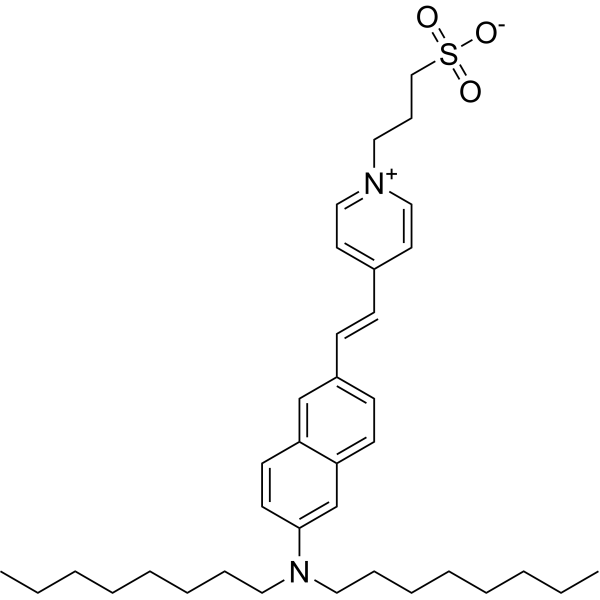
Di-8-ANEPPS is a naphthylstyryl voltage-sensitive dye, shifting both their fluorescence excitation and emission spectra upon changes in Vm .
loading...
    loading...
1
1 Cited Publications
Cat. No.: HY-149170
CAS No.: 2210244-83-8
Purity:  99.79%
Research Areas:  

Neurological Disease

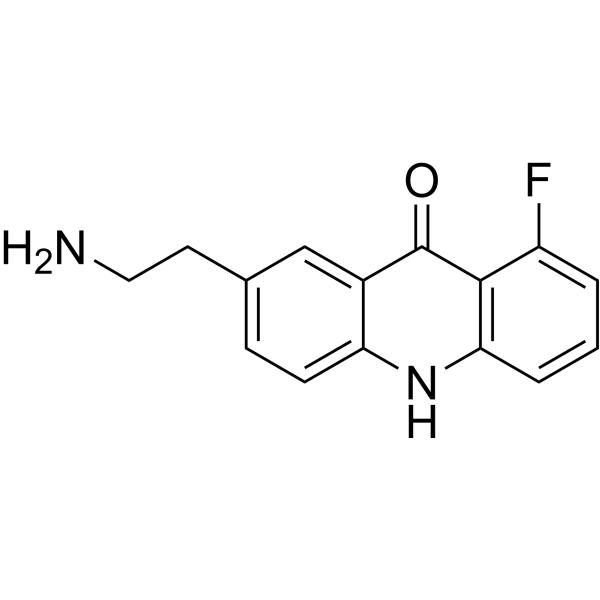
FFN246 is a fluorescent, dual substrate of serotonin transporter (SERT) probe and vesicular monoamine transporter 2 (VMAT2) with excitation and emission spectra 392/427 nm. FFN246 can be used for labeling serotonergic neurons in mouse brain tissue through SERT-dependent accumulation .
loading...
    loading...
Cat. No.: HY-P3983
CAS No.: 123380-68-7
Target:  

Inhibitory Antibodies

Research Areas:  

Others

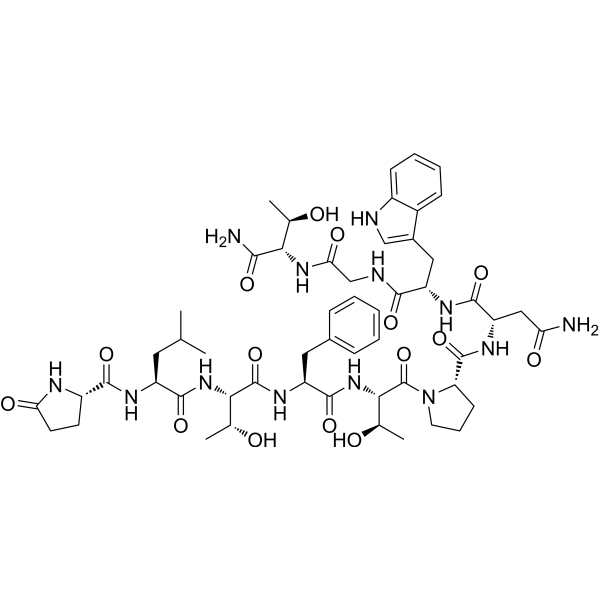
[Cys(Bzl)84] CD (81-92) is an acidic peptide. [Cys(Bzl)84] CD (81-92) can be sequencing by negative ion postsource decay (PSD) spectra .
loading...
    loading...
Cat. No.: HY-125385
CAS No.: 187099-99-6
Purity:  ≥95.0%
Target:  

Endogenous Metabolite

Research Areas:  

Metabolic Disease

Sulforhodamine 101 DHPE is a fluorescent probe made from the conjugation of the phospholipid 1,2-dipalmitoyl-sn-glycero-3-PE to sulforhodamine 101, a red fluorescent dye that displays excitation/emission spectra of 586/605 nm, respectively. It integrates into phospholipid bilayers and has been used for imaging of solid supported lipid bilayers, detection of protein-ligand binding on bilayers, and to monitor colocalization of lipid probes in liposomes via resonance energy transfer (RET).
loading...
    loading...
Cat. No.: HY-W110781
CAS No.: 82-94-0
Target:  

DNA Stain

Research Areas:  

Others

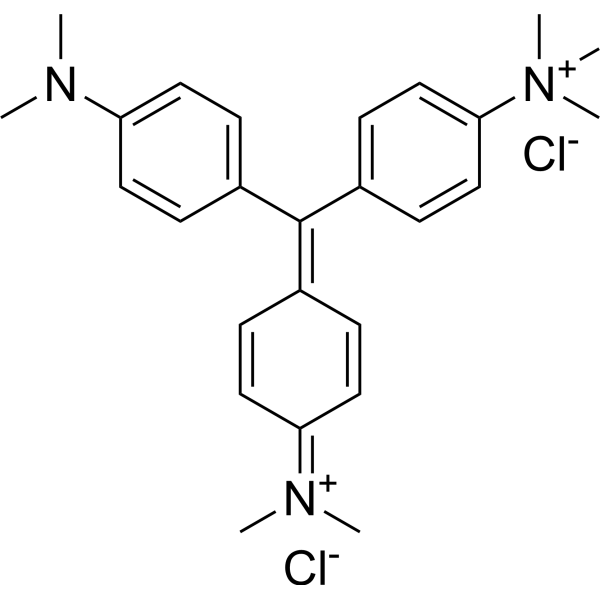
Basic Blue 20 is a very convenient red-emitting DNA stains. Basic Blue 20 has relatively narrow excitation and emission spectra, with peaks at 633 and 677 nm, respectively. Basic Blue 20 also has a very high resistance to photobleaching .
loading...
    loading...
Cat. No.: HY-D2749
CAS No.: 2353410-10-1
Sulfo-Bis-(N,N'-carboxylic acid)-Cy5 is a free unactivated carboxylic acid. Its absorbance and emission spectra are identical with Cy5 fluorophore.
loading...
    loading...
Cat. No.: HY-P3630
CAS No.: 102067-93-6
Research Areas:  

Others

Stick Insect Hypertrehalosaemic Factor II is a synthetic peptide. Stick Insect Hypertrehalosaemic Factor II has the same FAB spectra, reversed-phase high-performance liquid chromatographic behavior, and biological behavior as the natural material. Stick Insect Hypertrehalosaemic Factor II can be used for the research of hypertrehalosaemic effect .
loading...
    loading...
Cat. No.: HY-118205
CAS No.: 637772-75-9
Target:  

Bacterial

Research Areas:  

Infection

SCH-538415 is a novel acyl carrier protein synthase inhibitor isolated from an unknown bacterial microorganism. The structural elucidation of compound 1 was completed by analyzing spectral data including UV, MS and 2D-NMR spectra. Compound 1 showed inhibitory activity in the acyl carrier protein synthase (AcpS) test with an IC50 value of 4.19 μM and exhibited antibacterial activity against Staphylococcus aureus in the agar diffusion test.
loading...
    loading...
Cat. No.: HY-D2774
CAS No.: 105237-27-2
BP Fluor 488 Alkyne is a fluorophore. Its absorption and emission spectra are similar to fluorescein, but it is fluorescent in acidic media, and it is much more stable against photobleaching and oxidation.
loading...
    loading...
Cat. No.: HY-N18127
CAS No.: 1028708-26-0
Oxystemoninine is a Stemona alkaloid of the stemonamide type, which can be isolated from the roots of Stemona tuberosa. Oxystemoninine exhibits 1H- and 13C-NMR spectra similar to those of stemoninine (HY-134006) .
loading...
    loading...
Cat. No.: HY-184602
Gold nanoclusters (AuNCs) are molecular-level aggregates consisting of a core of several to dozens of gold atoms, protected by organic monomers such as thiol compounds or proteins. GSH-AuNCs utilize glutathione (a thiol-containing tripeptide) as both a reducing agent and a protecting group, reacting chemically with gold atoms to form nanoclusters, representing a transitional state between metal atoms and metal nanoparticles. Due to size effects and the emergence of quantized energy levels, GSH-AuNCs possess unique optical properties, such as tunable fluorescence emission spectra. Their fluorescence emission wavelength can be tuned with variations in particle size and composition.
loading...
    loading...
Cat. No.: HY-D3105
Target:  

Fluorescent Dye

Research Areas:  

Others

DCA is a Fluorescent probe for visualization of phase behavior in ER membranes. DCA is an ER-targeting, polarity-responsive NIR ratiometric probe, with its p-toluenesulfonamide group responsible for ER localization; its sensitivity to polarity relies on its donor-π-acceptor (D-π-A) structure, where aniline acts as the donor and dicyanomethylene acts as the acceptor, driving an intramolecular charge transfer (ICT) process upon excitation. In environments with low polarity, such as the closely packed, low water content ERₒ phase of ER membranes, DCA emits at a shorter wavelength, while in high polarity environments like the loosely packed, higher water content ERd phase, ICT leads to a red-shifted emission, allowing discrimination of the two phases via dual NIR emission colors and ratiometric imaging. Ex/Em = 488/570–620 nm and 488/665–735 nm; additional excitation/emission pairs include Ex/Em = 488/631 nm in low polarity 1,4-dioxane and Ex/Em = 488/677 nm in 1,4-dioxane with 30% water, the higher polarity condition. It shows a large Stokes shift of ~170 nm, and pH, viscosity, and biologically relevant species including Cys, GSH, H₂O₂, and metal ions do not exert marked interference on its fluorescence spectra[1].
loading...
    loading...
Cat. No.: HY-D3404
CAS No.: 169454-13-1
BODi-1 is a fluorescent modulator targeting dsDNA, which binds to dsDNA via a bis-intercalation mechanism (Ex=465 nm, Em=490 nm). BODi-1 exhibits a fluorescence enhancement effect upon binding to nucleic acids, but its fluorescence intensity, anisotropy and average lifetime decrease at higher dye/DNA ratios. When BODi-1 binds to DNA in liposome complexes, it also shows red-shifted emission spectra, along with reduced quantum yield and average lifetime. BODi-1 does not induce significant DNA conformational changes when the dye/DNA ratio is below 0.01. BODi-1 can be used as a fluorescent probe for the characterization of liposome complexes and FRET studies at this ratio .
loading...
    loading...
Cat. No.: HY-D1737
RADA is a fluorescent D-amino acid (FDAA) with high photostability and thermostability, which emits yellow-to-orange fluorescence. RADA shows low outer membrane permeability in wild-type Gram-negative Escherichia coli, but it targets penicillin-binding proteins and L,D-transpeptidases, mimics the interaction between acyl acceptors and enzyme intermediates, and integrates into peptidoglycan during biosynthesis. As a peptidoglycan labeling reagent, RADA metabolically integrates into the nascent peptidoglycan of live bacterial cells, labels the peptidoglycan at the poles and lateral walls of mycobacteria, and enables visualization of peptidoglycan synthesis and remodeling processes. RADA serves as a non-specific stain for fixed cells, is non-toxic to bacterial cells, and its red-shifted excitation/emission spectra reduce phototoxicity. RADA also supports virtual pulse-chase labeling experiments and stochastic optical reconstruction microscopy for sub-diffraction-limited imaging of bacterial cell walls .
loading...
    loading...
Cat. No.: HY-D3094
CAS No.: 2687198-42-9
Target:  

Fluorescent Dye

Research Areas:  

Others

TPE-SQ5 is a ratiometric Fluorescent probe for hypochlorite (ClO -) detection with a limit of detection of 5.6 nM. TPE-SQ5 exhibits high selectivity and high sensitivity towards ClO -. TPE-SQ5 can be oxidized by ClO - to form an epoxide, which quenches its deep red fluorescence; subsequently, the epoxide decomposes into a hemicyanine and a sulfonic acid-substituted oxindole, producing blue-green fluorescence to achieve a ratiometric response. TPE-SQ5 can form nanoparticles with Pluronic F-127 via the nanoprecipitation method, and these nanoparticles possess cell permeability. TPE-SQ5 has unique Ex/Em spectra in different solvents and nanoparticle forms, with emission peaks at 643 nm (380 nm excitation, 95% H2O/THF), 631 nm (564 nm excitation, DMSO), 652 nm (536 nm excitation, THF) and 630 nm (524 nm excitation, nanoparticles); the Ex/Em settings used for cell imaging are 488/550-650 nm (red channel) and 405/450-550 nm (green channel) .
loading...
    loading...
Cat. No.: HY-D3133
CAS No.: 2410296-16-9
Target:  

Fluorescent Dye

Research Areas:  

Others

HS-CyBz is a Fluorescent probe for H₂S detection, enabling ratiometric optical/photoacoustic dual-modality in/ex vivo imaging. Its detection mechanism relies on nucleophilic substitution of its benzoic ester group by HS⁻, which releases an enolic meso-hydroxyltricarboheptamethine cyanine that then undergoes keto-enol tautomerization to form Cy-ketone; this tautomerization causes distinct shifts in absorption and emission spectra, producing a ratiometric response that reduces interferences from tissue scattering, autofluorescence, and probe concentration. In its initial state, HS-CyBz has an excitation wavelength of 595 nm, with emission bands centered at 805 nm (main) and 630 nm (minor); upon reaction with H₂S, the 805 nm emission band decreases while the 630 nm band drastically increases, and its absorption spectrum shows a sharp band at 775 nm and a shoulder band at 708 nm, which decrease upon H₂S reaction with a minor increase at 850 nm and an isosbestic point at 825 nm. For in vivo optical imaging, excitation at 560 nm is used with emission channels at 620 nm and 790 nm, while in vivo photoacoustic imaging uses excitation at 775 nm and 825 nm. The detection limit of HS-CyBz for H₂S is 0.5 μM, and it shows high selectivity, with only H₂S inducing a distinct enhancement of the emission ratio F₆₃₀/F₈₀₅ and PA ratio PA₈₂₅/PA₇₇₅, while other biochemical species including cations, anions, reactive oxygen species, biothiols, and carboxylesterase trigger only minor changes and do not interfere with H₂S sensing. Tail intravenous injection of HS-CyBz leads to accumulation in the liver of mice, and it can be used to verify endogenous H₂S upregulation triggered by S-adenosyl-L-methionine via ratiometric optical/photoacoustic imaging .
loading...
    loading...
  • 1