14 Results for "

G2 DNA damage checkpoint

" in MedChemExpress (MCE) Product Catalog:
Products (14)

14 Results for "G2 DNA damage checkpoint" in MCE Product Catalog:

37
37 Publications Verification
Cat. No.: HY-16954
CAS No.: 1818885-28-7
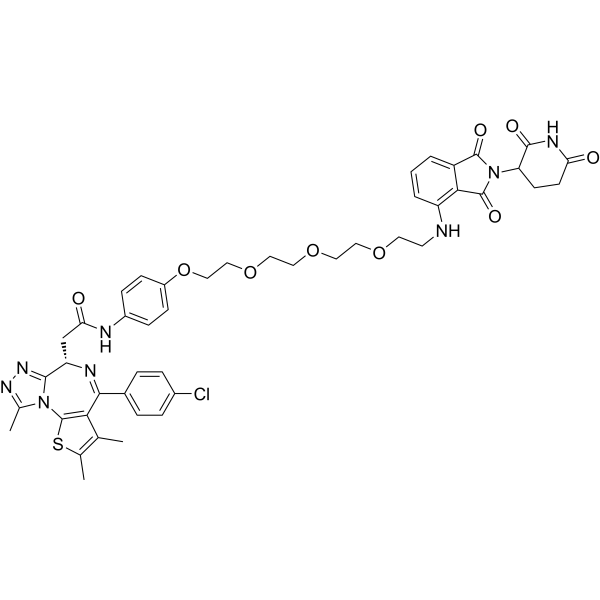
ARV-825 is a BET protein PROTAC degrader that recruits cereblon, and it targets BRD2, BRD3, and BRD4 for degradation via the ubiquitin-proteasome pathway. ARV-825 downregulates c-MYC, PLK1, MYCN, CDK4/6, JAK2, pSTAT3/5, PIM1, and Bcl-xL, upregulates p21 and p27, and modulates H3K27Ac-mediated transcription, the G2/M checkpoint, the Wnt/β-catenin pathway, and amino acid transport pathways. ARV-825 induces G1 phase cell cycle arrest, caspase 3/PARP-mediated apoptosis, DNA damage, and reactive oxygen species (ROS) production, reduces mitochondrial respiration, and simultaneously inhibits cell proliferation, clonogenic growth, and cell migration. ARV-825 is used in research on gastric cancer, leukemia, neuroblastoma, and cholangiocarcinoma .
loading...
    loading...
27
27 Cited Publications
Cat. No.: HY-13902
CAS No.: 1232416-25-9
Purity:  99.70%
Synonyms: VE-822; VX-970; M6620
Research Areas:  

Infection Metabolic Disease Cancer

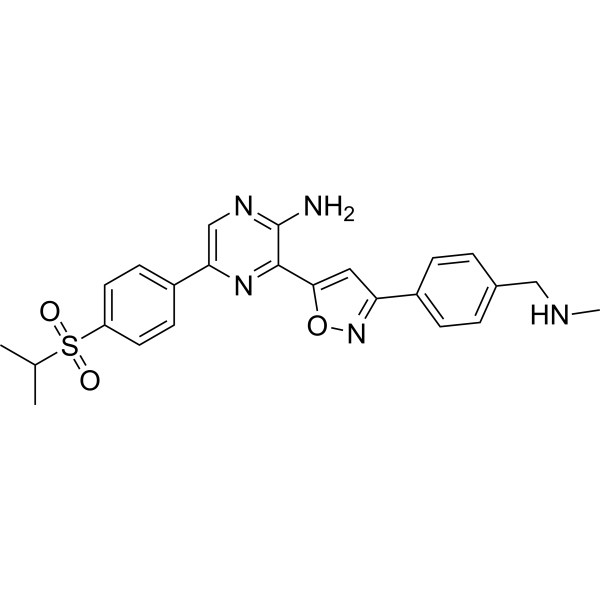
Berzosertib (VE-822) is an orally active, CNS-penetrant, and selective ATR kinase inhibitor. Berzosertib blocks ATR kinase activity, abrogates G2/M cell cycle checkpoint, impairs DNA damage repair. Berzosertib induces apoptosis, inhibnits conlony migration, inhibits cell proliferation, and activates cGAS-STING axes in cancer cells. Berzosertib can be used for the research of cancers, such as head and neck squamous cell carcinoma, and colorectal cancer .
loading...
    loading...
27
27 Cited Publications
Cat. No.: HY-13902A
CAS No.: 1428935-04-9
Synonyms: VE-822 hydrochloride; VX-970 hydrochloride; M6620 hydrochloride
Research Areas:  

Neurological Disease Cancer

Berzosertib (VE-822) hydrochloride is an orally active, CNS-penetrant, and selective ATR kinase inhibitor. Berzosertib hydrochloride blocks ATR kinase activity, abrogates G2/M cell cycle checkpoint, impairs DNA damage repair. Berzosertib hydrochloride induces apoptosis, inhibnits conlony migration, inhibits cell proliferation, and activates cGAS-STING axes in cancer cells. Berzosertib hydrochloride can be used for the research of cancers, such as head and neck squamous cell carcinoma, and colorectal cancer .
loading...
    loading...
Cat. No.: HY-15883
CAS No.: 1200126-26-6
Purity:  99.21%
Research Areas:  

Cancer

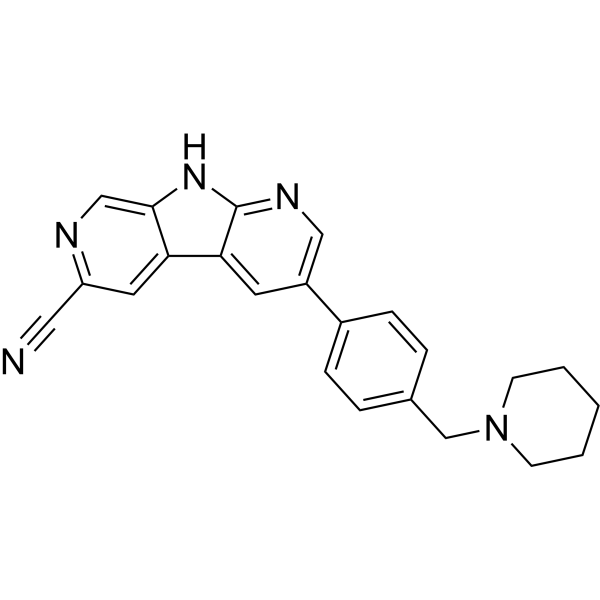
GNE-900 is a an ATP-competitive, selective, and orally active ChK1 inhibitor with IC50s of 0.0011, 1.5 μM for ChKl, ChK2, respectively. GNE-900 abrogates the G2-M checkpoint, enhances DNA damage, and induces Apoptosis. Gemcitabine (HY-17026) and GNE-900 administration shows anti-tumor activity .
loading...
    loading...
Cat. No.: HY-112347
CAS No.: 244148-46-7
Research Areas:  

Cancer

Isogranulatimide is a selective checkpoint kinase 1 (Chk1) inhibitor with an IC50 value of 0.1 μM. Isogranulatimide inhibits the G2/M checkpoint and inhibits the growth of p53-mutant tumor cells. Isogranulatimide is promising for research of tumors associated with DNA damage response .
loading...
    loading...
Cat. No.: HY-156916
CAS No.: 93326-70-6
WAY-230563 (ST045945) is a serine/threonine kinase inhibitor that can block CHK1/CHK2-mediated cell cycle checkpoints. WAY-230563 can induce G2/M phase arrest and DNA damage in tumor cells .
loading...
    loading...
Cat. No.: HY-15882
CAS No.: 1200127-66-7
Target:  

Endogenous Metabolite

Research Areas:  

Cancer

GNE-783 is a selective CHK1 inhibitor that enhances the activity of gemcitabine. GNE-783 improves the efficacy of anti-metabolite DNA damage drugs by inactivating S-phase and G2-phase cell cycle checkpoints following DNA damage. GNE-783 selectively enhances the chemical synergy of certain drugs in different tumor types, for example, enhancing the activity of temozolomide only in melanoma cell lines .
loading...
    loading...
Cat. No.: HY-168739
CAS No.: 2413582-45-1
Topoisomerase I inhibitor 17 (Compound 7h) is a Topoisomerase I (Top1) inhibitor. Topoisomerase I inhibitor 17 reduces DDX5 and reverses the locking of Top1 activity by DDX5. Topoisomerase I inhibitor 17 induces Top1-mediated DNA damage and promotes reactive oxygen species (ROS) production. Topoisomerase I inhibitor 17 induces Apoptosis (reduces antiapoptotic proteins XIAP, Bcl-2, Survivin and up-regulates pro-apoptotic proteins Bax, γH2AX). Topoisomerase I inhibitor 17 also blocks the progression of the G2/M checkpoint and induces cell cycle arrest. Topoisomerase I inhibitor 17 significantly inhibits colony formation and cell migration in colorectal cancer cells. Topoisomerase I inhibitor 17 effectively reduces tumors in human PDX tumor mice .
loading...
    loading...
Cat. No.: HY-N19737
CAS No.: 62560-99-0
Oliveroline is an aporphine alkaloid with anticancer activity and a G2 DNA damage checkpoint inhibitor. Oliveroline enables cells to escape G2 phase arrest after DNA damage. Oliveroline can be used in research related to various cancers including non-small cell lung cancer, lung cancer, and fibrosarcoma .
loading...
    loading...
Cat. No.: HY-160948
CAS No.: 622855-60-1
Research Areas:  

Cancer

DB07006 (compound 18) is a potent, ATP-cpmpetitive dual inhibitor of Wee1 (IC50 = 0.030 μM) and Chk1 checkpoint kinases (IC50 = 0.018 μM). DB07006 demonstrates effective abrogation of the G2/M checkpoint in combination with DNA-damaging agents in cellular models. DB07006 can be used for cancer research .
loading...
    loading...
Cat. No.: HY-189062
Target:  

CDK Apoptosis

Research Areas:  

Cancer

ZJC-11 is a CDK7 inhibitor with an IC50 of 5.4 nM. ZJC-11 binds covalently to CDK7, inhibits CDK7-dependent phosphorylation of RNAPII at Ser2, Ser5 and Ser7 sites, and suppresses transcriptional processes. ZJC-11 acts as a cell cycle inhibitor, inhibits the G2/M checkpoint pathway, and induces G2/M phase arrest. ZJC-11 induces DNA damage-driven cellular senescence and cell death. ZJC-11 exhibits antiproliferative activity against triple-negative breast cancer both in vitro and in vivo. ZJC-11 can be used for research related to triple-negative breast cancer
loading...
    loading...
Cat. No.: HY-13902R
CAS No.: 1232416-25-9
Synonyms: VE-822 (Standard); VX-970 (Standard); M6620 (Standard)
Berzosertib (Standard) is the analytical standard of Berzosertib (HY-13902). This product is intended for research and analytical applications. Berzosertib (VE-822) is an orally active, CNS-penetrant, and selective ATR Kinase inhibitor. Berzosertib blocks ATR Kinase activity, abrogates G2/M cell cycle checkpoint, impairs DNA damage repair. Berzosertib induces apoptosis, inhibnits conlony migration, inhibits cell proliferation, and activates cGAS-STING axes in cancer cells. Berzosertib can be used for the research of cancers, such as head and neck squamous cell carcinoma, and colorectal cancer .
loading...
    loading...
Cat. No.: HY-119225
CAS No.: 67427-51-4
Research Areas:  

Cancer

CBP-93872 is a G2 checkpoint inhibitor and a chemosensitizer. CBP-93872 specifically inhibits DNA double-strand break (DSB)-dependent, Nbs1-mediated ATR activation, without directly inhibiting ATR kinase activity or affecting ATR activation induced by other types of DNA damage; meanwhile, it suppresses the pathway between ATM and ATR activation, thereby reducing the autophosphorylation of ATR and the subsequent phosphorylation of Chk1. CBP-93872 does not inhibit DNA end resection at DSB sites. CBP-93872 induces cell death and enhances the cytotoxic effects of platinum-containing compounds and pyrimidine antimetabolites on cancer cells. CBP-93872 can be used in related research on p53-mutant cancers, colorectal cancer, and pancreatic cancer .
loading...
    loading...
Cat. No.: HY-183118
CAS No.: 3064485-16-8
Target:  

CDK Apoptosis

Research Areas:  

Neurological Disease Cancer

CID-078 is an orally active macrocyclic cyclin A and cyclin B inhibitor. CID-078 binds cyclin hydrophobic patches, disrupting interactions of cyclin A-Cdk2 with E2F1 and cyclin B-Cdk1 with Myt1, and selectively targets RxL binding motifs to block complex-substrate interactions. CID-078 induces DNA damage, G2/M cell cycle arrest, apoptosis, mitotic catastrophe, spindle assembly checkpoint activation, and neomorphic cyclin B-CDK2 complex formation, driving synthetic lethality in E2F-driven cancer cells. CID-078 can be used for the research of small cell lung cancer, non-small cell lung cancer, triple negative breast cancer, advanced solid tumors, luminal HR +/HER 2- breast cancer, RB1-altered solid tumors, and neuroblastoma .
loading...
    loading...
  • 1

