


17 Results for "

GPR10

" in MedChemExpress (MCE) Product Catalog:
Products (17)

17 Results for "GPR10" in MCE Product Catalog:

Cat. No.: HY-P1530
CAS No.: 235433-36-0
Target:  

Peptides

Research Areas:  

Neurological Disease

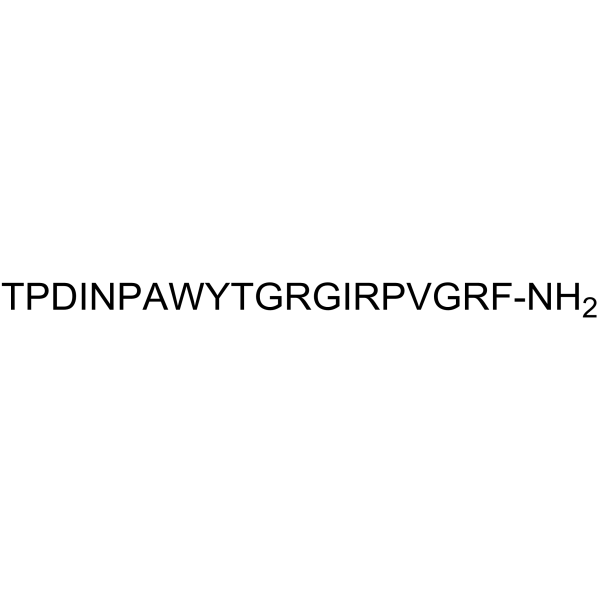
Prolactin Releasing Peptide (12-31), human is a fragment of the prolactin releasing peptide (PrRP). Prolactin Releasing Peptide (1-31), human is a high affinity GPR10 ligand that cause the release of the prolactin.
loading...
    loading...
Cat. No.: HY-P10377
Research Areas:  

Metabolic Disease

GUB03385 is a long-acting PrRP31 analogue. GUB03385 is a potent dual agonist for GPR10 (full agonist, EC50: 0.4 nM) and NPFF2R (partial agonist, EC50: 20 nM). GUB03385 has anti-obesity effect .
loading...
    loading...
Cat. No.: HY-P1520
CAS No.: 215510-22-8
Target:  

GnRH Receptor

Research Areas:  

Neurological Disease

Prolactin Releasing Peptide (1-31), human is a high affinity GPR10 ligand that cause the release of the prolactin. Prolactin Releasing Peptide (1-31) binds to GPR10 for human and rats with Ki values of 1.03 nM and 0.33 nM, respectively. Prolactin Releasing Peptide (1-31) can be used for the research of the hypothalamo-pituitary axis .
loading...
    loading...
Cat. No.: HY-P1520A
Target:  

GnRH Receptor

Research Areas:  

Neurological Disease

Prolactin Releasing Peptide (1-31), human (acetate) is a high affinity GPR10 ligand that causes the release of the prolactin. Prolactin Releasing Peptide (1-31) binds to GPR10 for human and rats with Ki values of 1.03 nM and 0.33 nM, respectively. Prolactin Releasing Peptide (1-31) can be used for the research of the hypothalamo-pituitary axis .
loading...
    loading...
Cat. No.: HY-P10378
Target:  

GnRH Receptor

Research Areas:  

Metabolic Disease

GPR10 agonist 1 (compound 18-S4) is a potent GPR10 agonist with EC50 values of 80, 7.8 nM in the presence (10%) or absence (0%) of FBS, respectively. GPR10 agonist 1 has the potential for the research of chronic obesity .
loading...
    loading...
Cat. No.: HY-P3789
CAS No.: 222988-10-5
Target:  

GnRH Receptor

Research Areas:  

Metabolic Disease

Prolactin-Releasing Peptide (12-31), rat is a fragment of the prolactin releasing peptide (PrRP). Prolactin-Releasing Peptide (12-31), rat shows high affinity for GPR10 receptors. Prolactin-Releasing Peptide (12-31), stimulates calcium mobilization in CHOK1 cells transfected with the PrRP receptor .
loading...
    loading...
Cat. No.: HY-P10380
palm11-PrRP31 is a lipidized endogenous appetite inhibitory neuropeptide (PrRP) analogue. palm11-PrRP31 is GPR10 (EC50=39 pM) and NPFF-R2 effective dual agonists. palm11-PrRP31 is able to mimic the natural function of PrRP by binding to these receptors to reduce food intake. palm11-PrRP31 can be used as a potential anti-obesity agent and for the study of neuropeptide-receptor interaction .
loading...
    loading...
Cat. No.: HY-P10380A
palm11-PrRP31 TFA is a lipidized endogenous appetite inhibitory neuropeptide (PrRP) analogue. palm11-PrRP31 TFA is GPR10 (EC50=39 pM) and NPFF-R2 effective dual agonists. palm11-PrRP31 TFA is able to mimic the natural function of PrRP by binding to these receptors to reduce food intake. palm11-PrRP31 TFA can be used as a potential anti-obesity agent and for the study of neuropeptide-receptor interaction .
loading...
    loading...
Cat. No.: HY-P10379
Research Areas:  

Others Neurological Disease

palm-PrRP31 is a potent dual receptor agonist for both GPR10 (EC50=72 pM) and NPFF-R2. palm-PrRP31 activates downstream signaling pathways through binding to its receptors, GPR10 and NPFF-R2, which results in reduced appetite and increased energy expenditure. Utilizing palm-PrRP31 facilitates the study of the mechanism of action in the nervous system, thereby elucidating the complex biological processes that regulate appetite and energy expenditure .
loading...
    loading...
Cat. No.: HY-P10381
Target:  

Peptides

Research Areas:  

Others

palm11-TTDS-PrRP31 is a strong agonist of GPR10 (EC50: 84 pM). palm11-TTDS-PrRP31 has long-lasting anorexigenic effects .
loading...
    loading...
Cat. No.: HY-P11811A
Research Areas:  

Metabolic Disease

GUB10194 acetate is a fully potent and selective GPR10 agonist with an EC50 of 15 nM. GUB10194 acetate does not significantly affect body weight or food intake .
loading...
    loading...
Cat. No.: HY-P11811
Research Areas:  

Metabolic Disease

GUB10194 is a fully potent and selective GPR10 agonist with an EC50 of 15 nM. GUB10194 does not significantly affect body weight or food intake .
loading...
    loading...
Cat. No.: HY-P11810A
Research Areas:  

Metabolic Disease

GUB08248 acetate is a full GPR10 agonist and a partial NPFF2R agonist, with EC50 values of 0.5 nM and 2.5 nM, respectively. GUB08248 acetate inhibits food intake and induces sustained weight loss. GUB08248 acetate can be used in obesity-related research .
loading...
    loading...
Cat. No.: HY-P11810
Research Areas:  

Metabolic Disease

GUB08248 is a full GPR10 agonist and a partial NPFF2R agonist, with EC50 values of 0.5 nM and 2.5 nM, respectively. GUB08248 inhibits food intake and induces sustained weight loss. GUB08248 can be used in obesity-related research .
loading...
    loading...
Cat. No.: HY-RS28216
Research Areas:  

Others

Prlhr Rat Pre-designed siRNA Set A contains three designed siRNAs for Prlhr gene (Rat), as well as a negative control, a positive control, and a FAM-labeled negative control.
loading...
    loading...
Cat. No.: HY-RS11162
Research Areas:  

Others

PRLHR Human Pre-designed siRNA Set A contains three designed siRNAs for PRLHR gene (Human), as well as a negative control, a positive control, and a FAM-labeled negative control.

loading...
    loading...
Cat. No.: HY-RS21698
Research Areas:  

Others

Prlhr Mouse Pre-designed siRNA Set A contains three designed siRNAs for Prlhr gene (Mouse), as well as a negative control, a positive control, and a FAM-labeled negative control.

loading...
    loading...
  • 1

