12 Results for "

Heteromeric

" in MedChemExpress (MCE) Product Catalog:
Products (12)

12 Results for "Heteromeric" in MCE Product Catalog:

1
1 Cited Publications
Cat. No.: HY-110121A
CAS No.: 216853-59-7
Purity:  99.78%
Target:  

nAChR

Research Areas:  

Neurological Disease

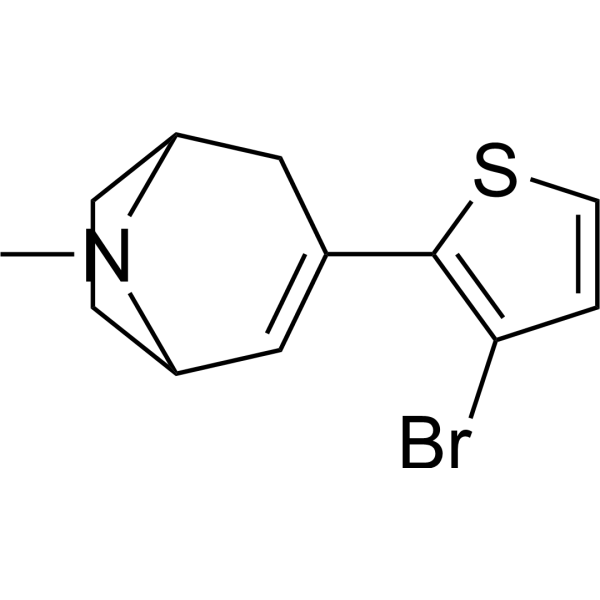
NS3861 is an agonist of nicotinic acetylcholine receptors (nAChRs) and binds with high affinity to heteromeric α3β4 nAChR. The binding Ki values of 0.62, 25, 7.8, 55 nM for α3β4, α3β2, α4β4, α4β2, respectively .
loading...
    loading...
1
1 Cited Publications
Cat. No.: HY-110121
CAS No.: 216853-60-0
Purity:  99.71%
Target:  

nAChR

Research Areas:  

Neurological Disease

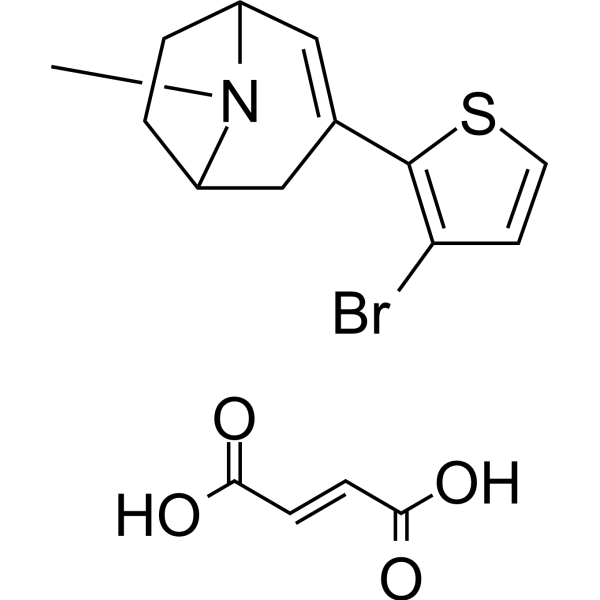
NS3861 fumarate is an agonist of nicotinic acetylcholine receptors (nAChRs) and binds with high affinity to heteromeric α3β4 nAChR. The binding Ki values of 0.62, 25, 7.8, 55 nM for α3β4, α3β2, α4β4, α4β2, respectively .
loading...
    loading...
Cat. No.: HY-D0877
CAS No.: 29915-38-6
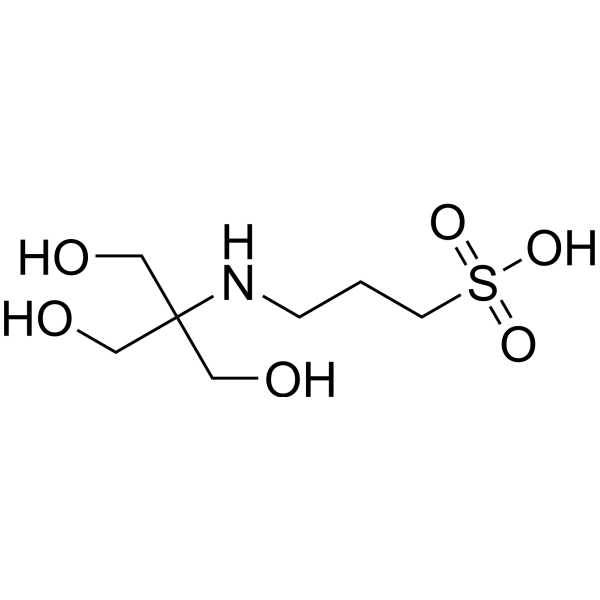
TAPS is an aminosulfonate-based lysozyme stabilizer and connexin channel inhibitor. TAPS maintains the native structure of lysozyme in aqueous solution at pH 7.0 and significantly protects it from heat-induced denaturation. TAPS directly inhibits the activity of heteromeric connexin 32/connexin 26 channels (Cx32/Cx26) via its protonated form, and this inhibitory effect is dependent on the presence of connexin 26. TAPS reduces connexin channel-mediated solute exchange in a recombinant liposome system, resulting in a decreased degree of liposome density shift in transport-specific separation assays. TAPS is a critical compound for investigating the structure and function of connexin channels .
loading...
    loading...
Cat. No.: HY-125982
CAS No.: 525582-84-7
Purity:  ≥98.0%
Target:  

Insecticide

Research Areas:  

Others

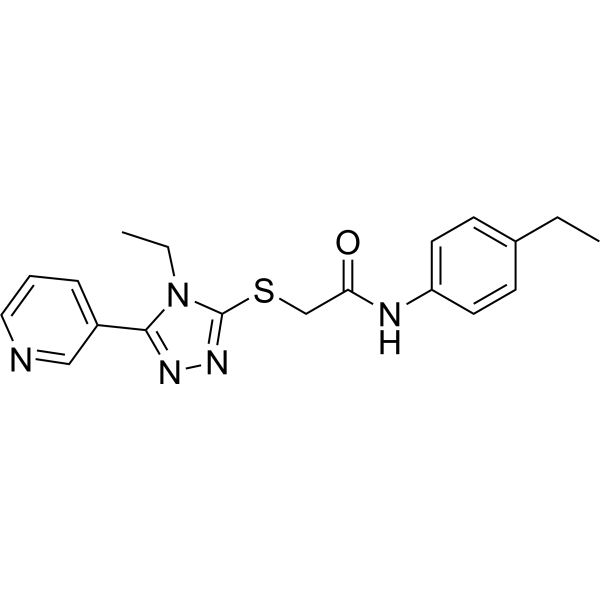
VUAA1 is an insect odorant co-receptor (Orco) agonist. VUAA1 activates both heteromeric and homomeric Orco-containing channels. VUAA1 can disrupt the destructive behaviors of nuisance insects. VUAA1 can be used for insect olfactory research .
loading...
    loading...
Cat. No.: HY-B1390A
CAS No.: 128-44-9
Research Areas:  

Infection

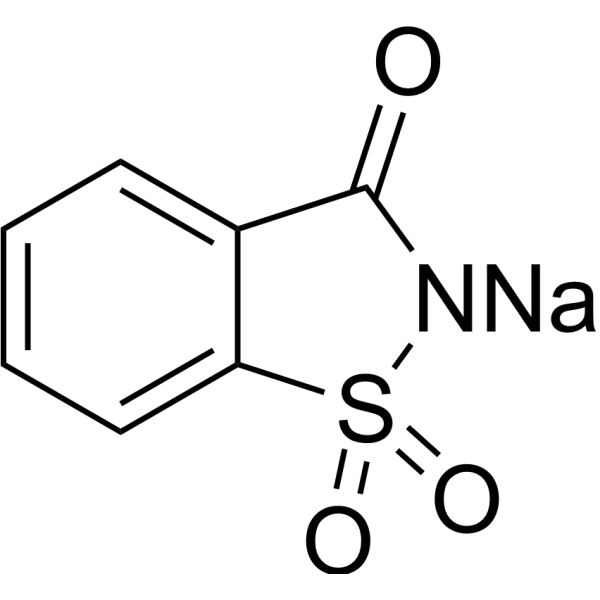
Saccharin sodium is an orally active, non-caloric artificial sweetener (NAS). Saccharin sodium has bacteriostatic and microbiome-modulating properties. Saccharin binds to and signals via specific taste receptors, not only in the oral cavity but also alongside the gastrointestinal tract. Saccharin has been reported to bind the human and rodent heteromeric guanine nucleotide-binding protein (G protein) coupled sweet taste receptors T1R2/T2R3 as well as the human bitter taste receptor T2R43 and T2R44. Saccharin can inhibit bacterial growth in vitro .
loading...
    loading...
Cat. No.: HY-131879
CAS No.: 309711-59-9
Purity:  99.83%
Target:  

Sodium Channel

Research Areas:  

Neurological Disease

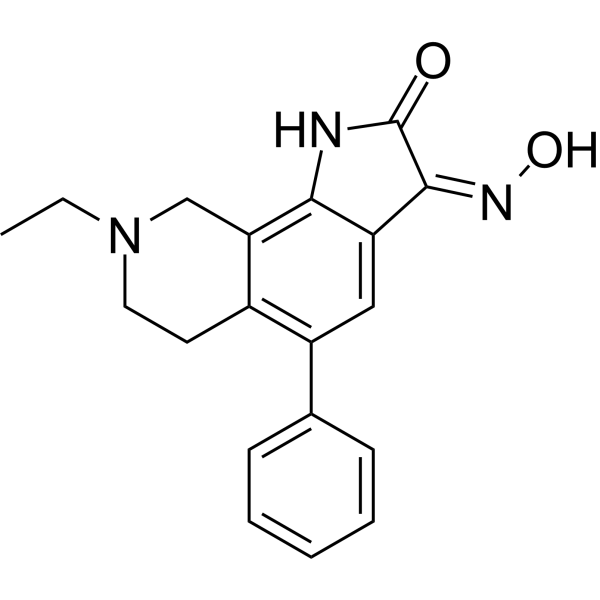
NS383 is a potent and uniquely selective inhibitor of rat ASICs containing 1a and/or 3 subunits. NS383 inhibits H(+)-activated currents recorded from rat homomeric ASIC1a, ASIC3, and heteromeric ASIC1a+3 with IC50 values ranging from 0.61 to 2.2 μM. NS383 is well tolerated and capable of reversing pathological painlike behaviors, presumably via peripheral actions, but possibly also via actions within central pain circuits .
loading...
    loading...
Cat. No.: HY-109173
CAS No.: 1948232-63-0
Purity:  98.78%
Synonyms: BAY 1902607
Research Areas:  

Inflammation/Immunology

Filapixant (BAY 1902607) is an orally active and selective P2X3 receptor antagonist. Filapixant is applicable to the research of refractory chronic cough .
loading...
    loading...
Cat. No.: HY-B1390AR
CAS No.: 128-44-9
Research Areas:  

Infection

Saccharin (sodium) (Standard) is the analytical standard of Saccharin (sodium). This product is intended for research and analytical applications. Saccharin sodium is an orally active, non-caloric artificial sweetener (NAS). Saccharin sodium has bacteriostatic and microbiome-modulating properties. Saccharin binds to and signals via specific taste receptors, not only in the oral cavity but also alongside the gastrointestinal tract. Saccharin has been reported to bind the human and rodent heteromeric guanine nucleotide-binding protein (G protein) coupled sweet taste receptors T1R2/T2R3 as well as the human bitter taste receptor T2R43 and T2R44. Saccharin can inhibit bacterial growth in vitro .
loading...
    loading...
Cat. No.: HY-174531
Target:  

mRNA

Research Areas:  

Cancer

Human TGFBR1 mRNA encodes the human transforming growth factor beta receptor 1 (TGFBR1) protein, a serine/threonine protein kinase. TGFBR1 can form a heteromeric complex with type II TGF-beta receptors when bound to TGF-beta, transducing the TGF-beta signal from the cell surface to the cytoplasm.
loading...
    loading...
Cat. No.: HY-N20645
Capricostatin A is a glycosylated heteromeric depsipeptide and Antibacterial agent. Capricostatin A is present in the fungus Austroacremonium gemini MST-FP2131. Capricostatin A inhibits the growth of Gram-positive bacteria, including Bacillus subtilis, Staphylococcus aureus, and MRSA. Capricostatin A exhibits no antifungal activity against Saccharomyces cerevisiae and no cytotoxicity against mammalian cells. Capricostatin A can be used in the research of bacterial infections caused by Bacillus subtilis and Staphylococcus aureus .
loading...
    loading...
Cat. No.: HY-184044
CAS No.: 13112-05-5
Target:  

P2X Receptor

Research Areas:  

Neurological Disease

P2X2R antagonist-1 (compound 66) is a P2X2 receptor antagonist derived from Reactive Blue 4 (HY-125815). P2X2R antagonist-1 shows high selectivity for P2X4, P2X7, P2Y2, P2Y4, P2Y6 and P2Y12 receptors, moderate selectivity for P2X1 and P2X3 receptors, and exhibits higher potency toward homomeric P2X2 receptors than heteromeric P2X2/3 receptors. P2X2R antagonist-1 competitively inhibits ATP-mediated currents. P2X2R antagonist-1 can be used in research related to pain and urinary incontinence .
loading...
    loading...
Cat. No.: HY-181874
CAS No.: 1359358-36-3
Target:  

Potassium Channel

Research Areas:  

Neurological Disease

E0714 is a blood-brain barrier-permeable, selective Kv7.2 potassium channel activator, with EC50 values of 1.90 μM and 0.021 μM for homotetrameric Kv7.2 channels and heterotetrameric Kv7.2/7.3 channels, respectively. E0714 exhibits anticonvulsant activity. E0714 can be used in research related to epilepsy .
loading...
    loading...
  • 1

