1. Search Result
Search Result
Results for "

Papillary thyroid cancer

" in MedChemExpress (MCE) Product Catalog:

9

Inhibitors & Agonists

1

Peptides

4

Natural
Products

1

Isotope-Labeled Compounds

Cat. No. Product Name Target Research Areas Chemical Structure
  • HY-N0164
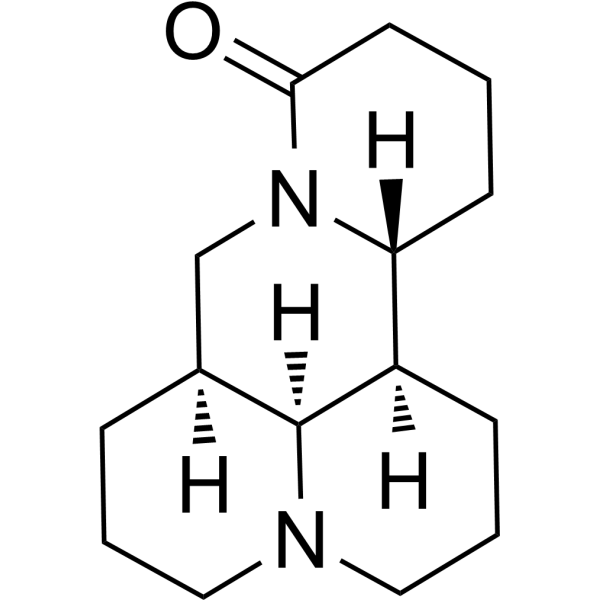
    Matrine
    15+ Cited Publications

    Matridin-15-one; Vegard; α-Matrine

    PINK1/Parkin Opioid Receptor Autophagy Mitophagy Ferroptosis Apoptosis Inflammation/Immunology Cancer
    Matrine (Matridin-15-one) is an alkaloid found in plants from the Sophora genus that can act as a kappa opioid receptor and u-receptor agonist. Matrine has a variety of pharmacological effects, including anti-cancer, anti-oxidative stress, anti-inflammation and anti-apoptosis effects. Matrine is potential in the research of disease like human non-small cell lung cancer, hepatoma, papillary thyroid cancer and acute kidney injury (AKI) .
    Matrine
  • HY-N6841
    Rhodiolin
    1 Publications Verification

    Glucose-6-Phosphate Isomerase (GPI) Casein Kinase Virus Protease Flavivirus PI3K Akt mTOR Apoptosis Infection Cancer
    Rhodiolin, a flavonoid, is an orally active glucose 6-phosphate isomerase (GPI) inhibitor. Rhodiolin inhibits papillary thyroid cancer (PTC) by targeting glycolysis enzyme glucose 6-phosphate isomerase GPI and suppressing PI3K/AKT/mTOR phosphorylation and induce apoptosis. Rhodiolin as a NS2B-NS3 protease inhibitor can disrupt dengue viral replication. Rhodiolin is also a potential candidate for developing anticancer strategies inhibiting CK1ε kinase. Rhodiolin can be used for the study of anti-tumor and anti-viral .
    Rhodiolin
  • HY-W654256

    Matridin-15-one-d3; Vegard-d3; α-Matrine-d3

    Isotope-Labeled Compounds PINK1/Parkin Opioid Receptor Autophagy Mitophagy Ferroptosis Apoptosis Inflammation/Immunology Cancer
    Matrine-d3 (Matridin-d3) is a deuterium labeled Matrine (HY-N0164). Matrine (Matridin-15-one) is an alkaloid found in plants from the Sophora genus that can act as a kappa opioid receptor and u-receptor agonist. Matrine has a variety of pharmacological effects, including anti-cancer, anti-oxidative stress, anti-inflammation and anti-apoptosis effects. Matrine is potential in the research of disease like human non-small cell lung cancer, hepatoma, papillary thyroid cancer and acute kidney injury (AKI) .
    Matrine-d3
  • HY-170019

    RET Cancer
    RET-IN-28 (Compound 16) is a RET (transmembrane receptor tyrosine protein kinase) inhibitor. RET-IN-28 inhibits the activity of the mutant RET enzyme (RET-V804M), and can be applied to cancer research .
    RET-IN-28
  • HY-N0164R

    Matridin-15-one (Standard); Vegard (Standard); α-Matrine (Standard)

    PINK1/Parkin Reference Standards Opioid Receptor Autophagy Mitophagy Ferroptosis Apoptosis Inflammation/Immunology Cancer
    Matrine (Standard) is the analytical standard of Matrine. This product is intended for research and analytical applications. Matrine (Matridin-15-one) is an alkaloid found in plants from the Sophora genus that can act as a kappa opioid receptor and u-receptor agonist. Matrine has a variety of pharmacological effects, including anti-cancer, anti-oxidative stress, anti-inflammation and anti-apoptosis effects. Matrine is potential in the research of disease like human non-small cell lung cancer, hepatoma, papillary thyroid cancer and acute kidney injury (AKI) .
    Matrine (Standard)
  • HY-183684

    RET VEGFR PDGFR Akt ERK Endocrinology Cancer
    RET-IN-33 is a moderately selective inhibitor of RET mutants. RET-IN-33 potently inhibits G810 mutants, with IC50 values of 4.43 nM (G810R), 3.28 nM (G810C) and 0.51 nM (G810S), respectively. RET-IN-33 also inhibits other RET mutants: V804M (IC50 0.73 nM), V804L (IC50 0.36 nM), Y806H (IC50 0.74 nM) and M918T (IC50 0.55 nM). RET-IN-33 also inhibits other kinases, with an IC50 of 1.50 nM against VEGFR2 and 1.60 nM against PDGFRα. RET-IN-33 blocks the autophosphorylation of RET mutants and the downstream SHC/AKT/ERK signaling pathway. RET-IN-33 selectively inhibits the proliferation of RET-driven cell models without affecting non-RET-dependent or normal cells. RET-IN-33 exhibits dose-dependent antitumor efficacy in RET-driven xenograft models. RET-IN-33 can be used for the research of medullary thyroid carcinoma, papillary thyroid carcinoma and non-small cell lung cancer .
    RET-IN-33
  • HY-N16764

    Necroptosis NO Synthase Neurological Disease Inflammation/Immunology Endocrinology Cancer
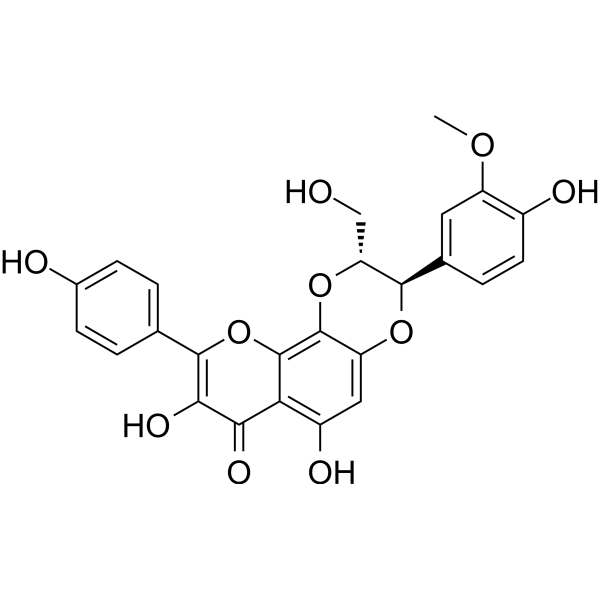
    (rel)-Salcolin A is a flavonoid lignan compound with anticancer, anti-inflammatory, and neuroprotective activities. (rel)-Salcolin A has IC50 values ??of 66.69 μM and 56.12 μM against anaplastic thyroid carcinoma cells (HTH83) and papillary thyroid carcinoma cells (TPC1), respectively. (rel)-Salcolin A also inhibits LPS-induced NO production with an IC50 of 14.65 μM. (rel)-Salcolin A exerts its effects by inducing necroptosis in thyroid cancer cells, inhibiting the production of the inflammatory factor NO, and protecting against glutamate-induced neuronal cell damage, with a neuroprotective E50 of 47.44 μM. (rel)-Salcolin A can be used in research related to thyroid cancer, anti-inflammation, and neuroprotection. (rel)-Salcolin A can be naturally extracted from the leaves of Casearia arborea and the stems of Zea mays (corn) .
    (rel)-Salcolin A
  • HY-183783

    PROTACs RET STAT ERK Apoptosis Endocrinology Cancer
    PROTAC RET Degrader 2 is a RET degrader with a target IC50 of 0.36 nM. PROTAC RET Degrader 2 is mainly composed of RET-IN-34 (HY-183729) and Thalidomide (HY-14658). PROTAC RET Degrader 2 mediates RET degradation via the ubiquitin-proteasome system. PROTAC RET Degrader 2 induces apoptosis, inhibits colony-forming ability, and exhibits antiproliferative activity in cancer cells. PROTAC RET Degrader 2 suppresses tumor growth in xenograft models. PROTAC RET Degrader 2 can be used in research related to medullary thyroid carcinoma, papillary thyroid carcinoma, and RET fusion-positive lung adenocarcinoma .
    PROTAC RET Degrader 2
  • HY-P11766

    GALA-cholesterol

    Biochemical Assay Reagents Cancer
    GALA-chol is a cholesterol-conjugated pH-responsive fusion peptide that can serve as a delivery adjuvant. GALA-chol enhances the endocytosis of siRNA RET/PTC1-SQ nanoparticles, inhibits cell viability, and undergoes pH-responsive charge conversion in the acidic lysosomal environment, thereby promoting lysosomal escape of small extracellular vesicle (sEV) cargo. GALA-chol anchors to the sEV membrane and maintains the structural integrity and intrinsic homing activity of sEVs. GALA-chol can be used in studies related to adjuvant delivery .
    GALA-chol

Inquiry Online

Your information is safe with us. * Required Fields.

Salutation


Country or Region *

Applicant Name *


Organization Name *

Department *


Email Address *


Product Name *

Cat. No.


Requested quantity *

Phone Number *


Remarks

Inquiry Online

Inquiry Information

Product Name:
Cat. No.:
Quantity:
MCE Japan Authorized Agent:

