18 Results for "

PrPC

" in MedChemExpress (MCE) Product Catalog:
Products (18)

18 Results for "PrPC" in MCE Product Catalog:

27
27 Publications Verification
Cat. No.: HY-P1363
Synonyms: Amyloid β-peptide (1-42) (human) TFA
Target:  

Amyloid-β

Research Areas:  

Neurological Disease

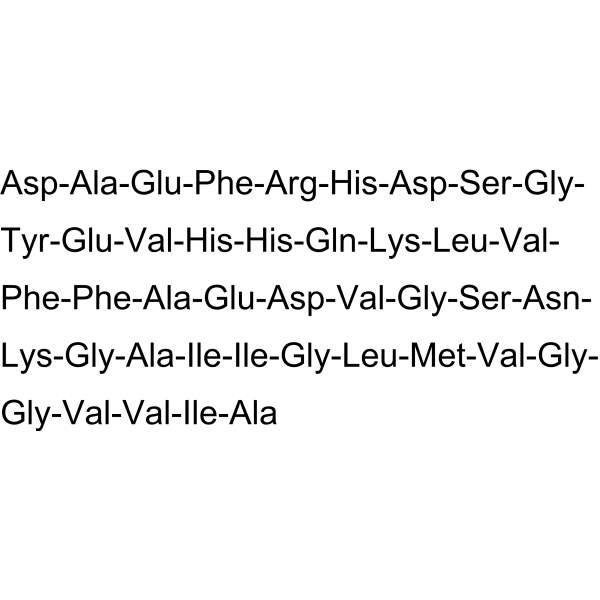
β-Amyloid (1-42) (Amyloid β-peptide (1-42), human TFA, a 42-amino acid peptide that has not been treated with HFIP, is a brain-penetrant amyloid protein fragment, which can be used in research on Alzheimer's disease and Down’s syndrome. β-Amyloid (1-42), human TFA remaining as a monomer exhibits antioxidant and neuroprotective effects. β-Amyloid (1-42), human TFA, after being monomericized by HFIP and dissolved in DMSO to form the stock solution, on the one hand, can form soluble oligomers (AβOs) when incubated at 4 °C, which have synaptic toxicity and neurotoxicity; on the other hand, it can be incubated at 37 °C to form insoluble fibrils, with lower neurotoxicity, and participating in the oxidative damage process. Aβ42 oligomers bind to various neuronal surface receptors (such as PrPc, mGluR5, NMDA receptors, etc.), triggering oxidative stress, calcium homeostasis imbalance, and synaptic toxicity via activating downstream signaling pathways, leading to neuronal dysfunction and death .
loading...
    loading...
27
27 Publications Verification
Cat. No.: HY-P1363A
CAS No.: 107761-42-2
Synonyms: Amyloid β-peptide (1-42) (human)
Target:  

Amyloid-β

Research Areas:  

Neurological Disease

β-Amyloid (1-42) (Amyloid β-peptide (1-42)), human, a 42-amino acid peptide that has not been treated with HFIP, is a brain-penetrant amyloid protein fragment, which can be used in research on Alzheimer's disease and Down’s syndrome. β-Amyloid (1-42), human remaining as a monomer exhibits antioxidant and neuroprotective effects. β-Amyloid (1-42), human, after being monomericized by HFIP and dissolved in DMSO to form the stock solution, on the one hand, can form soluble oligomers (AβOs) when incubated at 4 °C, which have synaptic toxicity and neurotoxicity; on the other hand, it can be incubated at 37 °C to form insoluble fibrils, with lower neurotoxicity, and participating in the oxidative damage process. Aβ42 oligomers bind to various neuronal surface receptors (such as PrPc, mGluR5, NMDA receptors, etc.), triggering oxidative stress, calcium homeostasis imbalance, and synaptic toxicity via activating downstream signaling pathways, leading to neuronal dysfunction and death .
loading...
    loading...
27
27 Publications Verification
Cat. No.: HY-P1363B
CAS No.: 107761-42-2
Target:  

Amyloid-β

Research Areas:  

Neurological Disease

β-Amyloid (1-42), human, HFIP-treated, a 42-amino acid peptide that has been treated with HFIP from β-Amyloid (1-42), human (HY-P1363A), is a brain-penetrant amyloid protein fragment, which can be used in research on Alzheimer's disease and Down’s syndrome. β-Amyloid (1-42), human, HFIP-treated remaining as a monomer exhibits antioxidant and neuroprotective effects. β-Amyloid (1-42), human, HFIP-treated, after being dissolved in DMSO to form the stock solution, on the one hand, can form soluble oligomers (AβOs) when incubated at 4°C, which have synaptic toxicity and neurotoxicity; on the other hand, it can be incubated at 37°C to form insoluble fibrils, with lower neurotoxicity, and participating in the oxidative damage process. Aβ42 oligomers bind to various neuronal surface receptors (such as PrPc, mGluR5, NMDA receptors, etc.), triggering oxidative stress, calcium homeostasis imbalance, and synaptic toxicity via activating downstream signaling pathways, leading to neuronal dysfunction and death .
loading...
    loading...
1
1 Cited Publications
Cat. No.: HY-139201A
CAS No.: 27964-99-4
Synonyms: PDLHB (MW 70000-150000)
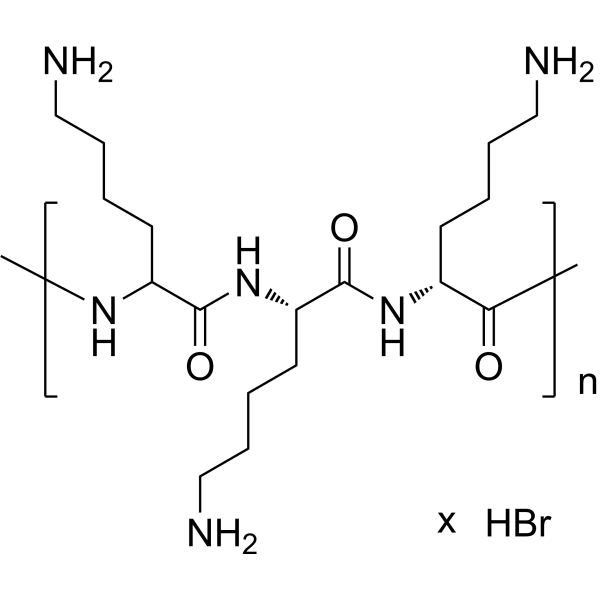
Poly-D-lysine hydrobromide (MW 70000-150000) is a synthetic polymeric substrate and is one of the most widely used substrate in neural cell culture. Poly-D-lysine hydrobromide is a CaSR agonist peptide .
loading...
    loading...
Cat. No.: HY-139201
CAS No.: 27964-99-4
Synonyms: PDLHB (MW 30000-70000)
Target:  

CaSR

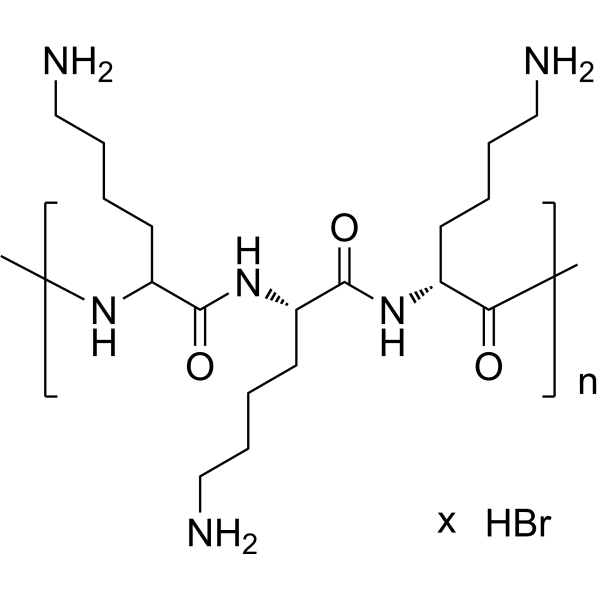
Poly-D-lysine hydrobromide (MW 30000-70000) is a synthetic polymeric substrate and is one of the most widely used substrate in neural cell culture. Poly-D-lysine hydrobromide is a CaSR agonist peptide .
loading...
    loading...
Cat. No.: HY-122559
CAS No.: 1375752-78-5
Purity:  99.94%
Target:  

mGluR

Research Areas:  

Neurological Disease

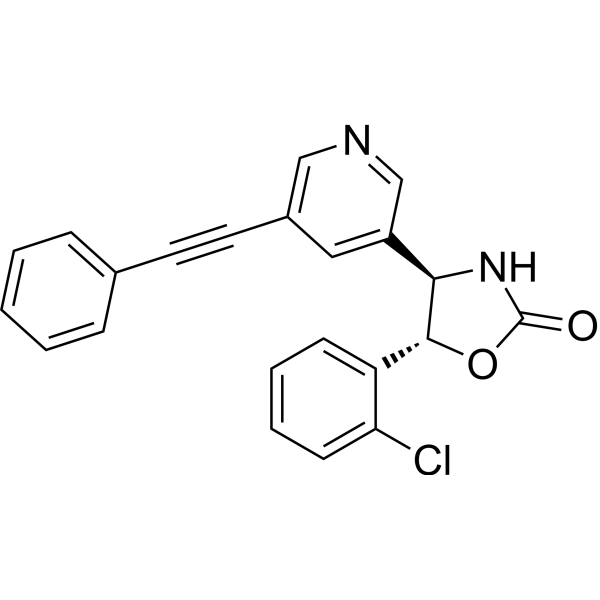
BMS-984923, a potent mGluR5 silent allosteric modulator (SAM), with exquisite binding affinity (Ki = 0.6 nM), exhibits good oral bioavailability and BBB penetration. BMS-984923 potently inhibits the PrPC-mGluR5 interaction and prevents pathological Aβo signaling without affecting physiological glutamate signaling .
loading...
    loading...
Cat. No.: HY-153756
CAS No.: 749212-56-4
Purity:  ≥95.0%
Target:  

Prion Protein

Research Areas:  

Infection

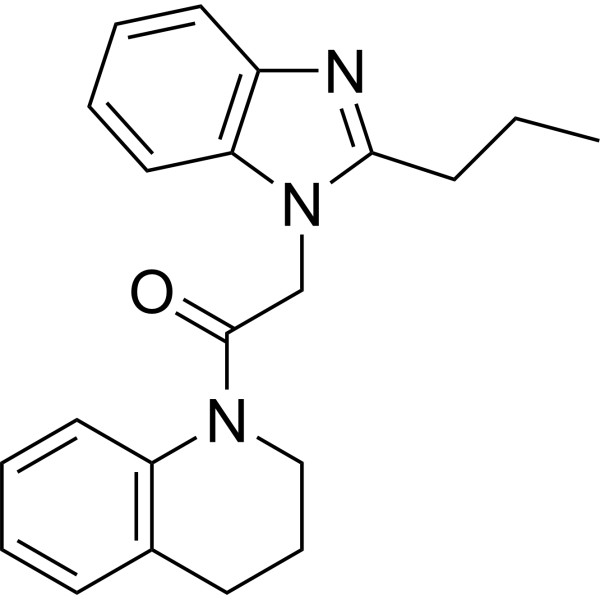
GFP16 is a low affinity antiprion compound. GFP16 can be used for research of antiprion drug discovery .
loading...
    loading...
Cat. No.: HY-P11319
CAS No.: 1337998-99-8
Target:  

CCR

Research Areas:  

Neurological Disease

RAP-103 is an orally active CCR antagonist that provides potent synaptic protection by inhibiting and reversing cytoskeletal changes induced by PrPC/NOX signaling. RAP-103 is potentially useful in Alzheimer's disease (AD) research .
loading...
    loading...
Cat. No.: HY-P1363S1
β-Amyloid (1-42), human, Ala( 13C3, 15N) TFA is the 13C and 15N-labeled β-Amyloid (1-42), human (HY-P1363A). β-Amyloid (1-42) (Amyloid β-peptide (1-42)), human, a 42-amino acid peptide that has not been treated with HFIP, is a brain-penetrant amyloid protein fragment, which can be used in research on Alzheimer's disease and Down’s syndrome. β-Amyloid (1-42), human remaining as a monomer exhibits antioxidant and neuroprotective effects. β-Amyloid (1-42), human, after being monomericized by HFIP and dissolved in DMSO to form the stock solution, on the one hand, can form soluble oligomers (AβOs) when incubated at 4 °C, which have synaptic toxicity and neurotoxicity; on the other hand, it can be incubated at 37 °C to form insoluble fibrils, with lower neurotoxicity, and participating in the oxidative damage process. Aβ42 oligomers bind to various neuronal surface receptors (such as PrPc, mGluR5, NMDA receptors, etc.), triggering oxidative stress, calcium homeostasis imbalance, and synaptic toxicity via activating downstream signaling pathways, leading to neuronal dysfunction and death .
loading...
    loading...
Cat. No.: HY-P990167

Research Areas:  

Neurological Disease

Anti-Mouse/Human PrP/prion protein Antibody (TW1) is a mouse-derived IgG2a type antibody inhibitor, targeting to mouse/human PrP/prion protein. Anti-Mouse/Human PrP/prion protein Antibody (TW1) binds to both PrPc (cellular prion protein) and PrPSc (Scrapie Prion Protein) and blocks the interaction of prion protein with tau protein. Anti-Mouse/Human PrP/prion protein Antibody (TW1) can be used for the researches of Alzheimer’s disease (AD) .
loading...
    loading...
Cat. No.: HY-RS11188
Research Areas:  

Others

PRNP Human Pre-designed siRNA Set A contains three designed siRNAs for PRNP gene (Human), as well as a negative control, a positive control, and a FAM-labeled negative control.

loading...
    loading...
Cat. No.: HY-141467S
CAS No.: 607721-34-6
Propionyl CoA-d5 is the deuterium labeled Propionyl CoA (HY-141467). Propionyl CoA serves as a common intermediate in the catabolic pathways of 1,2-propanediol and propionate in Salmonella enterica serovar Typhimurium LT2, and also functions as a precursor for 2-methylcitrate. Propionyl CoA is utilized as a substrate for the 2-methylcitrate synthase (PrpC) enzyme to synthesize 2-methylcitrate .
loading...
    loading...
Cat. No.: HY-P81980
Synonyms: CJD; GSS; PrP; PRNP; ASCR; KURU; PRIP; PrPC; CD230; AltPrP; Prion protein; PrP27-30; PrP33-35C

Host:  

Rabbit

Application:  

WB, IHC-P

Reactivity:  

Human, Mouse, Rat

loading...
    loading...
Cat. No.: HY-P81980A
Synonyms: CJD; GSS; PrP; PRNP; ASCR; KURU; PRIP; PrPC; CD230; AltPrP; Prion protein; PrP27-30; PrP33-35C

Host:  

Rabbit

Application:  

WB, IHC-P

Reactivity:  

Human, Mouse, Rat

loading...
    loading...
Cat. No.: HY-RS18367
Research Areas:  

Others

Prnp Mouse Pre-designed siRNA Set A contains three designed siRNAs for Prnp gene (Mouse), as well as a negative control, a positive control, and a FAM-labeled negative control.

loading...
    loading...
Cat. No.: HY-P82014
Synonyms: HPRP8; p220; PRP8; PrPC8; Prpf8; RP13; SNRNP220

Host:  

Rabbit

Application:  

WB, IHC-P

Reactivity:  

Human

loading...
    loading...
Cat. No.: HY-141467S1
Propionyl CoA-d5 sodium is the deuterium labeled Propionyl CoA. Propionyl CoA serves as a common intermediate in the catabolic pathways of 1,2-propanediol and propionate in Salmonella enterica serovar Typhimurium LT2, and also functions as a precursor for 2-methylcitrate. Propionyl CoA is utilized as a substrate for the 2-methylcitrate synthase (PrpC) enzyme to synthesize 2-methylcitrate .
loading...
    loading...
Cat. No.: HY-107662R
CAS No.: 34320-83-7
Research Areas:  

Infection Cancer

TCS PrP Inhibitor 13 (Standard) is the analytical standard of TCS PrP Inhibitor 13 (HY-107662). This product is intended for research and analytical applications. TCS PrP Inhibitor 13, an antiprion agent, is a cellular prion protein (PrPC) inhibitor. TCS PrP Inhibitor 13, as a protease-resistant form of prion protein (PrP-res) accumulation inhibitor, shows an IC50 value of 3 nM in both ScN2a and F3 cell lines. TCS PrP Inhibitor 13 induces Schwannoma cells apoptosis .
loading...
    loading...
  • 1

