12 Results for "

Swarming

" in MedChemExpress (MCE) Product Catalog:
Products (12)

12 Results for "Swarming" in MCE Product Catalog:

1
1 Cited Publications
Cat. No.: HY-P2975
CAS No.: 114956-81-9
Synonyms: Mouse laminin (Engelbreth-Holm-Swarm murine sarcoma basement membrane)
Laminin (Engelbreth-Holm-Swarm murine sarcoma basement membrane) is a crucial structural element in animal tissues, forming part of the scaffolding that supports tissue architecture. It interacts with type IV collagen through entactin and perlecan, connects to cell membranes via integrin receptors, dystroglycan complexes, and Lutheran blood group glycoproteins, and contains functional domains that facilitate collagen binding, cell adhesion, heparin interaction, and promote neurite outgrowth.
loading...
    loading...
Cat. No.: HY-30236
CAS No.: 10075-50-0
Target:  

Bacterial

Research Areas:  

Infection

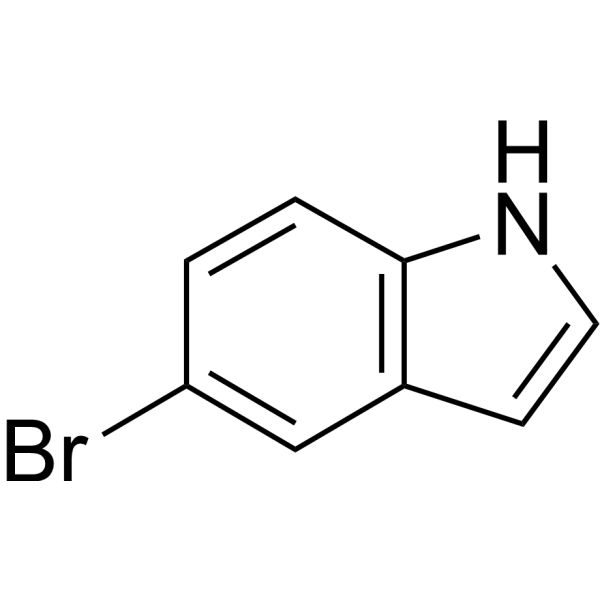
5-Bromoindole is an antibacterial agent with a MIC of 200 μg/mL. 5-Bromoindole inhibits biofilm and curli formation, reduces swarming motility and swimming motility. 5-Bromoindole can be used for the research of enterohemorrhagic escherichia coli o157:h7 infection .
loading...
    loading...
Cat. No.: HY-W104758
CAS No.: 15015-57-3
Target:  

Elastase Bacterial

Research Areas:  

Infection

LasR antagonist-2 is a LasR competitive antagonist and quorum sensing inhibitor, with a Kd value of 7.04 μM against LasR of Pseudomonas aeruginosa. LasR antagonist-2 reduces the production of virulence factors including elastase (elastase), pyocyanin (pyocyanin) and rhamnolipid (rhamnolipid). LasR antagonist-2 inhibits bacterial (bacterial) swarming and swimming motility, and moderately suppresses biofilm formation. LasR antagonist-2 inhibits Pseudomonas aeruginosa infection in the greater wax moth larva model. Elastase-IN-3 can be used in studies related to Pseudomonas aeruginosa infection .
loading...
    loading...
Cat. No.: HY-129503
CAS No.: 40522-46-1
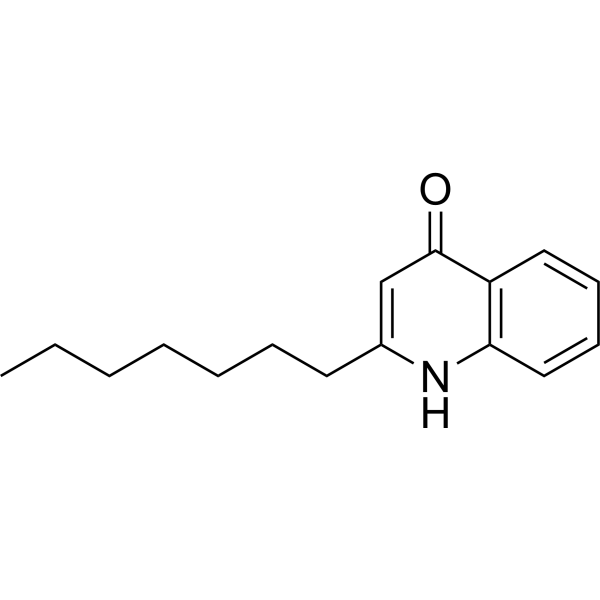
2-Heptyl-4-quinolone is an intermediate in the synthesis of the Pseudomonas quinolone signal (PQS) that controls swarming by positively regulating phenazine production. 2-Heptyl-4-quinolone induces the production of the phenazine-1-carboxylic acid (PCA) .
loading...
    loading...
Cat. No.: HY-115969
CAS No.: 1572464-22-2
Target:  

Bacterial

Research Areas:  

Infection

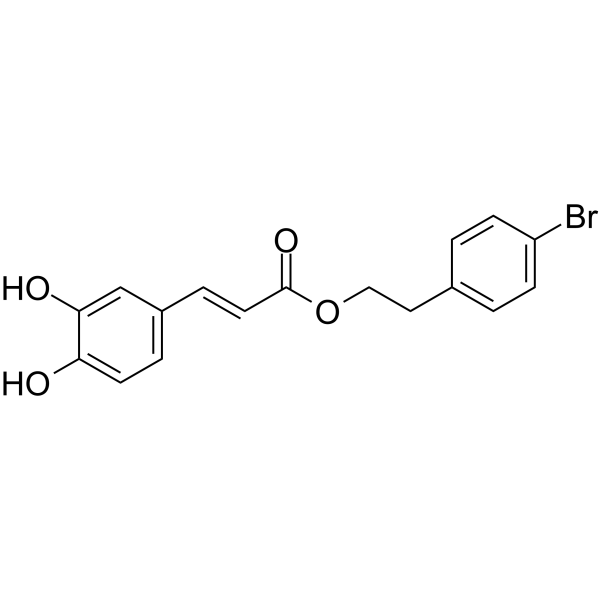
F-17 is a potential inhibitor of virulence factor. F-17 shows very significant inhibitory effect on biofilm, elastase, pyocyanin, and swarming motility. F-17 also shows a good binding effect on LasR and PqsR. F-17 has no obvious cytotoxicity .
loading...
    loading...
Cat. No.: HY-147112
CAS No.: 70622-78-5
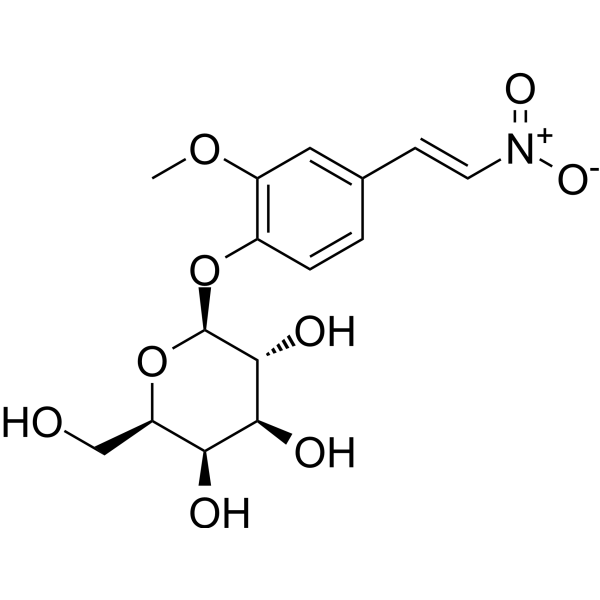
MNP-GAL is MNPs coated with galactose. MNP-Gal can be used as substrate for the assay of NAG and beta-d-galactosidase .
loading...
    loading...
Cat. No.: HY-129503S1
2-Heptyl-4-quinolone- 15N is the 15N-labeled 2-Heptyl-4-quinolone (HY-129503). 2-Heptyl-4-quinolone is an intermediate in the synthesis of the Pseudomonas quinolone signal (PQS) that controls swarming by positively regulating phenazine production. 2-Heptyl-4-quinolone induces the production of the phenazine-1-carboxylic acid (PCA) .
loading...
    loading...
Cat. No.: HY-182049
CAS No.: 3106820-05-4
Target:  

Bacterial

Research Areas:  

Infection

Antibacterial agent 332 is an inhibitor of DsbA from Escherichia coli (EcDsbA). Antibacterial agent 332 reduces the swarming motility of Escherichia coli without affecting bacterial growth. Antibacterial agent 332 can be used in the research of bacterial infections caused by Escherichia coli .
loading...
    loading...
Cat. No.: HY-184715
CAS No.: 872546-39-9
Target:  

Bacterial

Research Areas:  

Infection

LasR-IN-6 is a LasR inhibitor with an IC50 of 0.261 μM, and exhibits antibacterial activity against Pseudomonas aeruginosa. LasR-IN-6 stably binds to the active site of LasR via hydrophobic interactions, disrupts receptor dimerization, and interferes with quorum sensing. LasR-IN-6 inhibits protease production, biofilm formation, twitching motility and swarming motility in Pseudomonas aeruginosa. LasR-IN-6 can be used in studies related to Pseudomonas aeruginosa infection .
loading...
    loading...
Cat. No.: HY-180109
Synonyms: Benzo-17R-Resolvin D2
Benzo-17R-RvD2 (Benzo-17R-Resolvin D2) is a benzo-containing analog of RvD2 (HY-121636). Benzo-17R-RvD2 enhances human macrophage efferocytosis, limits neutrophil infiltration, reduces TNF-α, and increases IL-1 receptor antagonist in peritonitis. Benzo-17R-RvD2 promotes E. coli killing by human leukocytes and reduces neutrophil swarm area without compromising anti-Candida activity. Benzo-17R-RvD2 activates the human-RvD2 receptor with an EC50 ∼1.5 nM. Benzo-17R-RvD2 can be used in research on inflammation-associated diseases such as cardiovascular disease, cancer, neuroinflammation, pain, and muscle regeneration .
loading...
    loading...
Cat. No.: HY-W130115
CAS No.: 19932-84-4
Synonyms: 6-Chlorobenzo[d]oxazol-2(3H)-one
Target:  

Fungal

Research Areas:  

Infection

6-Chloro-2-benzoxazolinone (6-Chlorobenzo[d]oxazol-2 (3H)-one) is a derivative of DIMBOA (HY-N7432) and an antibacterial agent. The minimum inhibitory concentration (MIC) of 6-Chloro-2-benzoxazolinone against Ralstonia solanacearum is 100 mg/L, and its minimum bactericidal concentration (MBC) is 500 mg/L. 6-Chloro-2-benzoxazolinone reduces biofilm formation and inhibits swarming motility of *Ralstonia solanacearum*. It can be used for the research of bacterial wilt .
loading...
    loading...
Cat. No.: HY-129503S
2-Heptyl-4-quinolone- 13C6 is the 13C-labeled 2-Heptyl-4-quinolone (HY-129503). 2-Heptyl-4-quinolone is an intermediate in the synthesis of the Pseudomonas quinolone signal (PQS) that controls swarming by positively regulating phenazine production. 2-Heptyl-4-quinolone induces the production of the phenazine-1-carboxylic acid (PCA) .
loading...
    loading...
  • 1

