
Search Result
Results for "
copolymers
" in MedChemExpress (MCE) Product Catalog:
86
Biochemical Assay Reagents
1
Isotope-Labeled Compounds
| Cat. No. |
Product Name |
Target |
Research Areas |
Chemical Structure |
-
- HY-B2247
-
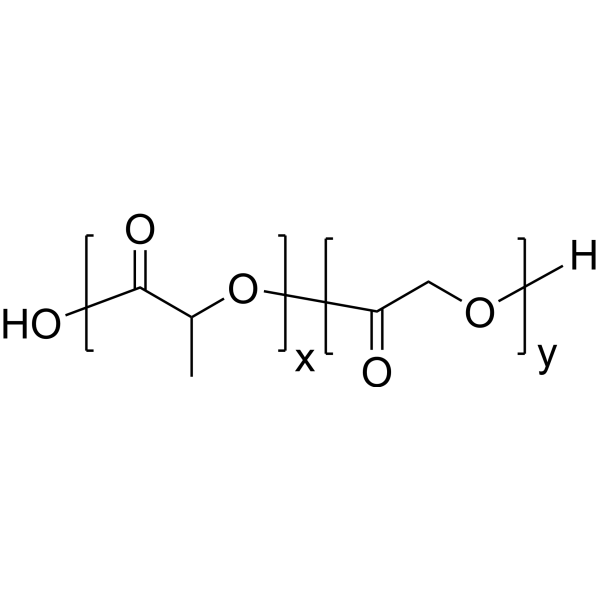
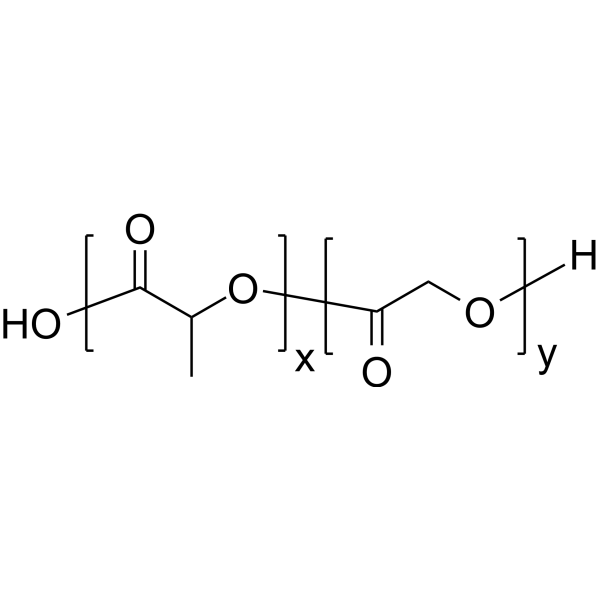
PLGA (50:50)
Maximum Cited Publications
29 Publications Verification
poly(lactic-co-glycolic acid) (50:50)
|
Biochemical Assay Reagents
|
Others
|
|
PLGA (50:50) (poly(lactic-co-glycolic acid) (50:50)) is a copolymer of poly lactic acid (PLA) and poly glycolic acid (PGA) which can be used to fabricate devices for drug delivery and tissue engineering applications.
|
-
-
- HY-D1005A
-
-
-
- HY-141540
-
|
|
Biochemical Assay Reagents
Endogenous Metabolite
|
Others
|
|
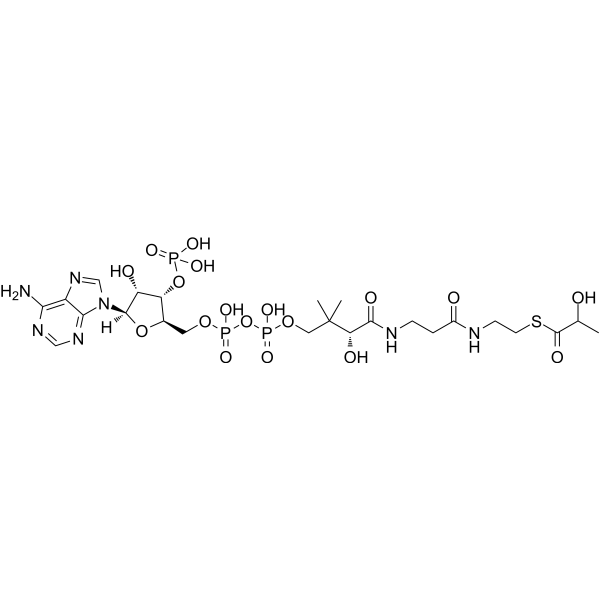
Lactyl-CoA is an acyl-CoA formally condensed from the sulfhydryl group of CoA and the carboxyl group of lactic acid, also known as lactyl-CoA. Lactyl-CoA is essential for the biosynthesis of biodegradable and biocompatible lactic acid-based copolymers .
|
-
-
- HY-B2247A
-
|
poly(lactic-co-glycolic acid) (75:25)
|
Biochemical Assay Reagents
|
Others
|
|
PLGA (75:25) is a low toxicity, biocompatible and biodegradable controlled drug delivery carrier, can achieve slow release in the organism. PLGA (75:25) is a copolymer of 75% poly lactic acid (PLA) and 25% poly glycolic acid (PGA). PLGA (75:25) has been extensively studied as delivery vehicles for agents, proteins and various other macromolecules such as DNA, RNA and peptides .
|
-
-
- HY-D1005H
-
-
-
- HY-W077028
-
|
|
Biochemical Assay Reagents
|
Others
|
|
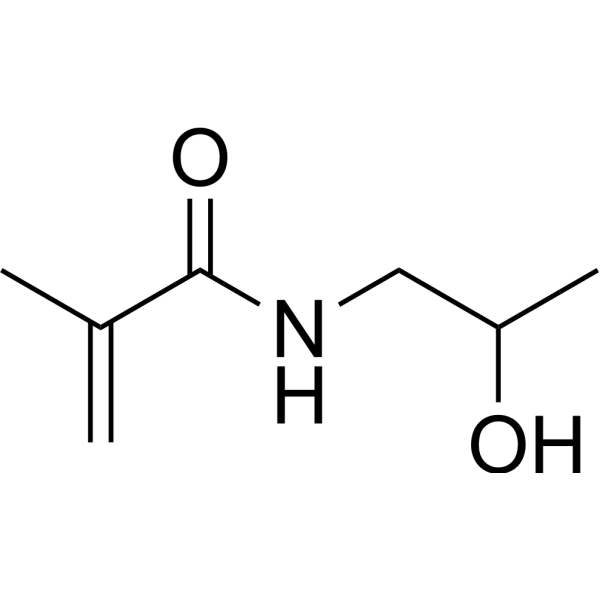
N-(2-Hydroxypropyl)methacrylamide is used to synthesize copolymers for the targeted delivery of antileishmanial agents in Visceral leishmaniasis (VL) .
|
-
-
- HY-140697
-
|
mPEG5000-Hydroxy; Polyethylene glycol monomethyl ether 5000
|
Environmental Pollutants
PROTAC Linkers
|
Cancer
|
|
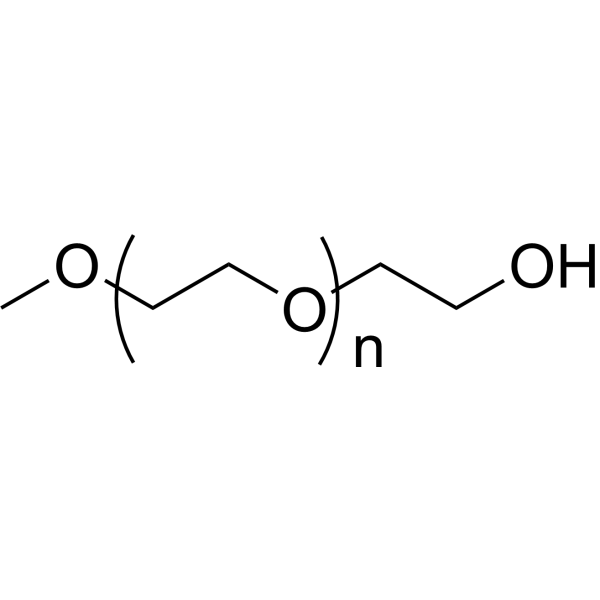
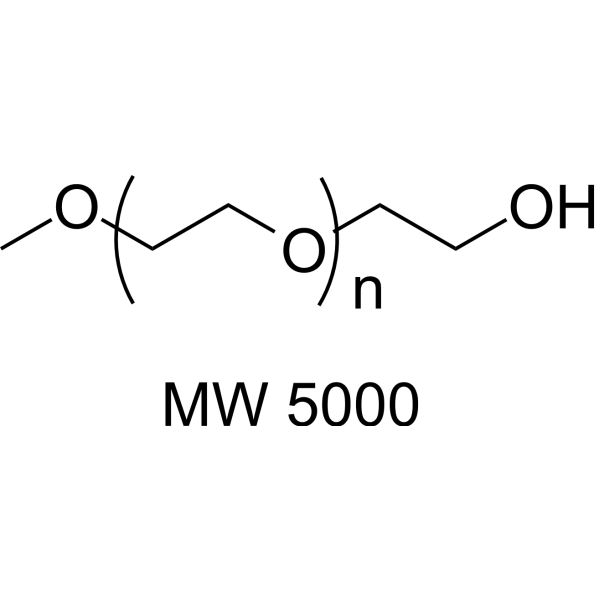
m-PEG5000-OH (mPEG5000-Hydroxy) is a monomethoxypolyethylene glycol and also a macroinitiator for organocatalytic ring-opening polymerization of aliphatic cyclic carbonate monomers. m-PEG1000-OH can participate in the synthesis of amphiphilic block copolymers. Amphiphilic block copolymers can be used to prepare nanoscale micelles for active drug delivery .
|
-
-
- HY-140696E
-
|
mPEG1000-Hydroxy; Polyethylene glycol monomethyl ether 1000
|
Environmental Pollutants
Biochemical Assay Reagents
|
Cancer
|
|
m-PEG1000-OH (mPEG1000-Hydroxy) is a monomethoxypolyethylene glycol and also a macroinitiator for organocatalytic ring-opening polymerization of aliphatic cyclic carbonate monomers. m-PEG1000-OH can participate in the synthesis of amphiphilic block copolymers. Amphiphilic block copolymers can be used to prepare nanoscale micelles for active drug delivery .
|
-
-
- HY-158231
-
|
F127DA
|
Integrin
FAK
|
Inflammation/Immunology
|
|
Polyether F127 Diacrylate (F127DA) is an acrylated polyethylene glycol-polypropylene glycol-polyethylene glycol triblock copolymer. Polyether F127 Diacrylate rapidly crosslinks and cures into a gel under ultraviolet or visible light with the action of a photoinitiator. Polyether F127 Diacrylate exhibits excellent thermogelation properties and favorable biosafety. Polyether F127 Diacrylate can upregulate the Integrin-FAK pathway, enhance collagen production, increase the protein and gene expression levels of COL-1/SCX, and promote fibroblastic differentiation of periodontal ligament stem cells. Polyether F127 Diacrylate promotes periodontal ligament regeneration and reduces abnormal healing in a rat model of delayed replanted teeth . Polyether F127 Diacrylate promotes functional osteochondral regeneration in a rat model of osteoarthritis. Polyether F127 Diacrylate supports adipose tissue survival, rendering it suitable for breast reconstruction applications. Polyether F127 Diacrylate can be used in studies related to periodontal ligament injury, breast defect and osteoarthritis .
|
-
-
- HY-116544
-
|
|
Biochemical Assay Reagents
|
Others
|
|
Octan-2-yl 2-cyanoacrylate is an alkyl cyanoacrylate monomer, base-sensitive monofunctional 1,1-disubstituted electron-deficient olefin, polymerizable and copolymerizable monomer. Octan-2-yl 2-cyanoacrylate undergoes homopolymerization via nucleophilic initiation with pyridine as initiator. Octan-2-yl 2-cyanoacrylate forms true copolymers with ethyl 2-cyanoacrylate via nucleophilic initiation with pyridine as initiator .
|
-
-
- HY-W1048558A
-
|
mPEG2000-COOH
|
Biochemical Assay Reagents
|
Others
|
|
mPEG2000-CM (mPEG2000-COOH) is a carboxyl-terminated monomethoxy polyethylene glycol. mPEG2000-CM bears a reactive carboxyl group (-COOH) at its structural terminal site, which can form stable amide bonds with amino groups and ester bonds with hydroxyl groups. mPEG2000-CM binds to PCA-g-PCL copolymers via electrostatic interaction to form polyion complex micelles with a hydrophilic PEG surface, which enhances the stability of micelles in aqueous media. mPEG2000-CM can be used for drug delivery .
|
-
-
- HY-W105423
-
|
NHS-MA
|
Biochemical Assay Reagents
|
Others
|
|
Methacrylic acid N-hydroxysuccinimide ester (NHS-MA) is a polymer that serves as a monomer to prepare degradable amphiphilic block copolymer microparticles via RAFT polymerization for low pH-triggered drug delivery. Methacrylic acid N-hydroxysuccinimide ester is used for the synthesis of nanogels .
|
-
-
- HY-D1005A25
-
-
-
- HY-D1567
-
|
|
Fluorescent Dye
|
Others
|
|
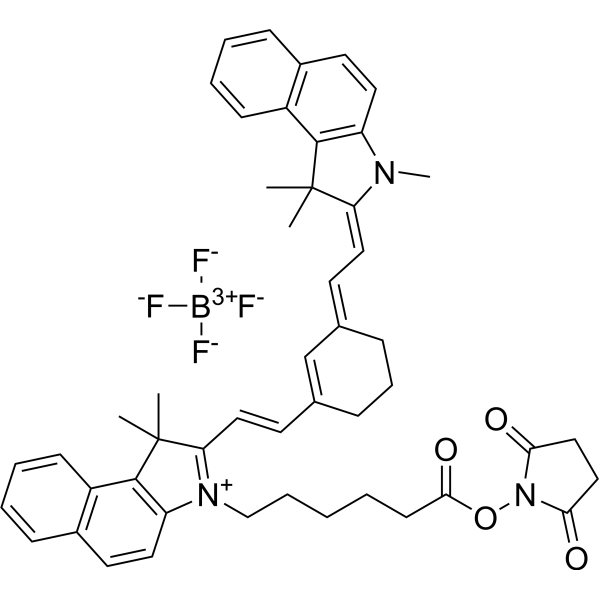
Cy7.5 NHS ester is a fluorescent dye. Cy7.5 NHS ester can be conjugated to mPEG-b-PDPA to form a mPEG-b-PDPA-Cy7.5 fluorescent copolymer. Cy7.5 NHS ester can be used for fluorescent imaging study (Ex/Em = 780/820 nm) .
|
-
-
- HY-D1005A23
-
|
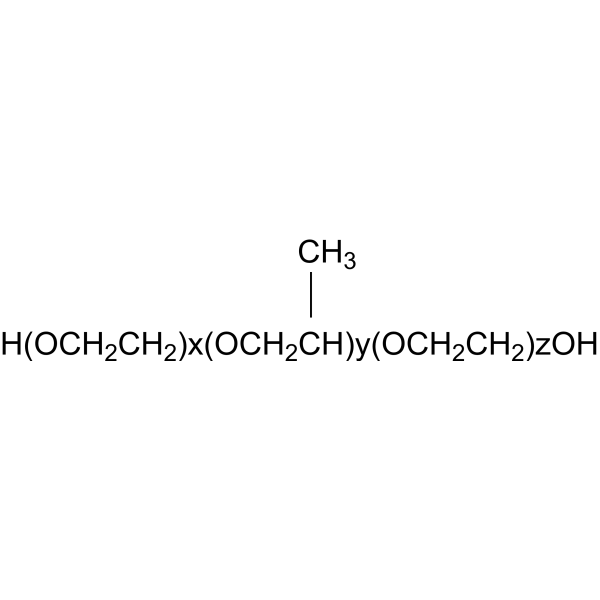
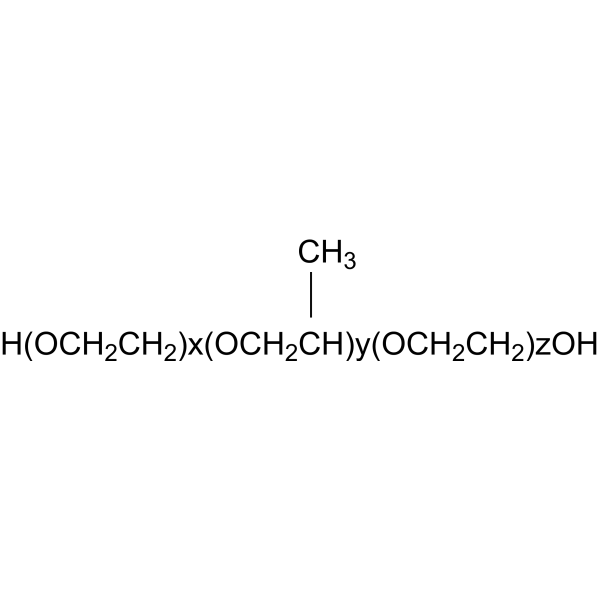
PEG-PPG-PEG, 4400 (Average)
|
Environmental Pollutants
Biochemical Assay Reagents
P-glycoprotein
|
Inflammation/Immunology
|
|
Poloxamer 401 L121 is a block copolymer of polyethylene oxide and polypropylene oxide with an average molecular weight of 4400. Poloxamer has the ability to inhibit P-gp. Poloxamer 401 inhibits multiagent resistance and adjuvant activity. Poloxamer 401 can be used as a cosmetic ingredient. Poloxamer 401 can be used in nanoparticle engineering (lymphatic targeting particles) research .
|
-
-
- HY-155902
-
|
Maleimide-PEG5000-Hydroxy
|
Biochemical Assay Reagents
|
Others
|
|
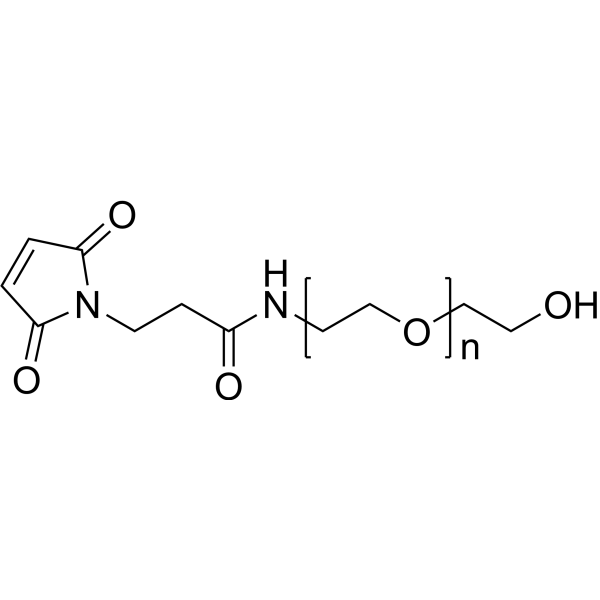
Mal-PEG5000-OH can be used as a macroinitiator to obtain amphiphilic diblock copolymers by ring-opening polymerization of LA. Nanoparticles prepared using amphiphilic block copolymers can form active drug delivery systems. Nanoparticles encapsulate Triptolide (HY-32735), which can avoid the disadvantage of Triptolide’s poor water solubility and reduce its toxicity.
|
-
-
- HY-158089
-
|
|
Biochemical Assay Reagents
|
Others
|
|
PLGA-COOH (MW 80000) (LA/GA 50:50) is a copolymer composed of lactic acid (LA)-glycolic acid (GA) at a molar ratio of 50:50 and a terminal carboxyl group. PLGA-COOH (MW 80000) (LA/GA 50:50) is used in compound delivery systems due to its biocompatibility and biodegradability .
|
-
-
- HY-W010708
-
|
|
Endogenous Metabolite
|
Inflammation/Immunology
|
|
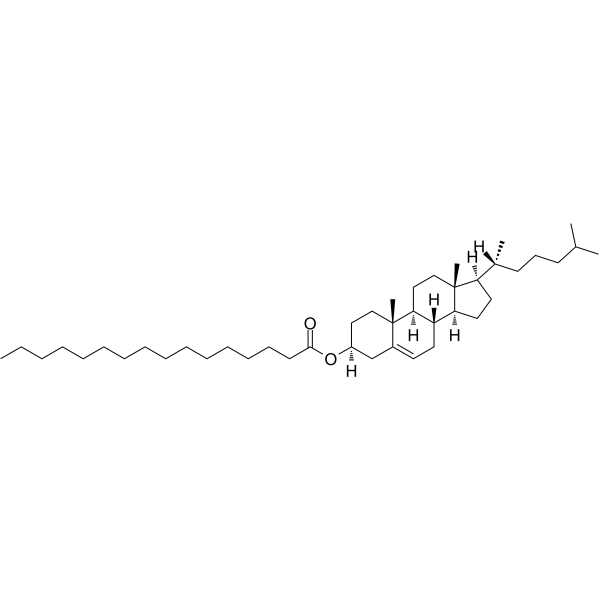
Cholesteryl palmitate is the main cholesterol ester found in human blephariol and has been used to form a stable tear film to study amphiphilic block copolymers as surfactants for dry eye syndrome. Cholesteryl palmitate can be used as a predictor of fetal lung maturity. Cholesteryl palmitate can be used as a prognostic biomarker for chronic interstitial pneumonia .
|
-
-
- HY-139819
-
|
|
Biochemical Assay Reagents
|
Others
|
|
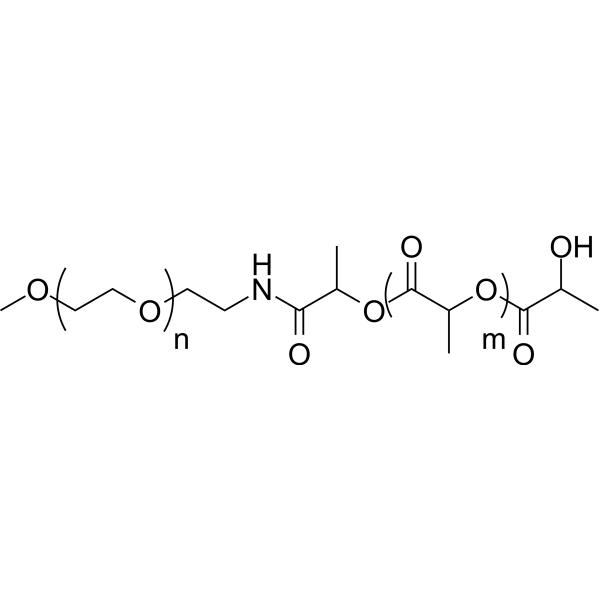
MPEG-PLA (PEG MW 3000 & PLA MW 50,000) is a block copolymer, which can be used to preparenanoparticles for targeted drug delivery .
|
-
-
- HY-W250126
-
|
Poly(ethylene-co-vinyl acetate)
|
Environmental Pollutants
Biochemical Assay Reagents
|
Others
|
|
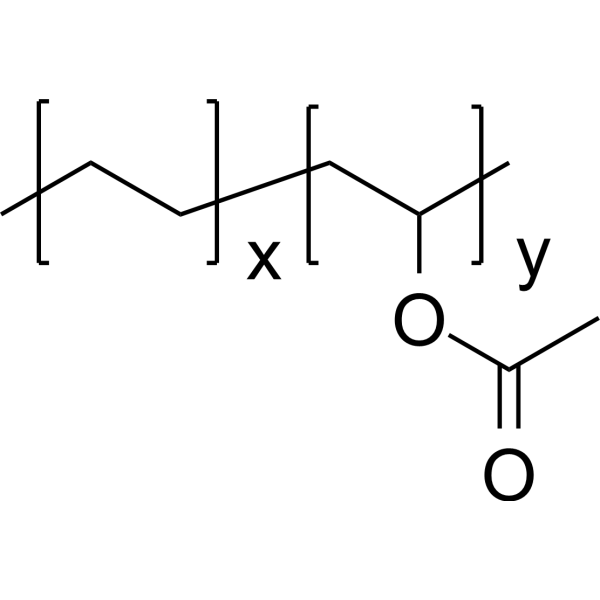
Ethylene-vinyl acetate copolymer (Poly(ethylene-co-vinyl acetate)) is an encapsulant. Ethylene-vinyl acetate copolymer is cross-linked by a thermally activated reaction with peroxides. Ethylene-vinyl acetate copolymer can be used for encapsulation of photovoltaic modules .
|
-
-
- HY-140696B
-
|
mPEG550-Hydroxy; Polyethylene glycol monomethyl ether 550
|
Environmental Pollutants
Biochemical Assay Reagents
|
Cancer
|
|
m-PEG550-OH (mPEG550-Hydroxy) is a monomethoxypolyethylene glycol and also a macroinitiator for organocatalytic ring-opening polymerization of aliphatic cyclic carbonate monomers. m-PEG550-OH can participate in the synthesis of amphiphilic block copolymers. Amphiphilic block copolymers can be used to prepare nanoscale micelles for active drug delivery .
|
-
-
- HY-172380A
-
|
|
Biochemical Assay Reagents
|
Others
|
|
PCL-PEG-PCL diacrylate (MW 800) is an amphiphilic triblock copolymer composed of PEG and two polycaprolactones (PCL). PCL-PEG-PCL diacrylate (MW 800) can be cross-linked by free radical polymerization and/or photopolymerization to form a cross-linked hydrogel network .
|
-
-
- HY-46846
-
|
|
Environmental Pollutants
Biochemical Assay Reagents
|
Others
|
|
Styrene-divinylbenzene sulfonated copolymer is a cation exchange resin prepared from sulfonic acid group-containing microporous styrene/divinylbenzene (DVB) copolymer. Styrene-divinylbenzene sulfonated copolymer serves as the core matrix material for most bilirubin adsorbents. It also acts as a hydrophilic cell immobilization carrier, whose porous structure provides an ideal environment for microbial growth and biochemical reactions .
|
-
-
- HY-N7701B
-
-
-
- HY-155902A
-
|
Maleimide-PEG2000-Hydroxy
|
Biochemical Assay Reagents
|
Others
|
|
Mal-PEG2000-OH can be used as a macroinitiator to obtain amphiphilic diblock copolymers by ring-opening polymerization of LA. Nanoparticles prepared using amphiphilic block copolymers can form active drug delivery systems. Nanoparticles encapsulate Triptolide (HY-32735), which can avoid the disadvantage of Triptolide’s poor water solubility and reduce its toxicity.
|
-
-
- HY-140696H
-
|
mPEG750-Hydroxy; Polyethylene glycol monomethyl ether 750
|
Biochemical Assay Reagents
|
Cancer
|
|
m-PEG750-OH (mPEG750-Hydroxy) is a monomethoxypolyethylene glycol and also a macroinitiator for organocatalytic ring-opening polymerization of aliphatic cyclic carbonate monomers. m-PEG750-OH can participate in the synthesis of amphiphilic block copolymers. Amphiphilic block copolymers can be used to prepare nanoscale micelles for active drug delivery .
|
-
-
- HY-140696C
-
|
mPEG20000-Hydroxy; Polyethylene glycol monomethyl ether 20000
|
PROTAC Linkers
|
Cancer
|
|
m-PEG20000-OH can be used as a macroinitiator to participate in the synthesis of amphiphilic block copolymers. Nanoscale micelles can be prepared by using amphiphilic block copolymers to deliver active drugs. Paclitaxel (HY-B0015), a hydrophobic anticancer agent encapsulated in micelles, has stronger activity in killing cancer cells than free Paclitaxel. And it preferentially accumulates in tumor tissue with only limited distribution in healthy organs.
|
-
-
- HY-D1005I
-
|
|
Biochemical Assay Reagents
|
Others
|
|
Poloxamer L61 is a non-ionic triblock copolymer surfactant. Poloxamer L61 effectively achieves intracellular molecular delivery to cancer cells during photoacoustic molecular delivery, and maintains cell viability by promoting cell membrane resealing, thus avoiding irreversible damage caused by laser-induced membrane permeabilization. Poloxamer L61 is a key component of SP1017, a compound related to gene therapy, which regulates the interaction between DNA and extracellular matrix as well as cellular uptake, and significantly enhances the distribution and bioavailability of plasmid DNA in skeletal muscle. Poloxamer L61 can be used in studies on local or systemic therapeutic protein production .
|
-
-
- HY-D1005A5
-
|
PEG-PPG-PEG, 1850 (Average)
|
Biochemical Assay Reagents
|
Others
|
|
Poloxamer 123 (L43) (PEG-PPG-PEG, average molecular weight 1850) is a nonionic triblock copolymer of polyoxyethylene-polyoxypropylene-polyoxyethylene with an average molecular weight of 1850. Poloxamer 123 L43 can be used as a surfactant, emulsifier, and solubilizer in cosmetics .
|
-
-
- HY-139818
-
|
|
Biochemical Assay Reagents
|
Others
|
|
Mal-PEG-PLA (PEG MW 3000 & PLA MW 70,000) is a block copolymer, which can be used to preparenanoparticles and micelles for targeted drug delivery .
|
-
-
- HY-N0977
-
|
Octadecane-1,18-diol
|
Biochemical Assay Reagents
|
Others
|
|
1,18-Octadecanediol (Octadecane-1,18-diol) is a copolymer of long-chain diol monomers that has properties similar to polyethylene while being easily chemically recyclable and biodegradable .
|
-
-
- HY-N7701A
-
|
|
Fungal
|
Infection
|
|
L-Triguluronic acid is a linear polysaccharide copolymer composed of three L-guluronic acid (G) and can be used to from Alginate . Alginate is a generic name of unbranched polyanionic polysaccharides and can be used for the research of anti-fungal agents delivery carries .
|
-
-
- HY-172380
-
|
|
Biochemical Assay Reagents
|
Others
|
|
PCL-PEG-PCL diacrylate (MW 800) is an amphiphilic triblock copolymer composed of PEG and two polycaprolactones (PCL). PCL-PEG-PCL diacrylate (MW 800) can be cross-linked by free radical polymerization and/or photopolymerization to form a cross-linked hydrogel network .
|
-
-
- HY-D1005A9
-
|
PEG-PPG-PEG, 2650 (Average)
|
Biochemical Assay Reagents
Bacterial
P-glycoprotein
|
Infection
|
|
Poloxamer 183 L63 is a block copolymer of polyoxyethylene and polyoxypropylene with an average molecular weight of 2000. Poloxamer has the ability to inhibit P-gp. Poloxamer 183 exhibits antimicrobial activity and can inhibit Mycobacterium avium. Poloxamer 183 can be used as a cosmetic ingredient .
|
-
-
- HY-172378
-
|
|
Biochemical Assay Reagents
|
Others
|
|
Poly(styrene)-block-poly(acrylic acid) (PS:PAA 30000:2000) is a diblock copolymer used to prepare polymer micelles or vesicles and other encapsulation applications .
|
-
-
- HY-139480A
-
|
|
Biochemical Assay Reagents
|
Others
|
|
Poly(ethylene glycol) dithiol (Mn 1000) is a thiol-modified PEG that can be used to synthesize dithiol-terminated amphiphilic diblock copolymers for drug delivery .
|
-
-
- HY-W888521
-
-
-
- HY-W888515
-
|
|
Biochemical Assay Reagents
|
Others
|
|
mPEG-PCL is a biodegradable, biocompatible, and semi-crystalline copolymer having a very low glass transition temperature. mPEG-PCL can be used as synthetic material for biomedical and drug delivery .
|
-
-
- HY-N7701E
-
|
|
Fungal
|
Infection
|
|
L-Diguluronic acid disodium is a linear polysaccharide copolymer composed of two L-guluronic acid. L-Diguluronic acid disodium can be used to form Alginate. L-Diguluronic acid disodium is a generic name of unbranched polyanionic polysaccharides and it can be used for the research of antifungal agents delivery carries .
|
-
-
- HY-N7701D
-
|
|
Others
|
Infection
|
|
L-Hexaguluronic acid is a linear polysaccharide copolymer composed of six L-guluronic acid (G) .
|
-
-
- HY-155902B
-
|
Maleimide-PEG1000-Hydroxy
|
Biochemical Assay Reagents
|
Others
|
|
Mal-PEG1000-OH was used as a macroinitiator to obtain amphiphilic diblock copolymers by ring-opening polymerization of LA. Nanoparticles prepared using amphiphilic block copolymers can form active drug delivery systems. Nanoparticles encapsulate Triptolide (HY-32735), which can avoid the disadvantage of Triptolide’s poor water solubility and reduce its toxicity.
|
-
-
- HY-139480B
-
|
|
Biochemical Assay Reagents
|
Others
|
|
Poly(ethylene glycol) dithiol (Mn 1500) is a thiol-modified PEG that can be used to synthesize dithiol-terminated amphiphilic diblock copolymers for drug delivery .
|
-
-
- HY-155902C
-
|
Maleimide-PEG3400-Hydroxy
|
Biochemical Assay Reagents
|
Others
|
|
Mal-PEG3400-OH (Maleimide-PEG3400-Hydroxy) is a linear heteroterminal bifunctional PEG product with maleimide and hydroxyl groups. Mal-PEG3400-OH can be used as a macroinitiator to obtain amphiphilic diblock copolymers through ring-opening polymerization of Lactate (Lactic Acid) (HY-B2227). Nanoparticles prepared using amphiphilic block copolymers can form active drug delivery systems .
|
-
-
- HY-172382
-
|
PGCL, 50:50
|
Biochemical Assay Reagents
|
Others
|
|
Poly(D,L-lactide-co-glycolide), 50:50 (PGCL, 50:50) is a copolymer formed by the ring-opening polymerization of lactide and glycolide, which can be used for drug delivery .
|
-
-
- HY-158209
-
|
|
Biochemical Assay Reagents
|
Others
|
|
Block polyoxyethylene-polyoxypropylene is a block copolymer composed of hydrophilic polyoxyethylene (POE) and hydrophobic polyoxypropylene (POP), which can be used to prepare biological materials such as emulsifiers, drug delivery carriers, and stabilizers .
|
-
-
- HY-179074C
-
|
|
Fluorescent Dye
|
Others
|
|
FITC-Polysucrose 70 is FITC-labeled Polysucrose 70 (HY-131960A). Polysucrose 70 is a high molecular weight branched polysaccharide polymer. Polysucrose 70 is a copolymer of sucrose and epichlorohydrin and can be used for cell separation. FITC-Polysucrose 70 is mainly used for permeability and microcirculation studies (Ex/Em = 488/525 nm) .
|
-
-
- HY-34502
-
|
6-Indolecarbonitrile
|
Biochemical Assay Reagents
|
Others
|
|
6-Cyanoindole is a biochemical reagent that can be used as a biological material or organic compound for life science related research. 6-Cyanoindole is a significant indole derivative for the electron-withdrawing -C≡N group. 6-Cyanoindole can be used to generate a copolymer P(6CNIn-co-EDOT) via electrocopolymerization with EDOT .
|
-
-
- HY-W077028R
-
-
-
- HY-167442
-
|
|
Biochemical Assay Reagents
|
Others
|
|
PLLA10000-PEG1000-NH2 is a block copolymer based on polylactic acid derivatives that can self-assemble in water. PLLA10000-PEG1000-NH2 can be used in drug delivery research .
|
-
-
- HY-160726
-
|
|
Biochemical Assay Reagents
|
Others
|
|
Polymethacrylate Copolymer N−C4−52−6.9 is a polymer that consists of hydrophobic butylmethacrylate and cationic methacroylcholine chloride monomers. Polymethacrylate Copolymer N−C4−52−6.9 is able to solubilise lipid bilayers into nanodiscs. Polymethacrylate Copolymer N−C4−52−6.9 can be utilized in structure and functional studies on membrane proteins .
|
-
- HY-N7701C
-
|
|
Others
|
Infection
|
|
L-Pentaguluronic acid is a linear polysaccharide copolymer composed of four L-guluronic acid (G) .
|
-
- HY-155902D
-
|
Maleimide-PEG10000-Hydroxy
|
Biochemical Assay Reagents
|
Others
|
|
Mal-PEG10000-OH (Maleimide-PEG10000-Hydroxy) is a linear heteroterminal bifunctional PEG product with maleimide and hydroxyl groups. Mal-PEG10000-OH can be used as a macroinitiator to obtain amphiphilic diblock copolymers through ring-opening polymerization of Lactate (Lactic Acid) (HY-B2227). Nanoparticles prepared using amphiphilic block copolymers can form active drug delivery systems .
|
-
- HY-129563
-
|
|
HIV
HIV Protease
|
Infection
|
|
CGP 57813 is a peptidomimetic inhibitor of HIV protease that can be encapsulated by nanoparticles composed of poly(D,L-lactic acid) (PLA) and pH-sensitive methacrylic acid copolymers and delivered into the body .
|
-
- HY-172382B
-
|
PGCL, 65:35
|
Biochemical Assay Reagents
|
Others
|
|
Poly(D,L-lactide-co-glycolide), 65:35 (PGCL, 65:35) is a copolymer formed by the ring-opening polymerization of lactide and glycolide, which can be used for drug delivery .
|
-
- HY-172382A
-
|
PGCL, 75:25
|
Biochemical Assay Reagents
|
Others
|
|
Poly(D,L-lactide-co-glycolide), 75:25 (PGCL, 75:25) is a copolymer formed by the ring-opening polymerization of lactide and glycolide, which can be used for drug delivery .
|
-
- HY-172378A
-
|
|
Biochemical Assay Reagents
|
Others
|
|
Poly(styrene)-block-poly(acrylic acid) (PS:PAA 3,000:5,000,DDMAT terminated) is a diblock copolymer used to prepare polymer micelles or vesicles and other encapsulation applications .
|
-
- HY-N7701
-
|
|
Fungal
|
Infection
|
|
L-Diguluronic acid is a linear polysaccharide copolymer composed of two L-guluronic acid (G) and can be used to from Alginate . Alginate is a generic name of unbranched polyanionic polysaccharides and can be used for the research of antifungal agents delivery carries .
|
-
- HY-179073A
-
|
|
Fluorescent Dye
|
Others
|
|
TRITC-Polysucrose 40 is TRITC-labeled Polysucrose 40 (HY-131960C). Polysucrose 40 is a copolymer of sucrose and epichlorohydrin. Polysucrose 40 can be used to prepare cross-linked polysucrose microspheres. TRITC-Polysucrose 40 is mainly used for permeability and microcirculation studies (Ex/Em = 544/570 nm) .
|
-
- HY-N16296
-
|
|
Fluorescent Dye
|
Others
|
|
Cy7.5 NHS ester chloride is a fluorescent dye. Cy7.5 NHS ester chloride can be conjugated to mPEG-b-PDPA to form a mPEG-b-PDPA-Cy7.5 fluorescent copolymer. Cy7.5 NHS ester chloride can be used for fluorescent imaging study (Ex/Em = 780/820 nm) .
|
-
- HY-P10770
-
|
|
Peptide-Drug Conjugates (PDCs)
E-Selectin
|
Cardiovascular Disease
Cancer
|
|
P-ESBP-DOX is a HPMA copolymer-drug conjugate, which is consistituted of the E-selectin binding peptide and the Doxorubicin (HY-15142). P-ESBP-DOX exhibits cytotoxicity against TNFα-activated human vascular endothelial cells IVECs with an IC50 of 0.28 μM. P-ESBP-DOX can be used in research about tumor vasculature .
|
-
- HY-167428
-
|
|
Biochemical Assay Reagents
|
Others
|
|
PLLA3000-PEG1000-NH2 is a block copolymer based on polylactic acid derivatives that can self-assemble in water. PLLA3000-PEG1000-NH2 can be used in drug delivery research .
|
-
- HY-167425
-
|
|
Biochemical Assay Reagents
|
Others
|
|
PLLA3000-PEG5000-NH2 is a block copolymer based on polylactic acid derivatives that can self-assemble in water. PLLA3000-PEG5000-NH2 can be used in drug delivery research .
|
-
- HY-167427
-
|
|
Biochemical Assay Reagents
|
Others
|
|
PLLA3000-PEG2000-NH2 is a block copolymer based on polylactic acid derivatives that can self-assemble in water. PLLA3000-PEG2000-NH2 can be used in drug delivery research .
|
-
- HY-167440
-
|
|
Biochemical Assay Reagents
|
Others
|
|
PLLA10000-PEG3000-NH2 is a block copolymer based on polylactic acid derivatives that can self-assemble in water. PLLA10000-PEG3000-NH2 can be used in drug delivery research .
|
-
- HY-167441
-
|
|
Biochemical Assay Reagents
|
Others
|
|
PLLA10000-PEG2000-NH2 is a block copolymer based on polylactic acid derivatives that can self-assemble in water. PLLA10000-PEG2000-NH2 can be used in drug delivery research .
|
-
- HY-167424
-
|
|
Biochemical Assay Reagents
|
Others
|
|
PLLA4000-PEG1000-NH2 is a block copolymer based on polylactic acid derivatives that can self-assemble in water. PLLA4000-PEG1000-NH2 can be used in drug delivery research .
|
-
- HY-167421
-
|
|
Biochemical Assay Reagents
|
Others
|
|
PLLA4000-PEG5000-NH2 is a block copolymer based on polylactic acid derivatives that can self-assemble in water. PLLA4000-PEG5000-NH2 can be used in drug delivery research .
|
-
- HY-167437
-
|
|
Biochemical Assay Reagents
|
Others
|
|
PLLA1000-PEG2000-NH2 is a block copolymer based on polylactic acid derivatives that can self-assemble in water. PLLA1000-PEG2000-NH2 can be used in drug delivery research .
|
-
- HY-167433
-
|
|
Biochemical Assay Reagents
|
Others
|
|
PLLA2000-PEG1000-NH2 is a block copolymer based on polylactic acid derivatives that can self-assemble in water. PLLA2000-PEG1000-NH2 can be used in drug delivery research .
|
-
- HY-167420
-
|
|
Biochemical Assay Reagents
|
Others
|
|
PLLA5000-PEG1000-NH2 is a block copolymer based on polylactic acid derivatives that can self-assemble in water. PLLA5000-PEG1000-NH2 can be used in drug delivery research .
|
-
- HY-167431
-
|
|
Biochemical Assay Reagents
|
Others
|
|
PLLA2000-PEG3000-NH2 is a block copolymer based on polylactic acid derivatives that can self-assemble in water. PLLA2000-PEG3000-NH2 can be used in drug delivery research .
|
-
- HY-167439
-
|
|
Biochemical Assay Reagents
|
Others
|
|
PLLA10000-PEG5000-NH2 is a block copolymer based on polylactic acid derivatives that can self-assemble in water. PLLA10000-PEG5000-NH2 can be used in drug delivery research .
|
-
- HY-167435
-
|
|
Biochemical Assay Reagents
|
Others
|
|
PLLA1000-PEG5000-NH2 is a block copolymer based on polylactic acid derivatives that can self-assemble in water. PLLA1000-PEG5000-NH2 can be used in drug delivery research .
|
-
- HY-167438
-
|
|
Biochemical Assay Reagents
|
Others
|
|
PLLA1000-PEG1000-NH2 is a block copolymer based on polylactic acid derivatives that can self-assemble in water. PLLA1000-PEG1000-NH2 can be used in drug delivery research .
|
-
- HY-167434
-
|
|
Biochemical Assay Reagents
|
Others
|
|
PLLA20000-PEG5000-NH2 is a block copolymer based on polylactic acid derivatives that can self-assemble in water. PLLA20000-PEG5000-NH2 can be used in drug delivery research .
|
-
- HY-167419
-
|
|
Biochemical Assay Reagents
|
Others
|
|
PLLA5000-PEG2000-NH2 is a block copolymer based on polylactic acid derivatives that can self-assemble in water. PLLA5000-PEG2000-NH2 can be used in drug delivery research .
|
-
- HY-167430
-
|
|
Biochemical Assay Reagents
|
Others
|
|
PLLA2000-PEG5000-NH2 is a block copolymer based on polylactic acid derivatives that can self-assemble in water. PLLA2000-PEG5000-NH2 can be used in drug delivery research .
|
-
- HY-167423
-
|
|
Biochemical Assay Reagents
|
Others
|
|
PLLA4000-PEG2000-NH2 is a block copolymer based on polylactic acid derivatives that can self-assemble in water. PLLA4000-PEG2000-NH2 can be used in drug delivery research .
|
-
- HY-167418
-
|
|
Biochemical Assay Reagents
|
Others
|
|
PLLA5000-PEG3000-NH2 is a block copolymer based on polylactic acid derivatives that can self-assemble in water. PLLA5000-PEG3000-NH2 can be used in drug delivery research .
|
-
- HY-167436
-
|
|
Biochemical Assay Reagents
|
Others
|
|
PLLA1000-PEG3000-NH2 is a block copolymer based on polylactic acid derivatives that can self-assemble in water. PLLA1000-PEG3000-NH2 can be used in drug delivery research .
|
-
- HY-167432
-
|
|
Biochemical Assay Reagents
|
Others
|
|
PLLA2000-PEG2000-NH2 is a block copolymer based on polylactic acid derivatives that can self-assemble in water. PLLA2000-PEG2000-NH2 can be used in drug delivery research .
|
-
- HY-167426
-
|
|
Biochemical Assay Reagents
|
Others
|
|
PLLA3000-PEG3000-NH2 is a block copolymer based on polylactic acid derivatives that can self-assemble in water. PLLA3000-PEG3000-NH2 can be used in drug delivery research .
|
-
- HY-167429
-
|
|
Biochemical Assay Reagents
|
Others
|
|
PLLA30000-PEG5000-NH2 is a block copolymer based on polylactic acid derivatives that can self-assemble in water. PLLA30000-PEG5000-NH2 can be used in drug delivery research .
|
-
- HY-167422
-
|
|
Biochemical Assay Reagents
|
Others
|
|
PLLA4000-PEG3000-NH2 is a block copolymer based on polylactic acid derivatives that can self-assemble in water. PLLA4000-PEG3000-NH2 can be used in drug delivery research .
|
-
- HY-167417
-
|
|
Biochemical Assay Reagents
|
Others
|
|
PLLA5000-PEG5000-NH2 is a block copolymer based on polylactic acid derivatives that can self-assemble in water. PLLA5000-PEG5000-NH2 can be used in drug delivery research .
|
-
- HY-131960B
-
|
|
Biochemical Assay Reagents
|
Others
|
|
Polysucrose 20 is a copolymer of sucrose and epichlorohydrin. Polysucrose 20 can be used to prepare crosslinked polysucrose microspheres .
|
-
- HY-131960C
-
|
|
Biochemical Assay Reagents
|
Others
|
|
Polysucrose 40 is a copolymer of sucrose and epichlorohydrin. Polysucrose 40 can be used to prepare crosslinked polysucrose microspheres .
|
-
- HY-131960D
-
|
|
Biochemical Assay Reagents
|
Others
|
|
Polysucrose 1000 is a copolymer of sucrose and epichlorohydrin. Polysucrose 1000 can be used to prepare crosslinked polysucrose microspheres .
|
-
- HY-N15296
-
|
|
Others
|
Others
|
|
Piperdial is a natural product that can be found in Lactifluus piperatus and Lactarius torminosus. Piperdial is in the form of a copolymer of suprarenin .
|
-
- HY-155902E
-
|
Maleimide-PEG20000-Hydroxy
|
Biochemical Assay Reagents
|
Others
|
|
Mal-PEG20000-OH (Maleimide-PEG20000-Hydroxy) is a linear heteroterminal bifunctional PEG product with maleimide and hydroxyl groups. Mal-PEG20000-OH can be used as a macroinitiator to obtain amphiphilic diblock copolymers through ring-opening polymerization of Lactate (Lactic Acid) (HY-B2227). Nanoparticles prepared using amphiphilic block copolymers can form active drug delivery systems .
|
-
- HY-155902H
-
|
Maleimide-PEG40000-Hydroxy
|
Biochemical Assay Reagents
|
Others
|
|
Mal-PEG40000-OH (Maleimide-PEG40000-Hydroxy) is a linear heteroterminal bifunctional PEG product with maleimide and hydroxyl groups. Mal-PEG40000-OH can be used as a macroinitiator to obtain amphiphilic diblock copolymers through ring-opening polymerization of Lactate (Lactic Acid) (HY-B2227). Nanoparticles prepared using amphiphilic block copolymers can form active drug delivery systems .
|
-
- HY-176278B
-
|
|
Biochemical Assay Reagents
|
Others
|
|
mPEG3400-LA is a linear block copolymer consisting of methoxy polyethylene glycol (mPEG) capped at one end and Lactic Acid (LA). mPEG3400-LA can be used for drug delivery .
|
-
- HY-176278A
-
|
|
Biochemical Assay Reagents
|
Others
|
|
mPEG2000-LA is a linear block copolymer consisting of methoxy polyethylene glycol (mPEG) capped at one end and Lactic Acid (LA). mPEG2000-LA can be used for drug delivery .
|
-
- HY-176278C
-
|
|
Biochemical Assay Reagents
|
Others
|
|
mPEG5000-LA is a linear block copolymer consisting of methoxy polyethylene glycol (mPEG) capped at one end and Lactic Acid (LA). mPEG5000-LA can be used for drug delivery .
|
-
- HY-176278
-
|
|
Biochemical Assay Reagents
|
Others
|
|
mPEG1000-LA is a linear block copolymer consisting of methoxy polyethylene glycol (mPEG) capped at one end and Lactic Acid (LA). mPEG1000-LA can be used for drug delivery .
|
-
- HY-141540S1
-
|
|
Isotope-Labeled Compounds
Biochemical Assay Reagents
Endogenous Metabolite
|
Others
|
|
Lactyl-CoA-d3 is the deuterium labeled Lactyl-CoA (HY-141540). Lactyl-CoA is an acyl-CoA formally condensed from the sulfhydryl group of CoA and the carboxyl group of lactic acid, also known as lactyl-CoA. Lactyl-CoA is essential for the biosynthesis of biodegradable and biocompatible lactic acid-based copolymers.
|
-
- HY-179073
-
|
|
Fluorescent Dye
|
Others
|
|
TRITC-Polysucrose 20 is TRITC-labeled Polysucrose 20 (HY-131960B). Polysucrose 20 is a copolymer of sucrose and epichlorohydrin. Polysucrose 20 can be used to prepare cross-linked polysucrose microspheres. TRITC-Polysucrose 20 is mainly used for permeability and microcirculation studies (Ex/Em = 544/570 nm) .
|
-
- HY-179074
-
|
|
Fluorescent Dye
|
Others
|
|
FITC-Polysucrose 20 is FITC-labeled Polysucrose 20 (HY-131960B). Polysucrose 20 is a copolymer of sucrose and epichlorohydrin. Polysucrose 20 can be used to prepare cross-linked polysucrose microspheres. FITC-Polysucrose 20 is mainly used for permeability and microcirculation studies (Ex/Em = 488/525 nm) .
|
-
- HY-179074A
-
|
|
Fluorescent Dye
|
Others
|
|
FITC-Polysucrose 40 is FITC-labeled Polysucrose 40 (HY-131960C). Polysucrose 40 is a copolymer of sucrose and epichlorohydrin. Polysucrose 40 can be used to prepare cross-linked polysucrose microspheres. FITC-Polysucrose 40 is mainly used for permeability and microcirculation studies (Ex/Em = 488/525 nm) .
|
-
- HY-179073B
-
|
|
Fluorescent Dye
|
Others
|
|
TRITC-Polysucrose 70 is TRITC-labeled Polysucrose 70 (HY-131960A). Polysucrose 70 is a high molecular weight branched polysaccharide polymer. Polysucrose 70 is a copolymer of sucrose and epichlorohydrin and can be used for cell separation. TRITC-Polysucrose 70 is mainly used for permeability and microcirculation studies (Ex/Em = 544/570 nm) .
|
-
- HY-W010708R
-
|
|
Reference Standards
Endogenous Metabolite
|
Inflammation/Immunology
|
|
Cholesteryl palmitate (Standard) is the analytical standard of Cholesteryl palmitate. This product is intended for research and analytical applications. Cholesteryl palmitate is the main cholesterol ester found in human blephariol and has been used to form a stable tear film to study amphiphilic block copolymers as surfactants for dry eye syndrome. Cholesteryl palmitate can be used as a predictor of fetal lung maturity. Cholesteryl palmitate can be used as a prognostic biomarker for chronic interstitial pneumonia.
|
-
- HY-W723152
-
|
|
Drug Intermediate
|
Inflammation/Immunology
|
|
Poly(D,L-lactide-co-glycolide) is a biodegradable polymer copolymer. Poly(D,L-lactide-co-glycolide) undergoes degradation through ester bond hydrolysis into lactic acid and glycolic acid. These two products can be naturally eliminated through metabolism in the body (such as the tricarboxylic acid cycle), without the risk of long-term accumulation. Poly(D,L-lactide-co-glycolide) can be used in medical sutures, implants, and drug delivery systems .
|
-
- HY-W013205
-
|
|
Biochemical Assay Reagents
|
Others
|
|
Bis(4-nitrophenyl) phosphate is a catalyst for metal micelles and can catalyze the hydrolysis of (4-nitrophenyl) phosphate. Bis(4-nitrophenyl) phosphate is also an effective catalyst for ring-opening polymerization (ROP), which can achieve controlled polymerization of β-butyrolactone (β-BL) ring-opening and can be used to prepare diembedded polymers without quenching. segment copolymer .
|
-
- HY-W243303J
-
|
|
Biochemical Assay Reagents
|
Cancer
|
|
Poly(acrylic acid) (MW 250000) is a synthetic cationic electrolyte containing abundant carboxyl groups (-COOH), which exhibits excellent water absorption and retention properties and is often cross-linked to form hydrogels. Poly(acrylic acid) (with a molecular weight of 250,000). Poly(acrylic acid) (MW 250000) can be used as a non-collagenous analog in the biomimetic mineralization research of type I collagen. Poly(acrylic acid) (MW 250000) has pH responsiveness and biocompatibility and is often used as a drug carrier, surface modifier and functional material .
|
-
- HY-W115727D
-
|
PAM,average Mn 40000
|
Biochemical Assay Reagents
|
Others
|
|
Polyacrylamide (PAM), average Mn 40000 is a versatile, high-molecular-weight polyacrylamide copolymer. Polyacrylamide series materials can maintain enzyme activity in enzyme immobilization, act as drug carriers to achieve controlled release, serve as smart materials responding to temperature/pH stimuli, and be used for in vitro toxin adsorption and soft tissue filling through mechanisms such as physical entrapment, covalent binding or chemical crosslinking. Polyacrylamide finds applications in biomedical engineering, environmental management and industrial applications .
|
-
- HY-27979
-
|
|
Biochemical Assay Reagents
|
Others
|
|
Ethyl acrylate-methyl methacrylate copolymer can be used as an excipient, such as sustained-release coating materials, matrix sustained-release tablet binders and retarders. Pharmaceutical excipients, or pharmaceutical auxiliaries, refer to other chemical substances used in the pharmaceutical process other than pharmaceutical ingredients. Pharmaceutical excipients generally refer to inactive ingredients in pharmaceutical preparations, which can improve the stability, solubility and processability of pharmaceutical preparations. Pharmaceutical excipients also affect the absorption, distribution, metabolism, and elimination (ADME) processes of co-administered drugs .
|
-
- HY-W115727E
-
|
PAM,average Mn 150000
|
Biochemical Assay Reagents
|
Others
|
|
Polyacrylamide, average Mn 150000 (PAM, average Mn 150000) is a versatile, high-molecular-weight polyacrylamide copolymer. Polyacrylamide series materials can maintain enzyme activity in enzyme immobilization, act as drug carriers to achieve controlled release, serve as smart materials responding to temperature/pH stimuli, and be used for in vitro toxin adsorption and soft tissue filling through mechanisms such as physical entrapment, covalent binding or chemical crosslinking. Polyacrylamide finds applications in biomedical engineering, environmental management and industrial applications .
|
-
- HY-158255
-
|
|
Biochemical Assay Reagents
|
Others
|
|
mPEG-PLGA (2000-80000) (LA/GA 50:50) is a copolymer, which consists of hydrophilic mPEG and biodegradable PLGA (molar ratio is 50:50) with a molecular weight of 2000 (mPEG) + 80000 (PLGA). mPEG-PLGA (2000-80000) (LA/GA 50:50) forms nanoparticles or microparticles, which is stable in aqueous solution at different pH values and elevated temperatures as well as in serum. mPEG-PLGA (2000-80000) (LA/GA 50:50) is utilized as carrier material in drug delivery systems .
|
-
- HY-W115727C
-
|
Acrylamide polymer,Nonionic,Mw 5-6 million
|
Biochemical Assay Reagents
|
Others
|
|
Polyacrylamide (Acrylamide polymer),Nonionic,Mw 5-6 million is a multifunctional, high-molecular-weight nonionic polyacrylamide copolymer. Polyacrylamide-based materials can maintain enzyme activity in enzyme immobilization, act as drug carriers for controlled release, function as smart materials responsive to temperature/pH stimuli, and be applied in in vitro toxin adsorption and soft tissue filling, through action mechanisms such as physical entrapment, covalent binding or chemical crosslinking. Polyacrylamide finds applications in biomedical engineering, environmental management and industrial applications .
|
-
- HY-D1005A10
-
|
PEG-PPG-PEG, 2900 (Average)
|
Environmental Pollutants
Biochemical Assay Reagents
Bacterial
P-glycoprotein
|
Infection
Inflammation/Immunology
|
|
Poloxamer 184 L64 is a block copolymer of polyethylene oxide and polypropylene oxide with an average molecular weight of 2900. Poloxamer has the ability to inhibit P-gp. Poloxamer 184 exhibits short-term skin toxicity, characterized by mild erythema and intradermal inflammatory reactions. Poloxamer 184 has antimicrobial activity, inhibiting 60% of Mycobacterium avium at a concentration of 1 mg/mL. Poloxamer 184 forms a thermoreversible hydrogel and is used as a food additive and as a drug delivery carrier in cosmetics and tissue engineering .
|
-
- HY-W250721E
-
|
Carboxy polymethylene (copolymer)
|
Biochemical Assay Reagents
|
Others
|
|
Carbomer copolymer can be used as an excipient, such as Bioadhesives, emulsifiers, release modifiers, suspending agents, tablet binders, viscosity enhancers, etc. Pharmaceutical excipients, or pharmaceutical auxiliaries, refer to other chemical substances used in the pharmaceutical process other than pharmaceutical ingredients. Pharmaceutical excipients generally refer to inactive ingredients in pharmaceutical preparations, which can improve the stability, solubility and processability of pharmaceutical preparations. Pharmaceutical excipients also affect the absorption, distribution, metabolism, and elimination (ADME) processes of co-administered drugs .
|
-
- HY-W1123936D
-
|
DBCO-PEG3400-Folate
|
Folate Receptor (FR)
|
Others
|
|
DBCO-PEG-FA (DBCO-PEG-Folate) (MW 3400) is a multifunctional bioconjugation reagent, which is a copolymer of DBCO and Folic acid (FA) (HY-16637) and can target folate receptors (FR). Folate receptors are highly overexpressed on the surface of many cancer cells (such as lung cancer, nasopharyngeal cancer, ovarian cancer, etc.), but exhibit extremely low expression levels in normal tissues. DBCO-PEG-FA can be used for click chemistry conjugation via its DBCO terminal, and thus applies to various bioconjugation and drug delivery applications .
|
-
- HY-W1123936H
-
|
DBCO-PEG10000-Folate
|
Folate Receptor (FR)
|
Others
|
|
DBCO-PEG10000-FA (DBCO-PEG10000-Folate) is a multifunctional bioconjugation reagent, which is a copolymer of DBCO and Folic acid (FA) (HY-16637) and can target folate receptors (FR). Folate receptors are highly overexpressed on the surface of many cancer cells (such as lung cancer, nasopharyngeal cancer, ovarian cancer, etc.), but exhibit extremely low expression levels in normal tissues. DBCO-PEG-FA can be used for click chemistry conjugation via its DBCO terminal, and thus applies to various bioconjugation and drug delivery applications .
|
-
- HY-W1123936B
-
|
DBCO-PEG1000-Folate
|
Folate Receptor (FR)
|
Cancer
|
|
DBCO-PEG1000-FA (DBCO-PEG1000-Folate) is a multifunctional bioconjugation reagent, which is a copolymer of DBCO and Folic acid (FA) (HY-16637) and can target folate receptors (FR). Folate receptors are highly overexpressed on the surface of many cancer cells (such as lung cancer, nasopharyngeal cancer, ovarian cancer, etc.), but exhibit extremely low expression levels in normal tissues. DBCO-PEG-FA can be used for click chemistry conjugation via its DBCO terminal, and thus applies to various bioconjugation and drug delivery applications .
|
-
- HY-W013205R
-
|
|
Biochemical Assay Reagents
Reference Standards
|
Others
|
|
Bis(4-nitrophenyl) phosphate (Standard) is the analytical standard of Bis(4-nitrophenyl) phosphate. This product is intended for research and analytical applications. Bis(4-nitrophenyl) phosphate is a catalyst for metal micelles and can catalyze the hydrolysis of (4-nitrophenyl) phosphate. Bis(4-nitrophenyl) phosphate is also an effective catalyst for ring-opening polymerization (ROP), which can achieve controlled polymerization of β-butyrolactone (β-BL) ring-opening and can be used to prepare diembedded polymers without quenching. segment copolymer .
|
-
- HY-W1123936C
-
|
DBCO-PEG2000-Folate
|
Folate Receptor (FR)
|
Others
|
|
DBCO-PEG2000-FA (DBCO-PEG2000-Folate) is a multifunctional bioconjugation reagent, which is a copolymer of DBCO and Folic acid (FA) (HY-16637) and can target folate receptors (FR). Folate receptors are highly overexpressed on the surface of many cancer cells (such as lung cancer, nasopharyngeal cancer, ovarian cancer, etc.), but exhibit extremely low expression levels in normal tissues. DBCO-PEG-FA can be used for click chemistry conjugation via its DBCO terminal, and thus applies to various bioconjugation and drug delivery applications .
|
-
- HY-W1123936E
-
|
DBCO-PEG5000-Folate
|
Folate Receptor (FR)
|
Others
|
|
DBCO-PEG5000-FA (DBCO-PEG5000-Folate) is a multifunctional bioconjugation reagent, which is a copolymer of DBCO and Folic acid (FA) (HY-16637) and can target folate receptors (FR). Folate receptors are highly overexpressed on the surface of many cancer cells (such as lung cancer, nasopharyngeal cancer, ovarian cancer, etc.), but exhibit extremely low expression levels in normal tissues. DBCO-PEG-FA can be used for click chemistry conjugation via its DBCO terminal, and thus applies to various bioconjugation and drug delivery applications .
|
-
- HY-W115727A
-
|
PAM,Anion,Mw 14-16 million
|
Biochemical Assay Reagents
|
Others
|
|
Polyacrylamide, Anion, Mw 14-16 million is a multifunctional high molecular weight anionic polyacrylamide copolymer. The anionic properties of Polyacrylamide, Anion, Mw 14-16 million enable it to be used as a flocculant to achieve charge neutralization and aggregation, while its high molecular weight properties provide viscoelastic properties for fluid applications. Polyacrylamide series materials can maintain enzyme activity in enzyme immobilization, achieve controlled release as a drug carrier, respond to temperature/pH stimulation as a smart material, and can also be used for in vitro toxin adsorption and soft tissue filling through mechanisms such as physical embedding, covalent bonding or chemical cross-linking. Polyacrylamide can be used in biomedical engineering, environmental management and industrial applications .
|
-
- HY-W115727B
-
|
PAM,Anion,Mw 18 million
|
Biochemical Assay Reagents
|
Others
|
|
Polyacrylamide,Anion,Mw 18 million (PAM,Anion,Mw 18 million) is a multifunctional high molecular weight anionic polyacrylamide copolymer. The anionic properties of Polyacrylamide,Anion,Mw 18 million enable it to be used as a flocculant to achieve charge neutralization and aggregation, while its high molecular weight properties provide viscoelastic properties for fluid applications. Polyacrylamide series materials can maintain enzyme activity in enzyme immobilization, act as drug carriers to achieve controlled release, serve as smart materials responding to temperature/pH stimuli, and be used for in vitro toxin adsorption and soft tissue filling through mechanisms such as physical entrapment, covalent binding or chemical crosslinking. Polyacrylamide finds applications in biomedical engineering, environmental management and industrial applications .
|
-
- HY-W110166
-
|
|
Biochemical Assay Reagents
|
Others
|
|
Hexyl acrylate is a photoinitiator. Hexyl acrylate undergoes self-polymerization via piCVD under 254 nm UV radiation. Hexyl acrylate can be polymerized by atom transfer radical polymerization technology .
|
-
| Cat. No. |
Product Name |
Type |
-
- HY-D1567
-
|
|
Fluorescent Dye
|
|
Cy7.5 NHS ester is a fluorescent dye. Cy7.5 NHS ester can be conjugated to mPEG-b-PDPA to form a mPEG-b-PDPA-Cy7.5 fluorescent copolymer. Cy7.5 NHS ester can be used for fluorescent imaging study (Ex/Em = 780/820 nm) .
|
| Cat. No. |
Product Name |
Type |
-
- HY-B2247
-
PLGA (50:50)
Maximum Cited Publications
29 Publications Verification
poly(lactic-co-glycolic acid) (50:50)
|
Biochemical Assay Reagents
|
|
PLGA (50:50) (poly(lactic-co-glycolic acid) (50:50)) is a copolymer of poly lactic acid (PLA) and poly glycolic acid (PGA) which can be used to fabricate devices for drug delivery and tissue engineering applications.
|
-
- HY-D1005A
-
|
PEG-PPG-PEG, 8800 (Average Mn)
|
Biochemical Assay Reagents
|
|
Poloxamer 188 is a nonionic linear copolymer with surfactant properties. Poloxamer 188 exhibits anti-thrombotic, anti-inflammatory, and cytoprotective activities in various tissue injury models. Poloxamer 188 can be used for drug delivery .
|
-
- HY-D1005H
-
|
PEG-PPG-PEG, 8400(Average Mn)
|
Biochemical Assay Reagents
|
|
Poloxamer 188 is a nonionic linear copolymer with surfactant properties. Poloxamer 188 exhibits anti-thrombotic, anti-inflammatory, and cytoprotective activities in various tissue injury models .
|
-
- HY-D1005A10
-
|
PEG-PPG-PEG, 2900 (Average)
|
Biochemical Assay Reagents
|
|
Poloxamer 184 L64 is a block copolymer of polyethylene oxide and polypropylene oxide with an average molecular weight of 2900. Poloxamer has the ability to inhibit P-gp. Poloxamer 184 exhibits short-term skin toxicity, characterized by mild erythema and intradermal inflammatory reactions. Poloxamer 184 has antimicrobial activity, inhibiting 60% of Mycobacterium avium at a concentration of 1 mg/mL. Poloxamer 184 forms a thermoreversible hydrogel and is used as a food additive and as a drug delivery carrier in cosmetics and tissue engineering .
|
-
- HY-140696E
-
|
mPEG1000-Hydroxy; Polyethylene glycol monomethyl ether 1000
|
Biochemical Assay Reagents
|
|
m-PEG1000-OH (mPEG1000-Hydroxy) is a monomethoxypolyethylene glycol and also a macroinitiator for organocatalytic ring-opening polymerization of aliphatic cyclic carbonate monomers. m-PEG1000-OH can participate in the synthesis of amphiphilic block copolymers. Amphiphilic block copolymers can be used to prepare nanoscale micelles for active drug delivery .
|
-
- HY-158231
-
|
F127DA
|
Biochemical Assay Reagents
|
|
Polyether F127 Diacrylate (F127DA) is an acrylated polyethylene glycol-polypropylene glycol-polyethylene glycol triblock copolymer. Polyether F127 Diacrylate rapidly crosslinks and cures into a gel under ultraviolet or visible light with the action of a photoinitiator. Polyether F127 Diacrylate exhibits excellent thermogelation properties and favorable biosafety. Polyether F127 Diacrylate can upregulate the Integrin-FAK pathway, enhance collagen production, increase the protein and gene expression levels of COL-1/SCX, and promote fibroblastic differentiation of periodontal ligament stem cells. Polyether F127 Diacrylate promotes periodontal ligament regeneration and reduces abnormal healing in a rat model of delayed replanted teeth . Polyether F127 Diacrylate promotes functional osteochondral regeneration in a rat model of osteoarthritis. Polyether F127 Diacrylate supports adipose tissue survival, rendering it suitable for breast reconstruction applications. Polyether F127 Diacrylate can be used in studies related to periodontal ligament injury, breast defect and osteoarthritis .
|
-
- HY-W115727B
-
|
PAM,Anion,Mw 18 million
|
Biochemical Assay Reagents
|
|
Polyacrylamide,Anion,Mw 18 million (PAM,Anion,Mw 18 million) is a multifunctional high molecular weight anionic polyacrylamide copolymer. The anionic properties of Polyacrylamide,Anion,Mw 18 million enable it to be used as a flocculant to achieve charge neutralization and aggregation, while its high molecular weight properties provide viscoelastic properties for fluid applications. Polyacrylamide series materials can maintain enzyme activity in enzyme immobilization, act as drug carriers to achieve controlled release, serve as smart materials responding to temperature/pH stimuli, and be used for in vitro toxin adsorption and soft tissue filling through mechanisms such as physical entrapment, covalent binding or chemical crosslinking. Polyacrylamide finds applications in biomedical engineering, environmental management and industrial applications .
|
-
- HY-W1048558A
-
|
mPEG2000-COOH
|
Biochemical Assay Reagents
|
|
mPEG2000-CM (mPEG2000-COOH) is a carboxyl-terminated monomethoxy polyethylene glycol. mPEG2000-CM bears a reactive carboxyl group (-COOH) at its structural terminal site, which can form stable amide bonds with amino groups and ester bonds with hydroxyl groups. mPEG2000-CM binds to PCA-g-PCL copolymers via electrostatic interaction to form polyion complex micelles with a hydrophilic PEG surface, which enhances the stability of micelles in aqueous media. mPEG2000-CM can be used for drug delivery .
|
-
- HY-W105423
-
|
NHS-MA
|
Biochemical Assay Reagents
|
|
Methacrylic acid N-hydroxysuccinimide ester (NHS-MA) is a polymer that serves as a monomer to prepare degradable amphiphilic block copolymer microparticles via RAFT polymerization for low pH-triggered drug delivery. Methacrylic acid N-hydroxysuccinimide ester is used for the synthesis of nanogels .
|
-
- HY-D1005A25
-
|
PEG-PPG-PEG, 5750 (Average)
|
Biochemical Assay Reagents
|
|
Poloxamer 403 P123 is a block copolymer of polyoxyethylene and polyoxypropylene with an average molecular weight of 5750. Poloxamer has the ability to inhibit P-gp. Poloxamer 403 increases creatine kinase levels. Poloxamer 403 is myotoxic .
|
-
- HY-D1005A23
-
|
PEG-PPG-PEG, 4400 (Average)
|
Biochemical Assay Reagents
|
|
Poloxamer 401 L121 is a block copolymer of polyethylene oxide and polypropylene oxide with an average molecular weight of 4400. Poloxamer has the ability to inhibit P-gp. Poloxamer 401 inhibits multiagent resistance and adjuvant activity. Poloxamer 401 can be used as a cosmetic ingredient. Poloxamer 401 can be used in nanoparticle engineering (lymphatic targeting particles) research .
|
-
- HY-W243303J
-
|
|
Biochemical Assay Reagents
|
|
Poly(acrylic acid) (MW 250000) is a synthetic cationic electrolyte containing abundant carboxyl groups (-COOH), which exhibits excellent water absorption and retention properties and is often cross-linked to form hydrogels. Poly(acrylic acid) (with a molecular weight of 250,000). Poly(acrylic acid) (MW 250000) can be used as a non-collagenous analog in the biomimetic mineralization research of type I collagen. Poly(acrylic acid) (MW 250000) has pH responsiveness and biocompatibility and is often used as a drug carrier, surface modifier and functional material .
|
-
- HY-W115727E
-
|
PAM,average Mn 150000
|
Biochemical Assay Reagents
|
|
Polyacrylamide, average Mn 150000 (PAM, average Mn 150000) is a versatile, high-molecular-weight polyacrylamide copolymer. Polyacrylamide series materials can maintain enzyme activity in enzyme immobilization, act as drug carriers to achieve controlled release, serve as smart materials responding to temperature/pH stimuli, and be used for in vitro toxin adsorption and soft tissue filling through mechanisms such as physical entrapment, covalent binding or chemical crosslinking. Polyacrylamide finds applications in biomedical engineering, environmental management and industrial applications .
|
-
- HY-W115727A
-
|
PAM,Anion,Mw 14-16 million
|
Biochemical Assay Reagents
|
|
Polyacrylamide, Anion, Mw 14-16 million is a multifunctional high molecular weight anionic polyacrylamide copolymer. The anionic properties of Polyacrylamide, Anion, Mw 14-16 million enable it to be used as a flocculant to achieve charge neutralization and aggregation, while its high molecular weight properties provide viscoelastic properties for fluid applications. Polyacrylamide series materials can maintain enzyme activity in enzyme immobilization, achieve controlled release as a drug carrier, respond to temperature/pH stimulation as a smart material, and can also be used for in vitro toxin adsorption and soft tissue filling through mechanisms such as physical embedding, covalent bonding or chemical cross-linking. Polyacrylamide can be used in biomedical engineering, environmental management and industrial applications .
|
-
- HY-155902
-
|
Maleimide-PEG5000-Hydroxy
|
Biochemical Assay Reagents
|
|
Mal-PEG5000-OH can be used as a macroinitiator to obtain amphiphilic diblock copolymers by ring-opening polymerization of LA. Nanoparticles prepared using amphiphilic block copolymers can form active drug delivery systems. Nanoparticles encapsulate Triptolide (HY-32735), which can avoid the disadvantage of Triptolide’s poor water solubility and reduce its toxicity.
|
-
- HY-W250126
-
|
Poly(ethylene-co-vinyl acetate)
|
Biochemical Assay Reagents
|
|
Ethylene-vinyl acetate copolymer (Poly(ethylene-co-vinyl acetate)) is an encapsulant. Ethylene-vinyl acetate copolymer is cross-linked by a thermally activated reaction with peroxides. Ethylene-vinyl acetate copolymer can be used for encapsulation of photovoltaic modules .
|
-
- HY-140696B
-
|
mPEG550-Hydroxy; Polyethylene glycol monomethyl ether 550
|
Biochemical Assay Reagents
|
|
m-PEG550-OH (mPEG550-Hydroxy) is a monomethoxypolyethylene glycol and also a macroinitiator for organocatalytic ring-opening polymerization of aliphatic cyclic carbonate monomers. m-PEG550-OH can participate in the synthesis of amphiphilic block copolymers. Amphiphilic block copolymers can be used to prepare nanoscale micelles for active drug delivery .
|
-
- HY-172380A
-
|
|
Biochemical Assay Reagents
|
|
PCL-PEG-PCL diacrylate (MW 800) is an amphiphilic triblock copolymer composed of PEG and two polycaprolactones (PCL). PCL-PEG-PCL diacrylate (MW 800) can be cross-linked by free radical polymerization and/or photopolymerization to form a cross-linked hydrogel network .
|
-
- HY-W115727D
-
|
PAM,average Mn 40000
|
Biochemical Assay Reagents
|
|
Polyacrylamide (PAM), average Mn 40000 is a versatile, high-molecular-weight polyacrylamide copolymer. Polyacrylamide series materials can maintain enzyme activity in enzyme immobilization, act as drug carriers to achieve controlled release, serve as smart materials responding to temperature/pH stimuli, and be used for in vitro toxin adsorption and soft tissue filling through mechanisms such as physical entrapment, covalent binding or chemical crosslinking. Polyacrylamide finds applications in biomedical engineering, environmental management and industrial applications .
|
-
- HY-W115727C
-
|
Acrylamide polymer,Nonionic,Mw 5-6 million
|
Biochemical Assay Reagents
|
|
Polyacrylamide (Acrylamide polymer),Nonionic,Mw 5-6 million is a multifunctional, high-molecular-weight nonionic polyacrylamide copolymer. Polyacrylamide-based materials can maintain enzyme activity in enzyme immobilization, act as drug carriers for controlled release, function as smart materials responsive to temperature/pH stimuli, and be applied in in vitro toxin adsorption and soft tissue filling, through action mechanisms such as physical entrapment, covalent binding or chemical crosslinking. Polyacrylamide finds applications in biomedical engineering, environmental management and industrial applications .
|
-
- HY-W1123936B
-
|
DBCO-PEG1000-Folate
|
Biochemical Assay Reagents
|
|
DBCO-PEG1000-FA (DBCO-PEG1000-Folate) is a multifunctional bioconjugation reagent, which is a copolymer of DBCO and Folic acid (FA) (HY-16637) and can target folate receptors (FR). Folate receptors are highly overexpressed on the surface of many cancer cells (such as lung cancer, nasopharyngeal cancer, ovarian cancer, etc.), but exhibit extremely low expression levels in normal tissues. DBCO-PEG-FA can be used for click chemistry conjugation via its DBCO terminal, and thus applies to various bioconjugation and drug delivery applications .
|
-
- HY-155902A
-
|
Maleimide-PEG2000-Hydroxy
|
Biochemical Assay Reagents
|
|
Mal-PEG2000-OH can be used as a macroinitiator to obtain amphiphilic diblock copolymers by ring-opening polymerization of LA. Nanoparticles prepared using amphiphilic block copolymers can form active drug delivery systems. Nanoparticles encapsulate Triptolide (HY-32735), which can avoid the disadvantage of Triptolide’s poor water solubility and reduce its toxicity.
|
-
- HY-140696H
-
|
mPEG750-Hydroxy; Polyethylene glycol monomethyl ether 750
|
Biochemical Assay Reagents
|
|
m-PEG750-OH (mPEG750-Hydroxy) is a monomethoxypolyethylene glycol and also a macroinitiator for organocatalytic ring-opening polymerization of aliphatic cyclic carbonate monomers. m-PEG750-OH can participate in the synthesis of amphiphilic block copolymers. Amphiphilic block copolymers can be used to prepare nanoscale micelles for active drug delivery .
|
-
- HY-140696C
-
|
mPEG20000-Hydroxy; Polyethylene glycol monomethyl ether 20000
|
Biochemical Assay Reagents
|
|
m-PEG20000-OH can be used as a macroinitiator to participate in the synthesis of amphiphilic block copolymers. Nanoscale micelles can be prepared by using amphiphilic block copolymers to deliver active drugs. Paclitaxel (HY-B0015), a hydrophobic anticancer agent encapsulated in micelles, has stronger activity in killing cancer cells than free Paclitaxel. And it preferentially accumulates in tumor tissue with only limited distribution in healthy organs.
|
-
- HY-D1005I
-
|
|
Biochemical Assay Reagents
|
|
Poloxamer L61 is a non-ionic triblock copolymer surfactant. Poloxamer L61 effectively achieves intracellular molecular delivery to cancer cells during photoacoustic molecular delivery, and maintains cell viability by promoting cell membrane resealing, thus avoiding irreversible damage caused by laser-induced membrane permeabilization. Poloxamer L61 is a key component of SP1017, a compound related to gene therapy, which regulates the interaction between DNA and extracellular matrix as well as cellular uptake, and significantly enhances the distribution and bioavailability of plasmid DNA in skeletal muscle. Poloxamer L61 can be used in studies on local or systemic therapeutic protein production .
|
-
- HY-D1005A5
-
|
PEG-PPG-PEG, 1850 (Average)
|
Biochemical Assay Reagents
|
|
Poloxamer 123 (L43) (PEG-PPG-PEG, average molecular weight 1850) is a nonionic triblock copolymer of polyoxyethylene-polyoxypropylene-polyoxyethylene with an average molecular weight of 1850. Poloxamer 123 L43 can be used as a surfactant, emulsifier, and solubilizer in cosmetics .
|
-
- HY-172380
-
|
|
Biochemical Assay Reagents
|
|
PCL-PEG-PCL diacrylate (MW 800) is an amphiphilic triblock copolymer composed of PEG and two polycaprolactones (PCL). PCL-PEG-PCL diacrylate (MW 800) can be cross-linked by free radical polymerization and/or photopolymerization to form a cross-linked hydrogel network .
|
-
- HY-D1005A9
-
|
PEG-PPG-PEG, 2650 (Average)
|
Biochemical Assay Reagents
|
|
Poloxamer 183 L63 is a block copolymer of polyoxyethylene and polyoxypropylene with an average molecular weight of 2000. Poloxamer has the ability to inhibit P-gp. Poloxamer 183 exhibits antimicrobial activity and can inhibit Mycobacterium avium. Poloxamer 183 can be used as a cosmetic ingredient .
|
-
- HY-172378
-
|
|
Biochemical Assay Reagents
|
|
Poly(styrene)-block-poly(acrylic acid) (PS:PAA 30000:2000) is a diblock copolymer used to prepare polymer micelles or vesicles and other encapsulation applications .
|
-
- HY-139480A
-
|
|
Biochemical Assay Reagents
|
|
Poly(ethylene glycol) dithiol (Mn 1000) is a thiol-modified PEG that can be used to synthesize dithiol-terminated amphiphilic diblock copolymers for drug delivery .
|
-
- HY-W1123936C
-
|
DBCO-PEG2000-Folate
|
Biochemical Assay Reagents
|
|
DBCO-PEG2000-FA (DBCO-PEG2000-Folate) is a multifunctional bioconjugation reagent, which is a copolymer of DBCO and Folic acid (FA) (HY-16637) and can target folate receptors (FR). Folate receptors are highly overexpressed on the surface of many cancer cells (such as lung cancer, nasopharyngeal cancer, ovarian cancer, etc.), but exhibit extremely low expression levels in normal tissues. DBCO-PEG-FA can be used for click chemistry conjugation via its DBCO terminal, and thus applies to various bioconjugation and drug delivery applications .
|
-
- HY-155902B
-
|
Maleimide-PEG1000-Hydroxy
|
Biochemical Assay Reagents
|
|
Mal-PEG1000-OH was used as a macroinitiator to obtain amphiphilic diblock copolymers by ring-opening polymerization of LA. Nanoparticles prepared using amphiphilic block copolymers can form active drug delivery systems. Nanoparticles encapsulate Triptolide (HY-32735), which can avoid the disadvantage of Triptolide’s poor water solubility and reduce its toxicity.
|
-
- HY-139480B
-
|
|
Biochemical Assay Reagents
|
|
Poly(ethylene glycol) dithiol (Mn 1500) is a thiol-modified PEG that can be used to synthesize dithiol-terminated amphiphilic diblock copolymers for drug delivery .
|
-
- HY-155902C
-
|
Maleimide-PEG3400-Hydroxy
|
Biochemical Assay Reagents
|
|
Mal-PEG3400-OH (Maleimide-PEG3400-Hydroxy) is a linear heteroterminal bifunctional PEG product with maleimide and hydroxyl groups. Mal-PEG3400-OH can be used as a macroinitiator to obtain amphiphilic diblock copolymers through ring-opening polymerization of Lactate (Lactic Acid) (HY-B2227). Nanoparticles prepared using amphiphilic block copolymers can form active drug delivery systems .
|
-
- HY-172382
-
|
PGCL, 50:50
|
Biochemical Assay Reagents
|
|
Poly(D,L-lactide-co-glycolide), 50:50 (PGCL, 50:50) is a copolymer formed by the ring-opening polymerization of lactide and glycolide, which can be used for drug delivery .
|
-
- HY-158209
-
|
|
Biochemical Assay Reagents
|
|
Block polyoxyethylene-polyoxypropylene is a block copolymer composed of hydrophilic polyoxyethylene (POE) and hydrophobic polyoxypropylene (POP), which can be used to prepare biological materials such as emulsifiers, drug delivery carriers, and stabilizers .
|
-
- HY-179074C
-
|
|
Biochemical Assay Reagents
|
|
FITC-Polysucrose 70 is FITC-labeled Polysucrose 70 (HY-131960A). Polysucrose 70 is a high molecular weight branched polysaccharide polymer. Polysucrose 70 is a copolymer of sucrose and epichlorohydrin and can be used for cell separation. FITC-Polysucrose 70 is mainly used for permeability and microcirculation studies (Ex/Em = 488/525 nm) .
|
-
- HY-34502
-
|
6-Indolecarbonitrile
|
Biochemical Assay Reagents
|
|
6-Cyanoindole is a biochemical reagent that can be used as a biological material or organic compound for life science related research. 6-Cyanoindole is a significant indole derivative for the electron-withdrawing -C≡N group. 6-Cyanoindole can be used to generate a copolymer P(6CNIn-co-EDOT) via electrocopolymerization with EDOT .
|
-
- HY-W1123936D
-
|
DBCO-PEG3400-Folate
|
Biochemical Assay Reagents
|
|
DBCO-PEG-FA (DBCO-PEG-Folate) (MW 3400) is a multifunctional bioconjugation reagent, which is a copolymer of DBCO and Folic acid (FA) (HY-16637) and can target folate receptors (FR). Folate receptors are highly overexpressed on the surface of many cancer cells (such as lung cancer, nasopharyngeal cancer, ovarian cancer, etc.), but exhibit extremely low expression levels in normal tissues. DBCO-PEG-FA can be used for click chemistry conjugation via its DBCO terminal, and thus applies to various bioconjugation and drug delivery applications .
|
-
- HY-167442
-
|
|
Biochemical Assay Reagents
|
|
PLLA10000-PEG1000-NH2 is a block copolymer based on polylactic acid derivatives that can self-assemble in water. PLLA10000-PEG1000-NH2 can be used in drug delivery research .
|
-
- HY-160726
-
|
|
Biochemical Assay Reagents
|
|
Polymethacrylate Copolymer N−C4−52−6.9 is a polymer that consists of hydrophobic butylmethacrylate and cationic methacroylcholine chloride monomers. Polymethacrylate Copolymer N−C4−52−6.9 is able to solubilise lipid bilayers into nanodiscs. Polymethacrylate Copolymer N−C4−52−6.9 can be utilized in structure and functional studies on membrane proteins .
|
-
- HY-155902D
-
|
Maleimide-PEG10000-Hydroxy
|
Biochemical Assay Reagents
|
|
Mal-PEG10000-OH (Maleimide-PEG10000-Hydroxy) is a linear heteroterminal bifunctional PEG product with maleimide and hydroxyl groups. Mal-PEG10000-OH can be used as a macroinitiator to obtain amphiphilic diblock copolymers through ring-opening polymerization of Lactate (Lactic Acid) (HY-B2227). Nanoparticles prepared using amphiphilic block copolymers can form active drug delivery systems .
|
-
- HY-172382B
-
|
PGCL, 65:35
|
Biochemical Assay Reagents
|
|
Poly(D,L-lactide-co-glycolide), 65:35 (PGCL, 65:35) is a copolymer formed by the ring-opening polymerization of lactide and glycolide, which can be used for drug delivery .
|
-
- HY-172382A
-
|
PGCL, 75:25
|
Biochemical Assay Reagents
|
|
Poly(D,L-lactide-co-glycolide), 75:25 (PGCL, 75:25) is a copolymer formed by the ring-opening polymerization of lactide and glycolide, which can be used for drug delivery .
|
-
- HY-172378A
-
|
|
Biochemical Assay Reagents
|
|
Poly(styrene)-block-poly(acrylic acid) (PS:PAA 3,000:5,000,DDMAT terminated) is a diblock copolymer used to prepare polymer micelles or vesicles and other encapsulation applications .
|
-
- HY-179073A
-
|
|
Biochemical Assay Reagents
|
|
TRITC-Polysucrose 40 is TRITC-labeled Polysucrose 40 (HY-131960C). Polysucrose 40 is a copolymer of sucrose and epichlorohydrin. Polysucrose 40 can be used to prepare cross-linked polysucrose microspheres. TRITC-Polysucrose 40 is mainly used for permeability and microcirculation studies (Ex/Em = 544/570 nm) .
|
-
- HY-W1123936H
-
|
DBCO-PEG10000-Folate
|
Biochemical Assay Reagents
|
|
DBCO-PEG10000-FA (DBCO-PEG10000-Folate) is a multifunctional bioconjugation reagent, which is a copolymer of DBCO and Folic acid (FA) (HY-16637) and can target folate receptors (FR). Folate receptors are highly overexpressed on the surface of many cancer cells (such as lung cancer, nasopharyngeal cancer, ovarian cancer, etc.), but exhibit extremely low expression levels in normal tissues. DBCO-PEG-FA can be used for click chemistry conjugation via its DBCO terminal, and thus applies to various bioconjugation and drug delivery applications .
|
-
- HY-W1123936E
-
|
DBCO-PEG5000-Folate
|
Biochemical Assay Reagents
|
|
DBCO-PEG5000-FA (DBCO-PEG5000-Folate) is a multifunctional bioconjugation reagent, which is a copolymer of DBCO and Folic acid (FA) (HY-16637) and can target folate receptors (FR). Folate receptors are highly overexpressed on the surface of many cancer cells (such as lung cancer, nasopharyngeal cancer, ovarian cancer, etc.), but exhibit extremely low expression levels in normal tissues. DBCO-PEG-FA can be used for click chemistry conjugation via its DBCO terminal, and thus applies to various bioconjugation and drug delivery applications .
|
-
- HY-167428
-
|
|
Biochemical Assay Reagents
|
|
PLLA3000-PEG1000-NH2 is a block copolymer based on polylactic acid derivatives that can self-assemble in water. PLLA3000-PEG1000-NH2 can be used in drug delivery research .
|
-
- HY-167425
-
|
|
Biochemical Assay Reagents
|
|
PLLA3000-PEG5000-NH2 is a block copolymer based on polylactic acid derivatives that can self-assemble in water. PLLA3000-PEG5000-NH2 can be used in drug delivery research .
|
- HY-167427
-
|
|
Biochemical Assay Reagents
|
|
PLLA3000-PEG2000-NH2 is a block copolymer based on polylactic acid derivatives that can self-assemble in water. PLLA3000-PEG2000-NH2 can be used in drug delivery research .
|
- HY-167440
-
|
|
Biochemical Assay Reagents
|
|
PLLA10000-PEG3000-NH2 is a block copolymer based on polylactic acid derivatives that can self-assemble in water. PLLA10000-PEG3000-NH2 can be used in drug delivery research .
|
- HY-167441
-
|
|
Biochemical Assay Reagents
|
|
PLLA10000-PEG2000-NH2 is a block copolymer based on polylactic acid derivatives that can self-assemble in water. PLLA10000-PEG2000-NH2 can be used in drug delivery research .
|
- HY-167424
-
|
|
Biochemical Assay Reagents
|
|
PLLA4000-PEG1000-NH2 is a block copolymer based on polylactic acid derivatives that can self-assemble in water. PLLA4000-PEG1000-NH2 can be used in drug delivery research .
|
- HY-167421
-
|
|
Biochemical Assay Reagents
|
|
PLLA4000-PEG5000-NH2 is a block copolymer based on polylactic acid derivatives that can self-assemble in water. PLLA4000-PEG5000-NH2 can be used in drug delivery research .
|
- HY-167437
-
|
|
Biochemical Assay Reagents
|
|
PLLA1000-PEG2000-NH2 is a block copolymer based on polylactic acid derivatives that can self-assemble in water. PLLA1000-PEG2000-NH2 can be used in drug delivery research .
|
- HY-167433
-
|
|
Biochemical Assay Reagents
|
|
PLLA2000-PEG1000-NH2 is a block copolymer based on polylactic acid derivatives that can self-assemble in water. PLLA2000-PEG1000-NH2 can be used in drug delivery research .
|
- HY-167420
-
|
|
Biochemical Assay Reagents
|
|
PLLA5000-PEG1000-NH2 is a block copolymer based on polylactic acid derivatives that can self-assemble in water. PLLA5000-PEG1000-NH2 can be used in drug delivery research .
|
- HY-167431
-
|
|
Biochemical Assay Reagents
|
|
PLLA2000-PEG3000-NH2 is a block copolymer based on polylactic acid derivatives that can self-assemble in water. PLLA2000-PEG3000-NH2 can be used in drug delivery research .
|
- HY-167439
-
|
|
Biochemical Assay Reagents
|
|
PLLA10000-PEG5000-NH2 is a block copolymer based on polylactic acid derivatives that can self-assemble in water. PLLA10000-PEG5000-NH2 can be used in drug delivery research .
|
- HY-167435
-
|
|
Biochemical Assay Reagents
|
|
PLLA1000-PEG5000-NH2 is a block copolymer based on polylactic acid derivatives that can self-assemble in water. PLLA1000-PEG5000-NH2 can be used in drug delivery research .
|
- HY-167438
-
|
|
Biochemical Assay Reagents
|
|
PLLA1000-PEG1000-NH2 is a block copolymer based on polylactic acid derivatives that can self-assemble in water. PLLA1000-PEG1000-NH2 can be used in drug delivery research .
|
- HY-167434
-
|
|
Biochemical Assay Reagents
|
|
PLLA20000-PEG5000-NH2 is a block copolymer based on polylactic acid derivatives that can self-assemble in water. PLLA20000-PEG5000-NH2 can be used in drug delivery research .
|
- HY-167419
-
|
|
Biochemical Assay Reagents
|
|
PLLA5000-PEG2000-NH2 is a block copolymer based on polylactic acid derivatives that can self-assemble in water. PLLA5000-PEG2000-NH2 can be used in drug delivery research .
|
- HY-167430
-
|
|
Biochemical Assay Reagents
|
|
PLLA2000-PEG5000-NH2 is a block copolymer based on polylactic acid derivatives that can self-assemble in water. PLLA2000-PEG5000-NH2 can be used in drug delivery research .
|
- HY-167423
-
|
|
Biochemical Assay Reagents
|
|
PLLA4000-PEG2000-NH2 is a block copolymer based on polylactic acid derivatives that can self-assemble in water. PLLA4000-PEG2000-NH2 can be used in drug delivery research .
|
- HY-167418
-
|
|
Biochemical Assay Reagents
|
|
PLLA5000-PEG3000-NH2 is a block copolymer based on polylactic acid derivatives that can self-assemble in water. PLLA5000-PEG3000-NH2 can be used in drug delivery research .
|
- HY-167436
-
|
|
Biochemical Assay Reagents
|
|
PLLA1000-PEG3000-NH2 is a block copolymer based on polylactic acid derivatives that can self-assemble in water. PLLA1000-PEG3000-NH2 can be used in drug delivery research .
|
- HY-167432
-
|
|
Biochemical Assay Reagents
|
|
PLLA2000-PEG2000-NH2 is a block copolymer based on polylactic acid derivatives that can self-assemble in water. PLLA2000-PEG2000-NH2 can be used in drug delivery research .
|
- HY-167426
-
|
|
Biochemical Assay Reagents
|
|
PLLA3000-PEG3000-NH2 is a block copolymer based on polylactic acid derivatives that can self-assemble in water. PLLA3000-PEG3000-NH2 can be used in drug delivery research .
|
- HY-167429
-
|
|
Biochemical Assay Reagents
|
|
PLLA30000-PEG5000-NH2 is a block copolymer based on polylactic acid derivatives that can self-assemble in water. PLLA30000-PEG5000-NH2 can be used in drug delivery research .
|
- HY-167422
-
|
|
Biochemical Assay Reagents
|
|
PLLA4000-PEG3000-NH2 is a block copolymer based on polylactic acid derivatives that can self-assemble in water. PLLA4000-PEG3000-NH2 can be used in drug delivery research .
|
- HY-167417
-
|
|
Biochemical Assay Reagents
|
|
PLLA5000-PEG5000-NH2 is a block copolymer based on polylactic acid derivatives that can self-assemble in water. PLLA5000-PEG5000-NH2 can be used in drug delivery research .
|
- HY-131960B
-
|
|
Biochemical Assay Reagents
|
|
Polysucrose 20 is a copolymer of sucrose and epichlorohydrin. Polysucrose 20 can be used to prepare crosslinked polysucrose microspheres .
|
- HY-131960C
-
|
|
Biochemical Assay Reagents
|
|
Polysucrose 40 is a copolymer of sucrose and epichlorohydrin. Polysucrose 40 can be used to prepare crosslinked polysucrose microspheres .
|
- HY-131960D
-
|
|
Biochemical Assay Reagents
|
|
Polysucrose 1000 is a copolymer of sucrose and epichlorohydrin. Polysucrose 1000 can be used to prepare crosslinked polysucrose microspheres .
|
- HY-155902E
-
|
Maleimide-PEG20000-Hydroxy
|
Biochemical Assay Reagents
|
|
Mal-PEG20000-OH (Maleimide-PEG20000-Hydroxy) is a linear heteroterminal bifunctional PEG product with maleimide and hydroxyl groups. Mal-PEG20000-OH can be used as a macroinitiator to obtain amphiphilic diblock copolymers through ring-opening polymerization of Lactate (Lactic Acid) (HY-B2227). Nanoparticles prepared using amphiphilic block copolymers can form active drug delivery systems .
|
- HY-155902H
-
|
Maleimide-PEG40000-Hydroxy
|
Biochemical Assay Reagents
|
|
Mal-PEG40000-OH (Maleimide-PEG40000-Hydroxy) is a linear heteroterminal bifunctional PEG product with maleimide and hydroxyl groups. Mal-PEG40000-OH can be used as a macroinitiator to obtain amphiphilic diblock copolymers through ring-opening polymerization of Lactate (Lactic Acid) (HY-B2227). Nanoparticles prepared using amphiphilic block copolymers can form active drug delivery systems .
|
- HY-176278B
-
|
|
Biochemical Assay Reagents
|
|
mPEG3400-LA is a linear block copolymer consisting of methoxy polyethylene glycol (mPEG) capped at one end and Lactic Acid (LA). mPEG3400-LA can be used for drug delivery .
|
- HY-176278A
-
|
|
Biochemical Assay Reagents
|
|
mPEG2000-LA is a linear block copolymer consisting of methoxy polyethylene glycol (mPEG) capped at one end and Lactic Acid (LA). mPEG2000-LA can be used for drug delivery .
|
- HY-176278C
-
|
|
Biochemical Assay Reagents
|
|
mPEG5000-LA is a linear block copolymer consisting of methoxy polyethylene glycol (mPEG) capped at one end and Lactic Acid (LA). mPEG5000-LA can be used for drug delivery .
|
- HY-176278
-
|
|
Biochemical Assay Reagents
|
|
mPEG1000-LA is a linear block copolymer consisting of methoxy polyethylene glycol (mPEG) capped at one end and Lactic Acid (LA). mPEG1000-LA can be used for drug delivery .
|
- HY-179073
-
|
|
Biochemical Assay Reagents
|
|
TRITC-Polysucrose 20 is TRITC-labeled Polysucrose 20 (HY-131960B). Polysucrose 20 is a copolymer of sucrose and epichlorohydrin. Polysucrose 20 can be used to prepare cross-linked polysucrose microspheres. TRITC-Polysucrose 20 is mainly used for permeability and microcirculation studies (Ex/Em = 544/570 nm) .
|
- HY-179074
-
|
|
Biochemical Assay Reagents
|
|
FITC-Polysucrose 20 is FITC-labeled Polysucrose 20 (HY-131960B). Polysucrose 20 is a copolymer of sucrose and epichlorohydrin. Polysucrose 20 can be used to prepare cross-linked polysucrose microspheres. FITC-Polysucrose 20 is mainly used for permeability and microcirculation studies (Ex/Em = 488/525 nm) .
|
- HY-179074A
-
|
|
Biochemical Assay Reagents
|
|
FITC-Polysucrose 40 is FITC-labeled Polysucrose 40 (HY-131960C). Polysucrose 40 is a copolymer of sucrose and epichlorohydrin. Polysucrose 40 can be used to prepare cross-linked polysucrose microspheres. FITC-Polysucrose 40 is mainly used for permeability and microcirculation studies (Ex/Em = 488/525 nm) .
|
- HY-179073B
-
|
|
Biochemical Assay Reagents
|
|
TRITC-Polysucrose 70 is TRITC-labeled Polysucrose 70 (HY-131960A). Polysucrose 70 is a high molecular weight branched polysaccharide polymer. Polysucrose 70 is a copolymer of sucrose and epichlorohydrin and can be used for cell separation. TRITC-Polysucrose 70 is mainly used for permeability and microcirculation studies (Ex/Em = 544/570 nm) .
|
| Cat. No. |
Product Name |
Target |
Research Area |
-
- HY-P10770
-
|
|
Peptide-Drug Conjugates (PDCs)
E-Selectin
|
Cardiovascular Disease
Cancer
|
|
P-ESBP-DOX is a HPMA copolymer-drug conjugate, which is consistituted of the E-selectin binding peptide and the Doxorubicin (HY-15142). P-ESBP-DOX exhibits cytotoxicity against TNFα-activated human vascular endothelial cells IVECs with an IC50 of 0.28 μM. P-ESBP-DOX can be used in research about tumor vasculature .
|
| Cat. No. |
Product Name |
Category |
Target |
Chemical Structure |
| Cat. No. |
Product Name |
Chemical Structure |
-
- HY-141540S1
-
|
|
|
Lactyl-CoA-d3 is the deuterium labeled Lactyl-CoA (HY-141540). Lactyl-CoA is an acyl-CoA formally condensed from the sulfhydryl group of CoA and the carboxyl group of lactic acid, also known as lactyl-CoA. Lactyl-CoA is essential for the biosynthesis of biodegradable and biocompatible lactic acid-based copolymers.
|
-
| Cat. No. |
Product Name |
|
Classification |
-
- HY-W1123936B
-
|
DBCO-PEG1000-Folate
|
|
DBCO
|
|
DBCO-PEG1000-FA (DBCO-PEG1000-Folate) is a multifunctional bioconjugation reagent, which is a copolymer of DBCO and Folic acid (FA) (HY-16637) and can target folate receptors (FR). Folate receptors are highly overexpressed on the surface of many cancer cells (such as lung cancer, nasopharyngeal cancer, ovarian cancer, etc.), but exhibit extremely low expression levels in normal tissues. DBCO-PEG-FA can be used for click chemistry conjugation via its DBCO terminal, and thus applies to various bioconjugation and drug delivery applications .
|
-
- HY-W1123936C
-
|
DBCO-PEG2000-Folate
|
|
DBCO
|
|
DBCO-PEG2000-FA (DBCO-PEG2000-Folate) is a multifunctional bioconjugation reagent, which is a copolymer of DBCO and Folic acid (FA) (HY-16637) and can target folate receptors (FR). Folate receptors are highly overexpressed on the surface of many cancer cells (such as lung cancer, nasopharyngeal cancer, ovarian cancer, etc.), but exhibit extremely low expression levels in normal tissues. DBCO-PEG-FA can be used for click chemistry conjugation via its DBCO terminal, and thus applies to various bioconjugation and drug delivery applications .
|
-
- HY-W1123936D
-
|
DBCO-PEG3400-Folate
|
|
DBCO
|
|
DBCO-PEG-FA (DBCO-PEG-Folate) (MW 3400) is a multifunctional bioconjugation reagent, which is a copolymer of DBCO and Folic acid (FA) (HY-16637) and can target folate receptors (FR). Folate receptors are highly overexpressed on the surface of many cancer cells (such as lung cancer, nasopharyngeal cancer, ovarian cancer, etc.), but exhibit extremely low expression levels in normal tissues. DBCO-PEG-FA can be used for click chemistry conjugation via its DBCO terminal, and thus applies to various bioconjugation and drug delivery applications .
|
-
- HY-W1123936H
-
|
DBCO-PEG10000-Folate
|
|
DBCO
|
|
DBCO-PEG10000-FA (DBCO-PEG10000-Folate) is a multifunctional bioconjugation reagent, which is a copolymer of DBCO and Folic acid (FA) (HY-16637) and can target folate receptors (FR). Folate receptors are highly overexpressed on the surface of many cancer cells (such as lung cancer, nasopharyngeal cancer, ovarian cancer, etc.), but exhibit extremely low expression levels in normal tissues. DBCO-PEG-FA can be used for click chemistry conjugation via its DBCO terminal, and thus applies to various bioconjugation and drug delivery applications .
|
-
- HY-W1123936E
-
|
DBCO-PEG5000-Folate
|
|
DBCO
|
|
DBCO-PEG5000-FA (DBCO-PEG5000-Folate) is a multifunctional bioconjugation reagent, which is a copolymer of DBCO and Folic acid (FA) (HY-16637) and can target folate receptors (FR). Folate receptors are highly overexpressed on the surface of many cancer cells (such as lung cancer, nasopharyngeal cancer, ovarian cancer, etc.), but exhibit extremely low expression levels in normal tissues. DBCO-PEG-FA can be used for click chemistry conjugation via its DBCO terminal, and thus applies to various bioconjugation and drug delivery applications .
|
| Cat. No. |
Product Name |
|
Classification |
-
- HY-B2247
-
PLGA (50:50)
Maximum Cited Publications
29 Publications Verification
poly(lactic-co-glycolic acid) (50:50)
|
|
Polymers
|
|
PLGA (50:50) (poly(lactic-co-glycolic acid) (50:50)) is a copolymer of poly lactic acid (PLA) and poly glycolic acid (PGA) which can be used to fabricate devices for drug delivery and tissue engineering applications.
|
-
- HY-D1005A
-
|
PEG-PPG-PEG, 8800 (Average Mn)
|
|
Emulsifiers
Solubilizing Agents
|
|
Poloxamer 188 is a nonionic linear copolymer with surfactant properties. Poloxamer 188 exhibits anti-thrombotic, anti-inflammatory, and cytoprotective activities in various tissue injury models. Poloxamer 188 can be used for drug delivery .
|
-
- HY-B2247A
-
|
poly(lactic-co-glycolic acid) (75:25)
|
|
Polymers
|
|
PLGA (75:25) is a low toxicity, biocompatible and biodegradable controlled drug delivery carrier, can achieve slow release in the organism. PLGA (75:25) is a copolymer of 75% poly lactic acid (PLA) and 25% poly glycolic acid (PGA). PLGA (75:25) has been extensively studied as delivery vehicles for agents, proteins and various other macromolecules such as DNA, RNA and peptides .
|
-
- HY-D1005H
-
|
PEG-PPG-PEG, 8400(Average Mn)
|
|
Polymers
|
|
Poloxamer 188 is a nonionic linear copolymer with surfactant properties. Poloxamer 188 exhibits anti-thrombotic, anti-inflammatory, and cytoprotective activities in various tissue injury models .
|
-
- HY-155902
-
|
Maleimide-PEG5000-Hydroxy
|
|
Polymers
|
|
Mal-PEG5000-OH can be used as a macroinitiator to obtain amphiphilic diblock copolymers by ring-opening polymerization of LA. Nanoparticles prepared using amphiphilic block copolymers can form active drug delivery systems. Nanoparticles encapsulate Triptolide (HY-32735), which can avoid the disadvantage of Triptolide’s poor water solubility and reduce its toxicity.
|
-
- HY-158089
-
|
|
|
Polymers
|
|
PLGA-COOH (MW 80000) (LA/GA 50:50) is a copolymer composed of lactic acid (LA)-glycolic acid (GA) at a molar ratio of 50:50 and a terminal carboxyl group. PLGA-COOH (MW 80000) (LA/GA 50:50) is used in compound delivery systems due to its biocompatibility and biodegradability .
|
-
- HY-W010708
-
|
|
|
Cholesterol
|
|
Cholesteryl palmitate is the main cholesterol ester found in human blephariol and has been used to form a stable tear film to study amphiphilic block copolymers as surfactants for dry eye syndrome. Cholesteryl palmitate can be used as a predictor of fetal lung maturity. Cholesteryl palmitate can be used as a prognostic biomarker for chronic interstitial pneumonia .
|
-
- HY-139819
-
|
|
|
Polymers
|
|
MPEG-PLA (PEG MW 3000 & PLA MW 50,000) is a block copolymer, which can be used to preparenanoparticles for targeted drug delivery .
|
-
- HY-155902A
-
|
Maleimide-PEG2000-Hydroxy
|
|
Polymers
|
|
Mal-PEG2000-OH can be used as a macroinitiator to obtain amphiphilic diblock copolymers by ring-opening polymerization of LA. Nanoparticles prepared using amphiphilic block copolymers can form active drug delivery systems. Nanoparticles encapsulate Triptolide (HY-32735), which can avoid the disadvantage of Triptolide’s poor water solubility and reduce its toxicity.
|
-
- HY-139818
-
|
|
|
Polymers
|
|
Mal-PEG-PLA (PEG MW 3000 & PLA MW 70,000) is a block copolymer, which can be used to preparenanoparticles and micelles for targeted drug delivery .
|
-
- HY-W250721E
-
|
Carboxy polymethylene (copolymer)
|
|
Release-retarding Agents
|
|
Carbomer copolymer can be used as an excipient, such as Bioadhesives, emulsifiers, release modifiers, suspending agents, tablet binders, viscosity enhancers, etc. Pharmaceutical excipients, or pharmaceutical auxiliaries, refer to other chemical substances used in the pharmaceutical process other than pharmaceutical ingredients. Pharmaceutical excipients generally refer to inactive ingredients in pharmaceutical preparations, which can improve the stability, solubility and processability of pharmaceutical preparations. Pharmaceutical excipients also affect the absorption, distribution, metabolism, and elimination (ADME) processes of co-administered drugs .
|
-
- HY-155902B
-
|
Maleimide-PEG1000-Hydroxy
|
|
Polymers
|
|
Mal-PEG1000-OH was used as a macroinitiator to obtain amphiphilic diblock copolymers by ring-opening polymerization of LA. Nanoparticles prepared using amphiphilic block copolymers can form active drug delivery systems. Nanoparticles encapsulate Triptolide (HY-32735), which can avoid the disadvantage of Triptolide’s poor water solubility and reduce its toxicity.
|
Your information is safe with us. * Required Fields.
Inquiry Information
- Product Name:
- Cat. No.:
- Quantity:
- MCE Japan Authorized Agent:

