14 Results for "

dissociation rates

" in MedChemExpress (MCE) Product Catalog:
Products (14)

14 Results for "dissociation rates" in MCE Product Catalog:

1
1 Cited Publications
Cat. No.: HY-P10495A
Target:  

Inhibitory Antibodies

Research Areas:  

Cancer

GPR110 peptide agonist P12 acetate is the acetate salt form of GPR110 peptide agonist P12 (HY-P10495). GPR110 peptide agonist P12 acetateis a peptide that acts as a GPR110 agonist. GPR110 peptide agonist P12 acetate can significantly enhance the initial rate of GPR110 stimulated G protein GTPγS binding. GPR110 peptide agonist P12 acetate mimics the action of natural ligands, causing the extracellular domain (ECD) of the GPR110 to dissociate from the seven transmembrane domains (7TM), exposing the β-strand-13/stalk region at the N-terminus of the 7TM domain, which acts as an agonist to activate G protein signaling. GPR110 peptide agonist P12 acetate can be used in the study of developmental disorders and cancers related to GPR110 .
loading...
    loading...
Cat. No.: HY-125929
CAS No.: 3051-09-0
Purity:  ≥98.0%
Synonyms: Ammonium purpurate
Murexide is a coordinating dye and Eu 2+ ion-binding tool with utility for measuring dissociation rates of Eu 2+-containing cryptates and study of other Eu 2+ complexes .
loading...
    loading...
Cat. No.: HY-NP143
CAS No.: 93928-24-6
Nerve Growth Factor 2.5S,murine submaxillary gland is a neurotrophic polypeptide and protein growth factor isolated from murine submaxillary glands. Nerve Growth Factor 2.5S,murine submaxillary gland increases the survival rate, phagocytic capacity and superoxide anion production level of mouse cells. Nerve Growth Factor 2.5S,murine submaxillary gland acts through cell membrane surface receptors to mediate the differentiation and maintenance of adrenergic neurons in the sympathetic nervous system. Nerve Growth Factor 2.5S,murine submaxillary gland loses its activity and undergoes dimer dissociation due to oxidation; it remains active after modification of specific tryptophan residues, while its tyrosine residues are not essential for activity. Nerve Growth Factor 2.5S,murine submaxillary gland may play a role in the inflammatory process .
loading...
    loading...
Cat. No.: HY-150085
CAS No.: 2393881-77-9
Target:  

Kallikrein

Research Areas:  

Inflammation/Immunology

GSK951 is a highly potent, selective, and reversibly covalent KLK5 inhibitor, with an IC50 of approximately 250 pM and a pIC50 of 9.6 against hKLK5. It exhibits over 100-fold selectivity over KLK7, KLK14, matriptase, and elastase. GSK951 binds to the catalytic site of KLK5 via covalent interaction with the catalytic serine, with a slow dissociation rate. GSK951 improves skin barrier function, reduces transepidermal water loss, decreases the expression of proinflammatory cytokines, and inhibits the elevated KLK5 protease activity in the stratum corneum. GSK951 can be used in studies related to skin barrier dysfunction.
loading...
    loading...
Cat. No.: HY-P10495
CAS No.: 1778685-49-6
Research Areas:  

Others Cancer

GPR110 peptide agonist P12 is a peptide that acts as a GPR110 agonist. GPR110 peptide agonist P12 can significantly enhance the initial rate of GPR110 stimulated G protein GTPγS binding. GPR110 peptide agonist P12 mimics the action of natural ligands, causing the extracellular domain (ECD) of the GPR110 to dissociate from the seven transmembrane domains (7TM), exposing the β-strand-13/stalk region at the N-terminus of the 7TM domain, which acts as an agonist to activate G protein signaling. GPR110 peptide agonist P12 can be used in the study of developmental disorders and cancers related to GPR110 .
loading...
    loading...
Cat. No.: HY-175872
14-3-3σ/ERα stabilizer-2 (Compound 41) is a covalent 14-3-3σ/ERα stabilizer with a Kd of 10.1 nM. 14-3-3σ/ERα stabilizer-2 significantly decreases the dissociation rate of ERα, stabilizing the binary ERα/14-3-3σ interaction. 14-3-3σ/ERα stabilizer-2 can be used for molecular glues research .
loading...
    loading...
Cat. No.: HY-126829
CAS No.: 1260635-77-5
Target:  

HDAC

Research Areas:  

Cancer

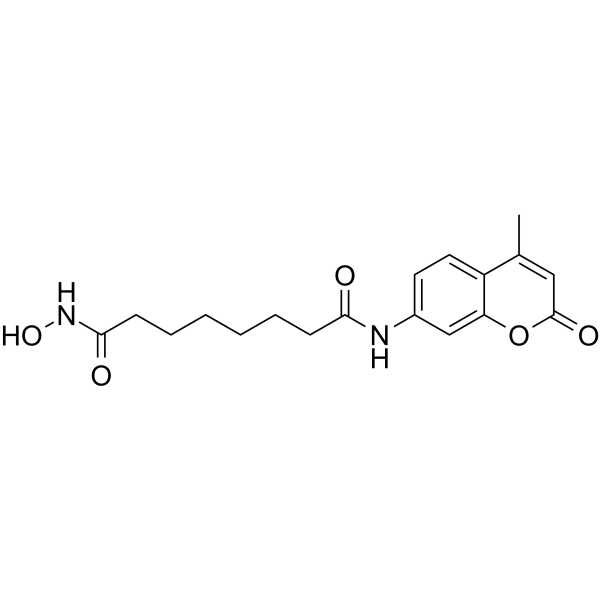
Coumarin-SAHA is a fluorescent probe for determining the binding affinities (kd) and the dissociation off-rates (koff) of the HDAC8-inhibitor complexes .
loading...
    loading...
Cat. No.: HY-161810
CAS No.: 2991693-72-0
Target:  

Adenosine Receptor

Research Areas:  

Others

MRS8247 is a positive allosteric modulator (PAM) of the A3 adenosine receptor (A3AR) that can also slow the dissociation rate of agonists .
loading...
    loading...
Cat. No.: HY-182423
CAS No.: 1310817-94-7
Target:  

Neurokinin Receptor

Research Areas:  

Neurological Disease

RO5328673 is an orally active, blood-brain barrier permeable neurokinin receptor antagonist that effectively targets human NK3 receptors (Ki=0.4 nM, Ka=0.1 nM), human NK2 receptors (Ki=1.1 nM, Ka=0.9 nM), and guinea pig NK3 receptors (Ka=0.1 nM and 0.13 nM). RO5328673 acts as an insurmountable antagonist of NK3 receptors with a slow dissociation rate, while it shows rapid association and dissociation rates at human NK2 receptors. RO5328673 potently inhibits senktide (HY-P0187)-induced enhancement of spontaneous activity in dopaminergic neurons and reverses senktide-induced changes in motor activity of gerbils. RO5328673 is widely applicable to research related to schizophrenia .
loading...
    loading...
Cat. No.: HY-P11770
CAS No.: 1352117-55-5
Target:  

Microtubule/Tubulin

Research Areas:  

Others

α-Tubulin (residues 440-451) (α-Tubulin Tail) is a Microtubule growth inhibitor. α-Tubulin (residues 440-451) transiently interacts with the longitudinal polymerization interface of α-tubulin, regulating the apparent association and dissociation rates of tubulin at the microtubule growing end. α-Tubulin (residues 440-451) inhibits microtubule growth .
loading...
    loading...
Cat. No.: HY-187811
Research Areas:  

Neurological Disease

MAO-B-IN-62 is a MAO-B inhibitor with an IC50 of 0.8 μM against MAO-B. MAO-B-IN-62 also acts as a PPARγ agonist with an EC50 of 14.6 μM. MAO-B-IN-62 binds to the active site of free MAO-B and activates PPARγ, both with a slow dissociation rate and sustained target-binding capacity. MAO-B-IN-62 exhibits antioxidant and anti-inflammatory activities. MAO-B-IN-62 can be used in the research of neurodegenerative diseases .
loading...
    loading...
Cat. No.: HY-187082
CAS No.: 587879-32-1
Target:  

Sodium Channel

Research Areas:  

Inflammation/Immunology

P552-02 is an epithelial sodium channel (ENaC) inhibitor. P552-02 blocks ENaC function in humans, guinea pigs, rats and sheep, exhibits the characteristic of reduced dissociation rate after binding to ENaC, inhibits ENaC-mediated short-circuit current, and slows the absorption of airway surface liquid (ASL). P552-02 induces hyperkalemia in guinea pigs and rats, blocks the activity of airway ENaC in guinea pigs, and enhances mucociliary clearance in sheep both in vivo and in vitro. P552-02 is applicable to cystic fibrosis-related research .
loading...
    loading...
Cat. No.: HY-W097223
CAS No.: 135-57-9
Target:  

PD-1/PD-L1

Research Areas:  

Infection

PD-1/PD-L1-IN-58 (compound 2) is a novel inhibitor of PD-1/PD-L1. PD-1/PD-L1-IN-58 selectively binds to PD-L1 over PD-1, with a dissociation rate constant (KD) value of 77.60  nM. PD-1/PD-L1-IN-58 has oral activity. PD-1/PD-L1-IN-58 can be used in the research of influenza A virus .
loading...
    loading...
Cat. No.: HY-182513
CAS No.: 459842-29-6
Research Areas:  

Others Inflammation/Immunology

ONO-8539 is an orally active prostanoid EP1 receptor antagonist with competitive, insurmountable binding and slow receptor dissociation for long-duration inhibition. ONO-8539 modulates afferent nerve function related to bladder activity, inhibits detrusor overactivity-related contractions, decreases nonvoiding contractions and voiding duration, and increases uroflow rate with ATP (HY-B2176)-induced detrusor overactivity. ONO-8539 attenuates acid-induced heartburn symptoms, extends time to first heartburn sensation, and prevents primary hypersensitivity after distal esophageal acidification. ONO-8539 can be used for the research of overactive bladder and gastroesophageal reflux disease .
loading...
    loading...
  • 1

