7 Results for "

human hepatocellular carcinoma cell lines

" in MedChemExpress (MCE) Product Catalog:
Products (7)

7 Results for "human hepatocellular carcinoma cell lines" in MCE Product Catalog:

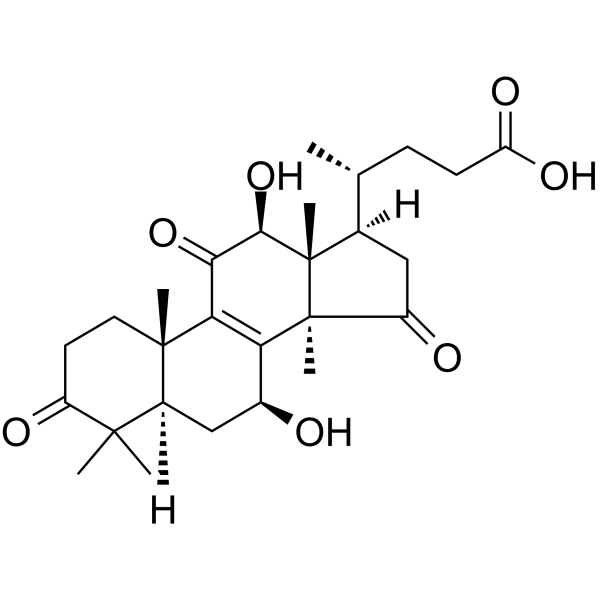
Cat. No.: HY-N6861
CAS No.: 95311-95-8
Lucidenic acid B is a triterpenoid compound. Lucidenic acid B inhibits the activities of ERK1/2, AP-1, NF-kB, and IKK, suppresses PMA (Phorbol 12-myristate 13-acetate) (HY-18739)-induced MMP-9 expression and cell invasion, and induces apoptosis in leukemia cells via the mitochondrial pathway. Lucidenic acid B inhibits the growth of various cancer cell lines without affecting normal lymphocytes and does not induce G1 phase arrest or necrosis. Lucidenic acid B can be used in research on hepatocellular carcinoma, human acute promyelocytic leukemia, and skin tumor promotion .
loading...
    loading...
Cat. No.: HY-122324
CAS No.: 482-20-2
Synonyms: (+)-(S)-Tylophorine; DCB-3500; NSC-717335
Tylophorine and its analogs are benzoindole alkaloids, most of which are derived from Garcinia plants. Tylophorine analogs all show potent growth inhibition against human hepatocellular carcinoma HepG2 and human nasopharyngeal carcinoma KB cell lines. Tylophorine analogs can also induce increased albumin expression and inhibit α-fetoprotein expression in HepG2 cells, and have the potential to induce HepG2 cell differentiation .
loading...
    loading...
Cat. No.: HY-175553
Target:  

VEGFR Apoptosis

Research Areas:  

Cancer

VEGFR-2-IN-72 is a selective VEGFR-2 inhibitor with an IC50 of 22.2 nM. VEGFR-2-IN-72 exhibits anticancer activity against HepG2 and Hep3B human HCC cell lines with IC50s of 15.7 and 2.4 μM. VEGFR-2-IN-72 can cause a mild blockage of the cell cycle and induce cell aopoptosis. VEGFR-2-IN-72 can used for the study of hepatocellular carcinoma (HCC) .
loading...
    loading...
Cat. No.: HY-182817
Research Areas:  

Cancer

Len-604 is a FGFR inhibitor with IC50 values of 9.71 nM, 9.93 nM, 29.80 nM and 14.48 nM against FGFR4, FGFR1, FGFR2 and FGFR3, respectively. Len-604 reduces the phosphorylation levels of FGFR4 and ERK, and induces DNA damage and apoptosis in cancer cells. Len-604 is applicable to research related to liver cancer .
loading...
    loading...
Cat. No.: HY-181947
Research Areas:  

Cancer

IDO1-IN-33 (Compound YC-16) is a IDO1 inhibitor (with an IC50 of 0.18 μM for IDO1 in HeLa cells). IDO1-IN-33 acts as an apo-IDO1 inhibitor by slowly and competitively displacing heme from mature holo-IDO1 and rapidly binding to the heme-binding site of immature apo-IDO1, without altering the expression level of IDO1. IDO1-IN-33 can be used for the research of hepatocellular carcinoma, non-small cell lung cancer, triple-negative breast cancer, and cervical cancer .
loading...
    loading...
Cat. No.: HY-N21516
CAS No.: 1207265-02-8
Trigonostemon F is a modified euphorbia diterpenoid, which is found in the roots of Trigonostemon thyrsoideum and the stems of Trigonostemon howii. Trigonostemon F inhibits the proliferation of human tumor cell lines and the growth of specific bacteria in vitro. Trigonostemon F is applicable to cancer-related research .
loading...
    loading...
Cat. No.: HY-181746
Research Areas:  

Cancer

Bcl-2/Mcl-1-IN-5 (Compound S6) is a Bcl-2 and Mcl-1 inhibitor. Bcl-2/Mcl-1-IN-5 promotes Apoptosis, downregulates anti-apoptotic proteins Bcl-2 and Mcl-1, induces mitochondrial membrane potential depolarization, and activates the Caspase-dependent apoptotic cascade, as evidenced by Caspase-3 activation and PARP1 cleavage. Bcl-2/Mcl-1-IN-5 has anti-hepatocellular carcinoma activity .
loading...
    loading...

