12 Results for "

profibrotic signaling

" in MedChemExpress (MCE) Product Catalog:
Products (12)

12 Results for "profibrotic signaling" in MCE Product Catalog:

7
7 Cited Publications
Cat. No.: HY-100113
CAS No.: 477775-14-7
Purity:  99.02%
Synonyms: AT2 receptor agonist C21
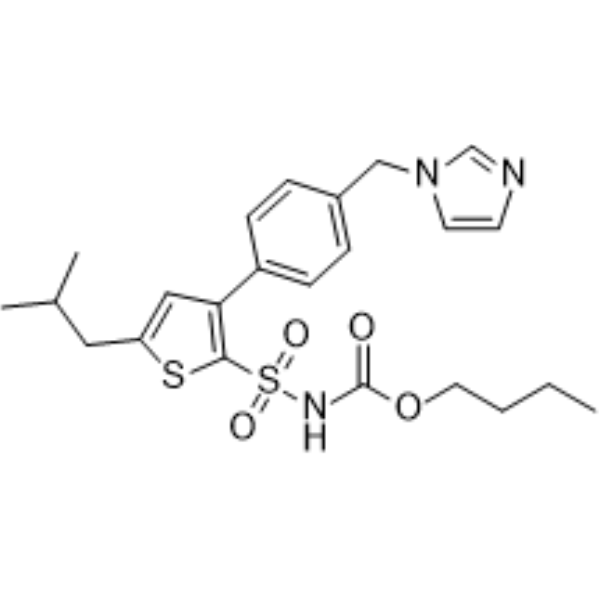
Buloxibutid (AT2 receptor agonist C21) is an orally active, selective angiotensin II type 2 receptor (AT2R) agonist, with a Ki value of 0.4 nM for porcine AT2R. Buloxibutid exerts effects such as vasodilation, anti-inflammation, anti-fibrosis (promoting the expression of collagenase MMP-13) and tissue repair mainly by activating the NO/cGMP pathway, inhibiting the pro-proliferative MAPK signaling, and suppressing the pro-fibrotic TGF-β/Smad pathway as well as the inflammatory NF-κB pathway. Buloxibutid can be used in research related to idiopathic pulmonary fibrosis, hypertension, and systemic sclerosis .
loading...
    loading...
Cat. No.: HY-168990
CAS No.: 2647949-48-0
Synonyms: AGMB-129
Ontunisertib (AGMB-129) is an orally active and selective gastrointestinal-restricted ALK5 (TGFβR1) inhibitor. Ontunisertib blocks signalling of the pro-fibrotic TGFβ pathway. Ontunisertib can be used for the research of fibrostenotic Crohn’s disease .
loading...
    loading...
Cat. No.: HY-P991267

Target:  

Interleukin Related

Research Areas:  

Inflammation/Immunology

CAN10 is is a humanized monoclonal antibody inhibitor targeting interleukin 1RAP (IL1RAP). CAN10 blocks IL-1, IL-33, and IL-36 signalling by targeting IL1RAP, preventing downstream proinflammatory and profibrotic responses. CAN10 reduces dermal and pulmonary fibrosis. CAN10 can be used for the research of immune system diseases, such as systemic sclerosis .
loading...
    loading...
Cat. No.: HY-P1636
CAS No.: 113274-56-9
Research Areas:  

Metabolic Disease

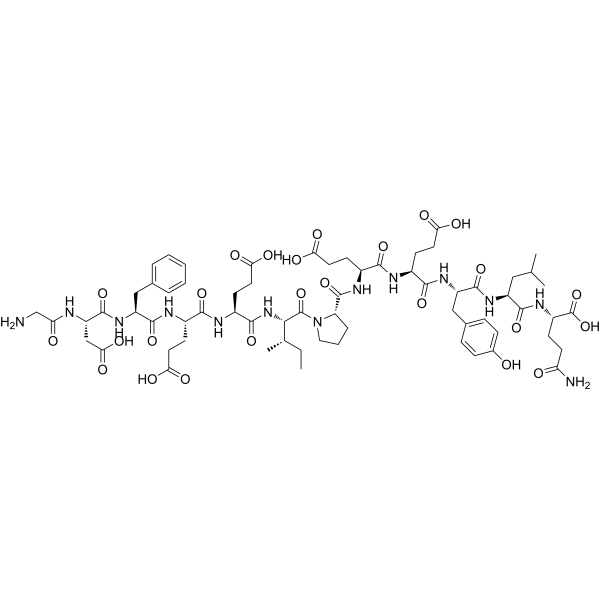
Hirudin (54-65) is a thrombin antagonist and YAP suppressor with anticoagulatory properties.Hirudin (54-65) blocks thrombin's anion binding site, acts on soluble and thrombus-bound thrombin.Hirudin (54-65) suppresses thrombin-induced profibrotic YAP activity, reduces YAP expression, nuclear translocation, and downstream effector signaling in vascular endothelial cells.Hirudin (54-65) ameliorates obstructive cholestasis, attenuates liver fibrosis symptoms, fibrosis-associated angiogenesis, and endothelial-to-mesenchymal transition.Hirudin (54-65) reduces liver inflammation and tissue hypoxia.Hirudin (54-65) promotes extracellular calcium influx through L-type calcium channels in canine coronary artery smooth muscle, mediates contraction.Hirudin (54-65) induces endothelium-independent contraction of canine coronary arterial segments; this response is not affected by indomethacin pretreatment.Hirudin (54-65) can be used for the research of liver obstructive cholestasis, liver fibrosis .
loading...
    loading...
Cat. No.: HY-N6928
CAS No.: 88901-37-5
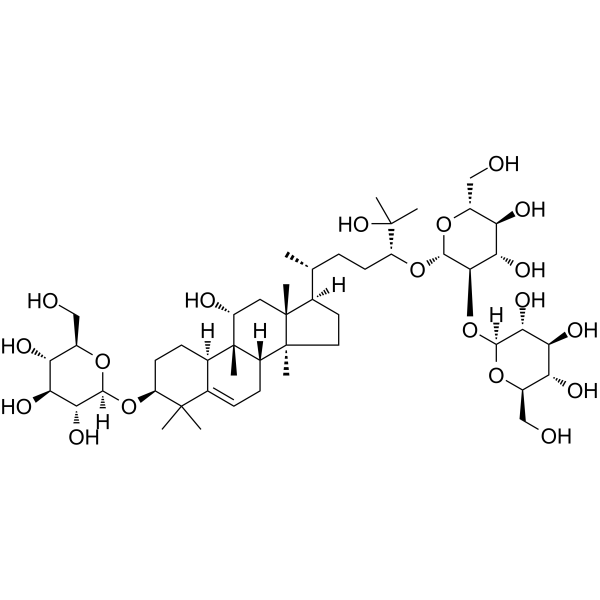
Mogroside III-E is a cucurbitane-type triterpenoid glycoside extracted from Siraitia grosvenorii, and it is an orally active TLR4 inhibitor. Mogroside III-E downregulates the expression of TLR4 and MyD88, and blocks the phosphorylation of downstream ERK, JNK and p38 MAPK molecules; meanwhile, it inhibits TGF-β- or LPS-mediated transdifferentiation of primary pulmonary fibroblasts into myofibroblasts, reduces the content of fibrosis markers such as hydroxyproline, suppresses the pro-fibrotic TGF-β/Smad signaling pathway, and downregulates the levels of inflammatory factors MPO and IL-1β. Mogroside III-E alleviates Bleomycin (HY-108345)-induced pulmonary collagen deposition and inflammatory infiltration in mice. Mogroside III-E can be used in studies related to idiopathic pulmonary fibrosis .
loading...
    loading...
Cat. No.: HY-120409
CAS No.: 1463912-49-3
Target:  

LPL Receptor Apoptosis

Research Areas:  

Cancer

AB1 is a highly selective S1P2 receptor antagonist (IC50=3.5 nM). AB1 inhibits sphingosine-1-phosphate (S1P) signaling, suppressing tumor cell migration, angiogenesis, and profibrotic mediator CTGF expression while inducing apoptosis. AB1 is promising for research of solid tumors .
loading...
    loading...
Cat. No.: HY-179410
Target:  

Galectin

Research Areas:  

Others

Galectin-3-IN-7 is a selective Galectin-3 inhibitor with a Kd of 5.7 nM and shows 390-fold selectivity over Gal-1. Galectin-3-IN-7 can downregulate profibrotic signaling such as ACTA2, COL1A2, and FN1 in TGFβ-stimulated LX2 hepatic stellate cells. Galectin-3-IN-7 can be used for the research of fibrosis .
loading...
    loading...
Cat. No.: HY-189141
Research Areas:  

Endocrinology

HIPK2-IN-2 is an orally active and selective HIPK2 inhibitor with an IC50 of 0.36 μM against HIPK2. HIPK2-IN-2 reduces HIPK2 protein expression levels. HIPK2-IN-2 inhibits the proliferation and migration of renal interstitial fibroblasts, alleviates renal tubular injury and collagen deposition, and suppresses TGF-β/Smad3-mediated profibrotic signaling pathways as well as TNF-α/NF-κB-mediated inflammatory signaling pathways in renal cells. HIPK2-IN-2 is used for the study of chronic kidney disease-associated renal fibrosis .
loading...
    loading...
Cat. No.: HY-185926
CAS No.: 2364414-05-9
Synonyms: NOX-D21; AON-D21
Ldalaptican pegol (AON-D21; NOX-D21) is a PEGylated mixed RNA/DNA L-aptamer that specifically binds to complement C5a. Ldalaptican pegol binds to C5a and the C5a moiety on uncleaved C5, thereby blocking C5a signaling. This inhibition suppresses downstream inflammatory responses, immune cell infiltration and chemotaxis, the release of pro-fibrotic factors, and abnormalities in lipid metabolism signaling pathways. Ldalaptican pegol can also alleviate allograft rejection. Ldalaptican pegol can be used in research on inflammatory muscle diseases, Duchenne muscular dystrophy (DMD), diabetes, renal fibrosis, and allograft organ transplant rejection .
loading...
    loading...
Cat. No.: HY-100113A
CAS No.: 1947313-60-1
Synonyms: AT2 receptor agonist C21 hydrochloride
Buloxibutid (AT2 receptor agonist C21) hydrochloride is an orally active, selective angiotensin II type 2 receptor (AT2R) agonist, with a Ki value of 0.4 nM for porcine AT2R. Buloxibutid hydrochloride exerts vasodilatory, anti-inflammatory, antifibrotic (promoting the expression of collagenase MMP-13) and tissue repair effects mainly by activating the NO/cGMP pathway, inhibiting the pro-proliferative MAPK signaling, and suppressing the pro-fibrotic TGF-β/Smad pathway and inflammatory NF-κB pathway. Buloxibutid hydrochloride can be used in research related to idiopathic pulmonary fibrosis, hypertension, systemic sclerosis and other conditions .
loading...
    loading...
Cat. No.: HY-100113R
CAS No.: 477775-14-7
Synonyms: AT2 receptor agonist C21 (Standard)
Buloxibutid (AT2 receptor agonist C21) (Standard) is the analytical standard of Buloxibutid (HY-100113). This product is intended for research and analytical applications. Buloxibutid is an orally active, selective angiotensin II type 2 receptor (AT2R) agonist, with a Ki value of 0.4 nM for porcine AT2R. Buloxibutid exerts effects such as vasodilation, anti-inflammation, anti-fibrosis (promoting the expression of collagenase MMP-13) and tissue repair mainly by activating the NO/cGMP pathway, inhibiting the pro-proliferative MAPK signaling, and suppressing the pro-fibrotic TGF-β/Smad pathway as well as the inflammatory NF-κB pathway. Buloxibutid can be used in research related to idiopathic pulmonary fibrosis, hypertension, and systemic sclerosis.
loading...
    loading...
Cat. No.: HY-181556
CAS No.: 3085181-00-3
Target:  

JNK TGF-beta/Smad Cadherin

Research Areas:  

Inflammation/Immunology

JNK3-IN-10 is a blood-brain barrier-impermeable JNK3 inhibitor (IC50=0.257 nM) with over 400-fold selectivity over JNK1. JNK3-IN-10 blocks the JNK3-mediated signaling pathway downstream of TGF-β1, inhibits TGF-β1-induced phosphorylation of c-Jun, reduces the expression of pro-fibrotic markers, and restores the expression of the epithelial protein E-cadherin. JNK3-IN-10 exhibits low cytotoxicity, anti-fibrotic, cytoprotective and renoprotective effects, and alleviates albuminuria, glomerulosclerosis and podocyte foot process fusion. JNK3-IN-10 can be used for the research of chronic kidney disease, glomerulosclerosis and adriamycin-induced nephropathy .
loading...
    loading...
  • 1

