
14 Results for "

renewable

" in MedChemExpress (MCE) Product Catalog:
Products (14)

14 Results for "renewable" in MCE Product Catalog:

1
1 Cited Publications
Cat. No.: HY-111830
CAS No.: 9005-53-2
Synonyms: Lignine
Lignin (Lignine) is a natural complex biopolymer with biodegradable and biocompatible. Lignin is the main component of plant cell walls and is a renewable aromatic polymer. Lignin has strongly antioxidant activity .
loading...
    loading...
1
1 Cited Publications
Cat. No.: HY-B2221
CAS No.: 9004-34-6
Synonyms: Pectin glycosidase
Cellulose (Pectin glycosidase) is a natural high molecular weight polysaccharide found in many plants and organisms. It is widely used in manufacturing industries, such as in paper making, textiles, food and medicine, etc. As a renewable resource, Cellulose is biodegradable and sustainable, and can also be used to manufacture chemicals such as Cellulose Esters, Cellulose Acetate and Cellulose Nitrate. In addition, Cellulose is often used as a food additive to increase the stability and quality of food.
loading...
    loading...
Cat. No.: HY-W015924
CAS No.: 594-61-6
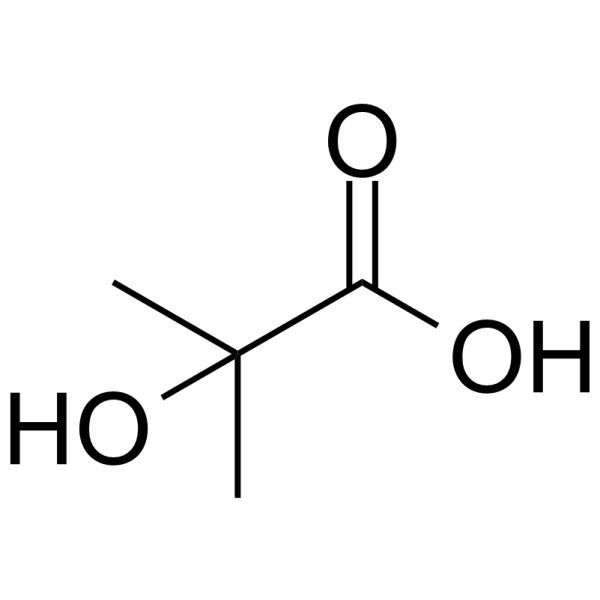
2-Hydroxyisobutyric acid (2-HIBA) is a selective modulator of the Insulin/IGF-1 pathway and the p38 MAPK pathway, which reduces reactive oxygen species (ROS) and fat accumulation in Caenorhabditis elegans. 2-Hydroxyisobutyric acid promotes β-oxidation and inhibits fatty acid synthesis by upregulating SKN-1/NRF2 and downregulating SREBP-1c transcription factors. 2-Hydroxyisobutyric acid has anti-aging and lipid-lowering effects, and can be used to study metabolic diseases such as obesity and diabetes. 2-Hydroxyisobutyric acid is also a renewable precursor of methacrylate through 2-HIB-CoA mutase-mediated biosynthesis[1][2].
loading...
    loading...
Cat. No.: HY-W250170
CAS No.: 68515-73-1
Synonyms: Octyldecyl glucoside
Decyl glucoside is a mild nonionic surfactant. Decyl glucoside can be derived from renewable raw materials such as glucose and fatty alcohols from coconut oil or palm kernel oil. Decyl glucoside is known for its excellent foaming and cleaning properties.
loading...
    loading...
Cat. No.: HY-W015924R
CAS No.: 594-61-6
2-Hydroxyisobutyric acid (Standard) is the analytical standard of 2-Hydroxyisobutyric acid. This product is intended for research and analytical applications. 2-Hydroxyisobutyric acid (2-HIBA) is a selective modulator of the Insulin/IGF-1 pathway and the p38 MAPK pathway, which reduces reactive oxygen species (ROS) and fat accumulation in Caenorhabditis elegans. 2-Hydroxyisobutyric acid promotes β-oxidation and inhibits fatty acid synthesis by upregulating SKN-1/NRF2 and downregulating SREBP-1c transcription factors. 2-Hydroxyisobutyric acid has anti-aging and lipid-lowering effects, and can be used to study metabolic diseases such as obesity and diabetes. 2-Hydroxyisobutyric acid is also a renewable precursor of methacrylate through 2-HIB-CoA mutase-mediated biosynthesis[1][2].
loading...
    loading...
Cat. No.: HY-W033823
CAS No.: 12036-35-0
Rhodium(III) oxide is an inorganic compound with catalytic activity. Rhodium(III) oxide can be used as an efficient catalyst in catalytic reactions and is often used to promote chemical reactions. Rhodium(III) oxide is also widely used in energy materials, especially in fuel cells and other renewable energy technologies. Rhodium(III) oxide is studied in the field of materials science for the development of new functional materials.
loading...
    loading...
Cat. No.: HY-B2221S1
U- 13C Cellulose from chicory is the 13C labeled Cellulose (HY-B2221). Cellulose (Pectin glycosidase) is a natural high molecular weight polysaccharide found in many plants and organisms. It is widely used in manufacturing industries, such as in paper making, textiles, food and medicine, etc. As a renewable resource, Cellulose is biodegradable and sustainable, and can also be used to manufacture chemicals such as Cellulose Esters, Cellulose Acetate and Cellulose Nitrate. In addition, Cellulose is often used as a food additive to increase the stability and quality of food .
loading...
    loading...
Cat. No.: HY-W111881
CAS No.: 623-15-4
Research Areas:  

Others

Furfurylideneacetone is a furfural-acetone compound and can be used as active diluent for epoxy resins fabrication .
loading...
    loading...
Cat. No.: HY-B2221S
U- 13C Cellulose high DP from potato is the 13C labeled Cellulose (HY-B2221). Cellulose (Pectin glycosidase) is a natural high molecular weight polysaccharide found in many plants and organisms. It is widely used in manufacturing industries, such as in paper making, textiles, food and medicine, etc. As a renewable resource, Cellulose is biodegradable and sustainable, and can also be used to manufacture chemicals such as Cellulose Esters, Cellulose Acetate and Cellulose Nitrate. In addition, Cellulose is often used as a food additive to increase the stability and quality of food .
loading...
    loading...
Cat. No.: HY-B2221S5
U- 13C Cellulose from broccoli is the 13C labeled Cellulose (HY-B2221). Cellulose is a natural high molecular weight polysaccharide found in many plants and organisms. It is widely used in manufacturing industries, such as in paper making, textiles, food and medicine, etc. As a renewable resource, Cellulose is biodegradable and sustainable, and can also be used to manufacture chemicals such as Cellulose Esters, Cellulose Acetate and Cellulose Nitrate. In addition, Cellulose is often used as a food additive to increase the stability and quality of food .
loading...
    loading...
Cat. No.: HY-B2221S3
U- 13C Cellulose high DP from maize is the 13C labeled Cellulose (HY-B2221). Cellulose (Pectin glycosidase) is a natural high molecular weight polysaccharide found in many plants and organisms. It is widely used in manufacturing industries, such as in paper making, textiles, food and medicine, etc. As a renewable resource, Cellulose is biodegradable and sustainable, and can also be used to manufacture chemicals such as Cellulose Esters, Cellulose Acetate and Cellulose Nitrate. In addition, Cellulose is often used as a food additive to increase the stability and quality of food .
loading...
    loading...
Cat. No.: HY-P1032S
CAS No.: 2226467-14-5
Research Areas:  

Others

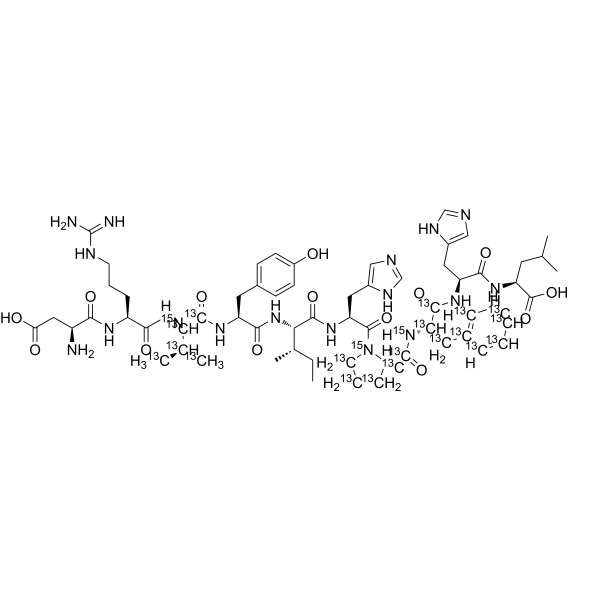
Angiotensin I- 13C19, 15N3 (human, mouse, rat) is the 13C and 15N labeled Angiotensin I (human, mouse, rat) (HY-P1032). Cellulose (Pectin glycosidase) is a natural high molecular weight polysaccharide found in many plants and organisms. It is widely used in manufacturing industries, such as in paper making, textiles, food and medicine, etc. As a renewable resource, Cellulose is biodegradable and sustainable, and can also be used to manufacture chemicals such as Cellulose Esters, Cellulose Acetate and Cellulose Nitrate. In addition, Cellulose is often used as a food additive to increase the stability and quality of food .
loading...
    loading...
Cat. No.: HY-D3179
CAS No.: 1451048-96-6
CDg13 is a fluorescent probe that specifically detects living neural stem/progenitor cells. CDg13 localizes to the endoplasmic reticulum via its dihexyl moiety, with no interaction with endoplasmic reticulum biomolecules. CDg13 undergoes selective efflux by active ABCG2 transporters, with increased intracellular accumulation following ABCG2 inhibition or knockdown. CDg13 isolates and enriches self-renewable neural stem/progenitor cells from embryonic mouse brain tissue, stains neural stem/progenitor cells brightly, and sorts ABCG2low cell populations from heterogeneous populations . (Ex/Em = 520/553 nm)
loading...
    loading...
Cat. No.: HY-W133968
CAS No.: 9003-04-7
Research Areas:  

Others

Polyacrylate sodium is a sodium polyacrylate salt with extremely strong hygroscopicity. Polyacrylate sodium serves as a gel excipient and can be used as a pharmaceutical excipient. Polyacrylate sodium can reduce permeability by modifying bentonite to form a cavity-containing microstructure, while improving the chemical resistance, cation exchange capacity, and free swelling index of bentonite. Polyacrylate sodium can enhance the water retention capacity, available water content, and top-layer water content of sandy soil, while reducing the saturated hydraulic conductivity, wetting front advance rate, and infiltration rate. Polyacrylate sodium can chelate Cu 2+ ions in aqueous solutions and has renewable adsorption capacity. Polyacrylate sodium is widely used in researches related to various fields such as consumer products, agriculture, and industry .
loading...
    loading...
  • 1

