
16 Results for "

surface recognition

" in MedChemExpress (MCE) Product Catalog:
Products (16)

16 Results for "surface recognition" in MCE Product Catalog:

1
1 Cited Publications
Cat. No.: HY-P3443
Synonyms: PNA
Peanut agglutinin (PNA) is a carbohydrate-recognition protein that binds competitively and irreversibly to cell-surface β-D-Gal (1-3)-GalNAc, and this binding can be inhibited by D-galactose and asialofetuin. Peanut agglutinin recognizes exposed glycoepitopes and reflects the glycosylation status of cells. Peanut agglutinin can label glycoconjugates at neuromuscular junctions to safely visualize synaptic structures. Peanut agglutinin can be used to synthesize dyes to distinguish between normal and tumor tissues. Peanut agglutinin provides support for research on leukemia, Burkitt's tumors, and cutaneous squamous lesions .
loading...
    loading...
Cat. No.: HY-N2427
CAS No.: 281-23-2
Adamantane is a polycyclic cage molecule with high symmetry and remarkable properties. Adamantane can be incorporated into a lipophilic part of the lipid bilayer that constitutes membranes and as an anchor in the lipid bilayer of liposomes. Adamantane can be studied in pharmacological research to improve the lipophilicity and pharmacological properties of other active products .
loading...
    loading...
Cat. No.: HY-160052
Target:  

Interleukin Related

Research Areas:  

Inflammation/Immunology Cancer

IL-6 aptamer sodium is an aptamer that specifically binds to IL-6, and can serve as a biological recognition receptor for high-sensitivity detection. IL-6 aptamer sodium enables label-free specific detection through changes in electrical signals of carbon nanotube microarrays or alterations in capacitive impedance on the surface of gold sensors. IL-6 aptamer sodium still maintains high selectivity even below the gray zone threshold for cancer diagnosis, and shows no significant non-specific binding to bovine serum albumin. IL-6 aptamer sodium can form an ordered self-assembled monolayer with 6-mercapto-1-hexanol on gold surfaces, making it suitable for reagent-free capacitive impedance biosensing platforms. IL-6 aptamer sodium is widely used in research related to fields such as cancer, inflammatory diseases, myeloma, liver cancer and glioma .
loading...
    loading...
Cat. No.: HY-N2427S
CAS No.: 30470-60-1
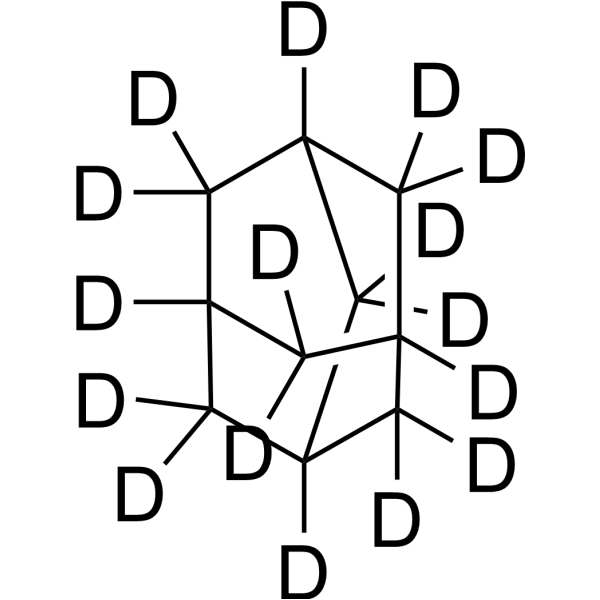
Adamantane-d16is the deuterium labeled Adamantane (HY-N2427). Adamantane, a polycyclic cage molecule with high symmetry and remarkable properties. Adamantane can be incorporated into a lipophilic part of the lipid bilayer that constitutes membranes and as an anchor in the lipid bilayer of liposomes. Adamantane can be used in research of surface recognition and drug delivery .
loading...
    loading...
Cat. No.: HY-W145682
CAS No.: 16741-18-7
Synonyms: Blood Group H
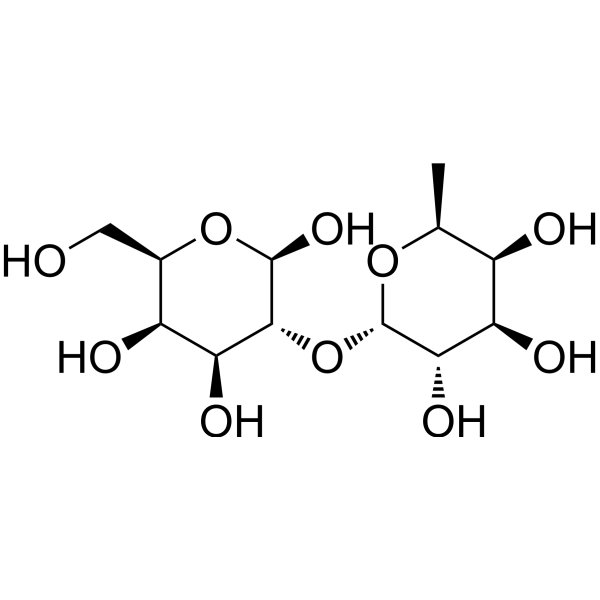
Blood group H carbohydrate is a carbohydrate containing two monosaccharides, fucose and galactose, linked by α1-2 glycosidic bonds. It is the precursor of ABO blood group antigens, which are present on the surface of red blood cells and play a role in immune recognition and transfusion compatibility. Type H disaccharides have diverse applications in biochemical research, especially in the study of carbohydrate-protein interactions and the biosynthesis of blood group antigens. In addition, it can be used as a diagnostic tool to identify ABO blood group phenotypes.
loading...
    loading...
Cat. No.: HY-P11023
Target:  

Peptides

E16-uPA24 is a chimeric peptide targeting urokinase-type plasminogen activator receptor (uPAR). E16-uPA24 modifies senescent cells surface with polyglutamic acid, promoting immune cell-mediated responses through glutamate recognition. E16-uPA24 induces immune clearance of senescent cells and restores tissue homeostasis by enhancing immune cells recruitment and directly coupling senescent cells and immune cells. E16-uPA24 can be used for tissue degeneration, chronic inflammatory disease and age-related tumorigenesis research .
loading...
    loading...
Cat. No.: HY-P1758
CAS No.: 153840-64-3
Synonyms: IRRP1
Target:  

IFNAR STAT Influenza Virus

Research Areas:  

Infection

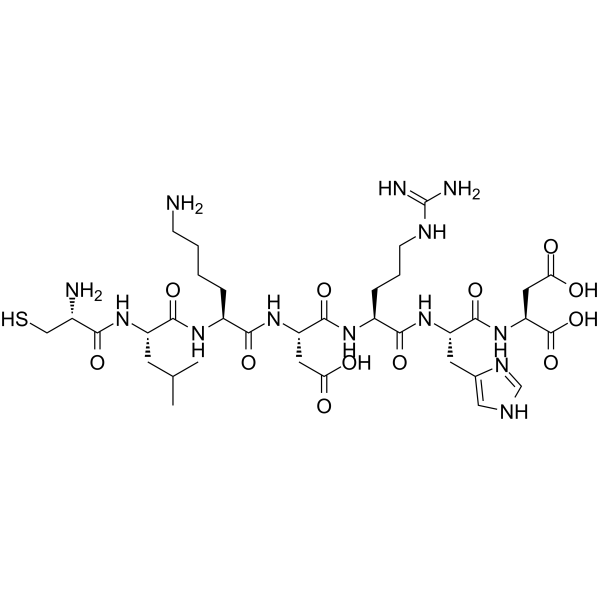
IFN-α Receptor Recognition Peptide 1 (IRRP1) is an amino acid synthetic peptide and also a regulator of IFN-α Receptor. IFN-α Receptor Recognition Peptide 1 binds to IFNAR2, enhances the binding capacity of IFN-α receptor, and slightly increases the IFN-α-induced growth inhibitory activity. IFN-α Receptor Recognition Peptide 1 inhibits IFN-α-induced STAT1 phosphorylation and STAT-DNA binding by blocking the activation of IFNAR by IFN-α. IFN-α Receptor Recognition Peptide 1 increases the occupancy of IFN-α on cell surface receptors, enhances the phosphorylation activation of ISGF3, and elevates IFN-α-induced antiviral activity. IFN-α Receptor Recognition Peptide 1 can be used in studies related to encephalomyocarditis virus infection .
loading...
    loading...
sgc8c aptamer sodium
0 Images
DNA, 5'-ATCTAACTGCTGCGCCGCCGGGAAAATACTGTACGGTTAGA-3', sodium salt
Cat. No.: HY-160065
sgc8c aptamer sodium is an aptamer that specifically targets the human protein tyrosine kinase PTK-7, which is mainly expressed on cervical cancer HeLa cells. sgc8c aptamer sodium can precisely bring the nanotags connected to it to the surface of cells expressing PTK-7, thus achieving specific recognition and labeling of target cells .
loading...
    loading...
Cat. No.: HY-N2427R
CAS No.: 281-23-2
Adamantane (Standard) is the analytical standard of Adamantane. This product is intended for research and analytical applications. Adamantane, a polycyclic cage molecule with high symmetry and remarkable properties. Adamantane can be incorporated into a lipophilic part of the lipid bilayer that constitutes membranes and as an anchor in the lipid bilayer of liposomes. Adamantane can be used in research of surface recognition and drug delivery .
loading...
    loading...
Cat. No.: HY-P1758A
Synonyms: IRRP1 acetate
Target:  

IFNAR STAT Influenza Virus

Research Areas:  

Infection

IFN-α Receptor Recognition Peptide 1 acetate (IRRP1 acetate) is an amino acid synthetic peptide and also a regulator of IFN-α Receptor. IFN-α Receptor Recognition Peptide 1 acetate binds to IFNAR2, enhances the binding capacity of IFN-α receptor, and slightly increases the IFN-α-induced growth inhibitory activity. IFN-α Receptor Recognition Peptide 1 acetate inhibits IFN-α-induced STAT1 phosphorylation and STAT-DNA binding by blocking the activation of IFNAR by IFN-α. IFN-α Receptor Recognition Peptide 1 acetate increases the occupancy of IFN-α on cell surface receptors, enhances the phosphorylation activation of ISGF3, and elevates IFN-α-induced antiviral activity. IFN-α Receptor Recognition Peptide 1 acetate can be used in studies related to encephalomyocarditis virus infection .
loading...
    loading...
Cat. No.: HY-182097
DSPE-PEG1000-GNYTCEVTELTREGETIIELK is a PEG compound which composed of DSPE and a peptide mimicking the function of CD47 (GNYTCEVTELTREGETIIELK). Modifying the surface of LNPs with GNYTCEVTELTREGETIIELK significantly reduced the recognition and clearance of LNPs by the mononuclear phagocytic system (MPS), and decreased their accumulation in non-target tissues such as the liver and spleen. DSPE-PEG1000-GNYTCEVTELTREGETIIELK can be used for drug delivery .
loading...
    loading...
Cat. No.: HY-182097A
DSPE-PEG3400-GNYTCEVTELTREGETIIELK is a PEG compound which composed of DSPE and a peptide mimicking the function of CD47 (GNYTCEVTELTREGETIIELK). Modifying the surface of LNPs with GNYTCEVTELTREGETIIELK significantly reduced the recognition and clearance of LNPs by the mononuclear phagocytic system (MPS), and decreased their accumulation in non-target tissues such as the liver and spleen. DSPE-PEG3400-GNYTCEVTELTREGETIIELK can be used for drug delivery .
loading...
    loading...
Cat. No.: HY-182097B
DSPE-PEG5000-GNYTCEVTELTREGETIIELK is a PEG compound which composed of DSPE and a peptide mimicking the function of CD47 (GNYTCEVTELTREGETIIELK). Modifying the surface of LNPs with GNYTCEVTELTREGETIIELK significantly reduced the recognition and clearance of LNPs by the mononuclear phagocytic system (MPS), and decreased their accumulation in non-target tissues such as the liver and spleen. DSPE-PEG5000-GNYTCEVTELTREGETIIELK can be used for drug delivery .
loading...
    loading...
Cat. No.: HY-D2930
Synonyms: SNAP-SS-SulfoCy5
BG-SS-SulfoCy5 (SNAP-SS-SulfoCy5) is a SulfoCy5-labeled SNAP tag fluorescent probe, linked by a disulfide bond. BG-SS-SulfoCy5 combines the specific recognition of SNAP-tag, the cleavability of disulfide bond, and the excellent optical properties of SulfoCy5. BG-SS-SulfoCy5 can be used for tracking the internalization of cell surface proteins and multiple labeling experiments .
loading...
    loading...
Cat. No.: HY-L150
6,915 compounds

Membrane receptors, also known cell surface receptors or transmembrane receptors, are transmembrane proteins embedded into the plasma membrane which play an essential role in maintaining communication between the internal processes within the cell and various types of extracellular signals. They act in cell signaling by receiving (binding to) extracellular molecules, which are also called ligands. These extracellular molecules include hormones, cytokines, growth factors, neurotransmitters, lipophilic signaling molecules such as prostaglandins, and cell recognition molecules.

There are three kinds of membrane receptors: ion channel-linked receptors, enzyme-linked receptors and G-protein-linked receptors. They play important roles in keeping human normal physiologic processes. GPCRs and ion channels are important drug targets in drug discovery.

MCE provides a unique collection of 6,915 compounds targeting a variety of membrane receptors. MCE Membrane reeptor-targeted Compound Library can be used for membrane receptor-focused screening and drug discovery.

Cat. No.: HY-P992159
Anti-ZnT8 Antibody (mAb43) is a monoclonal antibody targeting the zinc transporter ZnT8, with islet-specific biodistribution characteristics. Anti-ZnT8 Antibody (mAb43) binds to extracellular ZnT8 on the surface of pancreatic β-cells and masks its insulin-co-localizing sites to block autoimmune recognition. Anti-ZnT8 Antibody (mAb43) also promotes an increase in the proportion of regulatory T cells and inhibits B cell antigen presentation, thereby effectively blocking the T cell-mediated cascade of β-cell destruction. Anti-ZnT8 Antibody (mAb43) eliminates insulitis, preserves β-cell mass and induces seroconversion of autoantibodies, without directly altering the insulin secretion function or content of β-cells. Anti-ZnT8 Antibody (mAb43) can be used for research related to type 1 diabetes .
loading...
    loading...
  • 1

