



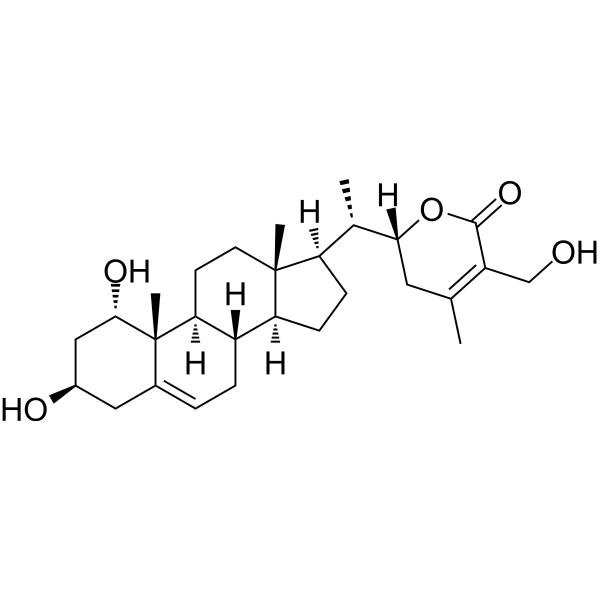
Sominone

Based on 1 Customer Validation
Sominone is the active metabolite of Withanoside IV (HY-N8693). Sominone enhances neuronal morphological plasticity by activating the RET pathway. Sominone can also induce axon/dendrite regeneration and synaptic reconstruction, thereby improving spatial memory. Sominone can be used in the research of neurodegenerative diseases such as Alzheimer's disease.
For research use only. We do not sell to patients.
- Purity : 99.96%
- CAS No.: 98569-64-3
- Formula: C28H42O5
- Molecular Weight:458.63
-
Storage:
-20°C, protect from light
* In solvent : -80°C, 6 months; -20°C, 1 month (protect from light)

To place orders, for customer services and technical support, please contact: MedChemExpress USA
Tel: 609-228-6898 E-mail: [email protected] [email protected]


-
 Biological Activity
-
Chemical Information
-
Solvent & Solubility
- Protocols
- Purity & Documentation
- References
-
 Help & FAQs




Biological Activity
Description
Cellular Effect
|
Cell Line

|
Type | Value | Description | References |
|---|---|---|---|---|
| NCI-H929 | IC50 |
4.96 μM
Compound: 13
|
Cytotoxicity against human NCI-H929 cells after 3 days by Alamar blue assay
Cytotoxicity against human NCI-H929 cells after 3 days by Alamar blue assay
|
[PMID: 24625088] |
In Vitro
Sominone (1 μM; 4-7 days) promotes axon and dendrite regeneration and synaptic reconstruction in β-Amyloid (25-35) (HY-P0128)-treated rat cortical neurons[1].
MedChemExpress (MCE) has not independently confirmed the accuracy of these methods. They are for reference only.
In Vivo
Sominone (10 μmol/kg; intraperitoneal injection; 9 days) has improvement effects in the AD model mice 5XFAD[3].
MedChemExpress (MCE) has not independently confirmed the accuracy of these methods. They are for reference only.
-
Animal Model:APP/PS1 doubly transgenic mice (5XFAD mice, Tg6799 line)[3
-
Dosage:10 μmol/kg
-
Administration:Intraperitoneal injection (i.p.); 9 days
-
Result:Significantly improved object recognition memory.
Significantly enhanced axonal densities in the frontal cortex and parietal cortex.
Had no effects on amyloid plaque number and activated microglia.


Chemical Information
-
CAS No. 98569-64-3
-
Appearance Solid
-
Molecular Weight 458.63
-
Formula C28H42O5
-
Color White to off-white
-
SMILES
C[C@@]12[C@]3([H])[C@](CC=C1C[C@H](C[C@@H]2O)O)([H])[C@@]4([H])[C@](CC3)([C@@](CC4)([H])[C@@H]([C@@]5([H])CC(C)=C(C(O5)=O)CO)C)C
-
Structure Classification
-
Initial Source
-
Shipping
Room temperature in continental US; may vary elsewhere.
-
Storage
-20°C, protect from light
* In solvent : -80°C, 6 months; -20°C, 1 month (protect from light)


Solvent & Solubility
In Vitro:
DMSO : 50 mg/mL (109.02 mM; Need ultrasonic; Hygroscopic DMSO has a significant impact on the solubility of product, please use newly opened DMSO)
Please refer to the solubility information to select the appropriate solvent. Once prepared, please aliquot and store the solution to prevent product inactivation from repeated freeze-thaw cycles.
Storage method and period of stock solution: -80°C, 6 months; -20°C, 1 month (protect from light). When stored at -80°C, please use it within 6 months. When stored at -20°C, please use it within 1 month.
Please refer to the solubility information to select the appropriate solvent. Once prepared, please aliquot and store the solution to prevent product inactivation from repeated freeze-thaw cycles.
Storage method and period of stock solution: -80°C, 6 months; -20°C, 1 month (protect from light). When stored at -80°C, please use it within 6 months. When stored at -20°C, please use it within 1 month.
Concentration (start) × Volume (start) = Concentration (final) × Volume (final)
In Vivo:
Select the appropriate dissolution method based on your experimental animal and administration route.
- For the following dissolution methods, please ensure to first prepare a clear stock solution using an In Vitro approach and then sequentially add co-solvents:
- To ensure reliable experimental results, the clarified stock solution can be appropriately stored based on storage conditions. As for the working solution for In Vivo experiments, it is recommended to prepare freshly and use it on the same day.
- The percentages shown for the solvents indicate their volumetric ratio in the final prepared solution. If precipitation or phase separation occurs during preparation, heat and/or sonication can be used to aid dissolution.
Add each solvent one by one: 10% DMSO 40% PEG300 5% Tween-80 45% Saline
Solubility: ≥ 1.25 mg/mL (2.73 mM); Clear solution
This protocol yields a clear solution of ≥ 1.25 mg/mL (saturation unknown).
Taking 1 mL working solution as an example, add 100 μL DMSO stock solution (12.5 mg/mL) to 400 μL PEG300, and mix evenly; then add 50 μL Tween-80 and mix evenly; then add 450 μL Saline to adjust the volume to 1 mL.
Preparation of Saline: Dissolve 0.9 g sodium chloride in ddH₂O and dilute to 100 mL to obtain a clear Saline solution.
Add each solvent one by one: 10% DMSO 90% (20% SBE-β-CD in Saline)
Solubility: ≥ 1.25 mg/mL (2.73 mM); Clear solution
This protocol yields a clear solution of ≥ 1.25 mg/mL (saturation unknown).
Taking 1 mL working solution as an example, add 100 μL DMSO stock solution (12.5 mg/mL) to 900 μL 20% SBE-β-CD in Saline, and mix evenly.
Preparation of 20% SBE-β-CD in Saline (4°C, storage for one week): 2 g SBE-β-CD powder is dissolved in 10 mL Saline, completely dissolve until clear.
In Vivo Dissolution Calculator
Please enter the basic information of animal experiments:
-
-
-
-
Recommended: Prepare an additional quantity of animals to account for potential losses during experiments.
Please enter your animal formula composition:
-
%DMSO +
Recommended: Keep the proportion of DMSO in working solution below 2% if your animal is weak.
-
%+
-
+%Tween-80 + +
-
%Saline +
The co-solvents required include: DMSO, . All of co-solvents are available by MedChemExpress (MCE). , Tween 80. All of co-solvents are available by MedChemExpress (MCE).
Working solution concentration: 0.22 mg/mL
Method for preparing stock solution: mg drug dissolved in μL DMSO. Stock solution concentration: mg/mL. * In solvent : -80°C, 6 months; -20°C, 1 month (protect from light)
1. Take μL DMSO stock solution;
2. Add μL .
μL , mix evenly;
3. Then add μL Tween 80, mix evenly;
4. Then add μL
Please ensure that the stock solution in the first step is dissolved to a clear state, and add co-solvents in sequence. You can use ultrasonic heating (ultrasonic cleaner, recommended frequency 20-40 kHz), vortexing, etc. to assist dissolution.


Purity & Documentation
-
Data Sheet (275 KB)
-
SDS (251 KB)
- English - EN (251 KB)
- Français - FR (251 KB)
- Deutsch - DE (251 KB)
- Norwegian - NO (251 KB)
- Español - ES (251 KB)
- Swedish - SV (251 KB)
- Italian - IT (251 KB)
- Korean - KR (251 KB)
- Portuguese - PT (251 KB)
-
Handling Instructions (2659 KB)
References
[1]. Kuboyama T, et al. Withanoside IV and its active metabolite, sominone, attenuate Abeta(25-35)-induced neurodegeneration. Eur J Neurosci. 2006 Mar;23(6):1417-26. [Content Brief]
[2]. Tohda C, et al. Sominone enhances neurite outgrowth and spatial memory mediated by the neurotrophic factor receptor, RET. Br J Pharmacol. 2009 Aug;157(8):1427-40. [Content Brief]
[3]. Joyashiki E, et al. Sominone improves memory impairments and increases axonal density in Alzheimer's disease model mice, 5XFAD. Int J Neurosci. 2011 Apr;121(4):181-90. [Content Brief]


Complete Stock Solution Preparation Table
Please refer to the solubility information to select the appropriate solvent. Once prepared, please aliquot and store the solution to prevent product inactivation from repeated freeze-thaw cycles.
Storage method and period of stock solution: -80°C, 6 months; -20°C, 1 month (protect from light). When stored at -80°C, please use it within 6 months. When stored at -20°C, please use it within 1 month.
| Optional Solvent | Concentration Solvent Mass | 1 mg | 5 mg | 10 mg | 25 mg |
|---|---|---|---|---|---|
| DMSO | 1 mM | 2.1804 mL | 10.9020 mL | 21.8041 mL | 54.5102 mL |
| 5 mM | 0.4361 mL | 2.1804 mL | 4.3608 mL | 10.9020 mL | |
| 10 mM | 0.2180 mL | 1.0902 mL | 2.1804 mL | 5.4510 mL | |
| 15 mM | 0.1454 mL | 0.7268 mL | 1.4536 mL | 3.6340 mL | |
| 20 mM | 0.1090 mL | 0.5451 mL | 1.0902 mL | 2.7255 mL | |
| 25 mM | 0.0872 mL | 0.4361 mL | 0.8722 mL | 2.1804 mL | |
| 30 mM | 0.0727 mL | 0.3634 mL | 0.7268 mL | 1.8170 mL | |
| 40 mM | 0.0545 mL | 0.2726 mL | 0.5451 mL | 1.3628 mL | |
| 50 mM | 0.0436 mL | 0.2180 mL | 0.4361 mL | 1.0902 mL | |
| 60 mM | 0.0363 mL | 0.1817 mL | 0.3634 mL | 0.9085 mL | |
| 80 mM | 0.0273 mL | 0.1363 mL | 0.2726 mL | 0.6814 mL | |
| 100 mM | 0.0218 mL | 0.1090 mL | 0.2180 mL | 0.5451 mL |


Sominone Related Classifications
HY-N10889 Related Classifications
 Powered by Bioz