



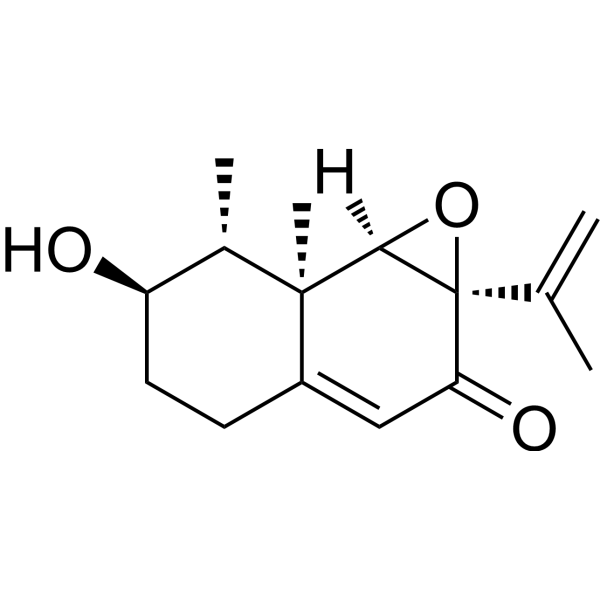
Sporogen AO-1
Sporogen AO-1 is a fungal metabolite originally isolated from the fungusAspergillus oryzae. Sporogen AO-1 has significant antimalarial activity againstplasmodium falciparum, with an IC50 value of 1.53 μM, and also has certain cytotoxicity.
For research use only. We do not sell to patients.
- CAS No.: 88418-12-6
- Formula: C15H20O3
- Molecular Weight:248.32
-
Storage:
Please store the product under the recommended conditions in the Certificate of Analysis.

To place orders, for customer services and technical support, please contact: MedChemExpress USA
Tel: 609-228-6898 E-mail: [email protected] [email protected]


-
 Biological Activity
-
Chemical Information
- Protocols
- Purity & Documentation
- References
-
 Help & FAQs


-

HY-129972
Ribavirin 5'-monophosphate dilithiumAntiviral Agents -

HY-113448
CE(20:3(8Z,11Z,14Z)) -
HY-P2124
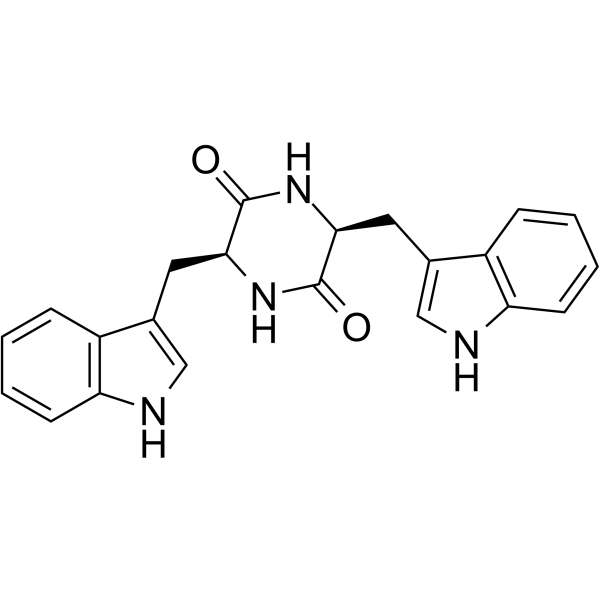
Cyclo(L-Trp-L-Trp)Antibiotic -
HY-129806
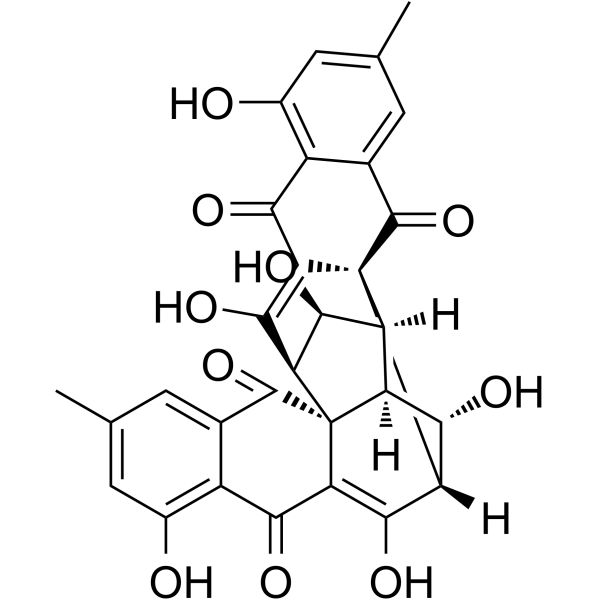
RugulosinAntibacterial Agent -
HY-157729
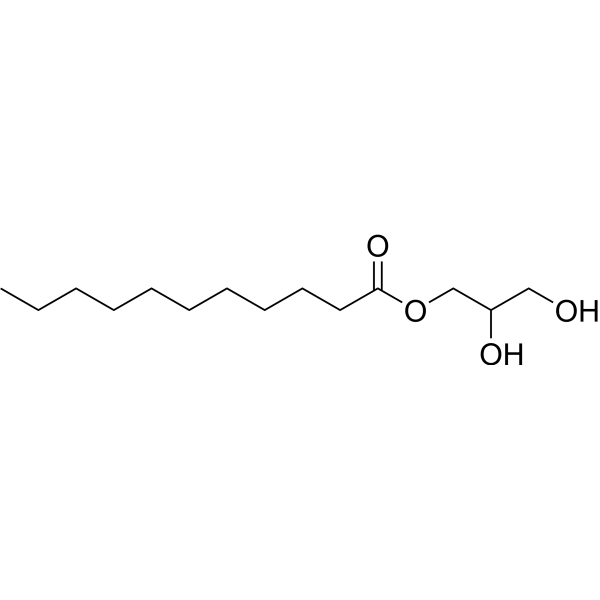
1-UndecanoylglycerolMonoacylglycerol -

HY-W015366
(S)-3-Amino-2-oxo-azepane hydrochlorideBiochemical Reagent -
HY-B0105BS
Levoketoconazole-d3Stable Isotope -

HY-P2124R
Cyclo(L-Trp-L-Trp) (Standard)Antibiotic -
HY-N7307
PachybasinAnti-bacterial Agent -
HY-141442
DihydronovobiocinATPase/Bacterial Inhibitor -

HY-N8280
IKD-8344Macrocyclic Dilactone -

HY-123457
PF-1163AAntifungal Agent/C-4 Sterol Methyl Oxidase Inhibitor
All Parasite Isoforms
More

Biological Activity
Description
Cellular Effect
|
Cell Line

|
Type | Value | Description | References |
|---|---|---|---|---|
| Huh-7 | CC50 |
>10 μM
Compound: GNF-Pf-1841
|
NOVARTIS: Cytotoxicity against human hepatocellular carcinoma cell line (Huh7)
NOVARTIS: Cytotoxicity against human hepatocellular carcinoma cell line (Huh7)
|
[PMID: 18579783] |
| KB | IC50 |
17.84 μM
Compound: 7
|
Antiproliferative activity against human KB cells assessed as reduction in cell growth incubated at 37 degC for 3 days by resazurin microplate assay
Antiproliferative activity against human KB cells assessed as reduction in cell growth incubated at 37 degC for 3 days by resazurin microplate assay
|
[PMID: 25734623] |
| Vero | IC50 |
4.23 μM
Compound: 7
|
Cytotoxicity against African green monkey Vero cells assessed as reduction in cell growth incubated at 37 degC for 4 days by fluorescence based assay
Cytotoxicity against African green monkey Vero cells assessed as reduction in cell growth incubated at 37 degC for 4 days by fluorescence based assay
|
[PMID: 25734623] |


Chemical Information
-
CAS No. 88418-12-6
-
Molecular Weight 248.32
-
Formula C15H20O3
-
SMILES
CC([C@]1(C(C=C2CC[C@H]3O)=O)[C@]([C@@]2([C@H]3C)C)([H])O1)=C
-
Structure Classification
-
Initial Source
Aspergillus flavus
-
Shipping
Room temperature in continental US; may vary elsewhere.
-
Storage
Please store the product under the recommended conditions in the Certificate of Analysis.

Protocols
-
Cell Cytotoxicity Assay
Cytotoxicity assays are usually based on the assessment of cell membrane damage, which can also be indirectly detected by measuring cell viability. Detection methods include MTT assay, CKK-8 assay, LDH assay and ATP assay, etc.
-
Mammalian live/dead viability and cytotoxicity staining
Live/dead viability and cytotoxicity staining assays are based on the simultaneous detection of intracellular esterase activity in metabolically active (viable) cells and membrane integrity loss in non-viable cells. In commonly used dual-staining approaches, membrane-permeant fluorogenic substrates are converted by intracellular esterases into fluorescent products in live cells, while impermeant DNA-binding dyes selectively enter cells with compromised plasma membranes and label nucleic acids in dead or dying cells, enabling discrimination between viable and non-viable populations by fluorescence microscopy or flow cytometry.
-
Cell Viability Determination by MTT Colorimetric Assay
The following protocol uses the MTT colorimetric assay as a classic literature-established method for assessing cell viability/metabolic activity in cultured mammalian cells. MTT[3-(4,5-dimethylthiazol-2-yl)-2,5-diphenyltetrazolium bromide] is reduced by metabolically active cells to a colored formazan product; the amount of formazan is quantified spectrophotometrically and provides an indirect measure of metabolically active viable cells. Importantly, MTT reduction reflects cellular oxidoreductase/metabolic activity rather than an absolute direct count of living cells, so changes in cellular metabolism can alter the signal independently of cell number.


Purity & Documentation
References

Calculators
Concentration (start) × Volume (start) = Concentration (final) × Volume (final)


Sporogen AO-1 Related Classifications
HY-N8285 Related Classifications
 Powered by Bioz