



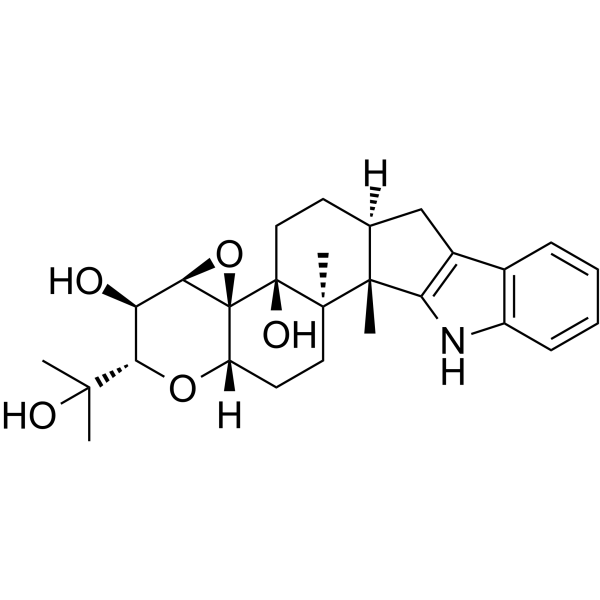
Terpendole I
Terpendole I is a fungal indole diterpenoid and an ACAT inhibitor (IC50 = 145 µM). Terpendole I can be used in studies related to lipid metabolism.
For research use only. We do not sell to patients.
- CAS No.: 167612-17-1
- Formula: C27H35NO5
- Molecular Weight:453.57
-
Storage:
Please store the product under the recommended conditions in the Certificate of Analysis.

To place orders, for customer services and technical support, please contact: MedChemExpress USA
Tel: 609-228-6898 E-mail: [email protected] [email protected]


-
 Biological Activity
-
Chemical Information
- Purity & Documentation
- References
-
 Help & FAQs




All Endogenous Metabolite Isoforms
More

Biological Activity
Description
IC50 & Target
[1]|
Microbial Metabolite |
In Vitro
Terpendole I weakly inhibits ACAT activity in rat liver microsomes with an IC50 of 145 μM[1].
Terpendole I (1 mg/mL (10 μg/paper disk); 24 h (bacteria); 48 h (fungi, yeasts)) shows no antimicrobial activity against tested bacteria, fungi, and yeasts[1].
MedChemExpress (MCE) has not independently confirmed the accuracy of these methods. They are for reference only.


Chemical Information
-
CAS No. 167612-17-1
-
Molecular Weight 453.57
-
Formula C27H35NO5
-
SMILES
C[C@@]12[C@@]([H])(CC[C@]3([C@]45[C@]([H])(CC[C@@]32C)O[C@@H]([C@H]([C@H]4O5)O)C(O)(C)C)O)CC6=C1NC7=C6C=CC=C7
-
Structure Classification
-
Initial Source
Albophoma yamanashiensis
-
Shipping
Room temperature in continental US; may vary elsewhere.
-
Storage
Please store the product under the recommended conditions in the Certificate of Analysis.


Purity & Documentation
References
[1]. Tomoda H, et al. Terpendoles, novel ACAT inhibitors produced by Albophoma yamanashiensis. III. Production, isolation and structure elucidation of new components. J Antibiot (Tokyo). 1995;48(8):793-804. [Content Brief]
[2]. Xu LL, et al. Prenylated Indole Diterpene Alkaloids from a Mine-Soil-Derived Tolypocladium sp. J Nat Prod. 2019;82(2):221-231. [Content Brief]

Calculators
Concentration (start) × Volume (start) = Concentration (final) × Volume (final)


Terpendole I Related Classifications
HY-N8331 Related Classifications
 Powered by Bioz