



Thymidine-d4

Based on 1 Customer Validation
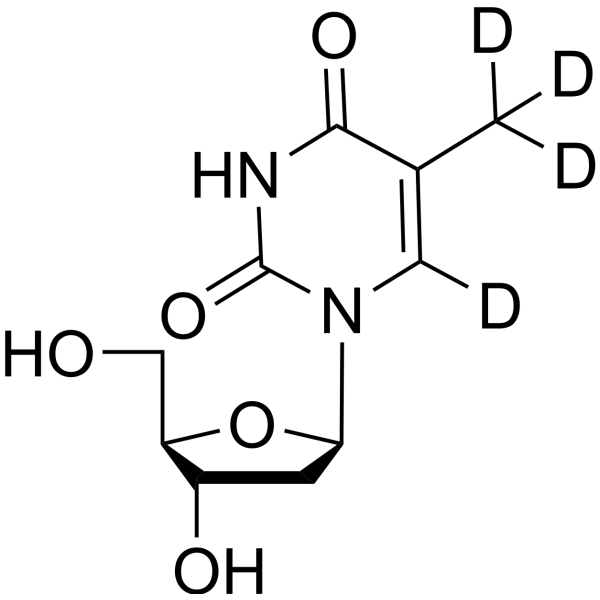
Thymidine-d4 is the deuterium labeled Thymidine. Thymidine, a specific precursor of deoxyribonucleic acid, is used as a cell synchronizing agent. Thymidine is a DNA synthesis inhibitor that can arrest cell at G1/S boundary, prior to DNA replication.
For research use only. We do not sell to patients.
- Purity : 99.99%
- CAS No.: 347841-67-2
- Formula: C10H10D4N2O5
- Molecular Weight:246.25
-
Storage:Powder -20°C, 3 years , 4°C, 2 years ; In solvent -80°C, 6 months , -20°C, 1 month

To place orders, for customer services and technical support, please contact: MedChemExpress USA
Tel: 609-228-6898 E-mail: [email protected] [email protected]


-
 Biological Activity
-
Chemical Information
-
Solvent & Solubility
- Protocols
- Purity & Documentation
- References
-
 Help & FAQs






Biological Activity
Description
In Vitro
Stable heavy isotopes of hydrogen, carbon, and other elements have been incorporated into drug molecules, largely as tracers for quantitation during the drug development process. Deuteration has gained attention because of its potential to affect the pharmacokinetic and metabolic profiles of drugs[1].
MedChemExpress (MCE) has not independently confirmed the accuracy of these methods. They are for reference only. Further protocols information, click here.
Application
1. This compound can be used as a tracer
2. This compound can be used as an internal standard for quantitative analysis by NMR, GC-MS, or LC-MS.


Chemical Information
-
CAS No. 347841-67-2
-
Unlabeled CAS 50-89-5
-
Appearance Solid
-
Molecular Weight 246.25
-
Formula C10H10D4N2O5
-
Color White to off-white
-
SMILES
O[C@H]1C[C@H](N2C([2H])=C(C([2H])([2H])[2H])C(NC2=O)=O)O[C@@H]1CO
-
Synonyms
DThyd-d4; NSC 21548-d4
-
Shipping
Room temperature in continental US; may vary elsewhere.
-
Storage
Powder -20°C 3 years 4°C 2 years In solvent -80°C 6 months -20°C 1 month


Solvent & Solubility
In Vitro:
DMF : ≥ 16 mg/mL (64.97 mM)
DMSO : ≥ 10 mg/mL (40.61 mM; Hygroscopic DMSO has a significant impact on the solubility of product, please use newly opened DMSO)
* "≥" means soluble, but saturation unknown.
Please refer to the solubility information to select the appropriate solvent. Once prepared, please aliquot and store the solution to prevent product inactivation from repeated freeze-thaw cycles.
Storage method and period of stock solution: -80°C, 6 months; -20°C, 1 month. When stored at -80°C, please use it within 6 months. When stored at -20°C, please use it within 1 month.
Please refer to the solubility information to select the appropriate solvent. Once prepared, please aliquot and store the solution to prevent product inactivation from repeated freeze-thaw cycles.
Storage method and period of stock solution: -80°C, 6 months; -20°C, 1 month. When stored at -80°C, please use it within 6 months. When stored at -20°C, please use it within 1 month.
Concentration (start) × Volume (start) = Concentration (final) × Volume (final)

Protocols
-
EdU Incorporation Assay (Click Chemistry-Based DNA Synthesis Measurement)
The EdU incorporation assay measures DNA synthesis by adding the thymidine analog 5-ethynyl-2′-deoxyuridine to cells or tissues, where it is incorporated into newly synthesized DNA during S phase. Incorporated EdU is detected by copper-catalyzed azide-alkyne cycloaddition, in which a fluorescent azide covalently reacts with the ethynyl group on EdU, allowing S-phase cells to be detected by fluorescence microscopy, flow cytometry, or high-content imaging. EdU detection does not require DNA denaturation or anti-BrdU antibody access, which preserves sample structure and improves compatibility with immunostaining and multiparameter cytometry compared with BrdU-based detection. EdU can be cytotoxic in a cell-type- and exposure-dependent manner, so pulse duration, concentration, and continuous-labeling designs should be validated for each cell type.
-
PCNA Immunodetection Proliferation Assay
PCNA immunodetection measures proliferative activity by detecting proliferating cell nuclear antigen, a nuclear protein associated with DNA polymerase δ function and DNA replication. The assay readout is the proportion of PCNA-positive nuclei among total counted cells, but PCNA labeling is not identical to BrdU labeling because PCNA can mark late G1/early S-associated replication competence and may persist beyond active DNA synthesis depending on fixation and extraction conditions.
-
BrdU Incorporation Assay
Bromodeoxyuridine (BrdU) incorporation assay is based on the principle that BrdU, a thymidine analog, is incorporated into newly synthesized DNA during the S phase of the cell cycle, thereby serving as a marker of DNA replication and cellular proliferation. Incorporated BrdU can be detected using anti-BrdU antibodies following DNA denaturation, enabling visualization or quantification of proliferating cells through immunochemical detection methods such as immunofluorescence or immunohistochemistry.


Purity & Documentation
-
Data Sheet (279 KB)
-
SDS (252 KB)
- English - EN (252 KB)
- Français - FR (252 KB)
- Deutsch - DE (252 KB)
- Norwegian - NO (252 KB)
- Español - ES (252 KB)
- Swedish - SV (252 KB)
- Italian - IT (252 KB)
- Korean - KR (252 KB)
- Portuguese - PT (252 KB)
-
Handling Instructions (2659 KB)
References
[1]. Russak EM, et al. Impact of Deuterium Substitution on the Pharmacokinetics of Pharmaceuticals. Ann Pharmacother. 2019;53(2):211-216. [Content Brief]
[2]. Chen G, et al. Cell Synchronization by Double Thymidine Block. Bio Protoc. 2018 Sep 5;8(17). [Content Brief]
[3]. FIRKET H, et al. Autoradiographic visualization of synthesis of deoxyribonucleic acid in tissue culture with tritium-labelled thymidine. Nature. 1958 Jan 24;181(4604):274-5.FIRKET H, et al. Autoradiographic visualization of synthesis of deoxyribonucleic acid in tissue culture with tritium-labelled thymidine. Nature. 1958 Jan 24;181(4604):274-5. [Content Brief]
[4]. Izeradjene K, et al. Inhibition of thymidine synthesis by folate analogues induces a Fas-Fas ligand-independentdeletion of superantigen-reactive peripheral T cells. Int Immunol. 2001 Jan;13(1):85-93. [Content Brief]


Complete Stock Solution Preparation Table
Please refer to the solubility information to select the appropriate solvent. Once prepared, please aliquot and store the solution to prevent product inactivation from repeated freeze-thaw cycles.
Storage method and period of stock solution: -80°C, 6 months; -20°C, 1 month. When stored at -80°C, please use it within 6 months. When stored at -20°C, please use it within 1 month.
| Optional Solvent | Concentration Solvent Mass | 1 mg | 5 mg | 10 mg | 25 mg |
|---|---|---|---|---|---|
| DMSO / DMF | 1 mM | 4.0609 mL | 20.3046 mL | 40.6091 mL | 101.5228 mL |
| 5 mM | 0.8122 mL | 4.0609 mL | 8.1218 mL | 20.3046 mL | |
| 10 mM | 0.4061 mL | 2.0305 mL | 4.0609 mL | 10.1523 mL | |
| 15 mM | 0.2707 mL | 1.3536 mL | 2.7073 mL | 6.7682 mL | |
| 20 mM | 0.2030 mL | 1.0152 mL | 2.0305 mL | 5.0761 mL | |
| 25 mM | 0.1624 mL | 0.8122 mL | 1.6244 mL | 4.0609 mL | |
| 30 mM | 0.1354 mL | 0.6768 mL | 1.3536 mL | 3.3841 mL | |
| 40 mM | 0.1015 mL | 0.5076 mL | 1.0152 mL | 2.5381 mL | |
| DMF | 50 mM | 0.0812 mL | 0.4061 mL | 0.8122 mL | 2.0305 mL |
| 60 mM | 0.0677 mL | 0.3384 mL | 0.6768 mL | 1.6920 mL |


Thymidine-d4 Related Classifications
HY-N1150S1 Related Classifications
 Powered by Bioz