



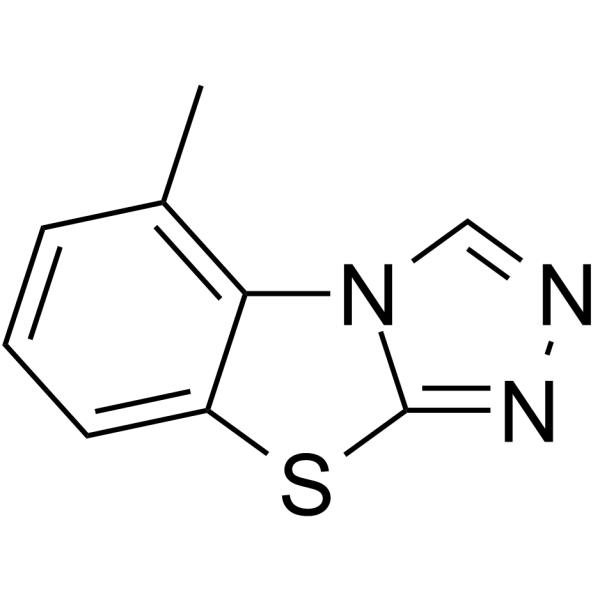
Tricyclazole
Based on 3 publication(s) in Google Scholar
Tricyclazole is a pentaketone melanin biosynthesis inhibitor and a unique fungicide for controlling rice blast. Tricyclazole alters the structure and function of fungal cell walls, reduces fungal pathogenicity and penetration, and causes dose-dependent liver damage in animals.
For research use only. We do not sell to patients.
- Purity : 98.40%
- CAS No.: 41814-78-2
- Formula: C9H7N3S
- Molecular Weight:189.24
-
Storage:Powder -20°C, 3 years , 4°C, 2 years ; In solvent -80°C, 2 years , -20°C, 1 year

To place orders, for customer services and technical support, please contact: MedChemExpress USA
Tel: 609-228-6898 E-mail: [email protected] [email protected]


-
 Biological Activity
-
Chemical Information
-
Solvent & Solubility
- Protocols
- Purity & Documentation
- References
-
 Help & FAQs




Publications Citing Use of MedChemExpress (MCE) Tricyclazole
More

Biological Activity
Description
IC50 & Target
Pentaketide-derived melanin biosynthesis[1]
In Vitro
Tricyclazole (16 μg/mL) causes morphological changes in Fonsecaea pedrosoi conidia and sclerotic cells[1].
Tricyclazole (0.1-10 μg/mL; 24-48 h) inhibits melanization of Pyriculariaoryzae appressoria, prevents penetration of epidermal cell walls and Formvar membranes, and increases permeability of appressorial walls to solutes[2].
MedChemExpress (MCE) has not independently confirmed the accuracy of these methods. They are for reference only.
In Vivo
MedChemExpress (MCE) has not independently confirmed the accuracy of these methods. They are for reference only.
-
Animal Model:adult NMRI mice (two months old, average weight 30 g)[3]
-
Dosage:5 mg/kg, 15 mg/kg
-
Administration:intraperitoneal injection, 5 days a week for 2 weeks
-
Result:Showed a significant decrease in hepatocyte number and increase in Kupffer cell number.
Increased serum levels of ALT and AST.
Decreased ALP.
Showed histopathological changes, including hepatocyte necrosis, degeneration, inflammatory cell infiltration, fibrosis, and sinusoid expansion.


Chemical Information
-
CAS No. 41814-78-2
-
Appearance Solid
-
Molecular Weight 189.24
-
Formula C9H7N3S
-
Color Light yellow to yellow
-
SMILES
CC1=C2N3C(SC2=CC=C1)=NN=C3
-
Shipping
Room temperature in continental US; may vary elsewhere.
-
Storage
Powder -20°C 3 years 4°C 2 years In solvent -80°C 2 years -20°C 1 year


Publications (3)
-
Journal Impact Factor
-
Most Recent
-
ACS Environ Au
Machine Learning-Assisted Recognition of Environmental Sulfur-Containing Chemicals in Nontargeted Mass Spectrometry Analysis of Inadequate Mass Resolution. [Abstract]2025 Aug 5;5(6):573-582. PMID: 41277996 -
Anal Chem
Exposome-Scale Investigation of Cl-/Br-Containing Chemicals Using High-Resolution Mass Spectrometry, Multistage Machine Learning, and Cloud Computing. [Abstract]2025 Jun 3;97(21):11099-11109. PMID: 40401576 -
J Agric Food Chem
Resveratrol Analog ResA1 Targeting MoYpk1 Exhibits Broad-Spectrum Antifungal Activity against Rice Blast. [Abstract]2026 Jun 3;74(21):16299-16311. PMID: 42172023


Solvent & Solubility
In Vitro:
DMSO : 125 mg/mL (660.54 mM; Need ultrasonic; Hygroscopic DMSO has a significant impact on the solubility of product, please use newly opened DMSO)
H2O : < 0.1 mg/mL (insoluble)
Please refer to the solubility information to select the appropriate solvent. Once prepared, please aliquot and store the solution to prevent product inactivation from repeated freeze-thaw cycles.
Storage method and period of stock solution: -80°C, 2 years; -20°C, 1 year. When stored at -80°C, please use it within 2 years. When stored at -20°C, please use it within 1 year.
Please refer to the solubility information to select the appropriate solvent. Once prepared, please aliquot and store the solution to prevent product inactivation from repeated freeze-thaw cycles.
Storage method and period of stock solution: -80°C, 2 years; -20°C, 1 year. When stored at -80°C, please use it within 2 years. When stored at -20°C, please use it within 1 year.
Concentration (start) × Volume (start) = Concentration (final) × Volume (final)
In Vivo:
Select the appropriate dissolution method based on your experimental animal and administration route.
- For the following dissolution methods, please ensure to first prepare a clear stock solution using an In Vitro approach and then sequentially add co-solvents:
- To ensure reliable experimental results, the clarified stock solution can be appropriately stored based on storage conditions. As for the working solution for In Vivo experiments, it is recommended to prepare freshly and use it on the same day.
- The percentages shown for the solvents indicate their volumetric ratio in the final prepared solution. If precipitation or phase separation occurs during preparation, heat and/or sonication can be used to aid dissolution.
Add each solvent one by one: 10% DMSO 40% PEG300 5% Tween-80 45% Saline
Solubility: ≥ 2.08 mg/mL (10.99 mM); Clear solution
This protocol yields a clear solution of ≥ 2.08 mg/mL (saturation unknown).
Taking 1 mL working solution as an example, add 100 μL DMSO stock solution (20.8 mg/mL) to 400 μL PEG300, and mix evenly; then add 50 μL Tween-80 and mix evenly; then add 450 μL Saline to adjust the volume to 1 mL.
Preparation of Saline: Dissolve 0.9 g sodium chloride in ddH₂O and dilute to 100 mL to obtain a clear Saline solution.
Add each solvent one by one: 10% DMSO 90% (20% SBE-β-CD in Saline)
Solubility: ≥ 2.08 mg/mL (10.99 mM); Clear solution
This protocol yields a clear solution of ≥ 2.08 mg/mL (saturation unknown).
Taking 1 mL working solution as an example, add 100 μL DMSO stock solution (20.8 mg/mL) to 900 μL 20% SBE-β-CD in Saline, and mix evenly.
Preparation of 20% SBE-β-CD in Saline (4°C, storage for one week): 2 g SBE-β-CD powder is dissolved in 10 mL Saline, completely dissolve until clear.
In Vivo Dissolution Calculator
Please enter the basic information of animal experiments:
-
-
-
-
Recommended: Prepare an additional quantity of animals to account for potential losses during experiments.
Please enter your animal formula composition:
-
%DMSO +
Recommended: Keep the proportion of DMSO in working solution below 2% if your animal is weak.
-
%+
-
+%Tween-80 + +
-
%Saline +
The co-solvents required include: DMSO, . All of co-solvents are available by MedChemExpress (MCE). , Tween 80. All of co-solvents are available by MedChemExpress (MCE).
Working solution concentration: 0.22 mg/mL
Method for preparing stock solution: mg drug dissolved in μL DMSO. Stock solution concentration: mg/mL.
1. Take μL DMSO stock solution;
2. Add μL .
μL , mix evenly;
3. Then add μL Tween 80, mix evenly;
4. Then add μL
Please ensure that the stock solution in the first step is dissolved to a clear state, and add co-solvents in sequence. You can use ultrasonic heating (ultrasonic cleaner, recommended frequency 20-40 kHz), vortexing, etc. to assist dissolution.


Purity & Documentation
-
Data Sheet (281 KB)
-
SDS (480 KB)
- English - EN (480 KB)
- Français - FR (480 KB)
- Deutsch - DE (480 KB)
- Norwegian - NO (480 KB)
- Español - ES (480 KB)
- Swedish - SV (480 KB)
- Italian - IT (480 KB)
- Korean - KR (480 KB)
- Portuguese - PT (480 KB)
-
Handling Instructions (2659 KB)
References


Complete Stock Solution Preparation Table
Please refer to the solubility information to select the appropriate solvent. Once prepared, please aliquot and store the solution to prevent product inactivation from repeated freeze-thaw cycles.
Storage method and period of stock solution: -80°C, 2 years; -20°C, 1 year. When stored at -80°C, please use it within 2 years. When stored at -20°C, please use it within 1 year.
| Optional Solvent | Concentration Solvent Mass | 1 mg | 5 mg | 10 mg | 25 mg |
|---|---|---|---|---|---|
| DMSO | 1 mM | 5.2843 mL | 26.4215 mL | 52.8429 mL | 132.1074 mL |
| 5 mM | 1.0569 mL | 5.2843 mL | 10.5686 mL | 26.4215 mL | |
| 10 mM | 0.5284 mL | 2.6421 mL | 5.2843 mL | 13.2107 mL | |
| 15 mM | 0.3523 mL | 1.7614 mL | 3.5229 mL | 8.8072 mL | |
| 20 mM | 0.2642 mL | 1.3211 mL | 2.6421 mL | 6.6054 mL | |
| 25 mM | 0.2114 mL | 1.0569 mL | 2.1137 mL | 5.2843 mL | |
| 30 mM | 0.1761 mL | 0.8807 mL | 1.7614 mL | 4.4036 mL | |
| 40 mM | 0.1321 mL | 0.6605 mL | 1.3211 mL | 3.3027 mL | |
| 50 mM | 0.1057 mL | 0.5284 mL | 1.0569 mL | 2.6421 mL | |
| 60 mM | 0.0881 mL | 0.4404 mL | 0.8807 mL | 2.2018 mL | |
| 80 mM | 0.0661 mL | 0.3303 mL | 0.6605 mL | 1.6513 mL | |
| 100 mM | 0.0528 mL | 0.2642 mL | 0.5284 mL | 1.3211 mL |


Tricyclazole Related Classifications
HY-B0848 Related Classifications
 Powered by Bioz