



Antipain
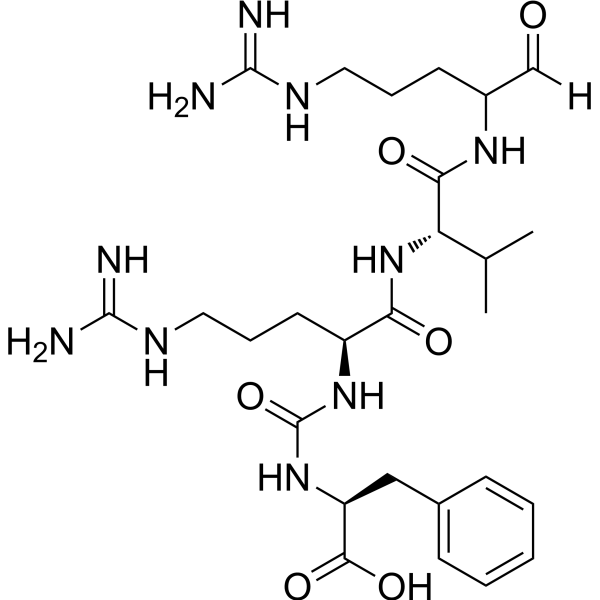
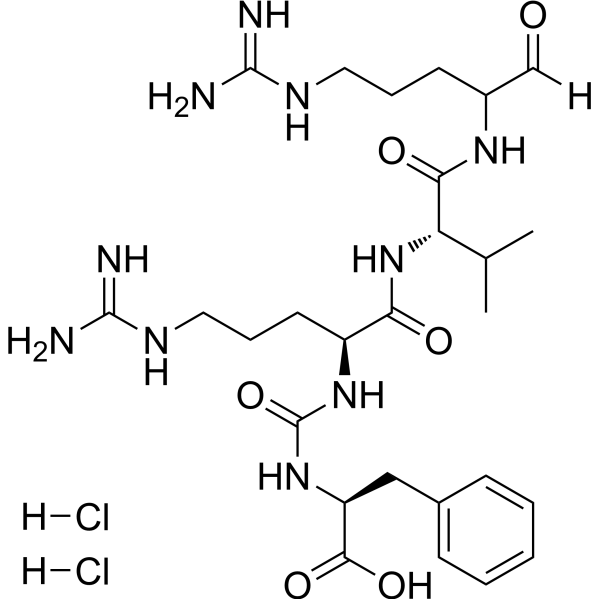
Antipain is a protease inhibitor isolated from Actinomycetes. Antipain inhibits N-methyl-N'-nitro-N-nitrosoguanidine (MNNG)-induced transformation and increases chromosomal aberrations. Antipain restricts uterine DNA synthesis and function in mice.
For research use only. We do not sell to patients.
- CAS No.: 37691-11-5
- Formula: C27H44N10O6
- Molecular Weight:604.70
-
Storage:
Please store the product under the recommended conditions in the Certificate of Analysis.

To place orders, for customer services and technical support, please contact: MedChemExpress USA
Tel: 609-228-6898 E-mail: [email protected] [email protected]


-
 Biological Activity
-
Chemical Information
- Protocols
- Purity & Documentation
- References
-
 Help & FAQs


All DNA/RNA Synthesis Isoforms
More

Biological Activity
Description
In Vivo
Antipain (100 μg/g body wt; i.p.; at 12h intervals from 0 to 120 h or 240 to 360 h) shows inhibitory effect on Urethane-induced lung neoplasia in mice[5].
MedChemExpress (MCE) has not independently confirmed the accuracy of these methods. They are for reference only.


Chemical Information
-
CAS No. 37691-11-5
-
Molecular Weight 604.70
-
Formula C27H44N10O6
-
SMILES
OC([C@@H](NC(N[C@@H](CCCNC(N)=N)C(N[C@@H](C(C)C)C(NC(C([H])=O)CCCNC(N)=N)=O)=O)=O)CC1=CC=CC=C1)=O
-
Shipping
Room temperature in continental US; may vary elsewhere.
-
Storage
Please store the product under the recommended conditions in the Certificate of Analysis.

Protocols
-
EdU Incorporation Assay (Click Chemistry-Based DNA Synthesis Measurement)
The EdU incorporation assay measures DNA synthesis by adding the thymidine analog 5-ethynyl-2′-deoxyuridine to cells or tissues, where it is incorporated into newly synthesized DNA during S phase. Incorporated EdU is detected by copper-catalyzed azide-alkyne cycloaddition, in which a fluorescent azide covalently reacts with the ethynyl group on EdU, allowing S-phase cells to be detected by fluorescence microscopy, flow cytometry, or high-content imaging. EdU detection does not require DNA denaturation or anti-BrdU antibody access, which preserves sample structure and improves compatibility with immunostaining and multiparameter cytometry compared with BrdU-based detection. EdU can be cytotoxic in a cell-type- and exposure-dependent manner, so pulse duration, concentration, and continuous-labeling designs should be validated for each cell type.
-
BrdU Incorporation Assay
Bromodeoxyuridine (BrdU) incorporation assay is based on the principle that BrdU, a thymidine analog, is incorporated into newly synthesized DNA during the S phase of the cell cycle, thereby serving as a marker of DNA replication and cellular proliferation. Incorporated BrdU can be detected using anti-BrdU antibodies following DNA denaturation, enabling visualization or quantification of proliferating cells through immunochemical detection methods such as immunofluorescence or immunohistochemistry.


Purity & Documentation
References
[1]. DiPaolo JA, et al. Antipain inhibits N-methyl-N'-nitro-N-nitrosoguanidine-induced transformation and increases chromosomal aberrations. Proc Natl Acad Sci U S A. 1980 Nov;77(11):6649-53. [Content Brief]
[2]. Suda H,et al. Antipain, a new protease inhibitor isolated from actinomycetes. J Antibiot (Tokyo). 1972 Apr;25(4):263-6. [Content Brief]
[3]. Sudha VT, et al. Identification of a serine protease as a major allergen (Per a 10) of Periplaneta americana. Allergy. 2008 Jun;63(6):768-76. [Content Brief]
[4]. Nomura T, et al. Inhibiting effects of antipain on urethane-induced lung neoplasia in mice. Br J Cancer. 1980;42(4):624‐626. [Content Brief]
[5]. Katz J, et al. Antipain and leupeptin restrict uterine DNA synthesis and function in mice. Proc Natl Acad Sci U S A. 1977;74(9):3754‐3757. [Content Brief]

Calculators
Concentration (start) × Volume (start) = Concentration (final) × Volume (final)


Antipain Related Classifications
HY-127039 Related Classifications
 Powered by Bioz