



UC-764864

Based on 1 Customer Validation
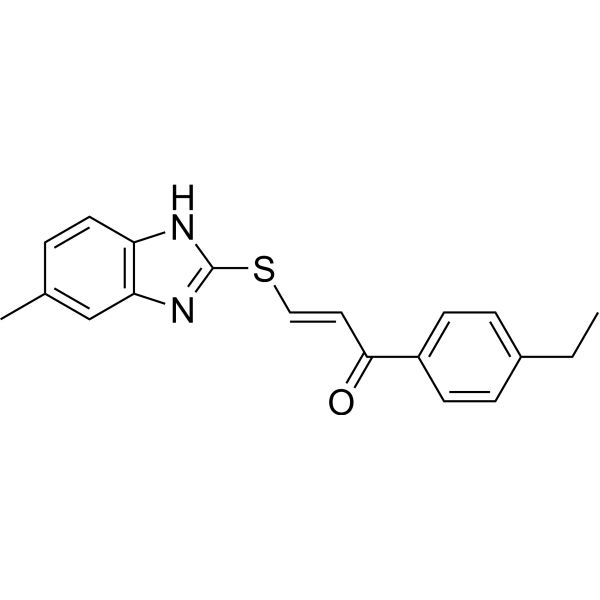
UC-764864 is a selective UBE2N inhibitor. UC-764864 covalently binds UBE2N catalytic Cys87, blocks ubiquitin-UBE2N thioester formation and polyubiquitin chain synthesis. UC-764864 blocks ubiquitination of innate immune- and inflammatory-related substrates, and induces cell apoptosis. UC-764864 can be used for the research of acute myeloid leukemia.
For research use only. We do not sell to patients.
- Purity : 99.89%
- CAS No.: 278806-03-4
- Formula: C19H18N2OS
- Molecular Weight:322.42
-
Storage:Powder -20°C, 3 years , 4°C, 2 years ; In solvent -80°C, 6 months , -20°C, 1 month

To place orders, for customer services and technical support, please contact: MedChemExpress USA
Tel: 609-228-6898 E-mail: [email protected] [email protected]


-
 Biological Activity
-
Chemical Information
-
Solvent & Solubility
- Protocols
- Purity & Documentation
- References
-
 Help & FAQs




Biological Activity
Description
In Vitro
UC-764864 (1-10 μM) potently and selectively inhibits wild-type UBE2N catalytic activity via its Cys87 residue[1].
UC-764864 (1 nM-0.1 mM; 1 h) selectively binds to the catalytic Cys87 residue of UBE2N in human MOLM-13 AML cells[1].
UC-764864 (2 μM; 24 h) selectively reduces UBE2N autoubiquitination at Lys92 and disrupts UBE2N-dependent innate immune and inflammatory signaling pathways in human MOLM-13 AML cells[1].
UC-764864 (1 nM-0.1 mM) potently and selectively inhibits UBE2N-mediated NF-κB activity downstream of multiple innate immune receptors in human THP-1 AML cells, with no effect on UBE2N-independent pathways[1].
UC-764864 (0-10 μM; 24-72 h) selectively suppresses viability and clonogenic potential of human AML cell lines and MDS cells in vitro, with no effect on healthy cord blood CD34+ cells[1].
UC-764864 (0.5-5 μM; 24-96 h) induces time- and dose-dependent cell death and apoptosis in human MOLM-13 AML cells in vitro[1].
UC-764864 (100 nM-10 μM; 72 h) exerts inhibitory effects on human MOLM-13 AML cell viability that depend on targeting the catalytic Cys87 residue of UBE2N, as UBE2NC87S-expressing cells are resistant to UC-764864[1].
MedChemExpress (MCE) has not independently confirmed the accuracy of these methods. They are for reference only.
-
Cell Line:human MOLM-13 AML cells
-
Concentration:0.5 μM; 1 μM; 2μM
-
Incubation Time:24 h
-
Result:Increased the proportion of apoptotic cells from ~15% to ~35% (P < 0.01) after 24-hour treatment with 2 μM.


Chemical Information
-
CAS No. 278806-03-4
-
Appearance Solid
-
Molecular Weight 322.42
-
Formula C19H18N2OS
-
Color Light yellow to yellow
-
SMILES
O=C(C1=CC=C(CC)C=C1)/C=C/SC2=NC3=C(N2)C=CC(C)=C3
-
Shipping
Room temperature in continental US; may vary elsewhere.
-
Storage
Powder -20°C 3 years 4°C 2 years In solvent -80°C 6 months -20°C 1 month


Solvent & Solubility
In Vitro:
DMSO : 125 mg/mL (387.69 mM; Need ultrasonic; Hygroscopic DMSO has a significant impact on the solubility of product, please use newly opened DMSO)
Please refer to the solubility information to select the appropriate solvent. Once prepared, please aliquot and store the solution to prevent product inactivation from repeated freeze-thaw cycles.
Storage method and period of stock solution: -80°C, 6 months; -20°C, 1 month. When stored at -80°C, please use it within 6 months. When stored at -20°C, please use it within 1 month.
Please refer to the solubility information to select the appropriate solvent. Once prepared, please aliquot and store the solution to prevent product inactivation from repeated freeze-thaw cycles.
Storage method and period of stock solution: -80°C, 6 months; -20°C, 1 month. When stored at -80°C, please use it within 6 months. When stored at -20°C, please use it within 1 month.
Concentration (start) × Volume (start) = Concentration (final) × Volume (final)


Purity & Documentation
-
Data Sheet (271 KB)
-
SDS (251 KB)
- English - EN (251 KB)
- Français - FR (251 KB)
- Deutsch - DE (251 KB)
- Norwegian - NO (251 KB)
- Español - ES (251 KB)
- Swedish - SV (251 KB)
- Italian - IT (251 KB)
- Korean - KR (251 KB)
- Portuguese - PT (251 KB)
-
Handling Instructions (2659 KB)
References


Complete Stock Solution Preparation Table
Please refer to the solubility information to select the appropriate solvent. Once prepared, please aliquot and store the solution to prevent product inactivation from repeated freeze-thaw cycles.
Storage method and period of stock solution: -80°C, 6 months; -20°C, 1 month. When stored at -80°C, please use it within 6 months. When stored at -20°C, please use it within 1 month.
| Optional Solvent | Concentration Solvent Mass | 1 mg | 5 mg | 10 mg | 25 mg |
|---|---|---|---|---|---|
| DMSO | 1 mM | 3.1015 mL | 15.5077 mL | 31.0154 mL | 77.5386 mL |
| 5 mM | 0.6203 mL | 3.1015 mL | 6.2031 mL | 15.5077 mL | |
| 10 mM | 0.3102 mL | 1.5508 mL | 3.1015 mL | 7.7539 mL | |
| 15 mM | 0.2068 mL | 1.0338 mL | 2.0677 mL | 5.1692 mL | |
| 20 mM | 0.1551 mL | 0.7754 mL | 1.5508 mL | 3.8769 mL | |
| 25 mM | 0.1241 mL | 0.6203 mL | 1.2406 mL | 3.1015 mL | |
| 30 mM | 0.1034 mL | 0.5169 mL | 1.0338 mL | 2.5846 mL | |
| 40 mM | 0.0775 mL | 0.3877 mL | 0.7754 mL | 1.9385 mL | |
| 50 mM | 0.0620 mL | 0.3102 mL | 0.6203 mL | 1.5508 mL | |
| 60 mM | 0.0517 mL | 0.2585 mL | 0.5169 mL | 1.2923 mL | |
| 80 mM | 0.0388 mL | 0.1938 mL | 0.3877 mL | 0.9692 mL | |
| 100 mM | 0.0310 mL | 0.1551 mL | 0.3102 mL | 0.7754 mL |


UC-764864 Related Classifications
HY-153775 Related Classifications
 Powered by Bioz