



UDP-Galactose
Based on 6 publication(s) in Google Scholar
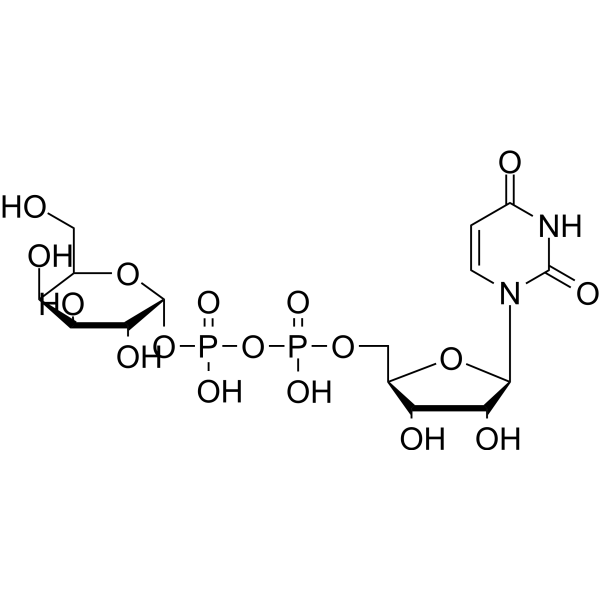
UDP-Galactose is a monosaccharide and a key glycosyl donor molecule in cells that participates in nucleotide sugar metabolism. UDP-Galactose is the natural agonist of the P2Y14 receptor coupled to Gi proteins in the immune system (IC50 = 0.67 μM, hP2Y14). UDP-Galactose can be used to study cell signal transduction and substance metabolism.
Nur für Forschungszwecke. Wir verkaufen nicht an Patienten.
- CAS. Nr.: 2956-16-3
- Formel: C15H24N2O17P2
- Molecular Weight:566.30
-
Speicherung:
Please store the product under the recommended conditions in the Certificate of Analysis.

To place orders, for customer services and technical support, please contact: MedChemExpress USA
Tel: 609-228-6898 E-mail: [email protected] [email protected]


-
 Biologische Aktivität
-
Chemical Information
- Reinheit & Dokumentation
- Verweise
-
 Help & FAQs


Publications Citing Use of MedChemExpress (MCE) UDP-Galactose
MoreAlle Endogenous Metabolite Isoform-spezifische Produkte anzeigen
MoreAlle P2Y Receptor Isoform-spezifische Produkte anzeigen
More

Biologische Aktivität
Beschreibung
IC50 & Target
|
Human Endogenous Metabolite |
P2Y14 Receptor 0.67 μM (EC50) |
Cellular Effect
|
Cell Line

|
Type | Value | Description | References |
|---|---|---|---|---|
| COS-7 | EC50 |
0.67 μM
Compound: 2
|
Agonist activity at human P2Y14 expressed in COS7 cells assessed as stimulation of PLC-mediated [3H]inositol hydrolysis
Agonist activity at human P2Y14 expressed in COS7 cells assessed as stimulation of PLC-mediated [3H]inositol hydrolysis
|
[PMID: 17407275] |
| COS-7 | EC50 |
0.67 μM
Compound: 7
|
Agonist activity at human P2Y14 receptor expressed in human COS7 cells
Agonist activity at human P2Y14 receptor expressed in human COS7 cells
|
[PMID: 19502066] |
In Vitro
UDP-Galactose (2 mM) restores UDP-galactose transport in the endoplasmic reticulum of GalT-1/UGT-CHOlec8 cells[2].
UDP-galactose is transported via the endoplasmic reticulum to support GalCer synthesis in GalT-1/UGT-CHOlec8 cells[2].
MedChemExpress (MCE) has not independently confirmed the accuracy of these methods. They are for reference only.


Chemical Information
-
CAS. Nr. 2956-16-3
-
Molecular Weight 566.30
-
Formel C15H24N2O17P2
-
SMILES
O=C(C=CN1[C@H]2[C@H](O)[C@H](O)[C@@H](COP(OP(O[C@@H]3[C@H](O)[C@@H](O)[C@@H](O)[C@@H](CO)O3)(O)=O)(O)=O)O2)NC1=O
-
Structure Classification
-
Initial Source
-
Versand
Room temperature in continental US; may vary elsewhere.
-
Speicherung
Please store the product under the recommended conditions in the Certificate of Analysis.


Publications (6)
-
Journal Impact Factor
-
Most Recent
-
Mol Plant
2025 Dec 13:S1674-2052(25)00435-6. PMID: 41392480 -
-
Cell Rep
Blocking glycogen synthase 1 in white adipose tissue alleviates hypermetabolism following severe burn injury through inhibition of JAK2 by UDPG. [Abstract]2025 Nov 18;44(12):116577. PMID: 41259203 -
J Exp Bot
Diel carbon buffering by floridoside enables source-sink resilience in the intertidal red alga Pyropia haitanensis. [Abstract]2026 Apr 17:erag189. PMID: 41999048 -
J Biotechnol
Rational design of a bifunctional glycosyltransferase for enhanced substrate promiscuity and thermostability. [Abstract]2025 Dec 19:410:285-297. PMID: 41422993 -


Reinheit & Dokumentation
Verweise
[1].
Ko H, et al. Structure-activity relationship of uridine 5'-diphosphoglucose analogues as agonists of the human P2Y14 receptor. J Med Chem. 2007 May 3;50(9):2030-9.
[Content Brief]
[2]. Sprong H, et al. Association of the Golgi UDP-galactose transporter with UDP-galactose:ceramide galactosyltransferase allows UDP-galactose import in the endoplasmic reticulum. Mol Biol Cell. 2003;14(8):3482-3493. [Content Brief]

Calculators
Konzentration (Stammlösung) × Volumen (Stammlösung) = Konzentration (Ziellösung) × Volumen (Ziellösung)


UDP-Galactose Related Classifications
HY-150524 Related Classifications
 Powered by Bioz