



ZXH-4-137
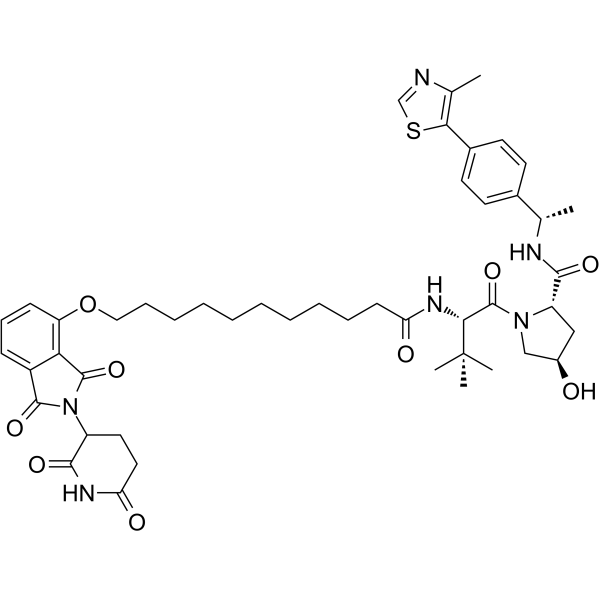
ZXH-4-137 is a CRBN PROTAC degrader. ZXH-4-137 brings CRBN and VHL E3 ligase into proximity, induces CRBN ubiquitination and proteasomal degradation, and exhibits high selectivity for CRBN. ZXH-4-137 blocks the degradation of CRBN-dependent target proteins such as GSPT1 and CDK9. ZXH-4-137 serves as a chemical knockdown tool compound for investigating CRBN-dependent biological processes.
(Pink: Cereblon ligand (HY-103596); Blue: VHL ligand (HY-112078); Black: linker (HY-132859)).
For research use only. We do not sell to patients.
- CAS No.: 2711006-74-3
- Formula: C47H60N6O9S
- Molecular Weight:885.08
-
Storage:
Please store the product under the recommended conditions in the Certificate of Analysis.

To place orders, for customer services and technical support, please contact: MedChemExpress USA
Tel: 609-228-6898 E-mail: [email protected] [email protected]


-
 Biological Activity
-
Chemical Information
- Protocols
- Purity & Documentation
- References
-
 Help & FAQs


All PROTACs Isoforms
More

Biological Activity
Description
IC50 & Target
[1]|
Cereblon |
VHL |
In Vitro
ZXH-4-137 (10-500 nM; 1-24 h) potently and selectively induces CRBN degradation in MM1.S cells[1].
ZXH-4-137 (50 nM; 2 h pre-treatment) mediates the knockdown of CRBN in MM1.S cells, and this effect blocks the CRBN-dependent degradation of GSPT1 by CC-885 (HY-101488)[1].
Knockdown of CRBN in MOLT-4 cells mediated by ZXH-4-137 (0.1 μM; 2 h pre-treatment) partially blocks the CRBN-dependent degradation of CDK9 induced by THAL-SNS-032 (HY-123937)[1].
MedChemExpress (MCE) has not independently confirmed the accuracy of these methods. They are for reference only. Further protocols information, click here.
-
Cell Line:MM1.S multiple myeloma cells
-
Concentration:10 nM, 50 nM, 100 nM, 500 nM
-
Incubation Time:4 h
-
Result:Reduced CRBN levels to 44% of DMSO control at 10 nM, 31% at 50 nM, 16% at 100 nM, and 17% at 500 nM after 4 hours.
Did not significantly alter levels of Ikaros, Aiolos, CK1α, pVHL30, or pVHL19 at any tested concentration.
-
Cell Line:MM1.S multiple myeloma cells
-
Concentration:50 nM
-
Incubation Time:1 h, 2 h, 4 h, 8 h, 16 h, 24 h
-
Result:Reduced CRBN levels to 58% of DMSO control at 1 h, 41% at 2 h, 23% at 4 h, 17% at 8 h, 13% at 16 h, and 31% at 24 h.
Left levels of Ikaros, pVHL30, and pVHL19 largely unchanged across all time points.
-
Cell Line:MM1.S multiple myeloma cells
-
Concentration:50 nM (ZXH-4-137 pre-treatment); 0.1 μM (CC-885)
-
Incubation Time:2 h (ZXH-4-137 pre-treatment); 4 h (CC-885 incubation)
-
Result:Rescued CC-885-induced GSPT1 degradation, maintaining GSPT1 levels comparable to DMSO control.
Induced nearly complete CRBN degradation.
Achieved rescue comparable to that seen with proteasome inhibitor carfilzomib pre-treatment.
-
Cell Line:MOLT-4 leukemia cells
-
Concentration:0.1 μM (ZXH-4-137 pre-treatment); 0.25 μM (THAL-SNS-032)
-
Incubation Time:2 h (ZXH-4-137 pre-treatment); 6 h (THAL-SNS-032 incubation)
-
Result:Partially prevented THAL-SNS-032-induced CDK9 degradation.
Induced nearly complete CRBN degradation.
Achieved partial rescue more effective than pre-treatment with 0.1 μM Pomalidomide.


Chemical Information
-
CAS No. 2711006-74-3
-
Molecular Weight 885.08
-
Formula C47H60N6O9S
-
SMILES
O=C1C2=C(OCCCCCCCCCCC(N[C@@H](C(C)(C)C)C(N3[C@@H](C[C@H](C3)O)C(N[C@H](C4=CC=C(C5=C(N=CS5)C)C=C4)C)=O)=O)=O)C=CC=C2C(N1C6C(NC(CC6)=O)=O)=O
-
Shipping
Room temperature in continental US; may vary elsewhere.
-
Storage
Please store the product under the recommended conditions in the Certificate of Analysis.

Protocols
-
RNA interference technology
RNA interference (RNAi) is a cellular mechanism that inhibits gene expression by suppressing gene transcription or activating RNA degradation. This mechanism was discovered in plants in 1998 by Andrew Fire and Craig Mello. Today, this phenomenon can be observed in almost all eukaryotes, including protozoa, flies, nematodes, insects, parasites, and mammals.


Purity & Documentation
References

Calculators
Concentration (start) × Volume (start) = Concentration (final) × Volume (final)


ZXH-4-137 Related Classifications
HY-132862 Related Classifications
 Powered by Bioz