



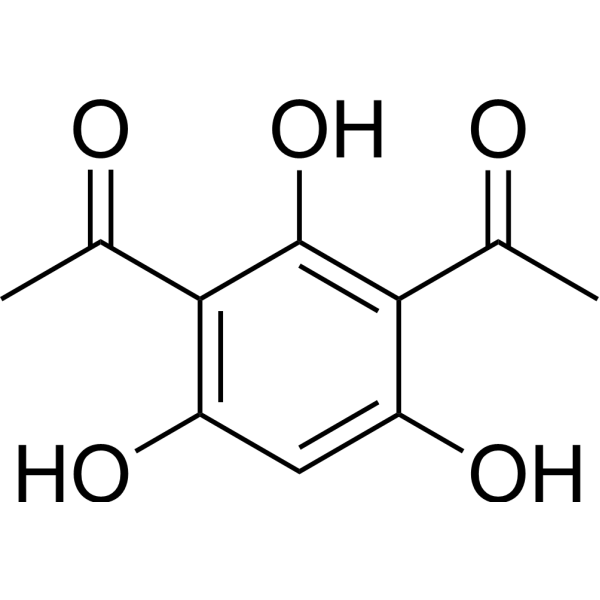
2,4-Diacetylphloroglucinol

Based on 1 Customer Validation
2,4-Diacetylphloroglucinol is a polyketide antibiotic produced by Pseudomonas fluorescens. 2,4-Diacetylphloroglucinol exhibits broad-spectrum toxicity against various organisms such as bacteria, fungi, oomycetes, and nematodes. 2,4-Diacetylphloroglucinol can also inhibit plant pathogens and affect the root development of tomato seedlings.
For research use only. We do not sell to patients.
- Purity : 99.27%
- CAS No.: 2161-86-6
- Formula: C10H10O5
- Molecular Weight:210.18
-
Storage:
-20°C, sealed storage, away from moisture
* In solvent : -80°C, 6 months; -20°C, 1 month (sealed storage, away from moisture)

To place orders, for customer services and technical support, please contact: MedChemExpress USA
Tel: 609-228-6898 E-mail: [email protected] [email protected]


-
 Biological Activity
-
Chemical Information
-
Solvent & Solubility
- Purity & Documentation
- References
-
 Help & FAQs





Biological Activity
Description
Cellular Effect
|
Cell Line

|
Type | Value | Description | References |
|---|---|---|---|---|
| LLC-PK1 | IC50 |
11 μg/mL
Compound: 4
|
Cytotoxicity against LLC-PK1 cells by neutral red assay
Cytotoxicity against LLC-PK1 cells by neutral red assay
|
[PMID: 17070063] |
| Vero | IC50 |
12 μg/mL
Compound: 4
|
Cytotoxicity against Vero cells by neutral red assay
Cytotoxicity against Vero cells by neutral red assay
|
[PMID: 17070063] |
In Vitro
2,4-Diacetylphloroglucinol (0-100 μM; 0-4 days) can inhibit the growth of the primary root, promote the production of lateral roots, induce necrosis of the primary root tip, and cause a purple stress response in the hypocotyl of tomato seedlings. The mechanism involves the auxin signaling pathway[1].
2,4-Diacetylphloroglucinol (0-40 μg/mL; 0-6 h) can inhibit the production and motility of zoospores of Plasmopara viticola and Aphanomyces cochlioides[2].
MedChemExpress (MCE) has not independently confirmed the accuracy of these methods. They are for reference only.
In Vivo
MedChemExpress (MCE) has not independently confirmed the accuracy of these methods. They are for reference only.


Chemical Information
-
CAS No. 2161-86-6
-
Appearance Solid
-
Molecular Weight 210.18
-
Formula C10H10O5
-
Color Off-white to light yellow
-
SMILES
OC1=C(C(O)=C(C(O)=C1)C(C)=O)C(C)=O
-
Shipping
Room temperature in continental US; may vary elsewhere.
-
Storage
-20°C, sealed storage, away from moisture
* In solvent : -80°C, 6 months; -20°C, 1 month (sealed storage, away from moisture)


Solvent & Solubility
In Vitro:
DMSO : 100 mg/mL (475.78 mM; Need ultrasonic; Hygroscopic DMSO has a significant impact on the solubility of product, please use newly opened DMSO)
Please refer to the solubility information to select the appropriate solvent. Once prepared, please aliquot and store the solution to prevent product inactivation from repeated freeze-thaw cycles.
Storage method and period of stock solution: -80°C, 6 months; -20°C, 1 month (sealed storage, away from moisture). When stored at -80°C, please use it within 6 months. When stored at -20°C, please use it within 1 month.
Please refer to the solubility information to select the appropriate solvent. Once prepared, please aliquot and store the solution to prevent product inactivation from repeated freeze-thaw cycles.
Storage method and period of stock solution: -80°C, 6 months; -20°C, 1 month (sealed storage, away from moisture). When stored at -80°C, please use it within 6 months. When stored at -20°C, please use it within 1 month.
Concentration (start) × Volume (start) = Concentration (final) × Volume (final)
In Vivo:
Select the appropriate dissolution method based on your experimental animal and administration route.
- For the following dissolution methods, please ensure to first prepare a clear stock solution using an In Vitro approach and then sequentially add co-solvents:
- To ensure reliable experimental results, the clarified stock solution can be appropriately stored based on storage conditions. As for the working solution for In Vivo experiments, it is recommended to prepare freshly and use it on the same day.
- The percentages shown for the solvents indicate their volumetric ratio in the final prepared solution. If precipitation or phase separation occurs during preparation, heat and/or sonication can be used to aid dissolution.
Add each solvent one by one: 10% DMSO 40% PEG300 5% Tween-80 45% Saline
Solubility: ≥ 2.5 mg/mL (11.89 mM); Clear solution
This protocol yields a clear solution of ≥ 2.5 mg/mL (saturation unknown).
Taking 1 mL working solution as an example, add 100 μL DMSO stock solution (25.0 mg/mL) to 400 μL PEG300, and mix evenly; then add 50 μL Tween-80 and mix evenly; then add 450 μL Saline to adjust the volume to 1 mL.
Preparation of Saline: Dissolve 0.9 g sodium chloride in ddH₂O and dilute to 100 mL to obtain a clear Saline solution.
Add each solvent one by one: 10% DMSO 90% (20% SBE-β-CD in Saline)
Solubility: ≥ 2.5 mg/mL (11.89 mM); Clear solution
This protocol yields a clear solution of ≥ 2.5 mg/mL (saturation unknown).
Taking 1 mL working solution as an example, add 100 μL DMSO stock solution (25.0 mg/mL) to 900 μL 20% SBE-β-CD in Saline, and mix evenly.
Preparation of 20% SBE-β-CD in Saline (4°C, storage for one week): 2 g SBE-β-CD powder is dissolved in 10 mL Saline, completely dissolve until clear.
In Vivo Dissolution Calculator
Please enter the basic information of animal experiments:
-
-
-
-
Recommended: Prepare an additional quantity of animals to account for potential losses during experiments.
Please enter your animal formula composition:
-
%DMSO +
Recommended: Keep the proportion of DMSO in working solution below 2% if your animal is weak.
-
%+
-
+%Tween-80 + +
-
%Saline +
The co-solvents required include: DMSO, . All of co-solvents are available by MedChemExpress (MCE). , Tween 80. All of co-solvents are available by MedChemExpress (MCE).
Working solution concentration: 0.22 mg/mL
Method for preparing stock solution: mg drug dissolved in μL DMSO. Stock solution concentration: mg/mL. * In solvent : -80°C, 6 months; -20°C, 1 month (sealed storage, away from moisture)
1. Take μL DMSO stock solution;
2. Add μL .
μL , mix evenly;
3. Then add μL Tween 80, mix evenly;
4. Then add μL
Please ensure that the stock solution in the first step is dissolved to a clear state, and add co-solvents in sequence. You can use ultrasonic heating (ultrasonic cleaner, recommended frequency 20-40 kHz), vortexing, etc. to assist dissolution.


Purity & Documentation
-
Data Sheet (321 KB)
-
SDS (393 KB)
- English - EN (393 KB)
- Français - FR (393 KB)
- Deutsch - DE (393 KB)
- Norwegian - NO (393 KB)
- Español - ES (393 KB)
- Swedish - SV (393 KB)
- Italian - IT (393 KB)
- Korean - KR (393 KB)
- Portuguese - PT (393 KB)
-
Handling Instructions (2659 KB)
References
[1]. Brazelton JN, et al. 2,4-diacetylphloroglucinol alters plant root development. Mol Plant Microbe Interact. 2008 Oct;21(10):1349-58. [Content Brief]
[2]. Islam MT, et al. 2,4-Diacetylphloroglucinol suppresses zoosporogenesis and impairs motility of Peronosporomycete zoospores. World J Microbiol Biotechnol. 2011 Sep;27(9):2071-2079. [Content Brief]
[3]. Susan L F Meyer, et al. Toxicity of 2,4-diacetylphloroglucinol (DAPG) to plant-parasitic and bacterial-feeding nematodes. J Nematol. 2009 Dec;41(4):274-80. [Content Brief]


Complete Stock Solution Preparation Table
Please refer to the solubility information to select the appropriate solvent. Once prepared, please aliquot and store the solution to prevent product inactivation from repeated freeze-thaw cycles.
Storage method and period of stock solution: -80°C, 6 months; -20°C, 1 month (sealed storage, away from moisture). When stored at -80°C, please use it within 6 months. When stored at -20°C, please use it within 1 month.
| Optional Solvent | Concentration Solvent Mass | 1 mg | 5 mg | 10 mg | 25 mg |
|---|---|---|---|---|---|
| DMSO | 1 mM | 4.7578 mL | 23.7891 mL | 47.5783 mL | 118.9457 mL |
| 5 mM | 0.9516 mL | 4.7578 mL | 9.5157 mL | 23.7891 mL | |
| 10 mM | 0.4758 mL | 2.3789 mL | 4.7578 mL | 11.8946 mL | |
| 15 mM | 0.3172 mL | 1.5859 mL | 3.1719 mL | 7.9297 mL | |
| 20 mM | 0.2379 mL | 1.1895 mL | 2.3789 mL | 5.9473 mL | |
| 25 mM | 0.1903 mL | 0.9516 mL | 1.9031 mL | 4.7578 mL | |
| 30 mM | 0.1586 mL | 0.7930 mL | 1.5859 mL | 3.9649 mL | |
| 40 mM | 0.1189 mL | 0.5947 mL | 1.1895 mL | 2.9736 mL | |
| 50 mM | 0.0952 mL | 0.4758 mL | 0.9516 mL | 2.3789 mL | |
| 60 mM | 0.0793 mL | 0.3965 mL | 0.7930 mL | 1.9824 mL | |
| 80 mM | 0.0595 mL | 0.2974 mL | 0.5947 mL | 1.4868 mL | |
| 100 mM | 0.0476 mL | 0.2379 mL | 0.4758 mL | 1.1895 mL |


2,4-Diacetylphloroglucinol Related Classifications
HY-118448 Related Classifications
 Powered by Bioz