



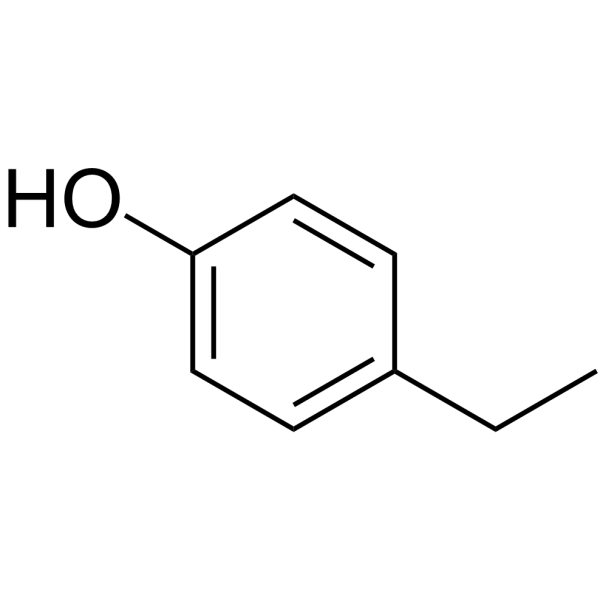
4-Ethylphenol
Based on 1 publication(s) in Google Scholar
4-Ethylphenol is a volatile phenolic compound associated with off-odour in wine. 4-Ethylphenol is a phenolic compound that can be synthesized by intestinal flora. 4-Ethylphenol will be converted to 4-ethylphenyl sulfate (HY-W674241) by Lactobacillus plantarum.
Nur für Forschungszwecke. Wir verkaufen nicht an Patienten.
- Reinheit : 99.99%
- CAS. Nr.: 123-07-9
- Formel: C8H10O
- Molecular Weight:122.17
-
Speicherung:Powder -20°C, 3 years , 4°C, 2 years ; In solvent -80°C, 2 years , -20°C, 1 year

To place orders, for customer services and technical support, please contact: MedChemExpress USA
Tel: 609-228-6898 E-mail: [email protected] [email protected]


-
 Biologische Aktivität
-
Chemical Information
-
Lösungsmittel & Löslichkeit
- Reinheit & Dokumentation
- Verweise
-
 Help & FAQs




Publications Citing Use of MedChemExpress (MCE) 4-Ethylphenol
MoreAlle Endogenous Metabolite Isoform-spezifische Produkte anzeigen
More

Biologische Aktivität
Beschreibung
In Vitro
In Vivo
4-Ethylphenol (30-300 mg/kg, po, daily for 42 days) causes mortality during labor and in offspring, leads to some abnormal nursing behaviors in Sprague Dawley rats models[3].
MedChemExpress (MCE) has not independently confirmed the accuracy of these methods. They are for reference only.
-
Animal Model:C57BL/6J mouse models[2]
-
Dosage:
-
Administration:Gavage colonization of a 1:1 mixture of 10⁹ CFU/ml Bacteroides ovatus (+/− 4EP pathway genes) and wild type Lactobacillus plantarum daily
-
Result:Reduced oligodendrocyte maturation and myelination in the brain.
Reduced time spending in the open arms of the elevated plus maze and the exposed zone of the open-field arena.
-
Animal Model:Sprague Dawley rats models[3]
-
Dosage:30-300 mg/kg
-
Administration:po, daily for 42 days
-
Result:Caused mortality in dams during labor and in offspring. Caused abnormal nursing behavior in some dams.


Chemical Information
-
CAS. Nr. 123-07-9
-
Appearance Solid
-
Molecular Weight 122.17
-
Formel C8H10O
-
Color White to light yellow
-
SMILES
OC1=CC=C(CC)C=C1
-
Structure Classification
-
Initial Source
-
Versand
Room temperature in continental US; may vary elsewhere.
-
Speicherung
Powder -20°C 3 years 4°C 2 years In solvent -80°C 2 years -20°C 1 year


Publications (1)
-
Journal Impact Factor
-
Most Recent
-
ACS Chem Neurosci
Tyrosine: A Key Neurotransmitter in Selective Serotonin Reuptake Inhibitor Treatment for Chronic Restraint Stress-Induced Reduction of Intestinal Innate Lymphoid Cell Type 3 Cells. [Abstract]2025 Jun 18;16(12):2312-2321. PMID: 40468180


Lösungsmittel & Löslichkeit
In Vitro:
DMSO : 60 mg/mL (491.12 mM; Need ultrasonic; Hygroscopic DMSO has a significant impact on the solubility of product, please use newly opened DMSO)
H2O : 2.63 mg/mL (21.53 mM; Need ultrasonic)
Please refer to the solubility information to select the appropriate solvent. Once prepared, please aliquot and store the solution to prevent product inactivation from repeated freeze-thaw cycles.
Storage method and period of stock solution: -80°C, 2 years; -20°C, 1 year. When stored at -80°C, please use it within 2 years. When stored at -20°C, please use it within 1 year.
* Note: If you choose water as the stock solution, please dilute it to the working solution, then filter and sterilize it with a 0.22 μm filter before use.
Please refer to the solubility information to select the appropriate solvent. Once prepared, please aliquot and store the solution to prevent product inactivation from repeated freeze-thaw cycles.
Storage method and period of stock solution: -80°C, 2 years; -20°C, 1 year. When stored at -80°C, please use it within 2 years. When stored at -20°C, please use it within 1 year.
* Note: If you choose water as the stock solution, please dilute it to the working solution, then filter and sterilize it with a 0.22 μm filter before use.
Konzentration (Stammlösung) × Volumen (Stammlösung) = Konzentration (Ziellösung) × Volumen (Ziellösung)
In Vivo:
Select the appropriate dissolution method based on your experimental animal and administration route.
- For the following dissolution methods, please ensure to first prepare a clear stock solution using an In Vitro approach and then sequentially add co-solvents:
- To ensure reliable experimental results, the clarified stock solution can be appropriately stored based on storage conditions. As for the working solution for In Vivo experiments, it is recommended to prepare freshly and use it on the same day.
- The percentages shown for the solvents indicate their volumetric ratio in the final prepared solution. If precipitation or phase separation occurs during preparation, heat and/or sonication can be used to aid dissolution.
Add each solvent one by one: 10% DMSO 40% PEG300 5% Tween-80 45% Saline
Solubility: ≥ 2.5 mg/mL (20.46 mM); Clear solution
This protocol yields a clear solution of ≥ 2.5 mg/mL (saturation unknown).
Taking 1 mL working solution as an example, add 100 μL DMSO stock solution (25.0 mg/mL) to 400 μL PEG300, and mix evenly; then add 50 μL Tween-80 and mix evenly; then add 450 μL Saline to adjust the volume to 1 mL.
Preparation of Saline: Dissolve 0.9 g sodium chloride in ddH₂O and dilute to 100 mL to obtain a clear Saline solution.
Add each solvent one by one: 10% DMSO 90% (20% SBE-β-CD in Saline)
Solubility: ≥ 2.5 mg/mL (20.46 mM); Clear solution
This protocol yields a clear solution of ≥ 2.5 mg/mL (saturation unknown).
Taking 1 mL working solution as an example, add 100 μL DMSO stock solution (25.0 mg/mL) to 900 μL 20% SBE-β-CD in Saline, and mix evenly.
Preparation of 20% SBE-β-CD in Saline (4°C, storage for one week): 2 g SBE-β-CD powder is dissolved in 10 mL Saline, completely dissolve until clear.
For the following dissolution methods, please prepare the working solution directly:
It is recommended to prepare fresh solutions and use them promptly within a short period of time.
The percentages shown for the solvents indicate their volumetric ratio in the final prepared solution. If precipitation or phase separation occurs during preparation, heat and/or sonication can be used to aid dissolution.
Add each solvent one by one: PBS
Solubility: 4.55 mg/mL (37.24 mM); Clear solution; Need ultrasonic and warming and heat to 60°C
In Vivo Dissolution Calculator
Please enter the basic information of animal experiments:
-
-
-
-
Recommended: Prepare an additional quantity of animals to account for potential losses during experiments.
Please enter your animal formula composition:
-
%DMSO +
Recommended: Keep the proportion of DMSO in working solution below 2% if your animal is weak.
-
%+
-
+%Tween-80 + +
-
%Saline +
The co-solvents required include: DMSO, . All of co-solvents are available by MedChemExpress (MCE). , Tween 80. All of co-solvents are available by MedChemExpress (MCE).
Working solution concentration: 0.22 mg/mL
Method for preparing stock solution: mg drug dissolved in μL DMSO. Stock solution concentration: mg/mL.
1. Take μL DMSO stock solution;
2. Add μL .
μL , mix evenly;
3. Then add μL Tween 80, mix evenly;
4. Then add μL
Please ensure that the stock solution in the first step is dissolved to a clear state, and add co-solvents in sequence. You can use ultrasonic heating (ultrasonic cleaner, recommended frequency 20-40 kHz), vortexing, etc. to assist dissolution.


Reinheit & Dokumentation
-
Data Sheet (284 KB)
-
SDS (476 KB)
- English - EN (476 KB)
- Français - FR (476 KB)
- Deutsch - DE (476 KB)
- Norwegian - NO (476 KB)
- Español - ES (476 KB)
- Swedish - SV (476 KB)
- Italian - IT (476 KB)
- Korean - KR (476 KB)
- Portuguese - PT (476 KB)
-
Handling Instructions (2659 KB)
Verweise
[1]. Nieto-Rojo R, et al. Sorption of 4-ethylguaiacol and 4-ethylphenol on yeast cell walls, using a synthetic wine. Food Chem. 2014;152:399-406. [Content Brief]
[2]. Needham BD, Funabashi M, Adame MD, Wang Z, Boktor JC, Haney J, Wu WL, Rabut C, Ladinsky MS, Hwang SJ, Guo Y, Zhu Q, Griffiths JA, Knight R, Bjorkman PJ, Shapiro MG, Geschwind DH, Holschneider DP, Fischbach MA, Mazmanian SK. A gut-derived metabolite alters brain activity and anxiety behaviour in mice. Nature. 2022 Feb;602(7898):647-653. [Content Brief]
[3]. Api AM, et al., RIFM fragrance ingredient safety assessment, p-ethylphenol, CAS Registry Number 123-07-9. Food Chem Toxicol. 2021 Mar;149 Suppl 1:111985. [Content Brief]
[4]. Midorikawa K, et al., Metabolic activation of carcinogenic ethylbenzene leads to oxidative DNA damage. Chem Biol Interact. 2004 Dec 7;150(3):271-81. [Content Brief]


Complete Stock Solution Preparation Table
Please refer to the solubility information to select the appropriate solvent. Once prepared, please aliquot and store the solution to prevent product inactivation from repeated freeze-thaw cycles.
Storage method and period of stock solution: -80°C, 2 years; -20°C, 1 year. When stored at -80°C, please use it within 2 years. When stored at -20°C, please use it within 1 year.
| Optional Solvent | Concentration Solvent Mass | 1 mg | 5 mg | 10 mg | 25 mg |
|---|---|---|---|---|---|
| H2O / DMSO | 1 mM | 8.1853 mL | 40.9266 mL | 81.8532 mL | 204.6329 mL |
| 5 mM | 1.6371 mL | 8.1853 mL | 16.3706 mL | 40.9266 mL | |
| 10 mM | 0.8185 mL | 4.0927 mL | 8.1853 mL | 20.4633 mL | |
| 15 mM | 0.5457 mL | 2.7284 mL | 5.4569 mL | 13.6422 mL | |
| 20 mM | 0.4093 mL | 2.0463 mL | 4.0927 mL | 10.2316 mL | |
| DMSO | 25 mM | 0.3274 mL | 1.6371 mL | 3.2741 mL | 8.1853 mL |
| 30 mM | 0.2728 mL | 1.3642 mL | 2.7284 mL | 6.8211 mL | |
| 40 mM | 0.2046 mL | 1.0232 mL | 2.0463 mL | 5.1158 mL | |
| 50 mM | 0.1637 mL | 0.8185 mL | 1.6371 mL | 4.0927 mL | |
| 60 mM | 0.1364 mL | 0.6821 mL | 1.3642 mL | 3.4105 mL | |
| 80 mM | 0.1023 mL | 0.5116 mL | 1.0232 mL | 2.5579 mL | |
| 100 mM | 0.0819 mL | 0.4093 mL | 0.8185 mL | 2.0463 mL |
* Note: If you choose water as the stock solution, please dilute it to the working solution, then filter and sterilize it with a 0.22 μm filter before use.


4-Ethylphenol Related Classifications
HY-W012836 Related Classifications
 Powered by Bioz