



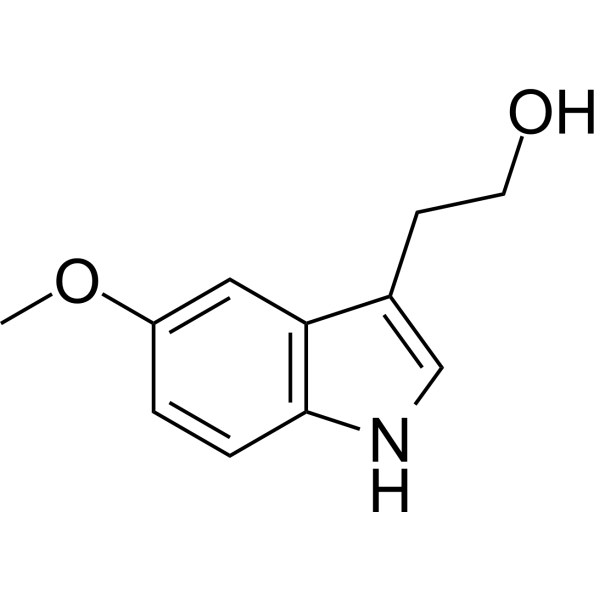
5-Methoxytryptophol
Based on 1 publication(s) in Google Scholar
5-Methoxytryptophol is a 5-methoxyindole alcohol structurally homologous to Melatonin (HY-B0075). It is secreted by the mammalian pineal gland and exhibits an inverse circadian rhythm. 5-Methoxytryptophol regulates bone metabolism by activating the ERK1/2 pathway. It reduces the levels of pro-inflammatory cytokines TNF-α and IL-1β, as well as proteolytic enzymes MMP-1 and MMP-2, in serum and dental pulp tissues, thereby ameliorating acute pulpitis. 5-Methoxytryptophol induces rapid sleep in mice, while high doses cause respiratory depression and death. 5-Methoxytryptophol. 5-Methoxytryptophol can be used in studies related to acute pulpitis, hypnosis, and bone metabolism.
Nur für Forschungszwecke. Wir verkaufen nicht an Patienten.
- Reinheit : 99.95%
- CAS. Nr.: 712-09-4
- Formel: C11H13NO2
- Molecular Weight:191.23
-
Speicherung:Pure form -20°C, 3 years , 4°C, 2 years ; In solvent -80°C, 6 months , -20°C, 1 month

To place orders, for customer services and technical support, please contact: MedChemExpress USA
Tel: 609-228-6898 E-mail: [email protected] [email protected]


-
 Biologische Aktivität
-
Chemical Information
-
Lösungsmittel & Löslichkeit
- Protokoll
- Reinheit & Dokumentation
- Verweise
-
 Help & FAQs


Publications Citing Use of MedChemExpress (MCE) 5-Methoxytryptophol
MoreAlle TNF Receptor Isoform-spezifische Produkte anzeigen
MoreAlle Endogenous Metabolite Isoform-spezifische Produkte anzeigen
More

Biologische Aktivität
Beschreibung
IC50 & Target
|
Human Endogenous Metabolite |
In Vitro
5-Methoxytryptophol (0.001-2.5 mM; 24 h) slightly reduces the metabolic activity of MC3T3-E1 preosteoblasts[2].
5-Methoxytryptophol (0.001-2.5 mM; 48 h) exhibits cytotoxicity against MC3T3-E1 preosteoblasts at concentrations of 1 mM and 2.5 mM, while doses of 0.001 mM and 0.01 mM exert protective effects[2].
5-Methoxytryptophol (0.001-2.5 mM; 14 days) reduces the total RNA content of MC3T3-E1 preosteoblasts at the concentration of 2.5 mM[2].
5-Methoxytryptophol (0.001-1 mM; 14 days) reduces Rankl mRNA expression in MC3T3-E1 preosteoblasts in a dose-dependent manner (with a stronger inhibitory effect at low doses than melatonin), and decreases Opg mRNA expression at concentrations of 0.1 and 1 mM[2].
5-Methoxytryptophol (0.1 mM; 14 days) significantly promotes osteocalcin secretion by MC3T3-E1 preosteoblasts[2].
5-Methoxytryptophol (0.1 mM; 14 days) enhances the mineralization of MC3T3-E1 preosteoblasts[2].
5-Methoxytryptophol (0.1 mM; 5 days) inhibits the formation of multinucleated TRAP-positive osteoclasts in RANKL-stimulated RAW264.7 preosteoclasts[2].
5-Methoxytryptophol (0.1 mM; 5 days) reduces the mRNA expression of Mmp-9 and CtsK in RANKL-stimulated RAW264.7 preosteoclasts, without altering the mRNA level of Trap[2].
5-Methoxytryptophol (0.1 mM; 5 days) inhibits the bone resorption activity of RANKL-stimulated RAW264.7 preosteoclasts on dentin slices[2].
5-Methoxytryptophol (0.1 mM; 2 h) activates the ERK1/2 pathway in MC3T3-E1 osteoprogenitor cells and RAW264.7 preosteoclasts (by upregulating the expression of phosphorylated ERK1/2), and this activation is inhibited by pretreatment with the melatonin receptor antagonist luzindole (HY-101254)[2].
5-Methoxytryptophol (0.01-10 mM; 50 min) inhibits lipid peroxidation in rat liver microsomal membranes, with an IC50 of 0.7 mM. Concentrations of 0.01-3 mM dose-dependently maintain membrane fluidity against oxidative stress, while the 10 mM concentration, although capable of inhibiting lipid peroxidation, fails to prevent membrane rigidification[4].
5-Methoxytryptophol (0.01-10 mM; 30 min) reduces the membrane fluidity of rat liver microsomal membranes at concentrations of 0.3-10 mM, and does not alter the level of lipid peroxidation in the absence of oxidative stress[4].
MedChemExpress (MCE) has not independently confirmed the accuracy of these methods. They are for reference only.
-
Cell Line:MC3T3-E1 preosteoblastic cells
-
Concentration:0.001 mM, 0.01 mM, 0.1 mM, 1 mM, 2.5 mM
-
Incubation Time:24 h
-
Result:Slightly reduced metabolic activity of MC3T3-E1 cells compared to vehicle control.
Showed a dose-response effect.
-
Cell Line:MC3T3-E1 preosteoblastic cells
-
Concentration:0.001 mM, 0.01 mM, 0.1 mM, 1 mM, 2.5 mM
-
Incubation Time:48 h
-
Result:Produced significantly higher LDH release at 2.5 mM and 1 mM compared to control, indicating cytotoxicity.
Showed lower LDH release at 2.5 mM than 2.5 mM melatonin.
Reduced cell death by ≤5% at 0.001 mM and 0.01 mM doses, showing a protective effect.
-
Cell Line:MC3T3-E1 preosteoblastic cells
-
Concentration:0.001 mM, 0.01 mM, 0.1 mM, 1 mM
-
Incubation Time:14 days
-
Result:Significantly decreased Rankl mRNA expression at all tested doses compared to control, with a dose-response effect where higher doses caused greater inhibition.
Decreased Rankl expression more than equivalent doses of melatonin at 0.001-0.1 mM doses.
Significantly decreased Opg mRNA expression at 0.1 mM and 1 mM compared to control.
-
Cell Line:RAW264.7 preosteoclastic cells
-
Concentration:0.1 mM (with 4 ng/mL RANKL co-treatment)
-
Incubation Time:5 days
-
Result:Did not significantly change Trap mRNA levels compared to RANKL-only control.
Significantly decreased mRNA levels of functional osteoclast markers Mmp-9 and CtsK.
-
Cell Line:MC3T3-E1 preosteoblastic cells, RAW264.7 preosteoclastic cells
-
Concentration:0.1 mM (with 0.1 mM luzindole pre-treatment for 2 h)
-
Incubation Time:2 h
-
Result:Increased phospho-ERK1/2 expression in both MC3T3-E1 and RAW264.7 cells to a greater degree than melatonin and vehicle control.
Pre-treatment with luzindole significantly reduced phospho-ERK1/2 expression induced by 5-MTX.
In Vivo
5-Methoxytryptophol (200-700 mg/kg; i.p.; single dose) induces rapid-onset sleep in healthy CD-1 mice, with mean sleep duration ranging from 5.2 min at 300 mg/kg to 43.9 min at 600 mg/kg, and an acute LD50 of about 750 mg/kg[3].
MedChemExpress (MCE) has not independently confirmed the accuracy of these methods. They are for reference only.
-
Animal Model:Wistar albino rats (male and female, 200-250 g, lipopolysaccharide-induced acute pulpitis)[1]
-
Dosage:5 mg/kg
-
Administration:i.p.; single dose
-
Result:Reduced serum and pulp tissue levels of TNF-α, IL-1β, MMP-1, and MMP-2 significantly compared to the untreated acute pulpitis group.
Showed considerable histopathological improvement compared to the untreated acute pulpitis group: 50% of samples had inflammatory reaction restricted to the 60-67.5 degree region of the pulp cavity (score 4), 12.5% had inflammatory infiltrate intensity scores of 2 (20-40 cells), 50% had scores of 3 (40-60 cells), 37.5% had scores of 4 (over 60 cells), 100% had persistent inflammatory edema, 87.5% had pulp necrosis restricted to 20-30% of the 45-105 degree area (score 3), and 12.5% had over 30% necrosis (score 4).
-
Animal Model:CD-1 (4-6 weeks old, 16-30 grams)[3]
-
Dosage:200 mg/kg; 300 mg/kg; 400 mg/kg; 500 mg/kg; 600 mg/kg; 700 mg/kg
-
Administration:i.p.
-
Result:Showed 0 out of 6 mice slept, with 0 min sleep onset and duration at 200 mg/kg.
Induced sleep in 5 out of 6 mice, with a mean sleep onset of 2.0 min and mean sleep duration of 5.2 min at 300 mg/kg.
Induced sleep in 4 out of 6 mice, with a mean sleep onset of 1.8 min and mean sleep duration of 13.8 min at 400 mg/kg.
Induced sleep in 5 out of 6 mice, with a mean sleep onset of 1.3 min and mean sleep duration of 16.3 min at 500 mg/kg.
Induced sleep in 5 out of 6 mice, with a mean sleep onset of 1.3 min and mean sleep duration of 43.9 min at 600 mg/kg.
Induced sleep in 4 out of 6 mice (2 mice died during observation), with a mean sleep onset of 1.2 min and mean sleep duration of 38.5 min at 700 mg/kg.
Exhibited an acute LD50 of about 750 mg/kg.


Chemical Information
-
CAS. Nr. 712-09-4
-
Appearance Viscous Liquid
-
Molecular Weight 191.23
-
Formel C11H13NO2
-
Color Colorless to light yellow
-
SMILES
OCCC1=CNC2=C1C=C(OC)C=C2
-
Structure Classification
-
Initial Source
-
Versand
Room temperature in continental US; may vary elsewhere.
-
Speicherung
Pure form -20°C 3 years 4°C 2 years In solvent -80°C 6 months -20°C 1 month


Publications (1)
-
Journal Impact Factor
-
Most Recent
-
STAR Protoc
Protocol for the quantification of melatonin and AFMK in cerebrospinal fluid by LC-MS/MS. [Abstract]2025 Oct 23;6(4):104145. PMID: 41134672


Lösungsmittel & Löslichkeit
In Vitro:
DMSO : 100 mg/mL (522.93 mM; Need ultrasonic; Hygroscopic DMSO has a significant impact on the solubility of product, please use newly opened DMSO)
Please refer to the solubility information to select the appropriate solvent. Once prepared, please aliquot and store the solution to prevent product inactivation from repeated freeze-thaw cycles.
Storage method and period of stock solution: -80°C, 6 months; -20°C, 1 month. When stored at -80°C, please use it within 6 months. When stored at -20°C, please use it within 1 month.
Please refer to the solubility information to select the appropriate solvent. Once prepared, please aliquot and store the solution to prevent product inactivation from repeated freeze-thaw cycles.
Storage method and period of stock solution: -80°C, 6 months; -20°C, 1 month. When stored at -80°C, please use it within 6 months. When stored at -20°C, please use it within 1 month.
Konzentration (Stammlösung) × Volumen (Stammlösung) = Konzentration (Ziellösung) × Volumen (Ziellösung)
In Vivo:
Select the appropriate dissolution method based on your experimental animal and administration route.
- For the following dissolution methods, please ensure to first prepare a clear stock solution using an In Vitro approach and then sequentially add co-solvents:
- To ensure reliable experimental results, the clarified stock solution can be appropriately stored based on storage conditions. As for the working solution for In Vivo experiments, it is recommended to prepare freshly and use it on the same day.
- The percentages shown for the solvents indicate their volumetric ratio in the final prepared solution. If precipitation or phase separation occurs during preparation, heat and/or sonication can be used to aid dissolution.
Add each solvent one by one: 10% DMSO 40% PEG300 5% Tween-80 45% Saline
Solubility: ≥ 2.5 mg/mL (13.07 mM); Clear solution
This protocol yields a clear solution of ≥ 2.5 mg/mL (saturation unknown).
Taking 1 mL working solution as an example, add 100 μL DMSO stock solution (25.0 mg/mL) to 400 μL PEG300, and mix evenly; then add 50 μL Tween-80 and mix evenly; then add 450 μL Saline to adjust the volume to 1 mL.
Preparation of Saline: Dissolve 0.9 g sodium chloride in ddH₂O and dilute to 100 mL to obtain a clear Saline solution.
Add each solvent one by one: 10% DMSO 90% (20% SBE-β-CD in Saline)
Solubility: ≥ 2.5 mg/mL (13.07 mM); Clear solution
This protocol yields a clear solution of ≥ 2.5 mg/mL (saturation unknown).
Taking 1 mL working solution as an example, add 100 μL DMSO stock solution (25.0 mg/mL) to 900 μL 20% SBE-β-CD in Saline, and mix evenly.
Preparation of 20% SBE-β-CD in Saline (4°C, storage for one week): 2 g SBE-β-CD powder is dissolved in 10 mL Saline, completely dissolve until clear.
In Vivo Dissolution Calculator
Please enter the basic information of animal experiments:
-
-
-
-
Recommended: Prepare an additional quantity of animals to account for potential losses during experiments.
Please enter your animal formula composition:
-
%DMSO +
Recommended: Keep the proportion of DMSO in working solution below 2% if your animal is weak.
-
%+
-
+%Tween-80 + +
-
%Saline +
The co-solvents required include: DMSO, . All of co-solvents are available by MedChemExpress (MCE). , Tween 80. All of co-solvents are available by MedChemExpress (MCE).
Working solution concentration: 0.22 mg/mL
Method for preparing stock solution: mg drug dissolved in μL DMSO. Stock solution concentration: mg/mL.
1. Take μL DMSO stock solution;
2. Add μL .
μL , mix evenly;
3. Then add μL Tween 80, mix evenly;
4. Then add μL
Please ensure that the stock solution in the first step is dissolved to a clear state, and add co-solvents in sequence. You can use ultrasonic heating (ultrasonic cleaner, recommended frequency 20-40 kHz), vortexing, etc. to assist dissolution.


Reinheit & Dokumentation
-
Data Sheet (294 KB)
-
SDS (393 KB)
- English - EN (393 KB)
- Français - FR (393 KB)
- Deutsch - DE (393 KB)
- Norwegian - NO (393 KB)
- Español - ES (393 KB)
- Swedish - SV (393 KB)
- Italian - IT (393 KB)
- Korean - KR (393 KB)
- Portuguese - PT (393 KB)
-
Handling Instructions (2659 KB)
Verweise
[1]. Kermeoğlu F, et al. Anti-Inflammatory Effects of Melatonin and 5-Methoxytryptophol on Lipopolysaccharide-Induced Acute Pulpitis in Rats. Biomed Res Int. 2021;2021:8884041. Published 2021 Feb 12. [Content Brief]
[2].
Satué M, et al. A new role for 5‐methoxytryptophol on bone cells function in vitro. Journal of Cellular Biochemistry. 2015 Apr;116(4):551-8.
[Content Brief]
[3].
Feldstein A, Chang FH, Kucharski JM. Tryptophol, 5-hydroxytryptophol and 5-methoxytryptophol induced sleep in mice. Life Sciences. 1970 Mar 15;9(6):323-9.
[Content Brief]
[4]. García JJ, et al. 5-methoxytryptophol preserves hepatic microsomal membrane fluidity during oxidative stress. J Cell Biochem. 2000;76(4):651-657. [Content Brief]


Complete Stock Solution Preparation Table
Please refer to the solubility information to select the appropriate solvent. Once prepared, please aliquot and store the solution to prevent product inactivation from repeated freeze-thaw cycles.
Storage method and period of stock solution: -80°C, 6 months; -20°C, 1 month. When stored at -80°C, please use it within 6 months. When stored at -20°C, please use it within 1 month.
| Optional Solvent | Concentration Solvent Mass | 1 mg | 5 mg | 10 mg | 25 mg |
|---|---|---|---|---|---|
| DMSO | 1 mM | 5.2293 mL | 26.1465 mL | 52.2931 mL | 130.7326 mL |
| 5 mM | 1.0459 mL | 5.2293 mL | 10.4586 mL | 26.1465 mL | |
| 10 mM | 0.5229 mL | 2.6147 mL | 5.2293 mL | 13.0733 mL | |
| 15 mM | 0.3486 mL | 1.7431 mL | 3.4862 mL | 8.7155 mL | |
| 20 mM | 0.2615 mL | 1.3073 mL | 2.6147 mL | 6.5366 mL | |
| 25 mM | 0.2092 mL | 1.0459 mL | 2.0917 mL | 5.2293 mL | |
| 30 mM | 0.1743 mL | 0.8716 mL | 1.7431 mL | 4.3578 mL | |
| 40 mM | 0.1307 mL | 0.6537 mL | 1.3073 mL | 3.2683 mL | |
| 50 mM | 0.1046 mL | 0.5229 mL | 1.0459 mL | 2.6147 mL | |
| 60 mM | 0.0872 mL | 0.4358 mL | 0.8716 mL | 2.1789 mL | |
| 80 mM | 0.0654 mL | 0.3268 mL | 0.6537 mL | 1.6342 mL | |
| 100 mM | 0.0523 mL | 0.2615 mL | 0.5229 mL | 1.3073 mL |


5-Methoxytryptophol Related Classifications
HY-113440 Related Classifications
 Powered by Bioz