



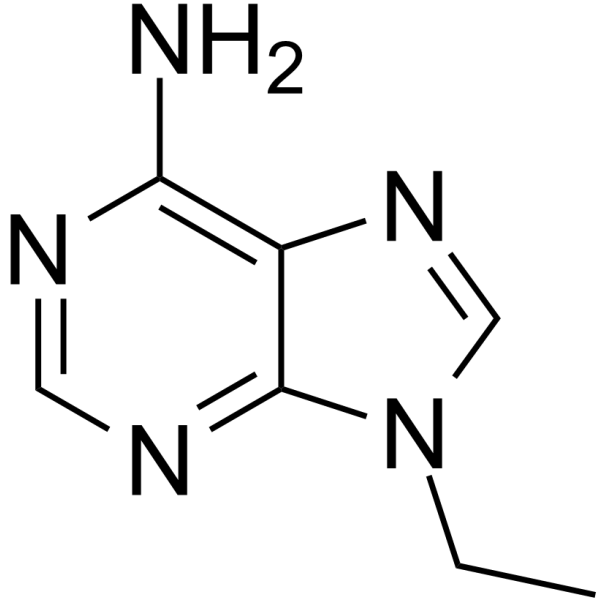
9-Ethyladenine

Based on 1 Customer Validation
9-Ethyladenine is a precursor of competitive antagonists of adenosine receptors (A1, A2, A3), with no significant inhibitory effect on adenine phosphoribosyltransferase (APRT). 9-Ethyladenine derivatives have high affinity and selectivity for A1 (Ki=27 nM), A2A (Ki=46 nM), and A3 (Ki=86 nM) receptors. 9-Ethyladenine does not inhibit brain APRT activity, can be used in the study of adenosine receptor-related diseases (such as nervous system diseases) models.
For research use only. We do not sell to patients.
- Purity : 99.79%
- CAS No.: 2715-68-6
- Formula: C7H9N5
- Molecular Weight:163.18
-
Storage:
4°C, protect from light
* In solvent : -80°C, 6 months; -20°C, 1 month (protect from light)

To place orders, for customer services and technical support, please contact: MedChemExpress USA
Tel: 609-228-6898 E-mail: [email protected] [email protected]


-
 Biological Activity
-
Chemical Information
-
Solvent & Solubility
- Purity & Documentation
- References
-
 Help & FAQs




All Adenosine Receptor Isoforms
More

Biological Activity
Description
IC50 & Target
|
Microbial Metabolite |
In Vivo
9-Ethyladenine (1.25×10⁻⁵ mol; intraperitoneal injection; 3 times a week; 4 weeks) may cause illness or even death in the above mouse models due to chronic toxicity, without self-injurious behavior[1].
MedChemExpress (MCE) has not independently confirmed the accuracy of these methods. They are for reference only.
-
Animal Model:C57BL/6 wild-type male mice (8 weeks old), HPRT-deficient male mice (8 weeks old)[1]
-
Dosage:2.5×10⁻⁶ mol, 1.25×10⁻⁵ mol
-
Administration:Intraperitoneal injection; 3 times per week; 5 weeks (2.5×10⁻⁶ mol) or 4 weeks (1.25×10⁻⁵ mol)
-
Result:Didn't result in self-injurious behavior (SIB), visible injury, or hair loss.
Resulted mice became too sick to move by week 4 at 1.25×10⁻⁵ mol dose.
Showed no significant reduction of APRT activity, compared to saline controls in both dosages.


Chemical Information
-
CAS No. 2715-68-6
-
Appearance Solid
-
Molecular Weight 163.18
-
Formula C7H9N5
-
Color White to off-white
-
SMILES
NC1=C2C(N(C=N2)CC)=NC=N1
-
Structure Classification
-
Initial Source
Escherichia coli (strain K12, MG1655)
-
Shipping
Room temperature in continental US; may vary elsewhere.
-
Storage
4°C, protect from light
* In solvent : -80°C, 6 months; -20°C, 1 month (protect from light)


Solvent & Solubility
In Vitro:
H2O : 100 mg/mL (612.82 mM; Need ultrasonic)
DMSO : 62.5 mg/mL (383.01 mM; Need ultrasonic; Hygroscopic DMSO has a significant impact on the solubility of product, please use newly opened DMSO)
Please refer to the solubility information to select the appropriate solvent. Once prepared, please aliquot and store the solution to prevent product inactivation from repeated freeze-thaw cycles.
Storage method and period of stock solution: -80°C, 6 months; -20°C, 1 month (protect from light). When stored at -80°C, please use it within 6 months. When stored at -20°C, please use it within 1 month.
* Note: If you choose water as the stock solution, please dilute it to the working solution, then filter and sterilize it with a 0.22 μm filter before use.
Please refer to the solubility information to select the appropriate solvent. Once prepared, please aliquot and store the solution to prevent product inactivation from repeated freeze-thaw cycles.
Storage method and period of stock solution: -80°C, 6 months; -20°C, 1 month (protect from light). When stored at -80°C, please use it within 6 months. When stored at -20°C, please use it within 1 month.
* Note: If you choose water as the stock solution, please dilute it to the working solution, then filter and sterilize it with a 0.22 μm filter before use.
Concentration (start) × Volume (start) = Concentration (final) × Volume (final)
In Vivo:
Select the appropriate dissolution method based on your experimental animal and administration route.
- For the following dissolution methods, please ensure to first prepare a clear stock solution using an In Vitro approach and then sequentially add co-solvents:
- To ensure reliable experimental results, the clarified stock solution can be appropriately stored based on storage conditions. As for the working solution for In Vivo experiments, it is recommended to prepare freshly and use it on the same day.
- The percentages shown for the solvents indicate their volumetric ratio in the final prepared solution. If precipitation or phase separation occurs during preparation, heat and/or sonication can be used to aid dissolution.
Add each solvent one by one: 10% DMSO 40% PEG300 5% Tween-80 45% Saline
Solubility: ≥ 3 mg/mL (18.38 mM); Clear solution
This protocol yields a clear solution of ≥ 3 mg/mL (saturation unknown).
Taking 1 mL working solution as an example, add 100 μL DMSO stock solution (30.0 mg/mL) to 400 μL PEG300, and mix evenly; then add 50 μL Tween-80 and mix evenly; then add 450 μL Saline to adjust the volume to 1 mL.
Preparation of Saline: Dissolve 0.9 g sodium chloride in ddH₂O and dilute to 100 mL to obtain a clear Saline solution.
Add each solvent one by one: 10% DMSO 90% (20% SBE-β-CD in Saline)
Solubility: ≥ 3 mg/mL (18.38 mM); Clear solution
This protocol yields a clear solution of ≥ 3 mg/mL (saturation unknown).
Taking 1 mL working solution as an example, add 100 μL DMSO stock solution (30.0 mg/mL) to 900 μL 20% SBE-β-CD in Saline, and mix evenly.
Preparation of 20% SBE-β-CD in Saline (4°C, storage for one week): 2 g SBE-β-CD powder is dissolved in 10 mL Saline, completely dissolve until clear.
For the following dissolution methods, please prepare the working solution directly:
It is recommended to prepare fresh solutions and use them promptly within a short period of time.
The percentages shown for the solvents indicate their volumetric ratio in the final prepared solution. If precipitation or phase separation occurs during preparation, heat and/or sonication can be used to aid dissolution.
Add each solvent one by one: PBS
Solubility: 33.33 mg/mL (204.25 mM); Clear solution; Need ultrasonic
In Vivo Dissolution Calculator
Please enter the basic information of animal experiments:
-
-
-
-
Recommended: Prepare an additional quantity of animals to account for potential losses during experiments.
Working solution concentration: 0.22 mg/mL
This product has good water solubility, please refer to the measured solubility data in water/PBS/Saline for details.


Purity & Documentation
-
Data Sheet (292 KB)
-
SDS (394 KB)
- English - EN (394 KB)
- Français - FR (394 KB)
- Deutsch - DE (394 KB)
- Norwegian - NO (394 KB)
- Español - ES (394 KB)
- Swedish - SV (394 KB)
- Italian - IT (394 KB)
- Korean - KR (394 KB)
- Portuguese - PT (394 KB)
-
Handling Instructions (2659 KB)
References
[1]. Edamura K, et al. No self-injurious behavior was found in HPRT-deficient mice treated with 9-ethyladenine. Pharmacol Biochem Behav. 1998 Oct;61(2):175-9. [Content Brief]
[2]. Klotz KN, et al. 9-Ethyladenine derivatives as adenosine receptor antagonists: 2- and 8-substitution results in distinct selectivities. Naunyn Schmiedebergs Arch Pharmacol. 2003 Jun;367(6):629-34. [Content Brief]


Complete Stock Solution Preparation Table
Please refer to the solubility information to select the appropriate solvent. Once prepared, please aliquot and store the solution to prevent product inactivation from repeated freeze-thaw cycles.
Storage method and period of stock solution: -80°C, 6 months; -20°C, 1 month (protect from light). When stored at -80°C, please use it within 6 months. When stored at -20°C, please use it within 1 month.
| Optional Solvent | Concentration Solvent Mass | 1 mg | 5 mg | 10 mg | 25 mg |
|---|---|---|---|---|---|
| DMSO / H2O | 1 mM | 6.1282 mL | 30.6410 mL | 61.2820 mL | 153.2051 mL |
| 5 mM | 1.2256 mL | 6.1282 mL | 12.2564 mL | 30.6410 mL | |
| 10 mM | 0.6128 mL | 3.0641 mL | 6.1282 mL | 15.3205 mL | |
| 15 mM | 0.4085 mL | 2.0427 mL | 4.0855 mL | 10.2137 mL | |
| 20 mM | 0.3064 mL | 1.5321 mL | 3.0641 mL | 7.6603 mL | |
| 25 mM | 0.2451 mL | 1.2256 mL | 2.4513 mL | 6.1282 mL | |
| 30 mM | 0.2043 mL | 1.0214 mL | 2.0427 mL | 5.1068 mL | |
| 40 mM | 0.1532 mL | 0.7660 mL | 1.5321 mL | 3.8301 mL | |
| 50 mM | 0.1226 mL | 0.6128 mL | 1.2256 mL | 3.0641 mL | |
| 60 mM | 0.1021 mL | 0.5107 mL | 1.0214 mL | 2.5534 mL | |
| 80 mM | 0.0766 mL | 0.3830 mL | 0.7660 mL | 1.9151 mL | |
| 100 mM | 0.0613 mL | 0.3064 mL | 0.6128 mL | 1.5321 mL |
* Note: If you choose water as the stock solution, please dilute it to the working solution, then filter and sterilize it with a 0.22 μm filter before use.


9-Ethyladenine Related Classifications
HY-119413 Related Classifications
 Powered by Bioz