



Benzetimide hydrochloride

Based on 1 Customer Validation
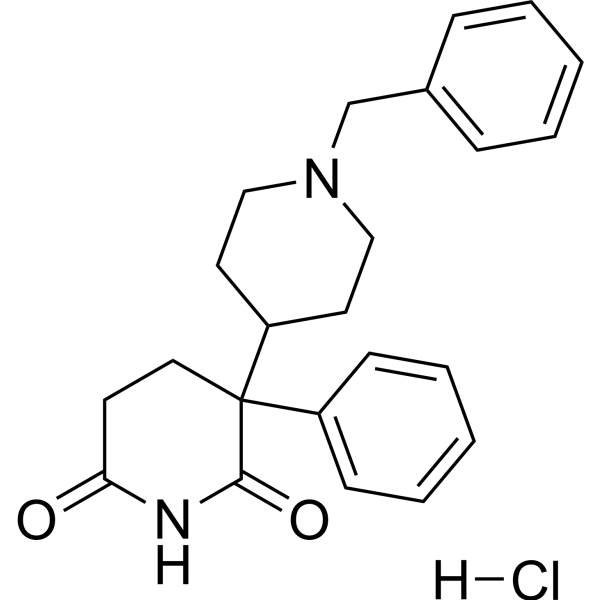
Benzetimide hydrochloride (R4929) is a blood-brain barrier-permeable muscarinic acetylcholine receptor antagonist. Benzetimide hydrochloride blocks cholinergic receptor sites. Benzetimide hydrochloride induces mydriasis, prevents acetylcholine-induced muscle contraction, inhibits pilocarpine (HY-B0726A)-induced parasympathomimetic effects, and exhibits antisecretory activity. Benzetimide hydrochloride can be used in research related to Parkinson's disease.
Nur für Forschungszwecke. Wir verkaufen nicht an Patienten.
- Reinheit : 99.44%
- CAS. Nr.: 5633-14-7
- Formel: C23H27ClN2O2
- Molecular Weight:398.93
-
Speicherung:
4°C, sealed storage, away from moisture
* In solvent : -80°C, 6 months; -20°C, 1 month (sealed storage, away from moisture)

To place orders, for customer services and technical support, please contact: MedChemExpress USA
Tel: 609-228-6898 E-mail: [email protected] [email protected]


-
 Biologische Aktivität
-
Chemical Information
-
Lösungsmittel & Löslichkeit
- Protokoll
- Reinheit & Dokumentation
- Verweise
-
 Help & FAQs




Biologische Aktivität
Beschreibung
In Vitro
Benzetimide ((+) Benzetimide) (0.02 mg/L; 30-60 min) hydrochloride inhibits acetylcholine-induced contraction of guinea pig ileal segments, whereas (-) Benzetimide at the same concentration achieves higher tissue radioactivity levels but exhibits no inhibitory activity[1].
MedChemExpress (MCE) has not independently confirmed the accuracy of these methods. They are for reference only. Further protocols information, click here.
In Vivo
Benzetimide hydrochloride (0.5 mg/kg; s.c.; single dose) has both (+) and (-) isomers that are predominantly excreted within 24 hours of subcutaneous administration, with the (-) enantiomer excreted more rapidly via urine and the (+) enantiomer excreted more heavily via feces, and with distinct metabolite proportion profiles between the isomers[1].
Benzetimide hydrochloride (2.5 mg/kg; s.c.; single dose) has both (+) and (-) isomers that penetrate rat eye and brain tissue, but only the (+) enantiomer produces anticholinergic effects (mydriasis), which are not correlated with general tissue radioactivity levels[1].
Benzetimide hydrochloride (0.02-10 mg/kg; s.c.) is a powerful antagonist of both peripheral and central parasympathomimetic effects of Pilocarpine (HY-B0726A), with an ED50AS of 0.04 mg/kg, ED50MY of 0.06 mg/kg, and ED50CA of 0.08 mg/kg[2].
MedChemExpress (MCE) has not independently confirmed the accuracy of these methods. They are for reference only.
-
Animal Model:Wistar rats (male, adult, ~250 g)[1]
-
Dosage:0.04 mg/kg (+ enantiomer); 4 mg/kg (- enantiomer)
-
Administration:s.c.; single dose
-
Result:Produced marked mydriasis at 0.04 mg/kg (+ enantiomer).
Showed no mydriasis at 4 mg/kg (- enantiomer).
-
Animal Model:Wistar rats (male, adult, ~250 g)[1]
-
Dosage:0.5 mg/kg
-
Administration:s.c.; single dose
-
Result:Excreted 29.4% of injected radioactivity in urine and 55.7% in feces over 4 days, with a total of 85.2% excreted (+ enantiomer).
Excreted 61.6% of injected radioactivity in urine and 27.3% in feces over 4 days, with a total of 88.9% excreted (- enantiomer).
Showed 12.4% unchanged reagent, 9.7% benzetamide, and 67.9% nor-benzetimide in day 1 urine (+ enantiomer).
Showed 6.9% unchanged reagent, 0.7% benzetamide, and 61.1% nor-benzetimide in day 1 urine (- enantiomer).
Showed 15.8% unchanged reagent, 41.5% benzetamide, and 39.6% nor-benzetimide in day 1 feces extracts (+ enantiomer).
Showed 7.9% unchanged reagent, 17.3% benzetamide, and 59.3% nor-benzetimide in day 1 feces extracts (- enantiomer).
-
Animal Model:Wistar rats (male, adult, ~250 g)[1]
-
Dosage:2.5 mg/kg
-
Administration:s.c.; single dose
-
Result:Reached radioactivity levels equivalent to 302 pg/mg wet tissue in eye tissue at 1 hour and 148 pg/mg wet tissue at 4 hours (+ enantiomer).
Reached radioactivity levels equivalent to 237 pg/mg wet tissue in eye tissue at 1 hour and 211 pg/mg wet tissue at 4 hours (- enantiomer).
Reached radioactivity levels equivalent to 259 pg/mg wet tissue in brain tissue at 1 hour and 155 pg/mg wet tissue at 4 hours (+ enantiomer).
Reached radioactivity levels equivalent to 143 pg/mg wet tissue in brain tissue at 1 hour and 135 pg/mg wet tissue at 4 hours (- enantiomer).
Produced maximal mydriasis still observable at 4 hours post-administration (+ enantiomer).
Showed no mydriasis even with higher eye radioactivity levels at 4 hours (- enantiomer).
-
Animal Model:Wistar (male, 215-235 g)[2]
-
Dosage:0.02 mg/kg; 0.04 mg/kg; 0.08 mg/kg; 0.16 mg/kg; 0.31 mg/kg; 1.25 mg/kg; 5 mg/kg; 10 mg/kg
-
Administration:s.c.
-
Result:Increased pilocarpine-induced mydriasis and inhibited pilocarpine-induced salivation at 0.04 mg/kg.
Induced mydriasis and inhibited pilocarpine-induced lacrimation, scratching, and hunching at 0.08 mg/kg.
Almost completely prevented pilocarpine-induced salivation, lacrimation, and scratching; slightly inhibited pilocarpine-induced hunching, piloerection, and tremors; increased basal mydriasis and pilocarpine-induced mydriasis; and showed no effect on pilocarpine-induced chewing at 0.16 mg/kg.
Antagonized pilocarpine-induced chewing at 1.25 mg/kg or higher.
Reached maximal mydriatic activity 1 hour after 0.31 mg/kg.
Partially blocked pilocarpine-induced hunching, piloerection, tremors, and chewing even at 10 mg/kg.
Achieved an ED50^MY (mydriatic activity before pilocarpine) of 0.06 mg/kg, ED50^AS (antisecretory activity) of 0.04 mg/kg, and ED50^CA (central anticholinergic activity) of 0.08 mg/kg.


Chemical Information
-
CAS. Nr. 5633-14-7
-
Appearance Solid
-
Molecular Weight 398.93
-
Formel C23H27ClN2O2
-
Color White to off-white
-
SMILES
O=C(C(C1CCN(CC2=CC=CC=C2)CC1)(C3=CC=CC=C3)CC4)NC4=O.[H]Cl
-
Synonyms
R4929; Dioxatrine
-
Versand
Room temperature in continental US; may vary elsewhere.
-
Speicherung
4°C, sealed storage, away from moisture
* In solvent : -80°C, 6 months; -20°C, 1 month (sealed storage, away from moisture)


Lösungsmittel & Löslichkeit
In Vitro:
DMSO : ≥ 32 mg/mL (80.21 mM; Hygroscopic DMSO has a significant impact on the solubility of product, please use newly opened DMSO)
H2O : 16.67 mg/mL (41.79 mM; Need ultrasonic)
* "≥" means soluble, but saturation unknown.
Please refer to the solubility information to select the appropriate solvent. Once prepared, please aliquot and store the solution to prevent product inactivation from repeated freeze-thaw cycles.
Storage method and period of stock solution: -80°C, 6 months; -20°C, 1 month (sealed storage, away from moisture). When stored at -80°C, please use it within 6 months. When stored at -20°C, please use it within 1 month.
* Note: If you choose water as the stock solution, please dilute it to the working solution, then filter and sterilize it with a 0.22 μm filter before use.
Please refer to the solubility information to select the appropriate solvent. Once prepared, please aliquot and store the solution to prevent product inactivation from repeated freeze-thaw cycles.
Storage method and period of stock solution: -80°C, 6 months; -20°C, 1 month (sealed storage, away from moisture). When stored at -80°C, please use it within 6 months. When stored at -20°C, please use it within 1 month.
* Note: If you choose water as the stock solution, please dilute it to the working solution, then filter and sterilize it with a 0.22 μm filter before use.
Konzentration (Stammlösung) × Volumen (Stammlösung) = Konzentration (Ziellösung) × Volumen (Ziellösung)
In Vivo:
Select the appropriate dissolution method based on your experimental animal and administration route.
- For the following dissolution methods, please ensure to first prepare a clear stock solution using an In Vitro approach and then sequentially add co-solvents:
- To ensure reliable experimental results, the clarified stock solution can be appropriately stored based on storage conditions. As for the working solution for In Vivo experiments, it is recommended to prepare freshly and use it on the same day.
- The percentages shown for the solvents indicate their volumetric ratio in the final prepared solution. If precipitation or phase separation occurs during preparation, heat and/or sonication can be used to aid dissolution.
Add each solvent one by one: 10% DMSO 40% PEG300 5% Tween-80 45% Saline
Solubility: ≥ 2.08 mg/mL (5.21 mM); Clear solution
This protocol yields a clear solution of ≥ 2.08 mg/mL (saturation unknown).
Taking 1 mL working solution as an example, add 100 μL DMSO stock solution (20.8 mg/mL) to 400 μL PEG300, and mix evenly; then add 50 μL Tween-80 and mix evenly; then add 450 μL Saline to adjust the volume to 1 mL.
Preparation of Saline: Dissolve 0.9 g sodium chloride in ddH₂O and dilute to 100 mL to obtain a clear Saline solution.
Add each solvent one by one: 10% DMSO 90% (20% SBE-β-CD in Saline)
Solubility: ≥ 2.08 mg/mL (5.21 mM); Clear solution
This protocol yields a clear solution of ≥ 2.08 mg/mL (saturation unknown).
Taking 1 mL working solution as an example, add 100 μL DMSO stock solution (20.8 mg/mL) to 900 μL 20% SBE-β-CD in Saline, and mix evenly.
Preparation of 20% SBE-β-CD in Saline (4°C, storage for one week): 2 g SBE-β-CD powder is dissolved in 10 mL Saline, completely dissolve until clear.
In Vivo Dissolution Calculator
Please enter the basic information of animal experiments:
-
-
-
-
Recommended: Prepare an additional quantity of animals to account for potential losses during experiments.
Working solution concentration: 0.22 mg/mL
This product has good water solubility, please refer to the measured solubility data in water/PBS/Saline for details.

Protokoll
-
Human pluripotent stem cell midbrain dopaminergic neuron differentiation
Human pluripotent stem cells are directed toward midbrain dopaminergic neurons by first inducing a neural floor-plate-like progenitor state, then patterning cells with ventralizing SHH signaling and midbrain/WNT-FGF cues, and finally maturing progenitors into neurons expressing dopaminergic markers such as TH, NURR1/NR4A2, PITX3, DAT/SLC6A3, VMAT2/SLC18A2, GIRK2/KCNJ6, FOXA2, LMX1A, and EN1. The main readouts are loss of pluripotency, acquisition of FOXA2+/LMX1A+ midbrain floor-plate progenitors, emergence of βIII-tubulin+/MAP2+ neurons, and production of TH+ dopaminergic neurons with molecular, dopamine-release, and electrophysiological features of midbrain dopaminergic identity.


Reinheit & Dokumentation
-
Data Sheet (304 KB)
-
SDS (396 KB)
- English - EN (396 KB)
- Français - FR (396 KB)
- Deutsch - DE (396 KB)
- Norwegian - NO (396 KB)
- Español - ES (396 KB)
- Swedish - SV (396 KB)
- Italian - IT (396 KB)
- Korean - KR (396 KB)
- Portuguese - PT (396 KB)
-
Handling Instructions (2659 KB)
Verweise
[1]. van Wijngaarden I. Differential anticholinergic activity, metabolism and excretion of the optical isomers of 14C-benzetimide hydrochloride. Life Sci. 1969 May 1;8(9):517-23. [Content Brief]
[2]. Janssen PA, et al. The peripheral and central anticholinergic properties of benzetimide (R 4929) and other atropine-like drugs as measured in a new anti-pilocarpine test in rats. Psychopharmacologia. 1967 Aug 4;11(3):231-54. [Content Brief]


Complete Stock Solution Preparation Table
Please refer to the solubility information to select the appropriate solvent. Once prepared, please aliquot and store the solution to prevent product inactivation from repeated freeze-thaw cycles.
Storage method and period of stock solution: -80°C, 6 months; -20°C, 1 month (sealed storage, away from moisture). When stored at -80°C, please use it within 6 months. When stored at -20°C, please use it within 1 month.
| Optional Solvent | Concentration Solvent Mass | 1 mg | 5 mg | 10 mg | 25 mg |
|---|---|---|---|---|---|
| H2O / DMSO | 1 mM | 2.5067 mL | 12.5335 mL | 25.0671 mL | 62.6676 mL |
| 5 mM | 0.5013 mL | 2.5067 mL | 5.0134 mL | 12.5335 mL | |
| 10 mM | 0.2507 mL | 1.2534 mL | 2.5067 mL | 6.2668 mL | |
| 15 mM | 0.1671 mL | 0.8356 mL | 1.6711 mL | 4.1778 mL | |
| 20 mM | 0.1253 mL | 0.6267 mL | 1.2534 mL | 3.1334 mL | |
| 25 mM | 0.1003 mL | 0.5013 mL | 1.0027 mL | 2.5067 mL | |
| 30 mM | 0.0836 mL | 0.4178 mL | 0.8356 mL | 2.0889 mL | |
| 40 mM | 0.0627 mL | 0.3133 mL | 0.6267 mL | 1.5667 mL | |
| DMSO | 50 mM | 0.0501 mL | 0.2507 mL | 0.5013 mL | 1.2534 mL |
| 60 mM | 0.0418 mL | 0.2089 mL | 0.4178 mL | 1.0445 mL | |
| 80 mM | 0.0313 mL | 0.1567 mL | 0.3133 mL | 0.7833 mL |
* Note: If you choose water as the stock solution, please dilute it to the working solution, then filter and sterilize it with a 0.22 μm filter before use.


Benzetimide hydrochloride Related Classifications
HY-B1547A Related Classifications
 Powered by Bioz