



Fenoprofen Calcium
Based on 2 publication(s) in Google Scholar
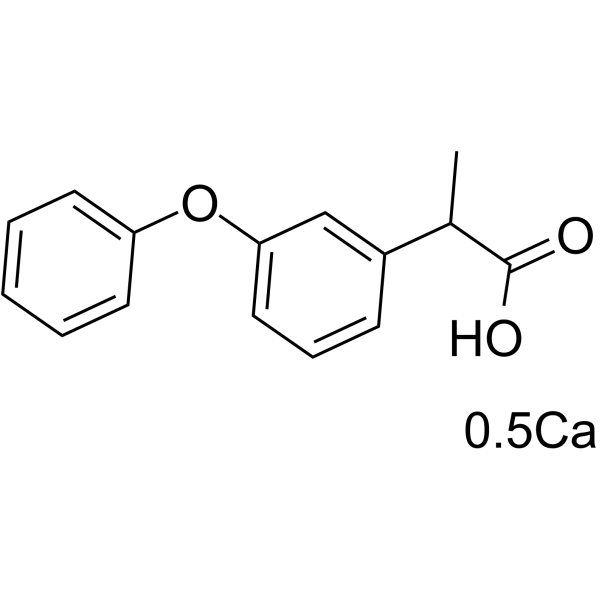
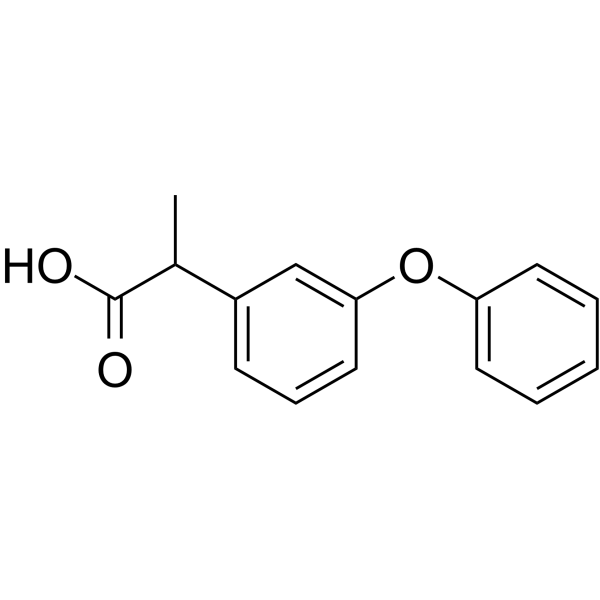
Fenoprofen (LILLY-53858) Calcium is a nonsteroidal anti-inflammatory agent (NSAID) and inhibits cyclooxygenase (COX). Fenoprofen Calcium is a melanocortin receptors (MCRs) positive allosteric modulator (PAM). Fenoprofen Calcium also increases ERK1/2 activation in HEK293T cells. Fenoprofen Calcium has anti-arthritic activities and can be used for the study of rheumatoid arthritis and osteoarthritis.
Nur für Forschungszwecke. Wir verkaufen nicht an Patienten.
- CAS. Nr.: 34597-40-5
- Formel: C15H14O3.1/2Ca
- Molecular Weight:262.31
-
Speicherung:
Please store the product under the recommended conditions in the Certificate of Analysis.

To place orders, for customer services and technical support, please contact: MedChemExpress USA
Tel: 609-228-6898 E-mail: [email protected] [email protected]


-
 Biologische Aktivität
-
Chemical Information
- Protokoll
- Reinheit & Dokumentation
- Verweise
-
 Help & FAQs



Publications Citing Use of MedChemExpress (MCE) Fenoprofen Calcium
More

Biologische Aktivität
Beschreibung
IC50 & Target
[1]|
COX |
In Vitro
In HEK293T cells, Fenoprofen Calcium stimulates ERK1/2 activation at MC3-5R in a biphasic manner, with the highest ERK1/2 activation observed at concentrations of 3 and 10 µM for MC3R, 1 µM for MC4R, and 3 µM for MC5R. No significant difference of Fenoprofen Calcium-induced pERK1/2 levels was observed in cells transfected with the empty vector pcDNA3.1 as well as MC1R. Fenoprofen Calcium induces biased signaling at MC3-5R, as it selectively activated ERK1/2 cascade but not the canonical cAMP signaling[1].
MedChemExpress (MCE) has not independently confirmed the accuracy of these methods. They are for reference only.
In Vivo
MedChemExpress (MCE) has not independently confirmed the accuracy of these methods. They are for reference only.
-
Animal Model:Male C57BL/6J wild-type (WT) mice (7-8 weeks old) and Mc3r-/- mice injected with the K/BxN serum[2]
-
Dosage:10 mg/kg
-
Administration:i.p.; twice per day from day 2; for 7 days
-
Result:Reduced paw volume and reduced disease incidence.


Chemical Information
-
CAS. Nr. 34597-40-5
-
Molecular Weight 262.31
-
Formel C15H14O3.1/2Ca
-
SMILES
CC(C(O)=O)C1=CC(OC2=CC=CC=C2)=CC=C1.[0.5Ca]
-
Synonyms
LILLY-53858 Calcium
-
Versand
Room temperature in continental US; may vary elsewhere.
-
Speicherung
Please store the product under the recommended conditions in the Certificate of Analysis.


Publications (2)
-
Journal Impact Factor
-
Most Recent
-
Int J Biol Macromol
Reticuline isomerase AKR1B1 with aldo-keto reductase activity and detoxification function from the insect Blaps rhynchopetera. [Abstract]2026 Mar:352:151224. PMID: 41791543 -
Cell Rep Methods
RECOVER identifies synergistic drug combinations in vitro through sequential model optimization. [Abstract]2023 Oct 23;3(10):100599. PMID: 37797618


Reinheit & Dokumentation
Verweise
[1]. Yuan XC, et al. Fenoprofen-An Old Drug Rediscovered as a Biased Allosteric Enhancer for Melanocortin Receptors. ACS Chem Neurosci. 2019 Mar 20;10(3):1066-1074. [Content Brief]
[2]. Montero-Melendez T, et al. Old drugs with new skills: fenoprofen as an allosteric enhancer at melanocortin receptor 3. Cell Mol Life Sci. 2017 Apr;74(7):1335-1345. [Content Brief]

Calculators
Konzentration (Stammlösung) × Volumen (Stammlösung) = Konzentration (Ziellösung) × Volumen (Ziellösung)


Fenoprofen Calcium Related Classifications
HY-B0288A Related Classifications
 Powered by Bioz