



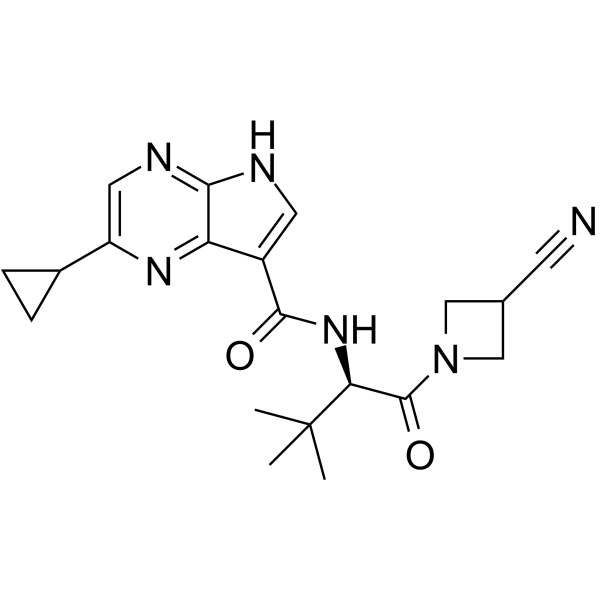
JAK-IN-1
Based on 4 publication(s) in Google Scholar
JAK-IN-1 is a JAK1/2/3 inhibitor with IC50s of 0.26, 0.8 and 3.2 nM, respectively. JAK-IN-1 shows improved selectivity for JAK3 over JAK1.
For research use only. We do not sell to patients.
- Purity : 98.39%
- CAS No.: 1334673-53-8
- Formula: C20H24N6O2
- Molecular Weight:380.44
-
Storage:Powder -20°C, 3 years , 4°C, 2 years ; In solvent -80°C, 6 months , -20°C, 1 month

To place orders, for customer services and technical support, please contact: MedChemExpress USA
Tel: 609-228-6898 E-mail: [email protected] [email protected]


-
 Biological Activity
-
Chemical Information
-
Solvent & Solubility
- Protocol
- Purity & Documentation
- References
-
 Help & FAQs


Publications Citing Use of MedChemExpress (MCE) JAK-IN-1
More

Biological Activity
Description
IC50 & Target
IC50: 0.26 nM (JAK1), 0.8 nM (JAK2), 3.2 nM (JAK3)[1]
Cellular Effect
|
Cell Line

|
Type | Value | Description | References |
|---|---|---|---|---|
| T-cell | IC50 |
0.031 μM
Compound: 2a
|
Inhibition of JAK3/1 in human T cells expressing CD3 assessed as inhibition of IL2-stimulated STAT5a phosphorylation
Inhibition of JAK3/1 in human T cells expressing CD3 assessed as inhibition of IL2-stimulated STAT5a phosphorylation
|
[PMID: 23540648] |
| T-cell | IC50 |
0.29 μM
Compound: 2a
|
Inhibition of JAK2/1 in human T cells expressing CD3 assessed as inhibition of IFNgamma-stimulated STAT1 phosphorylation
Inhibition of JAK2/1 in human T cells expressing CD3 assessed as inhibition of IFNgamma-stimulated STAT1 phosphorylation
|
[PMID: 23540648] |
In Vitro
JAK-IN-1 inhibits the proliferation of human CD4 and CD8 T cells in a dose-dependent manner upon stimulation by anti-CD3/anti-CD28 antibody-coated beads partially mimicking the activation signals brought to a Tcell by an antigen-presenting cell. JAK-IN-1 is active in both mechanistic and functional cell-based assays using T-cells, one of the major cell types in which JAK3 is potentially relevant[1].
MedChemExpress (MCE) has not independently confirmed the accuracy of these methods. They are for reference only.
In Vivo
MedChemExpress (MCE) has not independently confirmed the accuracy of these methods. They are for reference only.


Chemical Information
-
CAS No. 1334673-53-8
-
Appearance Solid
-
Molecular Weight 380.44
-
Formula C20H24N6O2
-
Color White to off-white
-
SMILES
O=C(C1=CNC2=NC=C(C3CC3)N=C21)N[C@@H](C(N4CC(C#N)C4)=O)C(C)(C)C
-
Shipping
Room temperature in continental US; may vary elsewhere.
-
Storage
Powder -20°C 3 years 4°C 2 years In solvent -80°C 6 months -20°C 1 month


Publications (4)
-
Journal Impact Factor
-
Most Recent
-
J Neuroimmune Pharmacol
Low-dose IL-2 Ameliorates Experimental Autoimmune Myasthenia Gravis in Rats by Restoring the CD4-positive Helper T-cell Balance Via the JAK/STAT5 Pathway. [Abstract]2026 Jan 31;21(1):9. PMID: 41619069 -
FASEB J
Regenerative Potential of Neonatal Tendons Is Regulated by Intrinsic Resistance to Inflammation and Supportive T-Cell-Secreted Factors. [Abstract]2025 Oct 31;39(20):e71144. PMID: 41099406 -
J Vis Exp
Mechanism of San Jie Tong Mai Fang in Atherosclerosis Attenuation by JAK/STAT-mediated Inhibition of Macrophage M1 Polarization. [Abstract]2025 Jul 18:(221). PMID: 40758612 -


Solvent & Solubility
In Vitro:
DMSO : 66.67 mg/mL (175.24 mM; Need ultrasonic; Hygroscopic DMSO has a significant impact on the solubility of product, please use newly opened DMSO)
Please refer to the solubility information to select the appropriate solvent. Once prepared, please aliquot and store the solution to prevent product inactivation from repeated freeze-thaw cycles.
Storage method and period of stock solution: -80°C, 6 months; -20°C, 1 month. When stored at -80°C, please use it within 6 months. When stored at -20°C, please use it within 1 month.
Please refer to the solubility information to select the appropriate solvent. Once prepared, please aliquot and store the solution to prevent product inactivation from repeated freeze-thaw cycles.
Storage method and period of stock solution: -80°C, 6 months; -20°C, 1 month. When stored at -80°C, please use it within 6 months. When stored at -20°C, please use it within 1 month.
Concentration (start) × Volume (start) = Concentration (final) × Volume (final)
In Vivo:
Select the appropriate dissolution method based on your experimental animal and administration route.
- For the following dissolution methods, please ensure to first prepare a clear stock solution using an In Vitro approach and then sequentially add co-solvents:
- To ensure reliable experimental results, the clarified stock solution can be appropriately stored based on storage conditions. As for the working solution for In Vivo experiments, it is recommended to prepare freshly and use it on the same day.
- The percentages shown for the solvents indicate their volumetric ratio in the final prepared solution. If precipitation or phase separation occurs during preparation, heat and/or sonication can be used to aid dissolution.
Add each solvent one by one: 10% DMSO 40% PEG300 5% Tween-80 45% Saline
Solubility: ≥ 1.43 mg/mL (3.76 mM); Clear solution
This protocol yields a clear solution of ≥ 1.43 mg/mL (saturation unknown).
Taking 1 mL working solution as an example, add 100 μL DMSO stock solution (14.3 mg/mL) to 400 μL PEG300, and mix evenly; then add 50 μL Tween-80 and mix evenly; then add 450 μL Saline to adjust the volume to 1 mL.
Preparation of Saline: Dissolve 0.9 g sodium chloride in ddH₂O and dilute to 100 mL to obtain a clear Saline solution.
In Vivo Dissolution Calculator
Please enter the basic information of animal experiments:
-
-
-
-
Recommended: Prepare an additional quantity of animals to account for potential losses during experiments.
Please enter your animal formula composition:
-
%DMSO +
Recommended: Keep the proportion of DMSO in working solution below 2% if your animal is weak.
-
%+
-
+%Tween-80 + +
-
%Saline +
The co-solvents required include: DMSO, . All of co-solvents are available by MedChemExpress (MCE). , Tween 80. All of co-solvents are available by MedChemExpress (MCE).
Working solution concentration: 0.22 mg/mL
Method for preparing stock solution: mg drug dissolved in μL DMSO. Stock solution concentration: mg/mL.
1. Take μL DMSO stock solution;
2. Add μL .
μL , mix evenly;
3. Then add μL Tween 80, mix evenly;
4. Then add μL
Please ensure that the stock solution in the first step is dissolved to a clear state, and add co-solvents in sequence. You can use ultrasonic heating (ultrasonic cleaner, recommended frequency 20-40 kHz), vortexing, etc. to assist dissolution.

Protocol
Cell Assay[1]
Carboxyfluorescein succinimidyl ester (CFSE)-labeled human PBMCs were exposed to JAK-IN-1 prior to stimulation with anti-CD3/anti-CD28 antibodies. Cell proliferation was then measured by CFSE dilutions as detected by flow cytometry in CD4 positive and CD8 positive T cells after staining with fluorochrome-conjugated antibodies[1]
MedChemExpress (MCE) has not independently confirmed the accuracy of these methods. They are for reference only.
Animal Administration[1]
Mice[1]
Adult (10−12 weeks old) C57BL/6 mice are treated with JAK-IN-1 (0.3, 1, 3, 10, 30, and 100 mg/kg). Mice received a single oral suspension dose of JAK-IN-1 or vehicle alone. Two hours after treatment by oral gavage, mice were euthanized for collecting whole blood in heparinized tubes[1].
MedChemExpress (MCE) has not independently confirmed the accuracy of these methods. They are for reference only.


Purity & Documentation
-
Data Sheet (275 KB)
-
SDS (251 KB)
- English - EN (251 KB)
- Français - FR (251 KB)
- Deutsch - DE (251 KB)
- Norwegian - NO (251 KB)
- Español - ES (251 KB)
- Swedish - SV (251 KB)
- Italian - IT (251 KB)
- Korean - KR (251 KB)
- Portuguese - PT (251 KB)
-
Handling Instructions (2659 KB)
References


Complete Stock Solution Preparation Table
Please refer to the solubility information to select the appropriate solvent. Once prepared, please aliquot and store the solution to prevent product inactivation from repeated freeze-thaw cycles.
Storage method and period of stock solution: -80°C, 6 months; -20°C, 1 month. When stored at -80°C, please use it within 6 months. When stored at -20°C, please use it within 1 month.
| Optional Solvent | Concentration Solvent Mass | 1 mg | 5 mg | 10 mg | 25 mg |
|---|---|---|---|---|---|
| DMSO | 1 mM | 2.6285 mL | 13.1427 mL | 26.2854 mL | 65.7134 mL |
| 5 mM | 0.5257 mL | 2.6285 mL | 5.2571 mL | 13.1427 mL | |
| 10 mM | 0.2629 mL | 1.3143 mL | 2.6285 mL | 6.5713 mL | |
| 15 mM | 0.1752 mL | 0.8762 mL | 1.7524 mL | 4.3809 mL | |
| 20 mM | 0.1314 mL | 0.6571 mL | 1.3143 mL | 3.2857 mL | |
| 25 mM | 0.1051 mL | 0.5257 mL | 1.0514 mL | 2.6285 mL | |
| 30 mM | 0.0876 mL | 0.4381 mL | 0.8762 mL | 2.1904 mL | |
| 40 mM | 0.0657 mL | 0.3286 mL | 0.6571 mL | 1.6428 mL | |
| 50 mM | 0.0526 mL | 0.2629 mL | 0.5257 mL | 1.3143 mL | |
| 60 mM | 0.0438 mL | 0.2190 mL | 0.4381 mL | 1.0952 mL | |
| 80 mM | 0.0329 mL | 0.1643 mL | 0.3286 mL | 0.8214 mL | |
| 100 mM | 0.0263 mL | 0.1314 mL | 0.2629 mL | 0.6571 mL |


JAK-IN-1 Related Classifications
HY-13827 Related Classifications
 Powered by Bioz