



IRE1 Activator
- 1
-
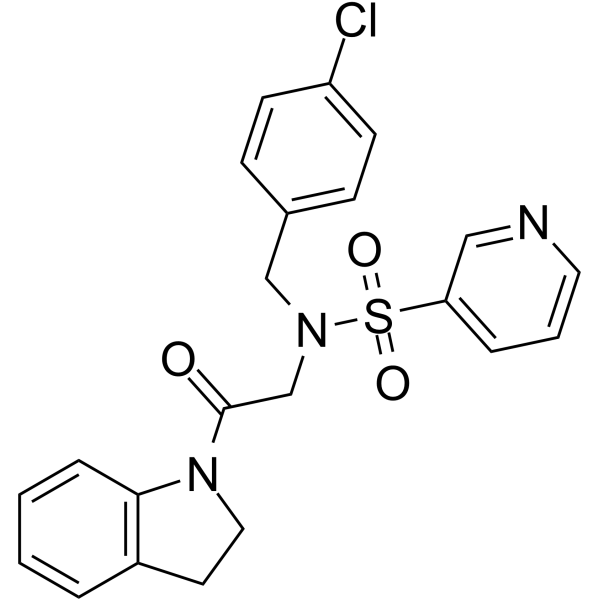
GRP78-IN-4
 0 ImagesCat. No.: HY-189800
GRP78-IN-4 is a GRP78 inhibitor with an IC50 value of 1.1 μM. GRP78-IN-4 induces the unfolded protein response through the PERK/eIF2α/ATF4/CHOP and IRE1/XBP1s signaling pathways. GRP78-IN-4 exhibits cytotoxicity in cancer cell lines. GRP78-IN-4 can be used for research on lung cancer.
-
Diphenylcyclopropenone
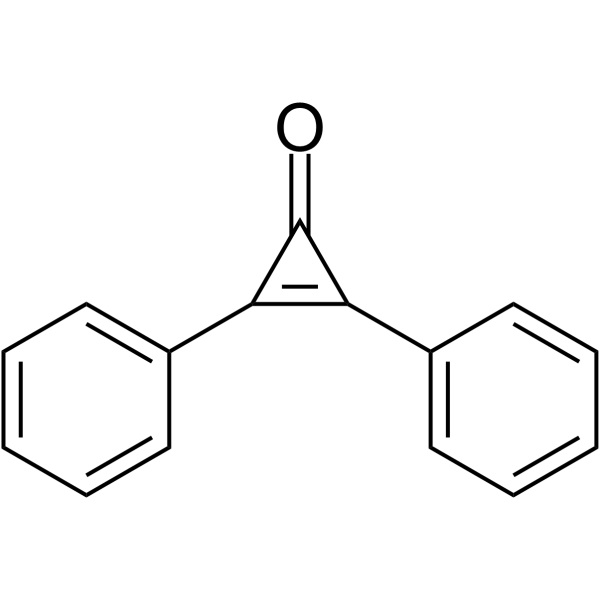 0 ImagesSynonyms: Diphencyprone
Diphenylcyclopropenone (Diphencyprone) is a potent hapten acting as a topical immunomodulatory agent, which induces an allergic contact dermatitis. Diphenylcyclopropenone induces an increase of cell-surface thiols in cells of a human monocytic cell line, THP-1. Diphenylcyclopropenone acts on the autoreactive T-lymphocytes within the follicular milieu to induce Apoptosis. Diphenylcyclopropenone can be used for alopecia areata research.
-
Palladium(Ⅱ) acetylacetonate
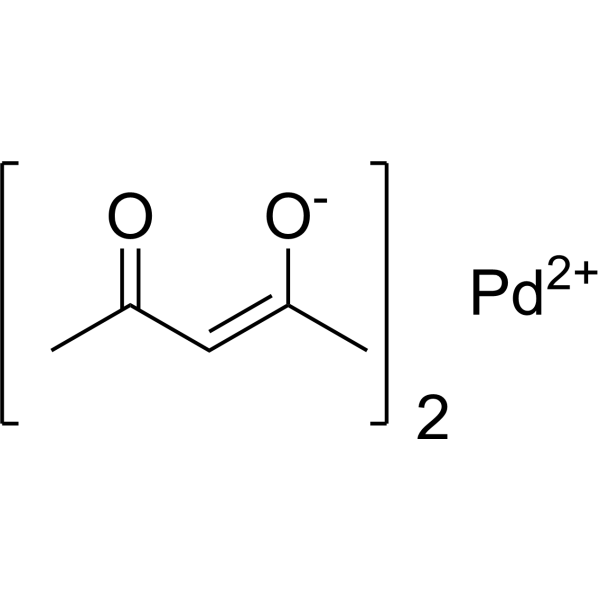 0 ImagesSynonyms: Palladium(Ⅱ) 2,4-pentanedionate; Pd(acac)2
Palladium(II) acetylacetonate is a metal-organic complex. Palladium(II) acetylacetonate upregulates the expression of GRP78, ATF-4, XBP-1, CHOP, and phosphorylated c-Jun. Palladium(II) acetylacetonate induces Apoptosis. Palladium(II) acetylacetonate has anticancer effects against non-small cell lung cancer, gastric cancer, leukemia, and cervical cancer.
-
Ironomycin
 0 Images
Ironomycin is a derivative of Salinomycin (HY-15597). Ironomycin exhibits selective inhibitory activity against mantle cell lymphoma (MCL) cells. Ironomycin blocks the cell cycle and induces apoptosis and ferroptosis. Ironomycin induces double-strand DNA breaks and activates the unfolded protein response (UPR), particularly the IRE1α signaling pathway accumulation. The combination of Ironomycin with Ibrutinib (HY-10997) shows a synergistic effect. Ironomycin can be used for the study of MCL.
-
6-Methoxydihydrosanguinarine
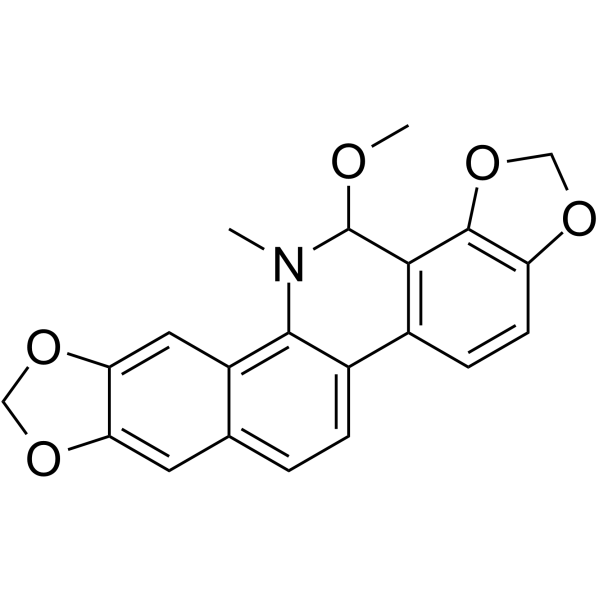 0 Images
6-Methoxydihydrosanguinarine is an alkaloid with activity across multiple cancer cell types. 6-Methoxydihydrosanguinarine activates IRE1/JNK signaling, blocks Akt/mTOR and PI3K/AKT/mTOR pathways, reduces expression of Cdc25C, CyclinB1, Cdc2, YAP/TAZ, Survivin, GPX4, and EGFR, upregulates IRE1 and DR5, and activates JNK and caspases. 6-Methoxydihydrosanguinarine induces apoptosis, G2/M phase arrest, DNA damage, ROS generation, lipid peroxidation, ferroptosis, autophagy, and suppresses cancer cell growth. 6-Methoxydihydrosanguinarine disruptes the biofilm formation of Candida albicans (C. albicans). 6-Methoxydihydrosanguinarine can be used for the research of non-small cell lung cancer, hepatocellular carcinoma, melanoma, colon carcinoma, ovarian cancer and breast cancer.
-
Diphenylcyclopropenone (Standard)
 0 ImagesSynonyms: Diphencyprone (Standard)
Diphenylcyclopropenone (Standard) is the analytical standard of Diphenylcyclopropenone. This product is intended for research and analytical applications. Diphenylcyclopropenone (Diphencyprone) is a topical immunomodulatory agent that can be used for alopecia areata research.
-
AK177
 0 ImagesCat. No.: HY-181886
AK177 is an allosteric activator of IRE1α ribonuclease, with values of 480 nM and 180 nM against non-phosphorylated and phosphorylated IRE1α, respectively. AK177 promotes IRE1α-mediated cleavage of XBP1 mRNA probe in a concentration-dependent manner and binds stably to its kinase domain. However, AK177 shows poor kinase selectivity, and due to poor membrane permeability at the cellular level, it induces no significant downstream pathway activation or antiproliferative activity.
-
SH458
 0 ImagesCat. No.: HY-189694CAS No.: 3109470-77-8
SH458 is an orally active anti-triple-negative breast cancer compound. SH458 significantly upregulates the expression of unfolded protein response (UPR)-related proteins, including p-eIF2α and p-IRE1α. SH458 induces Apoptosis, G2/M phase arrest, oxidative stress with increased ROS, DNA damage, and checkpoint kinase activation.
-
HBP-10
 0 ImagesCat. No.: HY-189745
HBP-10 is an anticancer agent containing a Michael acceptor. HBP-10 induces intracellular ROS accumulation, triggering IRE1α-JNK/CHOP-mediated ER stress, γ-H2AX-positive DNA damage, and caspase-dependent apoptosis (apoptosis). HBP-10's above effects are attenuated by NAC (HY-B0215). HBP-10 exerts antiproliferative and cytotoxic effects on NSCLC cells and shows certain selectivity for NSCLC cells. HBP-10 can be used for research on EGFR-mutant non-small cell lung cancer.
-
6-Methoxydihydrosanguinarine hydrochloride
 0 ImagesCat. No.: HY-N3000A
6-Methoxydihydrosanguinarine hydrochloride is an alkaloid with activity across multiple cancer cell types. 6-Methoxydihydrosanguinarine hydrochloride activates IRE1/JNK signaling, blocks Akt/mTOR and PI3K/AKT/mTOR pathways, reduces expression of Cdc25C, CyclinB1, Cdc2, YAP/TAZ, Survivin, GPX4, and EGFR, upregulates IRE1 and DR5, and activates JNK and caspases. 6-Methoxydihydrosanguinarine hydrochloride induces apoptosis, G2/M phase arrest, DNA damage, ROS generation, lipid peroxidation, ferroptosis, autophagy, and suppresses cancer cell growth. 6-Methoxydihydrosanguinarine hydrochloride disruptes the biofilm formation of Candida albicans (C. albicans). 6-Methoxydihydrosanguinarine hydrochloride can be used for the research of non-small cell lung cancer, hepatocellular carcinoma, melanoma, colon carcinoma, ovarian cancer and breast cancer.
- 1



