



JAK
Janus kinase
Janus kinase (JAK) is a family of intracellular, nonreceptor tyrosine kinases that transduce cytokine-mediated signals via the JAK-STAT pathway. Since members of the type I and type II cytokine receptor families possess no catalytic kinase activity, they rely on the JAK family of tyrosine kinases to phosphorylate and activate downstream proteins involved in their signal transduction pathways. The receptors exist as paired polypeptides, thus exhibiting two intracellular signal-transducing domains. JAKs associate with a proline-rich region in each intracellular domain, which is adjacent to the cell membrane and called a box1/box2 region. After the receptor associates with its respective cytokine/ligand, it goes through a conformational change, bringing the two JAKs close enough to phosphorylate each other. The JAK autophosphorylation induces a conformational change within itself, enabling it to transduce the intracellular signal by further phosphorylating and activating transcription factors called STATs. The activated STATs dissociate from the receptor and form dimers before translocating to the cell nucleus, where they regulate transcription of selected genes.
JAK Isoform Specific Products
All Product Categories
-
JAK Inhibitors
(543)
View all products
-
JAK Agonists
(2)
View all products
-
JAK Antagonists
(4)
View all products
-
JAK Activators
(24)
View all products
-
JAK Modulators
(8)
View all products
-
JAK Inducer
(1)
View all products
-
JAK Degraders
(13)
View all products
-
JAK Control
(1)
View all products
-
JAK Substrate
(1)
View all products
-
JAK Ligands
(5)
View all products
-
Janus Kinase 1 (JAK1) Proteins
(4)
View all products
-
JAK Related Products (632)
Related Products (632)

-
Recombinant Proteins (4)
-
Antibodies (7)
-
JAK Isoform Comparison
-
anti-TNBC agent-7
 0 ImagesCat. No.: HY-158439anti-TNBC agent-7 (Compound 13c) possesses anticancer activity, serving as a molecular probe to recognize and regulate the signal transduction of the USP21/JAK2/STAT3 axis, exhibiting nanomolar-level cytotoxicity against MDA-MB-231 and HCC-1806 cancer cells, effectively combating triple-negative breast cancer (TNBC).
-
JAK2-IN-5
 0 ImagesCat. No.: HY-136734CAS No.: 1110502-30-1JAK2-IN-5 (Compound 13) is a selective JAK kinase inhibitor, with an IC50 of 0.078 μM against JAK-2 and an IC50 of 0.206 μM against JAK-2V617F. JAK2-IN-5 can be used for the research of myeloproliferative disorders.
-
JAK3/BTK-IN-1
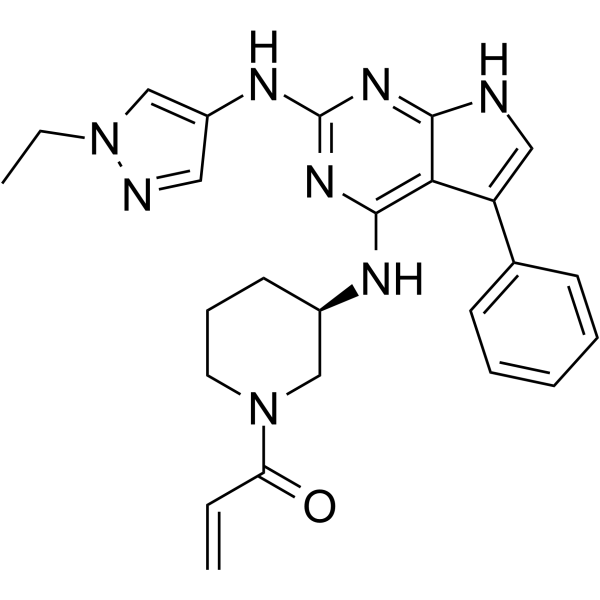 0 ImagesCat. No.: HY-143716CAS No.: 2674036-91-8JAK3/BTK-IN-1 is a potent inhibitor of JAK3/BTK. BTK and JAK3 are two important targets for autoimmune diseases. Simultaneous inhibition of the BTK/JAK3 signalling pathway exhibits synergistic effects. JAK3/BTK-IN-1 has the potential for the research of JAK3 kinase and/or BTK-related diseases (extracted from patent WO2021147952A1, compound 002).
-
Tyk2-IN-17
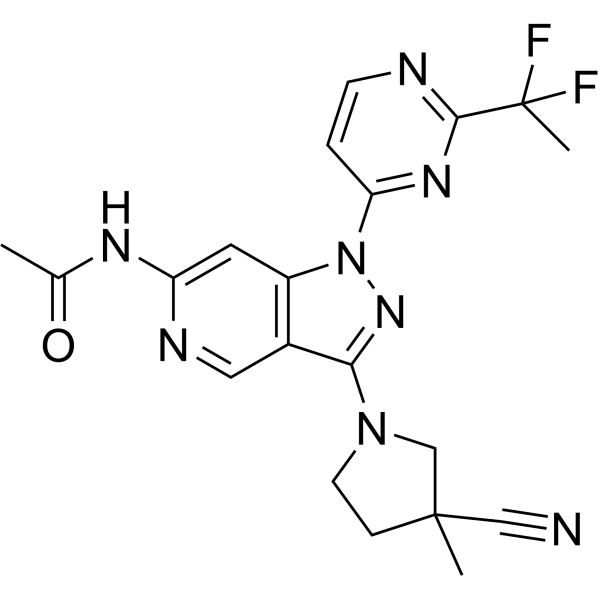 0 ImagesCat. No.: HY-163305CAS No.: 3010874-31-1Tyk2-IN-17 (compound 185) is a potent TYK2 inhibitor.
-
Radotinib dihydrochloride
 0 ImagesCat. No.: HY-179460CAS No.: 926037-85-6Synonyms: IY-5511 dihydrochlorideRadotinib (IY-5511) dihydrochloride is an orally active and BBB-permeable selective tyrosine kinase Bcr-Abl1 inhibitor with an IC50 of 34 nM. Radotinib dihydrochloride has anti-prion and anti-tumor activities. Radotinib dihydrochloride can inhibit the proliferation, induce cell cycle arrest and apoptosis of tumor cells . Radotinib dihydrochloride can be used in the research of cancer such as chronic myeloid leukemia and multiple myeloma, as well as neurodegenerative diseases such as prion diseases.
-
JAK-IN-44
 0 ImagesCat. No.: HY-188034CAS No.: 2119040-02-5JAK-IN-44 is an orally active and selective JAK2 inhibitor, with IC50 values of 0.2 nM, 7.3 nM, 21 nM and 27 nM against JAK2, TYK2, JAK1 and JAK3, respectively. JAK-IN-44 inhibits disease phenotypes in adjuvant-induced arthritis, systemic lupus erythematosus and experimental autoimmune uveitis models, and improves the survival rate of mice in LPS (HY-D1056)-induced sepsis models. JAK-IN-44 can be used in the research of autoimmune and inflammatory diseases such as systemic lupus erythematosus, uveitis, rheumatoid arthritis and sepsis.
-
Desmethoxyyangonin (Standard)
 0 ImagesCat. No.: HY-N0918RCAS No.: 15345-89-8Synonyms: Demethoxyyangonin (Standard); 5,6-Dehydrokavain (Standard)Desmethoxyyangonin (Standard) is one of the six major kavalactones found in the Piper methysticum (kava) plant. Desmethoxyyangonin (Standard) is a selective inhibitor of monoamine oxidase-B (MAO-B) (IC50: 0.123 µM). Desmethoxyyangonin (Standard) exerts anti-inflammatory effects by inhibiting Jak2/STAT3 and IKK signaling pathways. Desmethoxyyangonin (Standard) induces CYP3A23 expression and leads to skeletal muscle relaxation.
-
Upadacitinib-d5
 0 ImagesCat. No.: HY-19569S1Synonyms: ABT-494-d5Upadacitinib-d5 (ABT-494-d5) is the deuterium labeled Upadacitinib (HY-19569). Upadacitinib (ABT-494) is a potent, orally active and selective JAK1 inhibitor (IC50 = 43 nM). Upadacitinib (ABT-494) displays approximately 74 fold selective for JAK1 over JAK2 (200 nM) in cellular assays dependent on specific, relevant cytokines. Upadacitinib (ABT-494) can be used for several autoimmune disorders research.
-
AJI-214
 0 ImagesCat. No.: HY-164455CAS No.: 1395886-20-0AJI-214 is a dual-target inhibitor of Aurora kinase A and JAK2. AJI-214 directly blocks Aurora kinase A to inhibit T cell mitotic progression and cell polarity, and inhibits JAK2 activation to inhibit STAT3 phosphorylation, thereby reducing the differentiation of TH1 and TH17 cells. AJI-214 can be used in studies on regulating immune responses and preventing graft-versus-host disease (GVHD).
-
Tyk2-IN-5 (Standard)
 0 ImagesCat. No.: HY-111745RCAS No.: 1797432-62-2Tyk2-IN-5 (Standard) is the analytical standard of Tyk2-IN-5 (HY-111745). This product is intended for research and analytical applications. Tyk2-IN-5 (compound 6) is a potent, selective and orally active tyrosine Kinase 2 (Tyk2) inhibitor that acts on the JH2 structural domain. Tyk2-IN-5 shows a Ki value of 0.086 nM for Tyk2 JH2 and an IC50 value of 25 nM for IFNα. Tyk2-IN-5 efficiently inhibits the production of IFNγ in a pharmacodynamic rat model and is fully efficacious in a rat model of arthritis.
-
JAK-IN-38
 0 ImagesCat. No.: HY-162862JAK-IN-38 (Compound 1) is a JAK inhibitor, with IC50s of 0.03, 0.06, 0.12, 0.44 μM for Tyk2, JAK3, JAK2, JAK1 respectively. JAK-IN-38 is a collagen VII (C7) inducer and has anti-inflammatory activity. JAK-IN-38 can upregulate the expression of COL7A1 mRNA in donor-derived keratinocytes and works together with Gentamicin (HY-A0276A) to boost overall C7 levels.
-
JAK-IN-38
0 ImagesCat. No.: HY-162862JAK-IN-38 (Compound 1) is a JAK inhibitor, with IC50s of 0.03, 0.06, 0.12, 0.44 μM for Tyk2, JAK3, JAK2, JAK1 respectively. JAK-IN-38 is a collagen VII (C7) inducer and has anti-inflammatory activity. JAK-IN-38 can upregulate the expression of COL7A1 mRNA in donor-derived keratinocytes and works together with Gentamicin (HY-A0276A) to boost overall C7 levels.
-
WHI-P97 (Standard)
 0 ImagesCat. No.: HY-11067RCAS No.: 211555-05-4
-
Tyk2-IN-18-d3
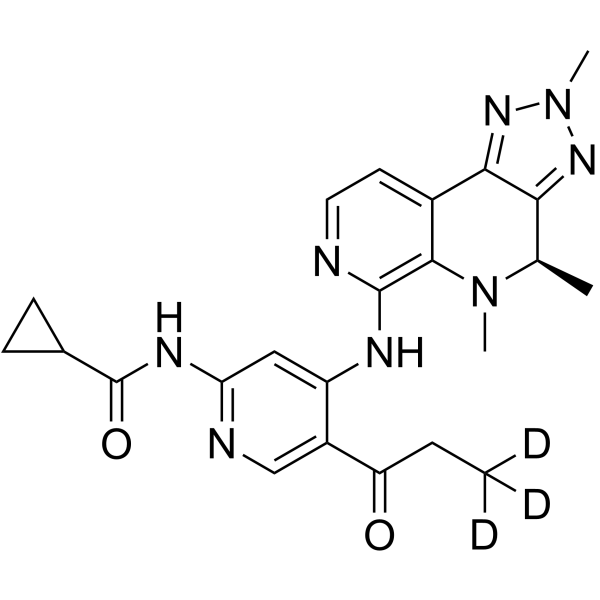 0 ImagesCat. No.: HY-163314SCAS No.: 3018160-68-1
-
TyK2-IN-2 (Standard)
 0 ImagesCat. No.: HY-101762RCAS No.: 2098466-94-3TyK2-IN-2 (Standard) is the analytical standard of TyK2-IN-2 (HY-101762). This product is intended for research and analytical applications. TyK2-IN-2 (Compoud 18) is a potent and selective TYK2 inhibitor with IC50s of 7 nM, 0.1 μM and 0.05 μM for TYK2 JH2, IL-23 and IFNα, respectively. TyK2-IN-2 also inhibits phosphodiesterase 4 (PDE4) with an IC50 of 62 nM. TyK2-IN-2 can be used for the research of inflammatory and autoimmune diseases.

-
PF-1367550
 0 ImagesCat. No.: HY-167884CAS No.: 319461-60-4
-
Tyk2-IN-26
 0 ImagesCat. No.: HY-184866CAS No.: 2824164-06-7
-
PF-06263276 (Standard)
 0 ImagesCat. No.: HY-101024RCAS No.: 1421502-62-6PF-06263276 (Standard) is the analytical standard of PF-06263276 (HY-101024). This product is intended for research and analytical applications. PF-06263276 (PF 6263276) is a potent and selective pan-JAK inhibitor, with IC50s of 2.2 nM, 23.1 nM, 59.9 nM and 29.7 nM for JAK1, JAK2, JAK3 and TYK2, respectively. PF-06263276 inhibits pSTAT3 and TYK2 pathway. PF-06263276 has a protective effect against ear skin inflammation.
-
JAK1/3-IN-1
 0 ImagesCat. No.: HY-123939CAS No.: 1400687-19-5JAK1/3-IN-1 is a selective, orally active JAK1/3 inhibitor with IC50 values of 1.9 nM and 0.9 nM, respectively. JAK1/3-IN-1 significantly reduces the mean arterial blood pressure and significantly increases the heart rate in rabbits. JAK1/3-IN-1 decreases the mean arterial blood pressure in conscious telemetered rats and induces lethal cardiovascular effects.




