



α-Tubulin
α-Tubulin partners with β-tubulin to form α/β-tubulin heterodimers that assemble microtubules, supporting cell division, intracellular transport, neuronal migration, and cytoskeletal organization[1]. Mechanistically, TUBA1A is central to brain development because it is the most prevalent α-tubulin gene expressed in post-mitotic neurons[1]. In disease models, mutations in α-tubulin cause abnormal neuronal migration in mice and lissencephaly in humans[2]. Clinical studies further show that TUBA1A mutations cause a wide spectrum of lissencephaly and suggest that multiple neuronal migration pathways converge on α-tubulins[3]. At the molecular level, TUBA1A R402 mutations dominantly disrupt cortical neuronal migration and selectively impair dynein motor activity[4]. Compared with related isoforms, TUBA1A shows strong neuronal relevance, whereas TUBA8 was described as a tissue-specific α-tubulin isoform conserved in human and mouse[1][5]. For experimental applications, TUBA1A variants provide models for testing how microtubule dynamics, XMAP215/Stu2 regulation, trafficking, synaptic maintenance, and axon guidance shape neurodevelopmental phenotypes[6][7][8]. Tubulin inhibitors remain useful research tools because colchicine-site ligands bind tubulin and interfere with microtubule assembly[9].
References:
- [1]. Aiken J, et al. The α-Tubulin gene TUBA1A in Brain Development: A Key Ingredient in the Neuronal Isotype Blend. J Dev Biol. 2017 Sep;5(3):8. [Content Brief]
- [2]. Keays DA, et al. Mutations in alpha-tubulin cause abnormal neuronal migration in mice and lissencephaly in humans. Cell. 2007;128(1):45-57. [Content Brief]
- [3]. Kumar RA, et al. TUBA1A mutations cause wide spectrum lissencephaly (smooth brain) and suggest that multiple neuronal migration pathways converge on alpha tubulins. Hum Mol Genet. 2010 Jul 15;19(14):2817-27. [Content Brief]
- [4]. Aiken J, et al. TUBA1A mutations identified in lissencephaly patients dominantly disrupt neuronal migration and impair dynein activity. Hum Mol Genet. 2019 Apr 15;28(8):1227-1243. [Content Brief]
- [5]. Stanchi F, et al. TUBA8: A new tissue-specific isoform of alpha-tubulin that is highly conserved in human and mouse. Biochem Biophys Res Commun. 2000 Apr 21;270(3):1111-8. [Content Brief]
- [6]. Hoff KJ, et al. TUBA1A tubulinopathy mutants disrupt neuron morphogenesis and override XMAP215/Stu2 regulation of microtubule dynamics. Elife. 2022 May 5;11:e76189. [Content Brief]
- [7]. Buscaglia G, et al. Reduced TUBA1A Tubulin Causes Defects in Trafficking and Impaired Adult Motor Behavior. eNeuro. 2020 Apr 27;7(2):ENEURO.0045-20.2020. [Content Brief]
- [8]. Buscaglia G, et al. Bridging the Gap: The Importance of TUBA1A α-Tubulin in Forming Midline Commissures. Front Cell Dev Biol. 2022 Jan 19;9:789438. [Content Brief]
- [9]. Wang Y, et al. Structures of a diverse set of colchicine binding site inhibitors in complex with tubulin provide a rationale for drug discovery. FEBS J. 2016 Jan;283(1):102-11. [Content Brief]
-
α-Tubulin Related Products (14)
Related Products (14)

- 1
-
Combretastatin A4
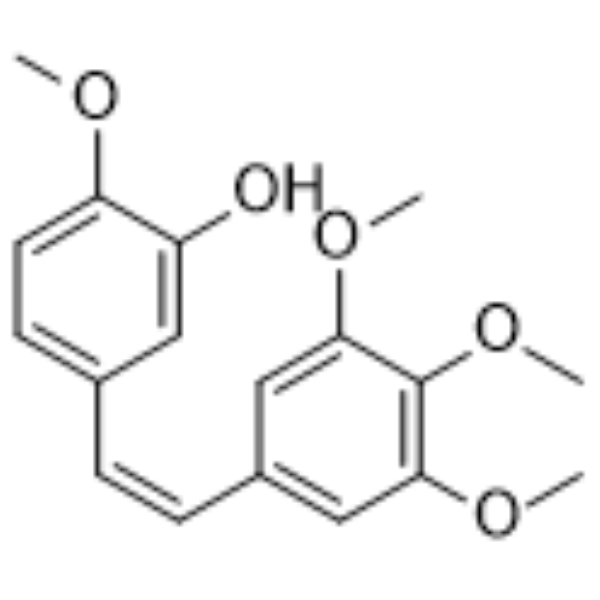 0 ImagesSynonyms: CRC 87-09Combretastatin A4 is a microtubule-targeting agent that binds β-tubulin with Kd of 0.4 μM.
-
Plecstatin-1 hydrochloride
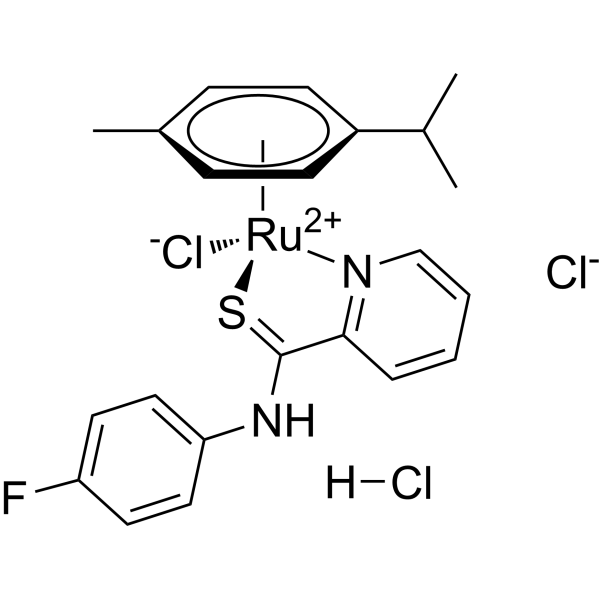 0 ImagesCat. No.: HY-156675APurity: 98.96%Plecstatin-1 hydrochloride is a metal complex that drives the aggregation and collapse of the plectin network, and disrupts the cytoskeletal structures of α‑tubulin and F‑actin. Plecstatin-1 hydrochloride triggers oxidative stress, mediates the phosphorylation of eIF2α, and induces molecular features associated with immunogenic cell death, including calreticulin membrane exposure, membrane localization of HSP70/HSP90, ATP secretion, and HMGB‑1 release. Plecstatin-1 hydrochloride induces apoptosis via the intrinsic mitochondrial pathway and exerts anti-invasive activity. Plecstatin-1 hydrochloride inhibits sphere proliferation and reduces clonogenicity in the 3D tumor spheroid model of colon cancer cells. Plecstatin-1 hydrochloride is applicable to relevant research on colorectal cancer.
-
Plecstatin-1
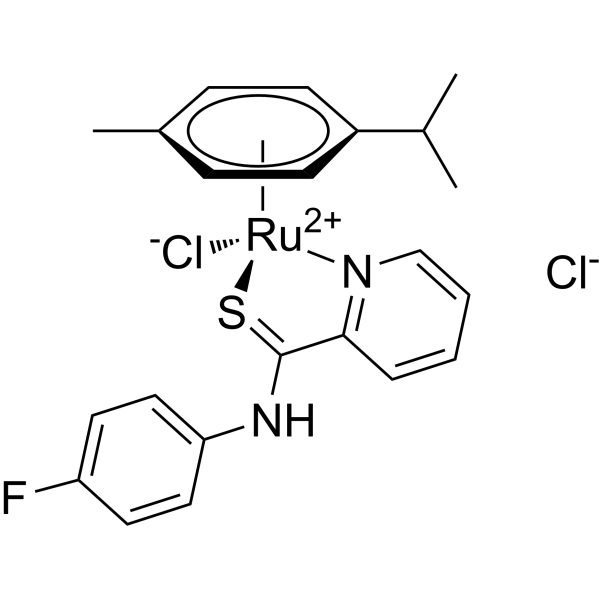 0 ImagesCat. No.: HY-156675CAS No.: 2119725-22-1Plecstatin‑1 is a metal complex that drives the aggregation and collapse of the plectin network, and disrupts the cytoskeletal structures of α‑tubulin and F‑actin. Plecstatin-1 triggers oxidative stress, mediates the phosphorylation of eIF2α, and induces molecular features associated with immunogenic cell death, including calreticulin membrane exposure, membrane localization of HSP70/HSP90, ATP secretion, and HMGB‑1 release. Plecstatin-1 induces apoptosis via the intrinsic mitochondrial pathway and exerts anti-invasive activity. Plecstatin‑1 inhibits sphere proliferation and reduces clonogenicity in the 3D tumor spheroid model of colon cancer cells. Plecstatin-1 is applicable to relevant research on colorectal cancer.
-
E7974
 0 ImagesCat. No.: HY-13614CAS No.: 610787-07-0E7974 is a selective inhibitor of α-tubulin (α-tubulin) with an IC50 of 3.9 μM. E7974 disrupts mitotic spindle formation, induces G2-M phase cell cycle arrest, initiates apoptosis, activates caspase-3, and induces poly (ADP-ribose) polymerase cleavage. E7974 reduces the area of choroidal neovascularization in mouse models, and exerts anti-angiogenic effects when loaded in modified micelles. E7974 can be used in research related to cancer and choroidal neovascularization.
-
NCT-10b
 0 ImagesCat. No.: HY-123699CAS No.: 908860-09-3NCT-10b is a selective HDAC6 inhibitor. NCT-10b mediates preferential α-tubulin acetylation without major histone H4 acetylation.NCT-10b can be used for the research of multiple myeloma.
-
Syk/HDAC6-IN-1
 0 ImagesCat. No.: HY-184415Syk/HDAC6-IN-1 is a dual SYK/HDAC6 selective inhibitor with IC50 values of 0.19 nM (SYK) and 0.66 nM (HDAC6). Syk/HDAC6-IN-1 downregulates p-SYK to block downstream AKT/FOXO1 signaling, elevates acetylated histone H3 and α-tubulin via HDAC suppression, represses SREBF1 -mediated lipid biosynthetic pathways, triggers G0/G1 cell cycle arrest and robust mitochondrial-dependent caspase-3-mediated apoptosis in leukemia cells. Syk/HDAC6-IN-1 can be used for the research of FLT3-mutant acute myeloid leukemia.
-
Tubulin degrader 1
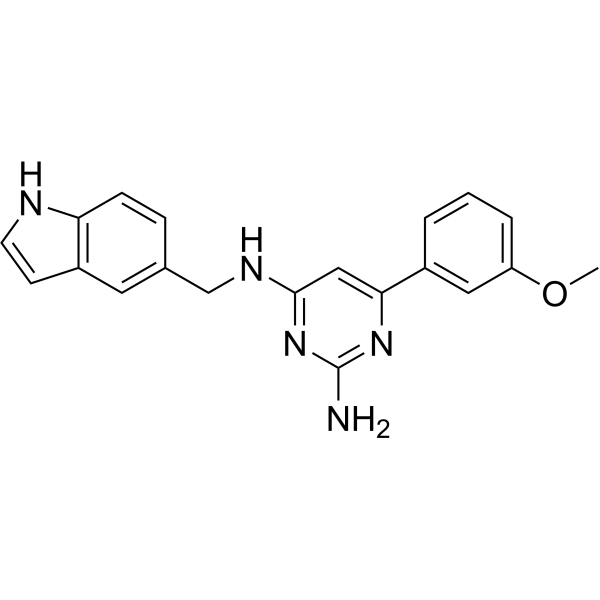 0 ImagesCat. No.: HY-161324Tubulin degrader 1, a derivative of BML284 (HY-19987), is an orally active Tubulin degrader with anti-tumor cell proliferation activity. Tubulin degrader 1 binds to the colchicine-binding site of β-tubulin, inhibits tubulin polymerization and promotes tubulin degradation. Tubulin degrader 1 inhibits microtubule polymerization, induces G2/M cell cycle arrest and apoptosis. Tubulin degrader 1 suppresses tumor growth in ovarian cancer xenograft models, induces anti-proliferative activity against tumor cells and overcomes multidrug resistance. Tubulin degrader 1 can be used in research related to various cancers including ovarian cancer.
-
HDAC1 Degrader-1
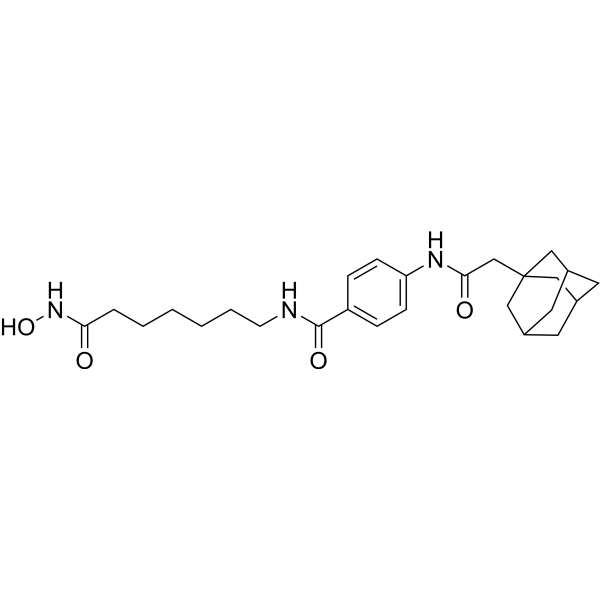 0 ImagesCat. No.: HY-157216HDAC1 Degrader-1 is a HDAC1 degrader with an IC50 of 192.3 nM. HDAC1 Degrader-1 induces degradation of HDAC1 in multiple myeloma cells via the proteasome system and enhances apoptosis of multiple myeloma cells. HDAC1 Degrader-1 can be used for research on multiple myeloma.
-
HDAC6-IN-87
 0 ImagesCat. No.: HY-189296CAS No.: 3122437-17-3HDAC6-IN-87 is a selective HDAC6 inhibitor (IC50 = 4.29 nM). HDAC6-IN-87 weakly inhibits HDAC1 (IC50 = 749.59 nM), HDAC3 (IC50 = 813.09 nM), and HDAC10 (IC50 = 679.25 nM). HDAC6-IN-87 exhibits broad-spectrum antitumor activity, elevates α-tubulin acetylation levels without affecting histone H3 acetylation, and induces cell cycle arrest and apoptosis. HDAC6-IN-87 can be used for cancer-related research.
-
Tubulin degrader 2
 0 ImagesCat. No.: HY-161641Tubulin degrader 2 is a tubulin HyT degrader and tubulin polymerization inhibitor, with a DC50 of 4.9 μM against α-tubulin in MCF-7 cells and an IC50 of 7.5 μM for the polymerization of purified recombinant tubulin. Tubulin degrader 2 binds to the colchicine-binding site of tubulin, induces proteasome-dependent degradation of α-tubulin and β-tubulin, inhibits the polymerization of purified recombinant tubulin, and triggers microtubule disruption and cell cycle arrest in cancer cells. Tubulin degrader 2 exhibits antitumor activity in a breast cancer allograft mouse model. Tubulin degrader 2 can be applied in the research of breast cancer, lung cancer, and colorectal cancer.
-
GV-001
 0 ImagesCat. No.: HY-182904CAS No.: 3082707-76-1GV-001 is a selective and orally active HDAC6 inhibitor with an IC50 of 1.18 nM against HDAC6. GV-001 selectively enhances α-tubulin acetylation, reduces sIL-6 and Collagen I levels, suppresses renal cyst growth, and upregulates PC1 expression. GV-001 can be used for the study of autosomal dominant polycystic kidney disease (ADPKD).
-
PROTAC HDAC8 Degrader-5
 0 ImagesCat. No.: HY-189151CAS No.: 3057302-21-0PROTAC HDAC8 Degrader-5 is a selective HDAC8 PROTAC degrader that mediates ubiquitination and proteasomal degradation through the formation of a ternary complex. PROTAC HDAC8 Degrader-5 degrades HDAC8 with a DC50 of 1.8 nM in MDA-MB-231 cells and a DC50 of 4.7 nM in Jurkat cells. PROTAC HDAC8 Degrader-5 inhibits cancer cell migration and proliferation, induces apoptosis through caspase 3/7 activation, and increases acetylated SMC3 and α-tubulin. PROTAC HDAC8 Degrader-5 is useful for cancer-related research, such as leukemia, triple-negative breast cancer, etc..

- 1



