



PARP1
PARP1 (poly(ADP-ribose) polymerase 1) is a nuclear ADP-ribosyltransferase that functions as an early sensor of DNA strand breaks and catalyzes poly(ADP-ribosyl)ation to recruit DNA repair factors and coordinate chromatin remodeling at sites of genomic damage[1][2]. Mechanistically, PARP1 is a central component of the DNA damage response and plays critical roles in single-strand break repair and base excision repair through the recruitment of repair proteins such as XRCC1 and associated repair complexes[1][3]. Beyond local DNA repair, PARP1 contributes to genome surveillance by transmitting damage signals that influence repair pathway selection, replication stress responses, and maintenance of genomic stability[1][4]. In disease contexts, impaired PARP1-regulated repair can promote genomic instability, whereas elevated dependence on PARP1-mediated repair is a characteristic feature of multiple cancer models, particularly tumors with homologous recombination defects[4][5]. Compared with the related isoform PARP2, PARP1 accounts for the majority of DNA damage-induced poly(ADP-ribose) synthesis and displays distinct DNA-binding properties, including efficient recognition of single-strand DNA breaks, while PARP2 preferentially recognizes repair intermediates such as DNA gaps and flaps[3][6]. These functional distinctions support nonredundant contributions of PARP1 and PARP2 to the spatial and temporal organization of DNA repair pathways[3]. For experimental applications, PARP inhibitors have become widely used tools for investigating DNA damage responses and synthetic lethality, particularly in BRCA1/2-deficient tumor models, where suppression of PARP1-dependent repair enhances the accumulation of unrepaired DNA lesions and promotes selective cancer cell death[5][7].
References:
- [1]. Wang F, et al. PARPs and PARP inhibitors: molecular mechanisms and clinical applications. Mol Biomed. 2025 Dec 29;6(1):152. [Content Brief]
- [2]. Sciencedirect.topics.
- [3]. Yelamos J, et al. PARP-1 and PARP-2: New players in tumour development. Am J Cancer Res. 2011;1(3):328-346. Epub 2011 Jan 8. PMID: 21968702; PMCID: PMC3180065. [Content Brief]
- [4]. Petropoulos M, et al. Transcription-replication conflicts underlie sensitivity to PARP inhibitors. Nature. 2024 Apr;628(8007):433-441. [Content Brief]
- [5]. Rose M, et al. PARP Inhibitors: Clinical Relevance, Mechanisms of Action and Tumor Resistance. Front Cell Dev Biol. 2020 Sep 9;8:564601. [Content Brief]
- [6]. Szántó M, et al. Specific and shared biological functions of PARP2 - is PARP2 really a lil' brother of PARP1? Expert Rev Mol Med. 2024;26:e13.
- [7]. Underhill C, et al. A review of PARP inhibitors: from bench to bedside. Ann Oncol. 2011 Feb;22(2):268-79. [Content Brief]
-
PARP1 Related Products (209)
Related Products (209)

-
Antibodies (2)
-
PARP1-IN-30
 0 ImagesCat. No.: HY-168094CAS No.: 908803-38-3
-
ARTD10/PARP10-IN-2
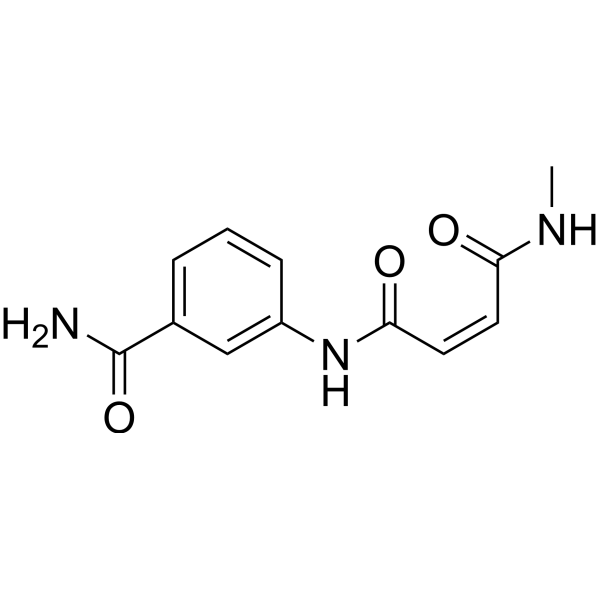 0 ImagesCat. No.: HY-148710CAS No.: 1708103-69-8ARTD10/PARP10-IN-2 (compound 19) is a potent and non-selective PARP inhibitor, targeting to mono-ADP-ribosyltransferases ARTD10/PARP10 and poly(ADP-ribose) polymerase-1 ARTD1/PARP1 with IC50s of 2.0 μM, and 9.7 μM, respectively.
-
ZINC000081009201
 0 ImagesCat. No.: HY-174836CAS No.: 1424500-13-9ZINC000081009201 is a potent poly(ADP-ribose) polymerase 1 (PARP1) inhibitor with an IC50 value of 1.4767 μM. ZINC000081009201 is promising for research of triple-negative breast cancer (TNBC).
-
YCH3971
 0 ImagesCat. No.: HY-181664YCH3971 is a PARP1 inhibitor with a PARP1 IC50 of 7.52 nM and a PARP1 EC50 of 67.75 nM. YCH3971 inhibits the proliferation of BRCA-deficient tumor cells. YCH3971 induces DNA damage, G2/M phase arrest, and caspase-mediated Apoptosis in triple-negative breast cancer cells. YCH3971 can be used for the research of BRCA-deficient tumors.

-
PARP1-IN-50
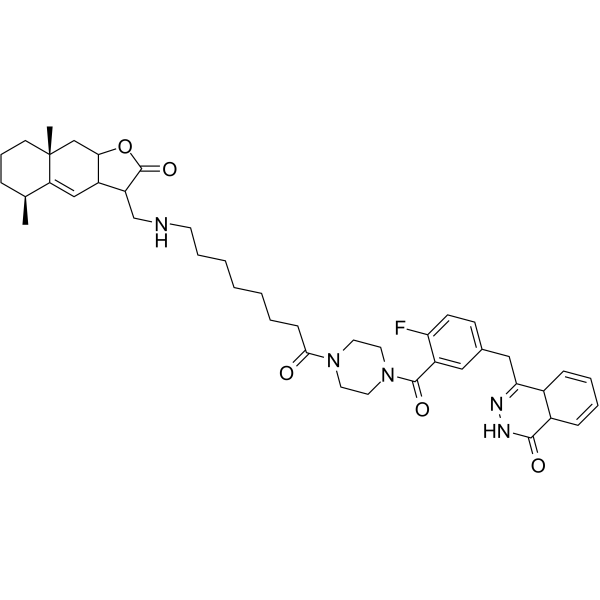
 0 ImagesCat. No.: HY-179614CAS No.: 2255341-36-5PARP1-IN-50 is a selective and orally active PARP-1 inhibitor with an IC50 of 64.98 nM. PARP1-IN-50 can inhibit PAR formation and induce DNA double strand breaks, thereby causing DNA damage. PARP1-IN-50 can induce G2/M phase arrest and cancer cells apoptosis. PARP1-IN-50 demonstrates significant antiproliferative activity against various cancer cells. PARP1-IN-50 can be used for the research of cancer, such as breast cancer.
-
TNKS-2-IN-4
 0 ImagesCat. No.: HY-167762CAS No.: 1613436-03-5TNKS-2-IN-4 (Compound 17) is a selective TNKS-2 inhibitor with an IC50 of 19 nM. TNKS-2-IN-4 exhibits anticancer activity against colorectal cancer.
-
PP-048
 0 ImagesCat. No.: HY-189225PP-048 is a selective dual inhibitor of Polθ/PARP1, with IC50 values of 4.9 nM and 6.8 nM for the Polθ helicase/ATPase domain and PARP1, respectively. PP-048 impairs the compensatory DNA repair capacity of homologous recombination-deficient cells by simultaneously inhibiting the DNA repair functions associated with Polθ and PARP1, thereby exacerbating DNA double-strand damage and inducing apoptosis. PP-048 exhibits more potent selective antiproliferative activity against HR-deficient cancer cells. PP-048 can be used in studies related to Polθ/PARP1 dual-target inhibition, synthetic lethality, DNA damage repair, and HR-deficient triple-negative breast cancer.
-
L-2286
 0 ImagesCat. No.: HY-129599CAS No.: 684276-17-3L-2286 is an orally active PARP-1 inhibitor. L-2286 alleviates carotid artery remodeling, oxidative stress and inflammation in spontaneously hypertensive rats, protects neurons in the dorsal hippocampus, and reduces pyramidal cell loss and gliosis without affecting blood pressure. L-2286 can be used in research related to hypertension.
-
MAHS-3
 0 ImagesCat. No.: HY-187513MAHS-3 is a thymidylate synthase (TS) and dihydrofolate reductase (DHFR) inhibitor, with IC50 values of 5.279 μM and 52.60 μM against human targets, respectively. MAHS-3 exhibits broad-spectrum antiproliferative activity against cancer cells, induces cell cycle arrest, activates endogenous caspase-dependent apoptosis, reduces MMP levels, inhibits cell migration, increases intracellular NO levels, and promotes autophagy activity. MAHS-3 can be used in cancer-related research.
-
PARP1-IN-35
 0 ImagesCat. No.: HY-168851PARP1-IN-35 (compound T26) is a selective, orally active, cross -the blood-brain barrierPARP1 inhibitor with IC50 values of 0.2, 122 nM for PARP1, PARP2, respectively. PARP1-IN-35 shows antiproliferative activity and anticancer activity. PARP1-IN-35 has the potential for the research of breast cancer.
-
CPP-13
 0 ImagesCat. No.: HY-187176CPP-13 is a selective PARP1 PROTAC degrader with a DC50 of 0.48 nM. CPP-13 induces CRBN-dependent ubiquitination and proteasomal degradation of PARP1. CPP-13 induces DNA damage. CPP-13 inhibits the growth of BRCA-deficient breast cancer and pancreatic cancer. CPP-13 can be used in studies related to BRCA-deficient breast cancer and BRCA-deficient pancreatic cancer.
-
PROTAC PARP1 degrader-3
 0 ImagesCat. No.: HY-168722PROTAC PARP1 degrader-3 is a PARP1 PROTAC degrader with a DC50 of 58.14 nM. PROTAC PARP1 degrader-3 promotes the ubiquitination and degradation of PARP1 via the ubiquitin-proteasome system. PROTAC PARP1 degrader-3 acts synergistically with SN-38 (HY-13704) to inhibit colorectal cancer. PROTAC PARP1 degrader-3 can be used in studies related to colorectal cancer.
-
CEP-9722
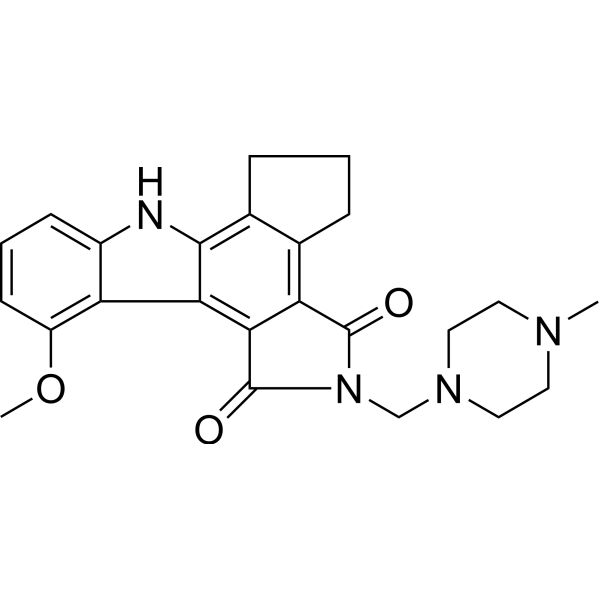 0 ImagesCat. No.: HY-105303CAS No.: 916574-83-9CEP-9722, the proagent of CEP-8983, is a selective and orally active PARP-1 and PARP-2 inhibitor with IC50s of 20 nM and 6 nM, respectively. CEP-9722 has anticancer effects.

-
PARP1-IN-58
 0 ImagesCat. No.: HY-187473PARP1-IN-58 is a ROS-responsive prodrug constructed based on a natural stilbene scaffold, and its active parent nucleus 24c acts as a selective PARP-1 inhibitor. PARP1-IN-58 only hydrolyzes to release the active parent compound in the high-ROS microenvironment of tumors; the active parent compound competitively binds to PARP-1 and blocks DNA single-strand damage repair, upregulates intracellular ROS levels, reduces mitochondrial membrane potential, and thereby induces cell cycle arrest and mitochondria-dependent apoptosis. PARP1-IN-58 exerts potent proliferation-inhibiting effects on BRCA-deficient breast cancer cells under simulated tumor oxidative stress conditions, and exhibits tumor growth inhibitory activity in breast cancer xenograft models. PARP1-IN-58 can be used in cancer-related research.

-
2'-Nitroflavone
 0 ImagesCat. No.: HY-181068CAS No.: 53277-26-22'-Nitroflavone is a PARP1 inhibitor. 2'-Nitroflavone inhibits the proliferation, induces cell cycle arrest and apoptosis of triple-negative breast cancer cells. 2'-Nitroflavone also inhibits the migration of triple-negative breast cancer cells and endothelial cells. 2'-Nitroflavone exhibits antitumor activity and can be used in the research of tumors such as triple-negative breast cancer.
-
PARP1/c-Met-IN-2
 0 ImagesCat. No.: HY-178348PARP1/c-Met-IN-2 is a highly potent, orally active, PARP1 (IC50 = 21.8 nM) and c-Met (IC50 = 30.2 nM) dual inhibitor. PARP1/c-Met-IN-2 can elevate the expression level of γH2AX, cause DNA damage. PARP1/c-Met-IN-2 exhibits remarkable anti-tumor efficacy in the Olaparib (HY-10162)-resistant HCT116 (HCT116OR) xenograft models. PARP1/c-Met-IN-2 can be used for the study of Colon Cancer.




