



PARP1 Degrader
- 1
-
PARP1 PROTAC 180055
 0 ImagesCat. No.: HY-170620Purity: 99.43%
PARP1 PROTAC 180055 is a PARP1 PROTAC degrader that recruits VHL, with DC50 values of 180 nM and 240 nM in T47D and MDA-MB-231 cells, respectively. PARP1 PROTAC 180055 selectively kills BRCA-mutant tumor cells by inducing PARP1 ubiquitination and proteasomal degradation, thereby blocking PARylation, NAD+ depletion and DNA trapping. PARP1 PROTAC 180055 can be used in the research of breast cancer, ovarian cancer, colorectal cancer, acute T-lymphoblastic leukemia, prostate cancer and osteosarcoma.
-
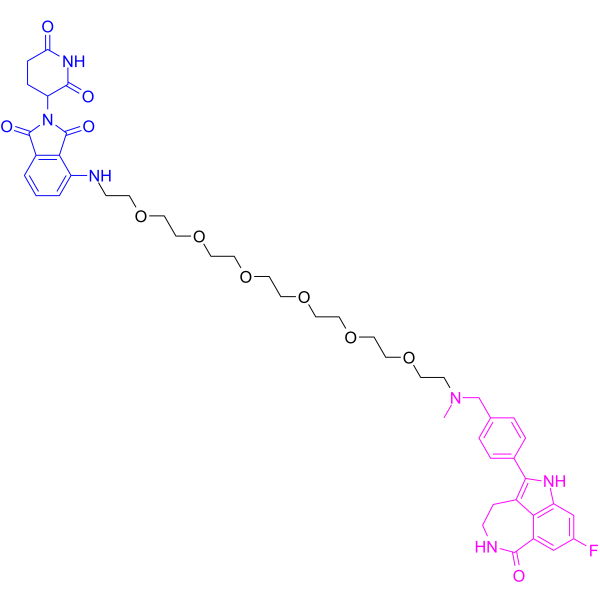
iRucaparib-AP6
 0 Images
iRucaparib-AP6 is a highly efficient and specific PROTAC PARP1 degrader. iRucaparib-AP6, a non-trapping PARP1 degrader, blocks both the catalytic activity and scaffolding effects of PARP1.
-
PROTAC PARP1 degrader-1
 0 Images
PROTAC PARP1 degrader-1 is a PARP1 PROTAC degrader with a DC50 value of 252.5 nM. PROTAC PARP1 degrader-1, combined with Daunorubicin (HY-13062A), induces the accumulation of cytoplasmic DNA fragments, activates the cGAS/STING innate immune pathway, and remodels the tumor microenvironment. PROTAC PARP1 degrader-1 can be used in research related to breast cancer.
-
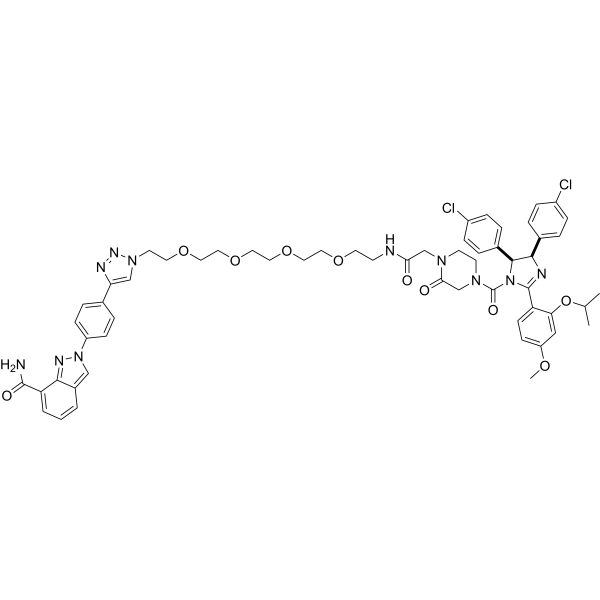
PROTAC PARP1 degrader
 0 Images
PROTAC PARP1 degrader is a PROTAC PARP1 degrader. PROTAC PARP1 degrader mediates the interaction between PARP1 and MDM2 E3 ubiquitin ligase, thereby inducing ubiquitination of PARP1 and subsequent proteasome-mediated degradation. PROTAC PARP1 degrader selectively inhibits the growth of breast cancer cells. PROTAC PARP1 degrader induces cell apoptosis by activating caspase-3 and phosphatidylserine externalization. PROTAC PARP1 degrader can be used in the research of triple-negative breast cancer.
-
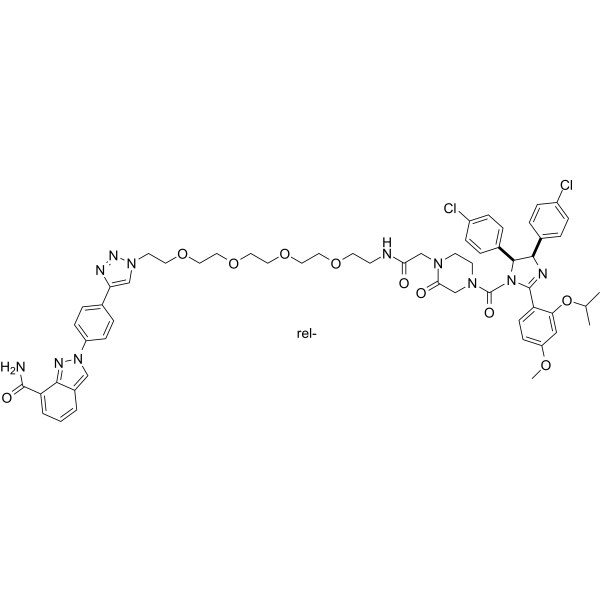
rel-PROTAC PARP1 degrader
 0 ImagesCat. No.: HY-114324APurity: 98.32%
rel-PROTAC PARP1 degrader is the relative configuration of ROTAC PARP1 degrader (HY-114324). PROTAC PARP1 degrader is a PROTAC PARP1 degrader. PROTAC PARP1 degrader mediates the interaction between PARP1 and MDM2 E3 ubiquitin ligase, thereby inducing ubiquitination of PARP1 and subsequent proteasome-mediated degradation. PROTAC PARP1 degrader selectively inhibits the growth of breast cancer cells. PROTAC PARP1 degrader induces cell apoptosis by activating caspase-3 and phosphatidylserine externalization. PROTAC PARP1 degrader can be used in the research of triple-negative breast cancer.
-
iVeliparib-AP6
 0 ImagesCat. No.: HY-130646CAS No.: 2472645-27-3
iVeliparib-AP6 is a proteolysis-targeting chimera (PROTAC) molecule designed based on Veliparib (HY-10129), which targets PARP1/2. The DC50s of iVeliparib-AP6 for inducing the degradation of PARP1 and PARP2 are 36 nM and 63 nM, respectively, and its IC50s are 69 nM and 21 nM, respectively. iVeliparib-AP6 contains a Veliparib-based PARP inhibitor warhead linked to a CRBN E3 ligase binder; it uses Thalidomide (HY-14658) as a ligand to recruit CRBN E3 ubiquitin ligase and exerts the PARP2 degradation mechanism.
-
DDO3602
 0 ImagesCat. No.: HY-178496
DDO3602 is a PARP1 HSPTAC (HSP90-mediated proteolysis-targeting chimera) degrader, with a DC50 of 490.3 nM against PARP1; its Kd values for PARP1 and HSP90 are 66.5 nM and 1.64 nM, respectively. DDO3602 induces the formation of an unnatural PARP1-HSP90 ternary complex, recruits E3 ubiquitin ligase, and promotes PARP1 degradation via the ubiquitin-proteasome pathway. DDO3602 induces G2/M cell cycle arrest, DNA damage, inhibits cell migration, and exhibits antiproliferative activity in breast cancer cells. DDO3602 can be used in breast cancer-related research.
-
2H-Indazole-7-carboxamide
 0 ImagesCat. No.: HY-W973851CAS No.: 952479-70-8
2H-Indazole-7-carboxamide is a PARP1 ligand and can be used for the synthesis of PROTACs, such as PROTAC PARP1 degrader-1 (HY-158045).
-
iRucaparib-TP3
 0 ImagesCat. No.: HY-130645CAS No.: 2410557-01-4
-
Antitumor agent-214
 0 ImagesCat. No.: HY-181720CAS No.: 1911631-77-0
Antitumor agent-214 is a chalcone analogue with anti-tumor activity. Antitumor agent-214 induces cell cycle arrest and apoptosis in tumor cells, disrupts mitochondrial metabolism, and upregulates the expression of caspase 3, caspase 7 and caspase 9, downregulates PARP1. Antitumor agent-214 can be used for anti-tumor research related to colorectal cancer, breast cancer, lung cancer, and cervical cancer.

-
PROTAC PARP1 degrader-5
 0 ImagesCat. No.: HY-181967
PROTAC PARP1 degrader-5 is a PARP1 PROTAC degrader with a DC50 of 0.12 μM. PROTAC PARP1 degrader-5 hijacks the ubiquitin-proteasome system via catalytic ternary complex formation to drive sustained PARP1 degradation. PROTAC PARP1 degrader-5 induces DNA damage, drives marginal cytosolic double-stranded DNA accumulation in tumor cells, and up-regulates PD-L1 surface expression in tumor cells. PROTAC PARP1 degrader-5 shows tumor growth inhibition activity in murine melanoma models when encapsulated in lipid nanoparticles. PROTAC PARP1 degrader-5 can be used for the research of cancer, such as melanoma.
-
PARP1 degrader 1
 0 ImagesCat. No.: HY-180276
PARP1 degrader 1 (Compound 2c) is a comparatively potent PARP1 HyT degrader (DC50: 618 nM for intracellular PARP-1). PARP1 degrader 1 is also a HyT-Olaparib (HY-10162) conjugate. PARP1 degrader 1 induces UPR/autophagy, thus facilitating the degradation of PARP-1. PARP1 Degrader 1 can be used in the research of cancer.
-
PARP1 degrader-2
 0 ImagesCat. No.: HY-181460
PARP1 degrader-2 (Compound 11e) is a potent, selective PARP1 HYT degrader (DC50: 2.16 μM). PARP1 degrader-2 selectively binds to and degrades PARP1 but not PARP2. PARP1 degrader-2 mediates the degradation of PARP1 via the ubiquitin-proteasome system (UPS). PARP1 degrader-2 exhibits anticancer activity against triple-negative breast cancer and colon cancer (hydrophobic tag: (HY-W022007); PARP1 ligand: (HY-75706); Linker: (HY-W015300)).
-
PARP1 degrader-3
 0 ImagesCat. No.: HY-189293
PARP1 degrader-3 is a selective PARP1 degrader derived from Olaparib (HY-10162) bearing a bicyclo[1.1.1]pentane (BCP) hydrophobic tag. PARP1 degrader-3 degrades PARP1 with a DC50 of 4.31 μM. PARP1 degrader-3 induces PARP1 degradation primarily through the ubiquitin-proteasome system, and the HSP70/HSP90-associated protein quality control pathway may be involved in this process. PARP1 degrader-3 can be used for colorectal cancer-related research.
-
CPP-13
 0 ImagesCat. No.: HY-187176
CPP-13 is a selective PARP1 PROTAC degrader with a DC50 of 0.48 nM. CPP-13 induces CRBN-dependent ubiquitination and proteasomal degradation of PARP1. CPP-13 induces DNA damage. CPP-13 inhibits the growth of BRCA-deficient breast cancer and pancreatic cancer. CPP-13 can be used in studies related to BRCA-deficient breast cancer and BRCA-deficient pancreatic cancer.
-
PROTAC PARP1 degrader-3
 0 ImagesCat. No.: HY-168722
PROTAC PARP1 degrader-3 is a PARP1 PROTAC degrader with a DC50 of 58.14 nM. PROTAC PARP1 degrader-3 promotes the ubiquitination and degradation of PARP1 via the ubiquitin-proteasome system. PROTAC PARP1 degrader-3 acts synergistically with SN-38 (HY-13704) to inhibit colorectal cancer. PROTAC PARP1 degrader-3 can be used in studies related to colorectal cancer.
-
XZ8078
 0 ImagesCat. No.: HY-184967
XZ8078 is a potent, selective dual-target PROTAC degrader against PARP1 and IKZF3. In Capan-1 cells, XZ8078 exhibits a DC50 of 23.01 nM for PARP1 degradation and a DC50 of 23.20 nM for IKZF3 degradation. XZ8078 upregulates DNA damage markers in a concentration-dependent manner, induces cell cycle arrest, upregulates activated caspases and triggers apoptosis. XZ8078 inhibits tumor growth in both AZD5305-sensitive and AZD5305-resistant xenograft models. XZ8078 can be used for cancer-related research.
- 1



