



SARS-CoV
SARS coronavirus
SARS-CoV is the coronavirus (CoV) that causes severe acute respiratory syndrome (SARS). CoVs are enveloped viruses with a positive-sense, single-stranded RNA and can cause health-threatening outbreaks by targeting human respiratory system, including not only SARS, but also Middle East respiratory syndrome (MERS) and SARS-CoV-2 (the cause of COVID-19).
CoVs have four main structural proteins: spike(S), membrane (M), envelope (E), and nucleocapsid (N) proteins. An S protein mediates the CoV entry into host cells by attaching to a cellular receptor (ACE2 for SARS-CoV and SARS-CoV-2, DPP4 for MERS-CoV), followed by fusion between virus and host cell membranes. Genome replication and subgenomic RNA transcription after entry carry on with the participation of many nonstructural proteins such as Mpro (main protease or 3CLpro), PLpro (papain-like protease) and RdRp (RNA-dependent RNA polymerase). Then the structural proteins are translated, assembled into mature virions, and released via vesicles by exocytosis. It is worth mentioning that a protease called TMPRSS2 (transmembrane protease, serine 2) play important roles throughout the whole life of CoVs (such as attachment, assembling and release) by cleaving S protein. All the proteins and subcellular structures participated in the life cycle of CoVs are promising targets for treatment of disease caused by CoVs.
All Product Categories
-
SARS-CoV Related Products (1204)
Related Products (1204)

-
Recombinant Proteins (196)
-
Dutacatib
 0 ImagesCat. No.: HY-100701CAS No.: 501000-36-8Dutacatib is inhibitor for SARS-CoV-2 3CLpro and cathepsin K, which exhibits antiviral activity and ameliorates the cancer-induced bone diseases.

-
SARS-CoV-2-IN-33
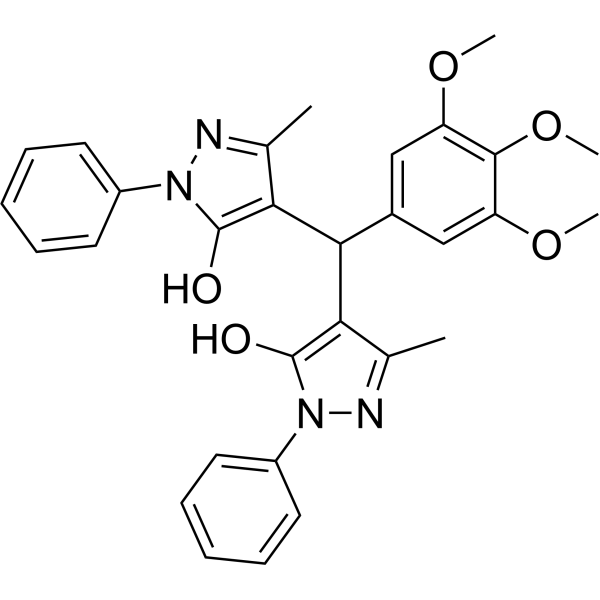 0 ImagesSARS-CoV-2-IN-33 (compound 3m) is a COVID-19 inhibitor. SARS-CoV-2-IN-33 shows anti-proliferative activity against cancer cells. SARS-CoV-2-IN-33 exhibits comparatively good binding affinity (-8.0 Kcal/mole) to COVID-19 main protease (Mpro) (PDB ID: 6LU7). SARS-CoV-2-IN-33 can be used in studies of cancer and COVID-19.
-
SARS-CoV-2-IN-58
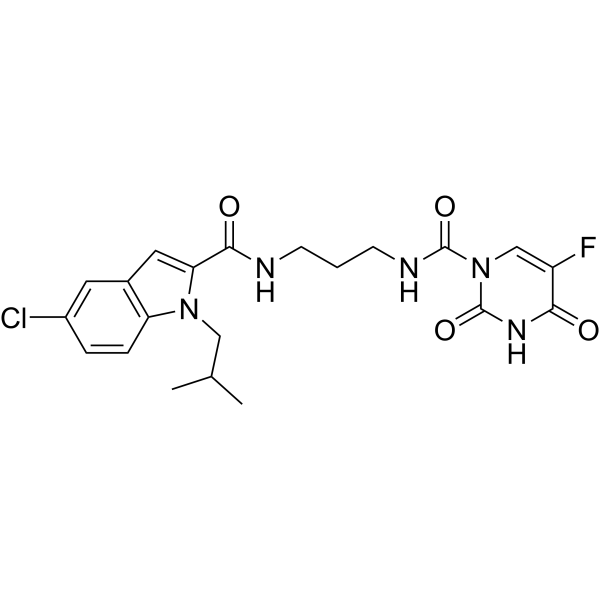 0 ImagesCat. No.: HY-156008CAS No.: 3052692-38-0SARS-CoV-2-IN-58 (Compound 21H) is an antiviral agent against SARS-CoV-2 (EC50: 18 μM). SARS-CoV-2-IN-58 inhibits SARS-CoV-2 Mpro with an IC50 of 0.35 μM.
-
N-Acetyl-L-leucyl-L-leucyl-L-methional
 0 ImagesCat. No.: HY-103321CAS No.: 145757-50-2N-Acetyl-L-leucyl-L-leucyl-L-methional is a Calpain II inhibitor with an IC50 of 0.24 μM against porcine Calpain II. N-Acetyl-L-leucyl-L-leucyl-L-methional forms a stable tetrahedral adduct with the thiol group at the active site of Calpain II, thereby inhibiting proteolytic activity. N-Acetyl-L-leucyl-L-leucyl-L-methionally inhibits cathepsins in a non-selective manner. N-Acetyl-L-leucyl-L-leucyl-L-methional reduces SARS-CoV-2 infection levels in human coronary artery endothelial cells in vitro. N-Acetyl-L-leucyl-L-leucyl-L-methional can be used in research related to cataracts and coronavirus infections.
-
Dexamethasone-d5-1
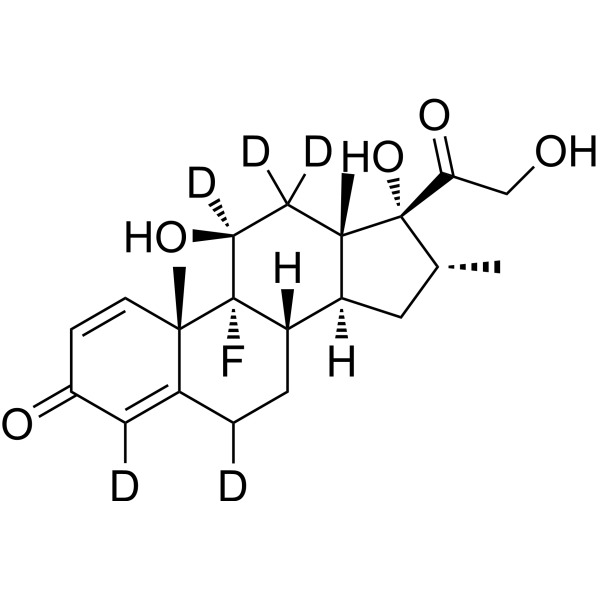 0 ImagesCat. No.: HY-14648S1Synonyms: Hexadecadrol-d5-1; Prednisolone F-d5-1Dexamethasone-d5-1 is deuterium labeled Dexamethasone. Dexamethasone (Hexadecadrol) is a glucocorticoid receptor agonist. Dexamethasone also significantly decreases CD11b, CD18, and CD62L expression on neutrophils, and CD11b and CD18 expression on monocytes. Dexamethasone is highly effective in the control of COVID-19 infection. Dexamethasone inhibits production of exosomes containing inflammatory microRNA-155 in lipopolysaccharide-induced macrophage inflammatory responses.
-
Anti-SARS-CoV-2 agent prodrug-1
 0 ImagesCat. No.: HY-187221Anti-SARS-CoV-2 agent prodrug-1 is a double prodrug modified with 5'-ProTide and N4-propionyl ester, exhibiting anti-SARS-CoV-2 activity (EC50 = 3.22 μM). Anti-SARS-CoV-2 agent prodrug-1 is rapidly converted by esterases into intermediate 4, which has stronger plasma metabolic stability and can be rapidly activated to exert antiviral effects. Anti-SARS-CoV-2 agent prodrug-1 shows anti-SARS-CoV-2 activity in vitro and exhibits low cytotoxicity. Anti-SARS-CoV-2 agent prodrug-1 can be used in studies related to SARS-CoV-2 infection.
-
Amantadine in Methanol (Standard)
 0 ImagesCat. No.: HY-B0402R1CAS No.: 768-94-5Synonyms: 1-Adamantanamine in Methanol (Standard); 1-Aminoadamantane in Methanol (Standard)Amantadine in Methanol (Standard) is the solution of Amantadine (Standard). This product is intended for research and analytical applications. Amantadine (1-Adamantanamine) is an orally avtive and potent antiviral agent with activity against influenza A viruses. Amantadine inhibits several ion channels such as NMDA and M2, and also inhibits Coronavirus ion channels. Amantadine also has anti-orthopoxvirus and anticancer activity. Amantadine can be used for Parkinson's disease, postoperative cognitive dysfunction (POCD) and COVID-19 research[4].

-
Imiquimod-d9
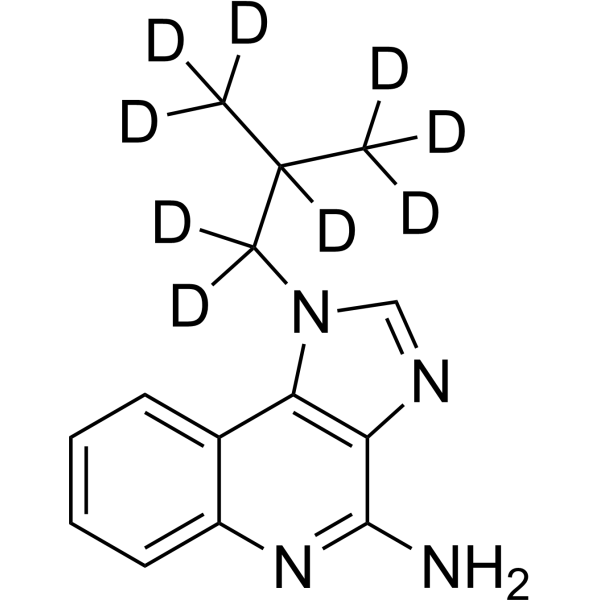 0 ImagesCat. No.: HY-B0180S1CAS No.: 2712126-48-0Synonyms: R 837-d9Imiquimod-d9 is deuterium labeled Imiquimod. Imiquimod (R 837), an immune response modifier, is a selective toll like receptor 7 (TLR7) agonist. Imiquimod exhibits antiviral and antitumor effects in vivo. Imiquimod can be used for the research of external genital, perianal warts, cancer and COVID-19.
-
Antiviral agent 58
 0 ImagesCat. No.: HY-162701CAS No.: 939655-35-3Antiviral agent 58 (Compound J1) is an orally active antiviral agent with broad-spectrum antiviral activity against enveloped viruses, including influenza A virus (IAV), respiratory syncytial virus (RSV), severe acute respiratory syndrome coronavirus 2 (SARS-CoV-2), human coronavirus OC43 (HCoV-OC43), herpes simplex virus type 1 (HSV-1), and HSV-2.

-
Canrivitug
 0 ImagesCat. No.: HY-P990711Canrivitug is an anti-SARS-CoV-2 human IgG1 λ2 monoclonal antibody. Recommend Isotype Controls: Human IgG1 lambda2, Isotype Control (HY-P990096).
-
Imiquimod-d6
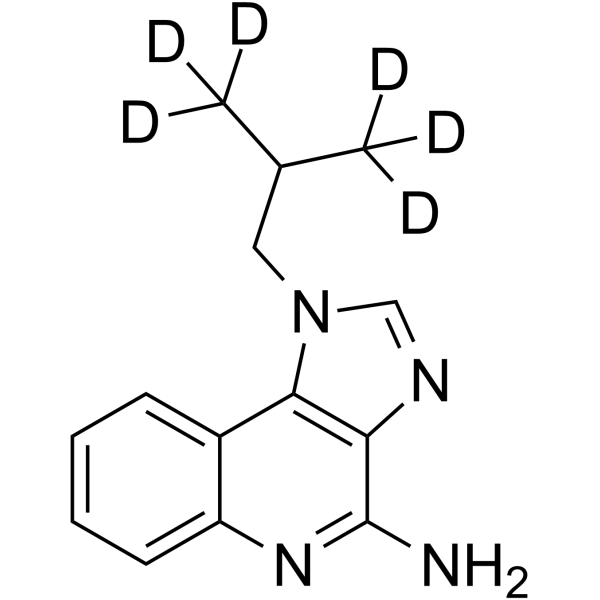 0 ImagesCat. No.: HY-B0180SSynonyms: R 837-d6Imiquimod-d6 is the deuterium labeled Imiquimod. Imiquimod (R 837), an immune response modifier, is a selective toll like receptor 7 (TLR7) agonist. Imiquimod exhibits antiviral and antitumor effects in vivo. Imiquimod can be used for the research of external genital, perianal warts, cancer and COVID-19.
-
SARS-CoV-2-IN-99
 0 ImagesCat. No.: HY-162984CAS No.: 2394839-81-5SARS-CoV-2-IN-99 (compund 58) is a SARS-CoV-2 main protease inhibitor.
-
N-0920
 0 ImagesCat. No.: HY-173459CAS No.: 3108784-69-3N-0920 is a potent TMPRSS2 inhibitor with an IC50 of 0.35 nM. N-0920 effectively inhibits SARS-CoV-2 variants EG.5.1 and JN.1 entry in Calu-3 cells, with picomolar EC50s values of 300 pM and 90 pM, respectively.
-
FOY 251 (Standard)
 0 ImagesCat. No.: HY-19727ARCAS No.: 71079-09-9
-
Oberadilol (monoethyl maleate)
 0 ImagesCat. No.: HY-19088ACAS No.: 114856-47-2Synonyms: CID-3047798 (monoethyl maleate); TZC 5665Oberadilol monoethyl maleate (CID-3047798 monoethyl maleate) is a Phosphodiesterase III inhibitor, non-selective β-adrenergic receptor blocker, vasodilator and positive inotropic agent. Oberadilol monoethyl maleate reduces left ventricular end-diastolic volume. Oberadilol monoethyl maleate is used in research related to chronic congestive heart failure and SARS-CoV-2 infection.

-
Efonidipine hydrochloride monoethanolate (Standard)
 0 ImagesSynonyms: NZ-105 hydrochloride monoethanolate (Standard); (±)-Efonidipine hydrochloride monoethanolate (Standard)Efonidipine (NZ-105) hydrochloride monoethanolate (Standard) is the analytical standard of Efonidipine hydrochloride monoethanolate (HY-12502AR). This product is intended for research and analytical applications. Efonidipine (NZ-105) hydrochloride monoethanolate is an orally active dual L-type and T-type calcium channel blocker (CCB) with IC50 values of 1.8 and 350 nM, respectively. Efonidipine hydrochloride monoethanolate inhibits SARS-CoV-2 main protease. Efonidipine hydrochloride monoethanolate modulates adrenal steroidogenesis by increasing the expression of steroidogenic acute regulatory protein (StAR), dbcAMP-or angiotensin II-induced StAR mRNA expression and DHEA-S production, while suppressing the biosynthesis of aldosterone and cortisol. Efonidipine hydrochloride monoethanolate reduces plasma aldosterone levels in vivo. Efonidipine hydrochloride monoethanolate improves cardiac function in heart failure models by inhibiting T-type calcium channels (via both tonic and use-dependent blockade), independently of blood pressure reduction. Efonidipine hydrochloride monoethanolate can be used for research in hypertension, heart failure, and disorders involving dysregulated steroid hormone synthesis.




