



Biochemical Assay Reagents
Biochemical agents refers to the life science research related to biological material or organic compounds. Due to a wide range of life sciences, rapid development, and therefore a wide variety of such agents, complex in nature. There are electrophoresis reagents, chromatography reagents, centrifuged reagents, immunological reagent, labeled reagent, staining agents, penetration agents and carcinogens variable, insecticides, culture, buffering agents, electron microscopy reagents, protein and nucleic acid precipitating agent, condensing agent ultrafiltration membrane, clinical diagnostic reagents, dyes, antioxidants, preservatives, detergents and surfactants, standard biochemical reagents, biochemical reagents quality control materials, separation material, etc..
All Product Categories
-
Biochemical Assay Reagents Inhibitors
(10)
View all products
-
Biochemical Assay Reagents Modulator
(1)
View all products
-
Biochemical Assay Reagents Chemicals
(7)
View all products
-
Biochemical Assay Reagents Inducer
(1)
View all products
-
Biochemical Assay Reagents Controls
(59)
View all products
-
Biochemical Assay Reagents Substrates
(4)
View all products
-
Biochemical Assay Reagents Ligands
(2)
View all products
-
Biochemical Assay Reagents Related Products (16057)
Related Products (16057)

-
Antibodies (44)
-
Poly(2-hydroxyethyl methacrylate) (Mv 300000)
 0 ImagesCat. No.: HY-112531BCAS No.: 25249-16-5Poly(2-hydroxyethyl methacrylate) (Mv 300000) is a biocompatible, optically transparent, hydrophilic, and non-degradable polymer with excellent cytocompatibility, eliciting a minimal immunological response from host tissue. Poly(2-hydroxyethyl methacrylate) (Mv 300000) can be used for different biomedical applications, such as bone tissue regeneration, wound dressings and drug delivery.
-
HEPPSO
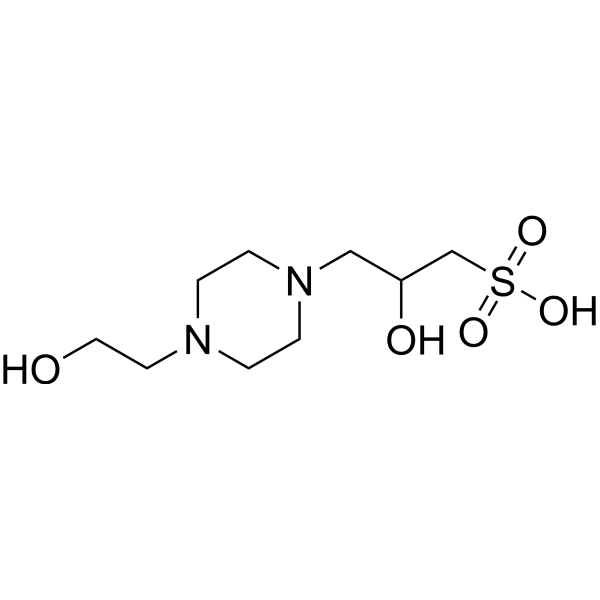 0 ImagesHEPPSO is a zwitterionic Good's buffer suitable for physiological pH conditions. HEPPSO forms high-order oligomers in aqueous solutions and can form a 1:1 complex with Cu2+ via its hydroxyalkyl and tertiary amine groups. However, HEPPSO contains a structurally similar trace impurity lacking an alkanesulfonic acid side chain. The complex formed by this impurity and Cu2+ has a very low Ka; therefore, HEPPSO may interfere with studies on copper speciation analysis in natural water bodies.
-
2'-Deoxyadenosine 5'-triphosphate disodium
 0 ImagesSynonyms: 5'-Dexoadenosine triphosphate disodium2'-Deoxyadenosine 5'-triphosphate disodium (5'-Dexoadenosine triphosphate disodium) is a nucleotide with important biological activities and can serve as a substrate for a variety of polymerases, including DNA polymerases and reverse transcriptases. 2'-Deoxyadenosine 5'-triphosphate disodium plays a key role in DNA synthesis and reverse transcription. 2'-Deoxyadenosine 5'-triphosphate disodium is also widely used in in vitro reactions in molecular biology research.

-
2,2-Dimethoxy-2-phenylacetophenone
 0 ImagesSynonyms: Photoinitiator-6512,2-Dimethoxy-2-phenylacetophenone is a hydrophobic benzoin ether-based free radical photoinitiator. 2,2-Dimethoxy-2-phenylacetophenone undergoes α-cleavage upon UV irradiation to generate benzoyl and substituted benzyl free radicals, thereby initiating photopolymerization reactions. 2,2-Dimethoxy-2-phenylacetophenone serves as a hydrophobic free radical photoinitiator for the photopolymerization of acrylamide and trimethylolpropane triacrylate in specific systems.
-
1,9-Bis-boc-1,5,9-triazanonane
 0 ImagesCat. No.: HY-W092176CAS No.: 82409-02-71,9-Bis-Boc-1,5,9-triazanonane is a linker containing two Boc-protected amino groups. The Boc groups can be deprotected under mild acidic conditions to form the free amines.
-
m-PEG750-thiol
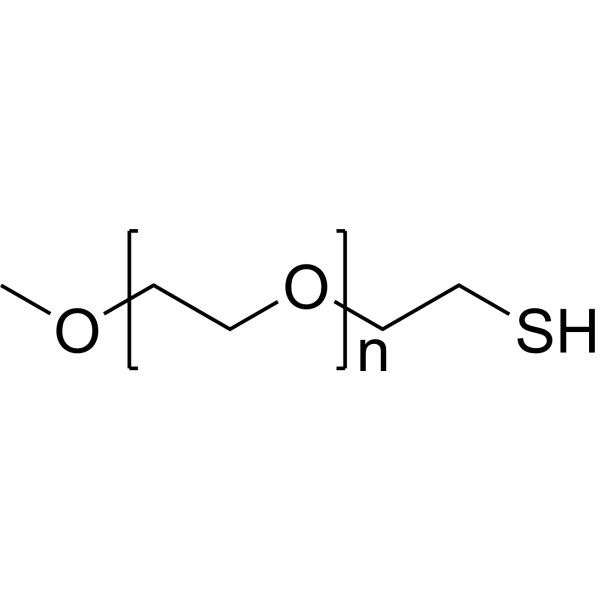 0 ImagesCat. No.: HY-W591476BCAS No.: 134874-49-0Synonyms: mPEG750-SHm-PEG750-thiol (mPEG750-SH) is a thiolated methoxypolyethylene glycol oligomer. m-PEG750-thiol serves for the synthesis of gold nanorods (AuNR) and also acts as a side chain fragment precursor for post-polymerization Michael addition reactions. m-PEG750-thiol can be used in organic synthesis-related research.
-
Polycaprolactone
 0 ImagesCat. No.: HY-W250312CAS No.: 24980-41-4Polycaprolactone is a biodegradable polyester commonly used in various biomedical and industrial applications. It is a white waxy polymer that can be molded into various shapes and forms. Polycaprolactone has various properties suitable for these applications, including low melting point, high flexibility and slow biodegradation rate. It can be used as a raw material for the production of tissue engineering scaffolds, drug delivery systems, and medical implants. In addition, it is used as a binder in the production of adhesives, coatings and paints.
-
tris-NTA Biotin
 0 ImagesTris-NTA Biotin is a biotin-labeled version of tris-NTA. Tris-NTA Biotin, as a bridge connecting His-tagged proteins with streptavidin, can reversibly label proteins and cell surfaces. Tris-NTA Biotin can be used in experiments such as protein immobilization, kinetic determination, live cell labeling, and Western blot detection.
-
Spermidine-alkyne trihydrochloride
 0 ImagesCat. No.: HY-170757APurity: 99.94%Spermidine-alkyne trihydrochloride is a Spermidine (HY-B1776) derivative endowed with an alkyne handle. Spermidine-alkyne trihydrochloride is a Spermidine probe, which can be used for the determination of the Spermidine binding to cellular proteins.
-
Keratin sulfate
 0 ImagesCat. No.: HY-172443CAS No.: 169799-44-4Keratin sulfate is a heparin-related proteoglycan that interacts with the receptor or alters its stability and function. Keratin sulfate does not enhance the mitogenic effect of FGF-2.
-
Sulfo-TAG COOH trisodium
 0 ImagesSulfo-TAG COOH trisodium is a catalyst ligand that can be used for the synthesis of electrochemiluminescence (ECL) labels.
-
Potassiumalum, for cell culture
 0 ImagesSynonyms: Aluminum potassium sulfate dodecahydrate, for cell culturePotassiumalum, for cell culture (Aluminum potassium sulfate dodecahydrate, for cell culture) is an egg white adjuvant. Potassiumalum, for cell culture acts as a mordant to help dyes bind to tissue components, enhancing the staining effect and stability during staining. Potassiumalum, for cell culture can induce allergic reactions in mice. Potassium alum, for cell culture can be used in research for bacterial and tissue staining.
-
TAMRA alkyne,5-isomer
 0 ImagesCat. No.: HY-W423080CAS No.: 945928-17-6TAMRA alkyne, 5-isomer (Compound 3) is an alkyne derivative of TAMRA and can be used for the enrichment, in-gel fluorescence detection, and identification of O-GlcNAc-modified proteins. TAMRA alkyne, 5-isomer contains an Alkyne group and can undergo copper-catalyzed azide-alkyne cycloaddition reaction (CuAAc) with molecules containing Azide groups. It can also undergo strain-promoted alkyne-azide cycloaddition (SPAAC) reactions with molecules containing DBCO or BCN groups.

-
(S)-2-Aminohexanedioic acid (Standard)
 0 Images(S)-2-Aminohexanedioic acid (Standard) is the analytical standard of (S)-2-Aminohexanedioic acid (HY-W013665). This product is intended for research and analytical applications. (S)-2-Aminohexanedioic acid is a biochemical reagent that can be used as a biological material or organic compound for life science related research.
-
N-Methylsuccinimide
 0 ImagesCat. No.: HY-W098559CAS No.: 1121-07-9N-Methylsuccinimide is a versatile solvent and extractant. N-Methylsuccinimide possesses anti-calculiating activity. N-Methylsuccinimide can be used in calculi research. N-Methylsuccinimide is also used in organic synthesis, chemical engineering, and other fields.
-
3′-O-Azidomethyl-dATP sodium solution (100 mM)
 0 ImagesCat. No.: HY-158719Purity: 98.74%Synonyms: 3′-O-Azidomethyl-dATP sodium3′-O-Azidomethyl-dATP sodium solution (100 mM) is a labeled modified deoxyoligonucleotide (dNTP) that can release pyrophosphate to produce fluorescence and has special applications in gene synthesis and sequencing.
-
2,2'-Piperazine-1,4-diyldiethanamine
 0 ImagesCat. No.: HY-W004440CAS No.: 6531-38-02,2'-(Piperazine-1,4-diyl)diethanamine is a piperazine with two N-ethanamine groups. This type of molecule may be used to build drug molecules or design novel ionizable aminolipid head groups for lipid nanoparticles.
-
Acetyl tributyl citrate-d3
 0 ImagesSynonyms: Tributyl O-acetylcitrate-d3; ATBC-d3Acetyl tributyl citrate-d3 (Tributyl O-acetylcitrate-d3) is the deuterium labeled Acetyl tributyl citrate (HY-W010981). Acetyl tributyl citrate can be used in cosmetics, food packaging, and as a flavoring substance for food.




