



Biochemical Assay Reagents
Biochemical agents refers to the life science research related to biological material or organic compounds. Due to a wide range of life sciences, rapid development, and therefore a wide variety of such agents, complex in nature. There are electrophoresis reagents, chromatography reagents, centrifuged reagents, immunological reagent, labeled reagent, staining agents, penetration agents and carcinogens variable, insecticides, culture, buffering agents, electron microscopy reagents, protein and nucleic acid precipitating agent, condensing agent ultrafiltration membrane, clinical diagnostic reagents, dyes, antioxidants, preservatives, detergents and surfactants, standard biochemical reagents, biochemical reagents quality control materials, separation material, etc..
All Product Categories
-
Biochemical Assay Reagents Inhibitors
(10)
View all products
-
Biochemical Assay Reagents Modulator
(1)
View all products
-
Biochemical Assay Reagents Chemicals
(7)
View all products
-
Biochemical Assay Reagents Inducer
(1)
View all products
-
Biochemical Assay Reagents Controls
(59)
View all products
-
Biochemical Assay Reagents Substrates
(4)
View all products
-
Biochemical Assay Reagents Ligands
(2)
View all products
-
Biochemical Assay Reagents Related Products (16057)
Related Products (16057)

-
Antibodies (44)
-
FITC-Dextran (MW 110000)
 0 ImagesCat. No.: HY-128868FCAS No.: 60842-46-8FITC-Dextran (MW 110000) is a compound belonging to the class of fluorescent dyes. It is commonly used in biomedical research as a tracer molecule to label and track cells or other biological matter. FITC-Dextran consists of fluorescein isothiocyanate (FITC) and dextran, a complex carbohydrate derived from starch. The combination of the two creates a stable fluorescent tracer that can be viewed under a microscope or quantified using specialized detection instruments.
-
D-Glucal
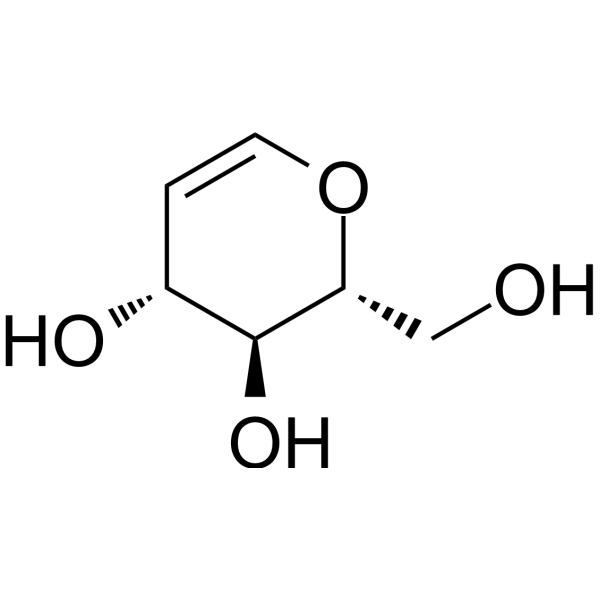 0 ImagesD-Glucal is an organic compound belonging to the family of aldoses, which are monosaccharides containing an aldehyde functional group. It has a six-carbon structure and is derived from glucose by oxidation of the primary alcohol group at carbon 1 to an aldehyde group. D-Glucal is a white crystalline solid that is soluble in water and has a sweet taste. It is an important intermediate in the chemical synthesis of a wide variety of compounds, including pharmaceuticals, agrochemicals, and natural products. D-Glucal can be converted into other carbohydrate derivatives such as glycosides, glycoconjugates and amino sugars. It also plays a role in the study of carbohydrate chemistry, where it is used as a chiral building block for the synthesis of complex structures.
-
3-Hydroxytetradecanoic acid
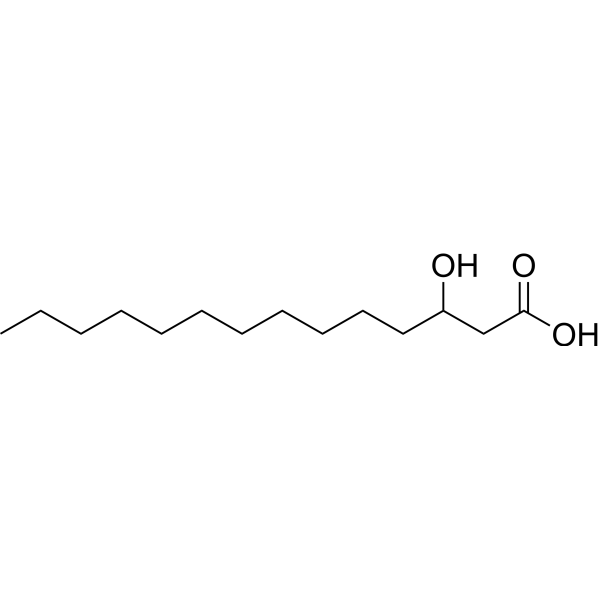 0 ImagesSynonyms: 3-Hydroxymyristic acid3-Hydroxytetradecanoic acidis a saturated fatty acid. 3-Hydroxytetradecanoic acidOccurs naturally in various animal and plant sources such as butter and milk fat. 3-Hydroxytetradecanoic acidIt has various uses in industry, especially in the production of soaps, detergents and other surfactants. 3-Hydroxytetradecanoic acidIt is also used as a precursor for the synthesis of other bioactive compounds such as antibiotics and anticancer drugs.
-
Dipotassium hydrogen phosphate trihydrate
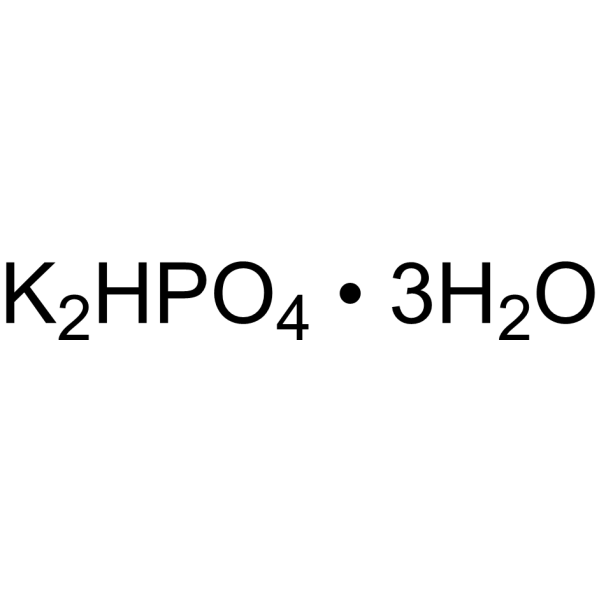 0 ImagesDipotassium hydrogen phosphate trihydrate, which is commonly used as a buffer and source of phosphorus and potassium in various applications, such as fertilizers, food processing, and pharmaceuticals, in biochemistry and molecular biology, Dipotassium hydrogen phosphate trihydrate is used in the preparation of cell culture media And reagent buffer system, in addition, it has been used in analytical chemistry as a reagent for the determination of calcium and magnesium ions in water samples.
-
5-Bromo-2'-deoxycytidine
 0 Images5-Bromo-2'-deoxycytidine is a DNA photosensitizer. 5-Bromo-2'-deoxycytidine modifies the double-stranded DNA, and determinate the DNA damage 300 nm photon.
-
Cyclopentylboronic acid
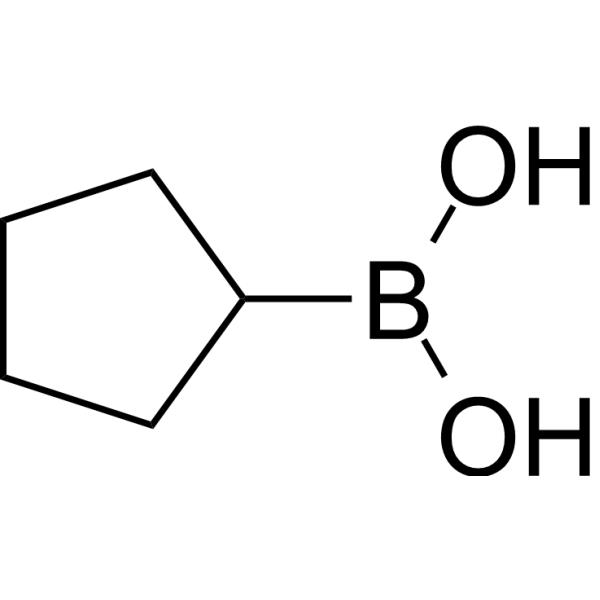 0 ImagesCat. No.: HY-W000955CAS No.: 63076-51-7Cyclopentylboronic acid is a biochemical reagent that can be used as a biological material or organic compound for life science related research.
-
3-Bromophenylacetic acid
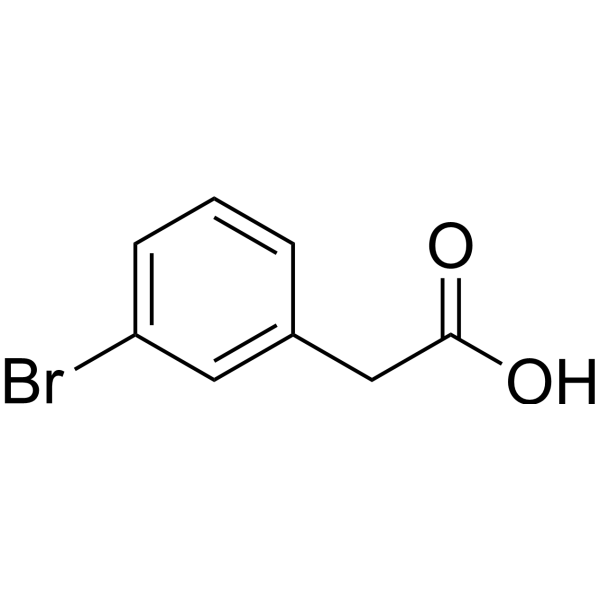 0 Images2-(3-Bromophenyl)acetic acid is a biochemical reagent that can be used as a biological material or organic compound for life science related research.
-
(Aminomethyl)phosphonic acid
 0 Images(Aminomethyl)phosphonic acid is used as a phosphonate agent in wastewater treatment.
-
D-Mannose-6-phosphate disodium
 0 ImagesD-Mannose-6-phosphate (disodium) is a class of biochemical reagents used in glycobiology research. Glycobiology studies the structure, synthesis, biology, and evolution of sugars. It involves carbohydrate chemistry, enzymology of glycan formation and degradation, protein-glycan recognition, and the role of glycans in biological systems. This field is closely related to basic research, biomedicine, and biotechnology.
-
Elastin Methacrylated
 0 ImagesCat. No.: HY-158226Synonyms: ElaMAElastin Methacrylated (ElaMA) elastin recruits and modulates innate immune cells and accelerates angiogenesis at the wound site, thereby improving wound regeneration. Elastin Methacrylated attracts large numbers of neutrophils and primarily M2 macrophages to the wound and induces their penetration into the hydrogel. Elastin Methacrylated has excellent immunomodulatory effects, leading to superior angiogenesis, collagen deposition and dermal regeneration. Elastin Methacrylated needs to self-assemble into fibrous hydrogel under the action of photoinitiator LAP (HY-44076), and target bioactive adhesion sites, play an inherent supporting role for tissue cells and biodegradable activity.
Application: cell culture, biological 3D printing, tissue engineering, etc.
-
Cucurbit[8]uril
![Cucurbit[8]uril](https://file.medchemexpress.com/product_pic/hy-103689.gif "Click to View Cucurbit[8]uril Product Detail") 0 ImagesCucurbit[8]uril is a potent, low toxicity and orally active supramolecular inducer of protein heterodimerization. Cucurbit[8]uril induces heterodimerization of methylviologen and naphthalene functionalized proteins. Cucurbit[8]uril can induce energy transfer .
0 ImagesCucurbit[8]uril is a potent, low toxicity and orally active supramolecular inducer of protein heterodimerization. Cucurbit[8]uril induces heterodimerization of methylviologen and naphthalene functionalized proteins. Cucurbit[8]uril can induce energy transfer .
-
Biotinylated-D-lysine TFA
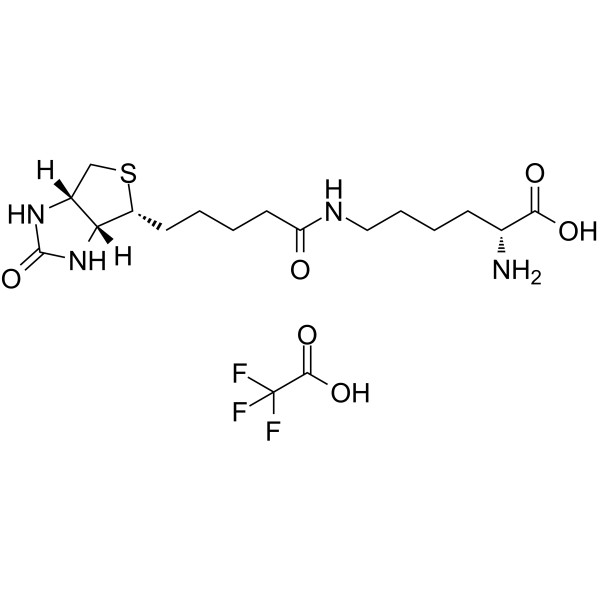 0 ImagesCat. No.: HY-101884APurity: 99.32%Biotinylated-D-lysine TFA is a conjugate of L-biotin and D-lysine, where the carboxylate of L-biotin is coupled with the ϵ-amine of D-lysine via a secondary amide bond. Biotinylated-D-lysine TFA is an isomer of the neuroanatomical tracer Biocyte.
-
m-PEG2000-mal
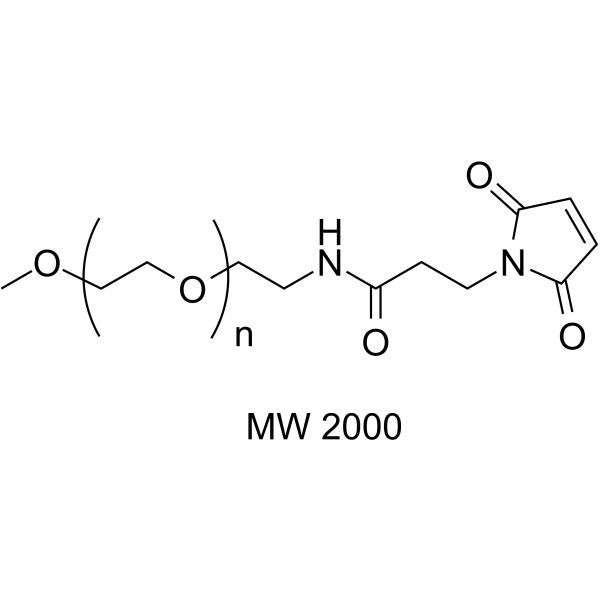 0 ImagesCat. No.: HY-140689m-PEG2000-mal is a PEG derivative modified with Maleimide (HY-W007324), which forms a stable thioether bond with sulfhydryl (-SH). PEG modification can improve solubility and stability and reduce the immunogenicity of proteins and peptides.

-
Ferric pyrophosphate
 0 ImagesCat. No.: HY-B1648CAS No.: 10058-44-3Ferric pyrophosphate is an orally effective anti-inflammatory agent and iron fortifier. Ferric pyrophosphate downregulates the expression of colonic pro-inflammatory cytokines, modulates the intestinal flora, and corrects the dysbiosis associated with iron deficiency anemia (IDA). Ferric pyrophosphate can be used in studies related to iron deficiency anemia.
-
Co(acac)2
 0 ImagesCat. No.: HY-W088188CAS No.: 14024-48-7Synonyms: Cobalt(II) acetylacetonateCo (acac)2 is an organometallic compound with catalytic activity, in which the central cobalt ion is chelated with acetylacetonate ligands. Co (acac)2 can serve as a precursor for thin films and nanomaterials, and is applicable to researches in organic synthesis, materials science, industrial applications, and other fields.
-
BHQ-2 NHS
 0 ImagesCat. No.: HY-42984CAS No.: 916753-62-3BHQ-2 NHS is a fluorescence dark quencher with an absorption spectrum spanning 550-650 nm that overlaps with tetramethylrhodamine (TMR) emission. BHQ-2 NHS quenches TMR fluorescence when conjugated to mesoporous silica nanoparticles. BHQ-2 NHS can be used for the research of cancer.
-
1-Adamantaneacetic acid
 0 Images1-Adamantaneacetic acid is an aliphatic carboxylic acid that can be used as an acylating agent, commonly found in chemical synthesis.




