



Fluorescent Dye
Fluorescence is a phenomenon of photoluminescence in luminescence. When an atom is irradiated by light, some electrons around the nucleus jump from their original orbitals to higher energy orbitals under the influence of light energy, i.e., from the ground state to the first or second excited single-line state, etc. Due to the instability of the first or second excited singlet state, the electron returns from the excited singlet state to the ground state accompanied by released energy, resulting in fluorescence.
Fluorescent dyes can be covalently bound or physically adsorbed in the structure of the substance. The fluorescence properties allow for the characterization, localization and quantitative analysis of the labeled object. Fluorescent dyes have shown great potential for the detection of proteins, nucleic acids, cells, and immunoassays, attributed to the advantages in non-radioactive contamination, simple experimental operation and easy observation.
Fluorescent dyes have penetrated many fields such as pharmacology, physiology, environmental science, and information science, as well as functional studies of proteins and drug screening.
All Product Categories
-
Fluorescent Dye Related Products (4914)
Related Products (4914)

-
Antibodies (4)

-
5,5'-Dibromo BAPTA tetrapotassium
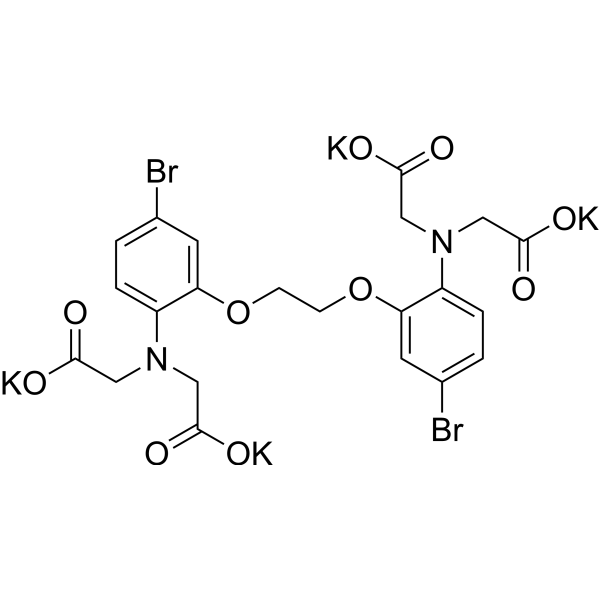 0 ImagesCat. No.: HY-D1639CAS No.: 73630-11-25,5'-Dibromo BAPTA tetrapotassium is a calcium chelator, can be formulated into a buffer with a defined calcium ion concentration. 5,5'-Dibromo BAPTA tetrapotassium can control the concentration of calcium ions inside and outside the cell and can be used in studies of calcium physiological activity.
-
Sulfo-NHS-LC-Biotin
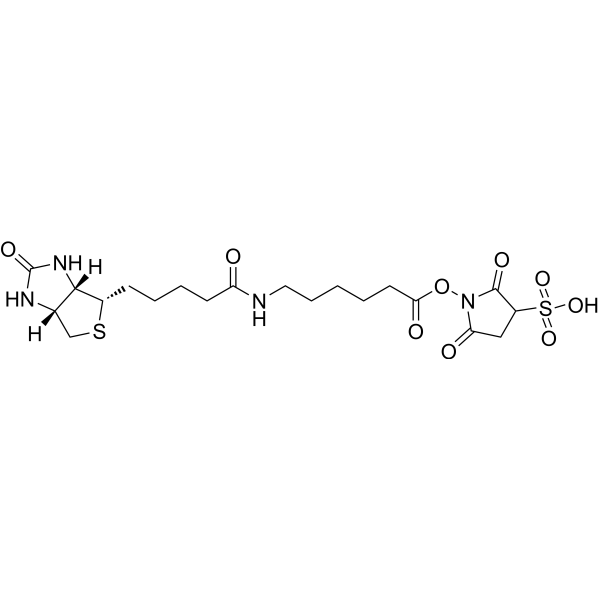 0 ImagesCat. No.: HY-D0799ACAS No.: 190598-57-3Sulfo-NHS-LC-Biotin is an amine-reactive ester derivative of biotin and cannot pass the intact blood-retinal barrier. It can be used to assess vascular permeability of the brain and retinal vasculature.
-
Resazurin sodium (solution)
 0 ImagesCat. No.: HY-DY1051CAS No.: 62758-13-8Resazurin sodium (Diazoresorcinol sodium) (solution) is a non-toxic, stable, membrane-permeable blue non-fluorescent dye (faintly fluorescent). Resazurin sodium is used as a redox indicator, can be reduced to pink, highly fluorescent Resorufin (Ex=530-560 nm, Em=590 nm) in living cells. Resazurin sodium can be used for the detection of cell viability, toxicity, proliferation, migration and invasion in cells (human, plant and animal, bacterial and fungal) .
Solvent and Concentration: Sterile water: 10 mM
-
RB-PEG3400-NHS
 0 ImagesCat. No.: HY-D2884DSynonyms: Rhodamine B-PEG3400-NHSRB-PEG3400-NHS (Rhodamine B-PEG3400-NHS) is a fluorescent dye composed of Rhodamine B (HY-Y0016), PEG and a hydroxysuccinimide (NHS) group. The NHS group can react with amine-containing groups. RB-PEG3400-NHS can be used for fluorescent labeling and imaging (Ex/Em=546/610 nm).
-
Cy3 alkyne chloride
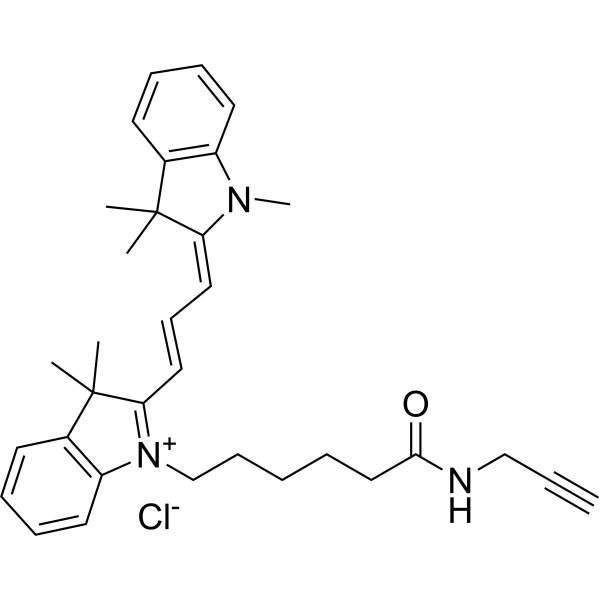 0 ImagesCat. No.: HY-D1860Cy3 alkyne chloride is a dye derivative of Cyanine 3 (Cy3) (HY-D0822) containing a sulfonate ion and an alkyne functional group. Cy3 is a fluorescent dye with a fluorescence spectrum typically in the green to orange wavelength range. The alkyne functional group of Cy3 alkyne chloride can react with molecules containing the azide functional group to form covalent bonds. Cy3 alkyne chloride can bind to biological molecules such as proteins and antibodies to track their location and dynamic changes in biological samples.

-
Crisp-17
 0 ImagesCat. No.: HY-D3212CAS No.: 2366253-25-8Crisp-17 is a monovalent copper ion probe. Crisp-17 can be used to characterize cellular phenotypes associated with copper metabolism defects. Crisp-17 is applicable to research related to Menkes disease.
-
Cyanine 3.5 chloride
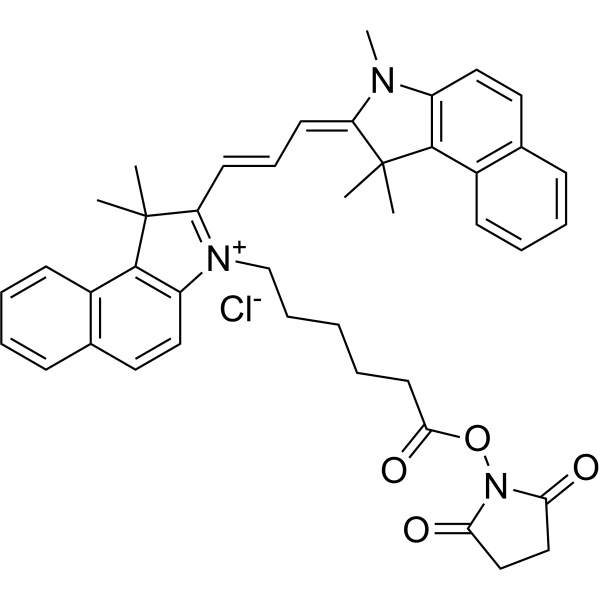 0 ImagesCat. No.: HY-D1596CAS No.: 2231670-86-1Synonyms: Cy3.5 NHS ester chloride; Cy 3.5 chlorideCyanine 3.5 (Cy3.5 NHS ester) chloride is an analog of Cy3.5 fluorophore. Cyanine 3.5 chloride is a reactive, red fluorescent dye. Cyanine 3.5 chloride is used for labeling of amino-groups in peptides, proteins, and oligonucleotides. (λex=591 nm, λem=604 nm).
-
Rhodamine-PEG5000
 0 ImagesCat. No.: HY-D2892ERhodamine-PEG5000 a fluorescent PEG derivative composed of Rhodamine B (HY-Y0016) and PEG. Rhodamine-PEG5000 can be used for fluorescent labeling and imaging (Ex/Em=546/610 nm).
-
Wheat Germ Agglutinin (Peroxidase)
 0 ImagesCat. No.: HY-NP0152Synonyms: WGA (Peroxidase)Wheat Germ Agglutinin (WGA) Peroxidase is a plant lectin that can be used as a probe to specifically bind biomolecules (such as polysaccharides, peptides, etc.).Wheat Germ Agglutinin (WGA) Peroxidase is a biological material or organic compound that can be used in life science research.
-
Cy3 Dextran (MW 3000)
 0 ImagesCat. No.: HY-D2706Cy3 Dextran (MW 3000) is a fluorescent labeling reagent that combines Cy3 (HY-D0822) fluorescent dye and Dextran (HY-112624). The Cy3 fluorophore is commonly used in applications such as immunolabeling, nucleic acid labeling, fluorescence microscopy, and flow cytometry. Dextran has an inhibitory effect on thrombocyte aggregation and coagulation factors and is used as a plasma volume expander (Ex/Em = 550/570 nm).
-
Digoxigenin-d3
 0 ImagesCat. No.: HY-W714529CAS No.: 127299-96-1Synonyms: Lanadigenin-d3Digoxigenin-d3 (Lanadigenin-d3) is the deuterium labeled Digoxigenin (HY-B1025). Digoxigenin (DIG) is a steroid. DIG is used for situ hybridization as a labeling molecule probe due to long shelf life and fast detection and high sensitivity of DIG-labeled riboprobes.
-
3,6-Diaminoacridine dihydrochloride
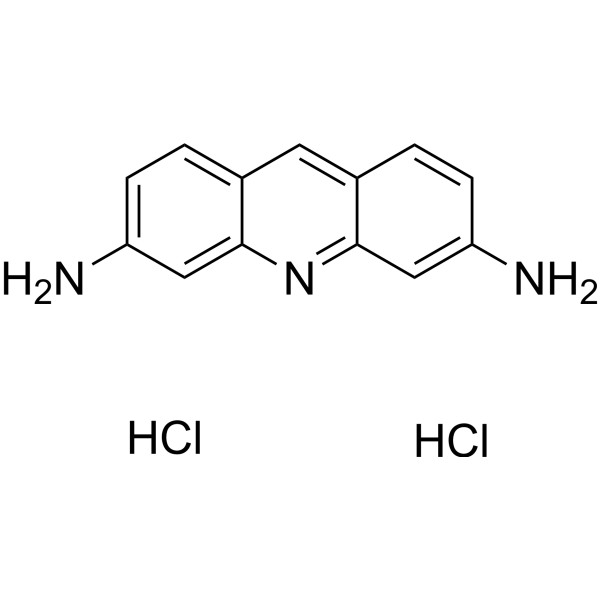 0 Images3,6-Diaminoacridine dihydrochloride is a versatile acridine compound. 3,6-Diaminoacridine dihydrochloride exerts antibacterial activity by intercalating into bacterial DNA, interfering with replication and transcription, and inducing bacterial lysis. 3,6-Diaminoacridine dihydrochloride is an acridine dye and also a DNA intercalator.
-
FAM labled Givosiran sodium
 0 ImagesCat. No.: HY-132610HFAM labled Givosiran sodiumis a FAM labled Givosiran sodium.

-
FAM labled Senvesiran sodium
 0 ImagesCat. No.: HY-177664CFAM labled Senvesiran sodiumis a FAM labled Senvesiran sodium.
-
RB-PEG2000-RB
 0 ImagesCat. No.: HY-D2893DSynonyms: Rhodamine B-PEG2000-Rhodamine BRB-PEG2000-RB (Rhodamine B-PEG2000-Rhodamine B) a fluorescent dye composed of two Rhodamine B (HY-Y0016) and PEG. RB-PEG2000-RB can be used for fluorescent labeling and imaging (Ex/Em=546/610 nm).




