



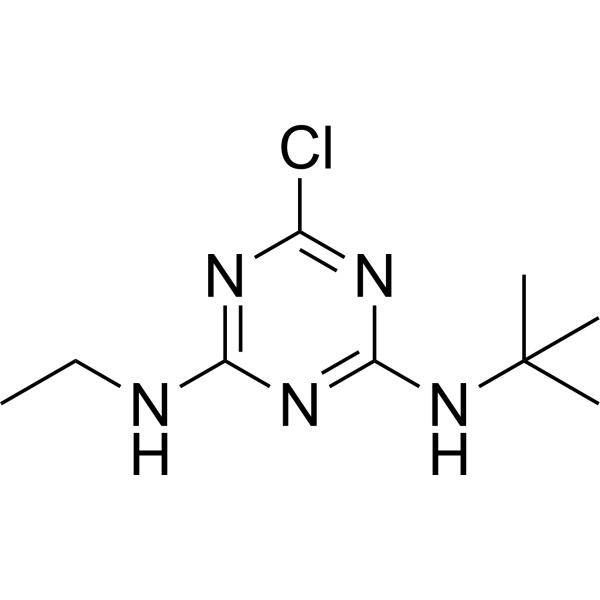
Terbuthylazine
Based on 1 publication(s) in Google Scholar
Terbuthylazine is an inhibitor of acetolactate syntase (ALS), is a selective herbicide. Terbuthylazine blocks electron transport in photosystem II via interaction with the D1-protein.
Nos produits utilisent uniquement pour la recherche. Nous ne vendons pas aux patients.
- Pureté : 98.0%
- CAS No.: 5915-41-3
- Formule: C9H16ClN5
- Masse moléculaire:229.71
-
Stockage:Powder -20°C, 3 years , 4°C, 2 years ; In solvent -80°C, 2 years , -20°C, 1 year

To place orders, for customer services and technical support, please contact: MedChemExpress USA
Tel: 609-228-6898 E-mail: [email protected] [email protected]


-
 Activité biologique
-
Chemical Information
-
Solvant et solubilité
- Pureté et documentation
- Références
-
 Help & FAQs


-
HY-121324
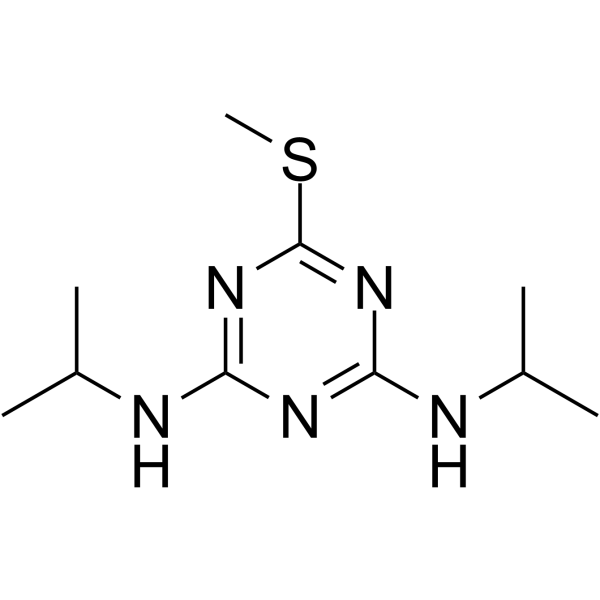
PrometrynHerbicide -
HY-B1876
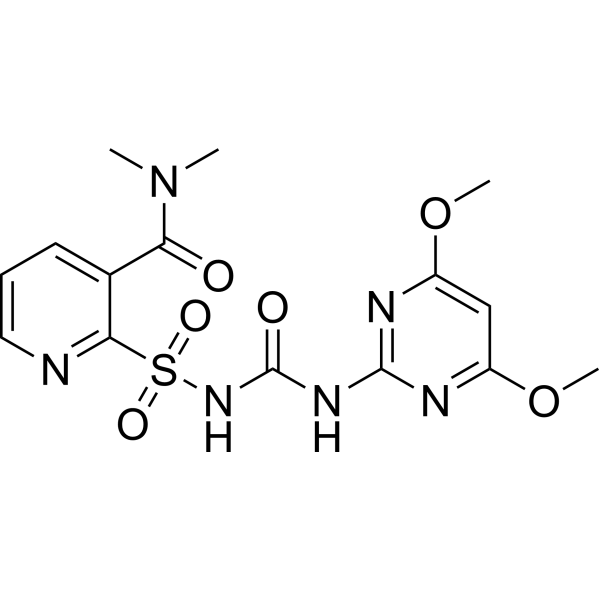
NicosulfuronSulfonylurea Herbicide, Photosynthetic System Inhibitor, Acetolactate Synthase (ALS) Inhibitor, Branched-chain Amino Acids (BCAAs) Inhibitor -

HY-B1847R
Terbuthylazine (Standard)Analytical Standard -
HY-B1876R
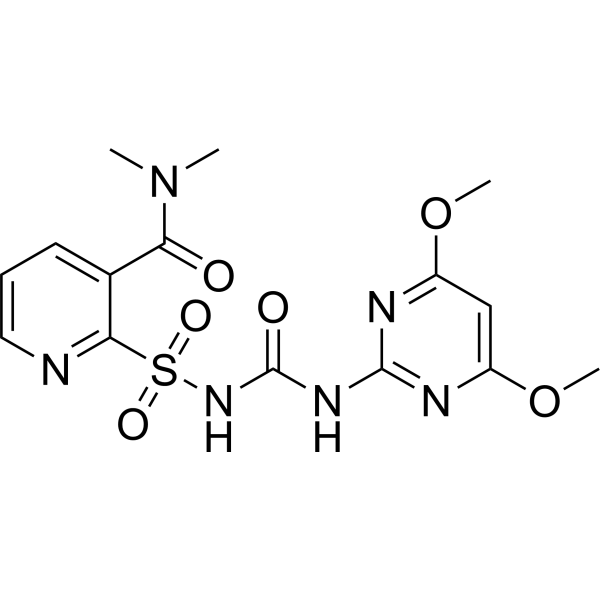
Nicosulfuron (Standard)Sulfonylurea Herbicide
Publications Citing Use of MedChemExpress (MCE) Terbuthylazine
More

Activité biologique
Description
In Vitro
Terbuthylazine (6500 nM; 3 h pulse, continuous long-term exposure) causes Lemna minor to show rapid inhibition of photosynthesis (measured via Fvj) within 1 h after a 3-h pulse, followed by near-complete recovery of Fvj within 24 h and no significant long-term growth inhibition[1].
Terbuthylazine (4-7 days long-term exposure; 3 h pulse exposure followed by 4-7 days herbicide-free growth) inhibits Lemna minor area-specific growth (EC50 values of 141, 645, 796 nM for 7 or 4 days), but a 3-h pulse exposure requires concentrations >22- to >123-fold higher to induce similar growth effects due to rapid recovery[1].
Terbuthylazine (0.58-8.00 ng/mL; 4 h) reduces human peripheral blood lymphocyte viability in a concentration-dependent manner, with the 8.00 ng/mL concentration reducing viability by 15% primarily via apoptosis[2].
Terbuthylazine (0.58-8.00 ng/mL; 4 h) does not significantly reduce human HepG2 cell viability at concentrations of 0.58, 0.80, or 8.00 ng/mL after 4 h of exposure[2].
Terbuthylazine (0.58-8.00 ng/mL; 4 h) induces low-level DNA instability in human peripheral blood lymphocytes and HepG2 cells, with significantly increased DNA damage detected at 0.80 and 8.00 ng/mL after 4 h of exposure[2].
MedChemExpress (MCE) has not independently confirmed the accuracy of these methods. They are for reference only.
In Vivo
MedChemExpress (MCE) has not independently confirmed the accuracy of these methods. They are for reference only.


Chemical Information
-
CAS No. 5915-41-3
-
Appearance Solid
-
Masse moléculaire 229.71
-
Formule C9H16ClN5
-
Color White to off-white
-
SMILES
CCNC1=NC(Cl)=NC(NC(C)(C)C)=N1
-
Livraison
Room temperature in continental US; may vary elsewhere.
-
Stockage
Powder -20°C 3 years 4°C 2 years In solvent -80°C 2 years -20°C 1 year


Publications (1)
-
Journal Impact Factor
-
Most Recent
-
Anal Chem
Exposome-Scale Investigation of Cl-/Br-Containing Chemicals Using High-Resolution Mass Spectrometry, Multistage Machine Learning, and Cloud Computing. [Abstract]2025 Jun 3;97(21):11099-11109. PMID: 40401576


Solvant et solubilité
In Vitro:
DMSO : 50 mg/mL (217.67 mM; Need ultrasonic; Hygroscopic DMSO has a significant impact on the solubility of product, please use newly opened DMSO)
Please refer to the solubility information to select the appropriate solvent. Once prepared, please aliquot and store the solution to prevent product inactivation from repeated freeze-thaw cycles.
Storage method and period of stock solution: -80°C, 2 years; -20°C, 1 year. When stored at -80°C, please use it within 2 years. When stored at -20°C, please use it within 1 year.
Please refer to the solubility information to select the appropriate solvent. Once prepared, please aliquot and store the solution to prevent product inactivation from repeated freeze-thaw cycles.
Storage method and period of stock solution: -80°C, 2 years; -20°C, 1 year. When stored at -80°C, please use it within 2 years. When stored at -20°C, please use it within 1 year.
Concentration (start) × Volume (start) = Concentration (final) × Volume (final)
In Vivo:
Select the appropriate dissolution method based on your experimental animal and administration route.
- For the following dissolution methods, please ensure to first prepare a clear stock solution using an In Vitro approach and then sequentially add co-solvents:
- To ensure reliable experimental results, the clarified stock solution can be appropriately stored based on storage conditions. As for the working solution for In Vivo experiments, it is recommended to prepare freshly and use it on the same day.
- The percentages shown for the solvents indicate their volumetric ratio in the final prepared solution. If precipitation or phase separation occurs during preparation, heat and/or sonication can be used to aid dissolution.
Add each solvent one by one: 10% DMSO 40% PEG300 5% Tween-80 45% Saline
Solubility: 2.5 mg/mL (10.88 mM); Suspended solution; Need ultrasonic
This protocol yields a suspended solution of 2.5 mg/mL. Suspended solution can be used for oral and intraperitoneal injection.
Taking 1 mL working solution as an example, add 100 μL DMSO stock solution (25.0 mg/mL) to 400 μL PEG300, and mix evenly; then add 50 μL Tween-80 and mix evenly; then add 450 μL Saline to adjust the volume to 1 mL.
Preparation of Saline: Dissolve 0.9 g sodium chloride in ddH₂O and dilute to 100 mL to obtain a clear Saline solution.
For the following dissolution methods, please prepare the working solution directly:
It is recommended to prepare fresh solutions and use them promptly within a short period of time.
The percentages shown for the solvents indicate their volumetric ratio in the final prepared solution. If precipitation or phase separation occurs during preparation, heat and/or sonication can be used to aid dissolution.
Add each solvent one by one: 50% PEG300 50% Saline
Solubility: 5 mg/mL (21.77 mM); Suspended solution; Need ultrasonic
Add each solvent one by one: 15% Cremophor EL 85% Saline
Solubility: 20 mg/mL (87.07 mM); Suspended solution; Need ultrasonic
In Vivo Dissolution Calculator
Please enter the basic information of animal experiments:
-
-
-
-
Recommended: Prepare an additional quantity of animals to account for potential losses during experiments.
Please enter your animal formula composition:
-
%DMSO +
Recommended: Keep the proportion of DMSO in working solution below 2% if your animal is weak.
-
%+
-
+%Tween-80 + +
-
%Saline +
The co-solvents required include: DMSO, . All of co-solvents are available by MedChemExpress (MCE). , Tween 80. All of co-solvents are available by MedChemExpress (MCE).
Working solution concentration: 0.22 mg/mL
Method for preparing stock solution: mg drug dissolved in μL DMSO. Stock solution concentration: mg/mL.
1. Take μL DMSO stock solution;
2. Add μL .
μL , mix evenly;
3. Then add μL Tween 80, mix evenly;
4. Then add μL
Please ensure that the stock solution in the first step is dissolved to a clear state, and add co-solvents in sequence. You can use ultrasonic heating (ultrasonic cleaner, recommended frequency 20-40 kHz), vortexing, etc. to assist dissolution.


Pureté et documentation
-
Fiche technique (273 KB)
-
SDS (597 KB)
- English - EN (597 KB)
- Français - FR (597 KB)
- Deutsch - DE (597 KB)
- Norwegian - NO (597 KB)
- Español - ES (597 KB)
- Swedish - SV (597 KB)
- Italian - IT (597 KB)
- Korean - KR (597 KB)
- Portuguese - PT (597 KB)
-
Instruction de manipulation (2659 KB)
Références
[1]. Cedergreen N, et al. Does the effect of herbicide pulse exposure on aquatic plants depend on Kow or mode of action. Aquat Toxicol. 2005;71(3):261-271. [Content Brief]
[2]. Želježić D, et al. Effects of the chloro-s-triazine herbicide terbuthylazine on DNA integrity in human and mouse cells. Environ Sci Pollut Res Int. 2018;25(19):19065-19081. [Content Brief]


Complete Stock Solution Preparation Table
Please refer to the solubility information to select the appropriate solvent. Once prepared, please aliquot and store the solution to prevent product inactivation from repeated freeze-thaw cycles.
Storage method and period of stock solution: -80°C, 2 years; -20°C, 1 year. When stored at -80°C, please use it within 2 years. When stored at -20°C, please use it within 1 year.
| Optional Solvent | Concentration Solvent Mass | 1 mg | 5 mg | 10 mg | 25 mg |
|---|---|---|---|---|---|
| DMSO | 1 mM | 4.3533 mL | 21.7666 mL | 43.5331 mL | 108.8329 mL |
| 5 mM | 0.8707 mL | 4.3533 mL | 8.7066 mL | 21.7666 mL | |
| 10 mM | 0.4353 mL | 2.1767 mL | 4.3533 mL | 10.8833 mL | |
| 15 mM | 0.2902 mL | 1.4511 mL | 2.9022 mL | 7.2555 mL | |
| 20 mM | 0.2177 mL | 1.0883 mL | 2.1767 mL | 5.4416 mL | |
| 25 mM | 0.1741 mL | 0.8707 mL | 1.7413 mL | 4.3533 mL | |
| 30 mM | 0.1451 mL | 0.7256 mL | 1.4511 mL | 3.6278 mL | |
| 40 mM | 0.1088 mL | 0.5442 mL | 1.0883 mL | 2.7208 mL | |
| 50 mM | 0.0871 mL | 0.4353 mL | 0.8707 mL | 2.1767 mL | |
| 60 mM | 0.0726 mL | 0.3628 mL | 0.7256 mL | 1.8139 mL | |
| 80 mM | 0.0544 mL | 0.2721 mL | 0.5442 mL | 1.3604 mL | |
| 100 mM | 0.0435 mL | 0.2177 mL | 0.4353 mL | 1.0883 mL |


Terbuthylazine Related Classifications
HY-B1847 Related Classifications
 Powered by Bioz