



Akt3 degrader 1

Based on 1 Customer Validation
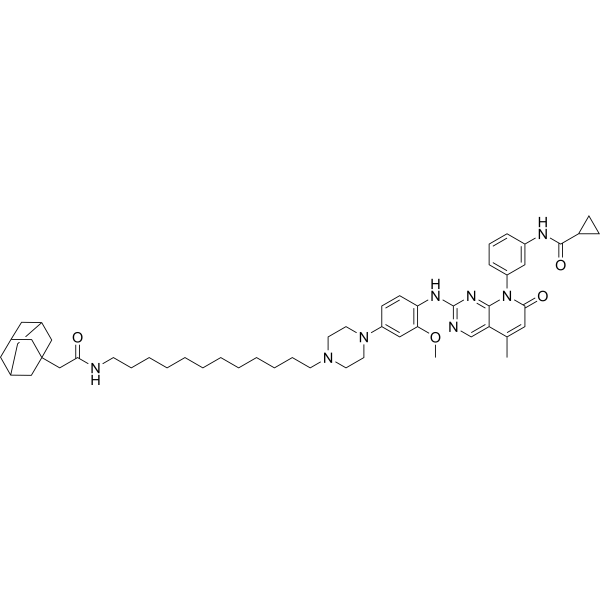
Akt3 degrader 1 is an orally active selective Akt3 degrader with a DC50 of 13 nM. Akt3 degrader 1 binds to the PH domain of Akt3 to trigger proteasome-mediated degradation, with minimal effects on Akt1/Akt2. Akt3 degrader 1 inhibits cancer cell growth. Akt3 degrader 1 can be used for the research of non-small cell lung cancer.
Nur für Forschungszwecke. Wir verkaufen nicht an Patienten.
- Reinheit : 95.10%
- CAS. Nr.: 2836342-69-7
- Formel: C53H72N8O4
- Molecular Weight:885.19
-
Speicherung:Powder -20°C, 3 years , 4°C, 2 years ; In solvent -80°C, 6 months , -20°C, 1 month

To place orders, for customer services and technical support, please contact: MedChemExpress USA
Tel: 609-228-6898 E-mail: [email protected] [email protected]


-
 Biologische Aktivität
-
Chemical Information
- Protokoll
- Reinheit & Dokumentation
- Verweise
-
 Help & FAQs




Biologische Aktivität
Beschreibung
IC50 & Target
[1]|
Akt3 13 nM (DC50) |
Cellular Effect
|
Cell Line

|
Type | Value | Description | References |
|---|---|---|---|---|
| NSCLC | IC50 |
7 nM
|
Antiproliferative activity against osimertinib-resistant H1975OR NSCLC cells measured by CCK-8 assay after 72 hours of incubation.
Antiproliferative activity against osimertinib-resistant H1975OR NSCLC cells measured by CCK-8 assay after 72 hours of incubation.
|
36173763 |
In Vitro
Akt3 degrader 1 (1000 nM; 24 h) selectively induces proteasomal degradation of Akt3 with a DC50 of 13 nM in Osimertinib (HY-15772)-resistant H1975OR NSCLC cells, while having minimal impact on Akt1 and Akt2[1].
Akt3 degrader 1 (1.6-1000 nM; 24 h) selectively induces dose-dependent degradation of Akt3 in A549, HCC827, H1975, H1975OR, PC9, H1299, and H460 NSCLC cell lines, with no significant impact on Akt1 or Akt2 levels[1].
Akt3 degrader 1 (100 nM; 0-12 h) accelerates the degradation of Akt3 protein in Cycloheximide (HY-12320)-treated H1975OR NSCLC cells, reducing Akt3 stability over 12 hours[1].
Akt3 degrader 1 (100 nM; 24 h)-induced degradation of Akt3 in H1975OR NSCLC cells is mediated by the ubiquitin-proteasome system, as the effect is blocked by co-treatment with the proteasome inhibitor MG132[1].
Akt3 degrader 1 (3-30 nM; 24 h) dose-dependently increases the ubiquitination of Akt3 in H1975OR NSCLC cells, supporting ubiquitin-mediated proteasomal degradation as the mechanism of action[1].
Akt3 degrader 1 (50 μM; 2 h) directly binds to Akt3 protein in H1975OR NSCLC cells, as demonstrated by competitive labeling with a chemical probe, pull-down validation, and LC-MS analysis[1].
Akt3 degrader 1 (2 μM) binds to Akt3 in H1975OR NSCLC cells, as indicated by an increase in Akt3 protein thermal stability[1].
Akt3 degrader 1 (0-100 nM for H1975OR transfected cells; 0-500 nM for H1975 transfected cells) binds to the PH domain of Akt3 to induce degradation, as it fails to degrade PH domain-deleted Akt3 but effectively degrades PH domain-only Akt3 in H1975OR NSCLC cells, and degrades full-length Akt3 in H1975 NSCLC cells[1].
Akt3 degrader 1 (12l) (0.000508-10 μM; 72 h) potently suppresses the proliferation of Osimertinib-resistant H1975OR NSCLC cells with an IC50 of 7 nM[1].
MedChemExpress (MCE) has not independently confirmed the accuracy of these methods. They are for reference only. Further protocols information, click here.
-
Cell Line:Osimertinib-resistant H1975OR non-small cell lung cancer (NSCLC) cells
-
Concentration:1000 nM; concentrations used to calculate DC50
-
Incubation Time:24 h
-
Result:Potently induced proteasomal degradation of Akt3 with a DC50 of 13 nM, achieving 88% maximal degradation (Dmax) at 1000 nM.
Had minimal effects on Akt1 and Akt2, with DC50 values >1000 nM for both isoforms.
-
Cell Line:NSCLC cell lines (A549, HCC827, H1975, H1975OR, PC9, H1299, H460)
-
Concentration:0.6-1000 nM
-
Incubation Time:24 h
-
Result:Induced dose-dependent degradation of Akt3 in all tested NSCLC cell lines.
Had minimal to no effect on the protein levels of Akt1 and Akt2 at all tested concentrations.
-
Cell Line:H1975OR NSCLC cells
-
Concentration:100 nM
-
Incubation Time:24 h
-
Result:Reduced Akt3 protein levels when used alone.
Co-treatment with MG132 completely prevented reagent-induced Akt3 degradation, restoring Akt3 protein levels to those of untreated cells.
-
Cell Line:H1975OR NSCLC cells
-
Concentration:0.000508-10 μM
-
Incubation Time:72 h
-
Result:Potently inhibited the proliferation of H1975OR cells with an IC50 of 7 nM.
In Vivo
Akt3 degrader 1 exhibits promising in vivo antitumor efficacy against PC9 NSCLC xenografts, achieving 75% TGI without overt toxicity[1].
MedChemExpress (MCE) has not independently confirmed the accuracy of these methods. They are for reference only.
-
Animal Model:NOD-SCID-IL2Rg-/- (NSI) (male, 6-7 weeks old, 20-24 g, subcutaneous xenograft of H1975OR Osimertinib-resistant NSCLC cells)[1]
-
Dosage:10 mg/kg (i.p. q3d TGI); 20 mg/kg (i.p. q3d TGI; i.g. q3d TGI); 40 mg/kg (i.p. qw TGI)
-
Administration:i.p.; once every 3 days; 5 weeks; i.p.; once weekly; 3-4 weeks; i.g.; once every 3 days; 5 weeks
-
Result:Induced 33.2% tumor growth inhibition (TGI).
Induced 88.8% tumor growth inhibition (TGI).
Induced 87.6% tumor growth inhibition (TGI).
Induced 79.8% tumor growth inhibition (TGI), with nearly complete TGI achieved after 3-4 doses.
Did not cause obvious body weight loss or toxicity.
Confirmed selective degradation of Akt3 in tumor tissue, with minimal effects on Akt1 and Akt2 protein levels.


Chemical Information
-
CAS. Nr. 2836342-69-7
-
Appearance Solid
-
Molecular Weight 885.19
-
Formel C53H72N8O4
-
Color Light yellow to yellow
-
SMILES
COC1=C(C=CC(N2CCN(CC2)CCCCCCCCCCCCNC(CC34CC5CC(C4)CC(C3)C5)=O)=C1)NC6=NC=C7C(C)=CC(N(C7=N6)C8=CC=CC(NC(C9CC9)=O)=C8)=O
-
Versand
Room temperature in continental US; may vary elsewhere.
-
Speicherung
Powder -20°C 3 years 4°C 2 years In solvent -80°C 6 months -20°C 1 month

Protokoll
-
Protocol for Cell Counting and Cell Density Analysis
Cell counting and cell-density analysis estimate the number of cells in a known volume or field area. Manual hemocytometer counting uses a chamber of defined geometry to convert counted cells into cells/mL, while automated counters and image-analysis workflows detect cell objects from optical, brightfield, fluorescence, impedance, or digital-image features. Trypan blue viability counting is based on dye exclusion: viable cells with intact membranes exclude dye, while non-viable cells with compromised membranes stain blue. The readout is total cell density, viable-cell density, dead-cell density, and percent viability. Cell density can also be estimated from microscopy images by counting objects per image area, from flow cytometry using calibrated volume or reference particles, or from in situ microscopy in bioreactors after calibration against reference methods such as hemocytometer or flow cytometry.
-
Somatic Cell Culture
A method of simulating the in vivo environment in vitro to maintain the cell growth, differentation and main functions.
-
CCK-8/WST-8 Cell Proliferation Assay
The CCK-8/WST-8 assay is based on the reduction of the water-soluble tetrazolium salt WST-8 to a water-soluble formazan product by cellular dehydrogenases in metabolically active cells, where the generated formazan amount is proportional to the number of living cells and is quantified by measuring absorbance in the visible range, providing a colorimetric readout for cell viability and proliferation assessment. This class of tetrazolium-based assays improves upon earlier MTT-based systems by producing a water-soluble formazan, eliminating the need for organic solubilization steps and enabling direct spectrophotometric measurement in culture medium.
-
Cell Counting-Based Growth Curve Assay
Cell counting-based growth curve assays quantify cell proliferation by directly measuring changes in viable cell number over time using manual or automated counting methods such as hemocytometer-based counting or instrument-assisted cell enumeration, enabling construction of growth curves that reflect population expansion dynamics in response to culture conditions. A widely used approach is trypan blue exclusion with hemocytometer counting, where membrane-compromised (non-viable) cells take up the dye, allowing discrimination between viable and non-viable cells while simultaneously enabling total cell number quantification. Repeated sampling across time points allows estimation of proliferation rate, growth phases, and comparative growth kinetics between experimental conditions.
-
MTT Cell Proliferation Assay
The MTT assay is a colorimetric endpoint assay for estimating viable cell number, cell growth, cytotoxicity, or cell activation in cultured mammalian cells. Living cells reduce the yellow tetrazolium salt MTT into purple/blue formazan, while dead cells do not generate the same signal; the resulting color can be quantified with a multiwell spectrophotometer. MTT reduction is commonly interpreted as a readout of metabolic activity that often correlates with viable cell number, but it should not be treated as a direct cell-counting method unless the assay is optimized for the cell type and experimental condition. Studies show that MTT reduction can involve mitochondrial and non-mitochondrial reducing systems, and formazan may accumulate in intracellular lipid droplets rather than simply marking mitochondria.
-
Cell Viability Determination by MTT Colorimetric Assay
The following protocol uses the MTT colorimetric assay as a classic literature-established method for assessing cell viability/metabolic activity in cultured mammalian cells. MTT[3-(4,5-dimethylthiazol-2-yl)-2,5-diphenyltetrazolium bromide] is reduced by metabolically active cells to a colored formazan product; the amount of formazan is quantified spectrophotometrically and provides an indirect measure of metabolically active viable cells. Importantly, MTT reduction reflects cellular oxidoreductase/metabolic activity rather than an absolute direct count of living cells, so changes in cellular metabolism can alter the signal independently of cell number.


Reinheit & Dokumentation
-
Data Sheet (280 KB)
-
SDS (251 KB)
- English - EN (251 KB)
- Français - FR (251 KB)
- Deutsch - DE (251 KB)
- Norwegian - NO (251 KB)
- Español - ES (251 KB)
- Swedish - SV (251 KB)
- Italian - IT (251 KB)
- Korean - KR (251 KB)
- Portuguese - PT (251 KB)
-
Handling Instructions (2659 KB)
Verweise

Calculators
Konzentration (Stammlösung) × Volumen (Stammlösung) = Konzentration (Ziellösung) × Volumen (Ziellösung)


Akt3 degrader 1 Related Classifications
HY-151606 Related Classifications
 Powered by Bioz