



AMPK activator 6
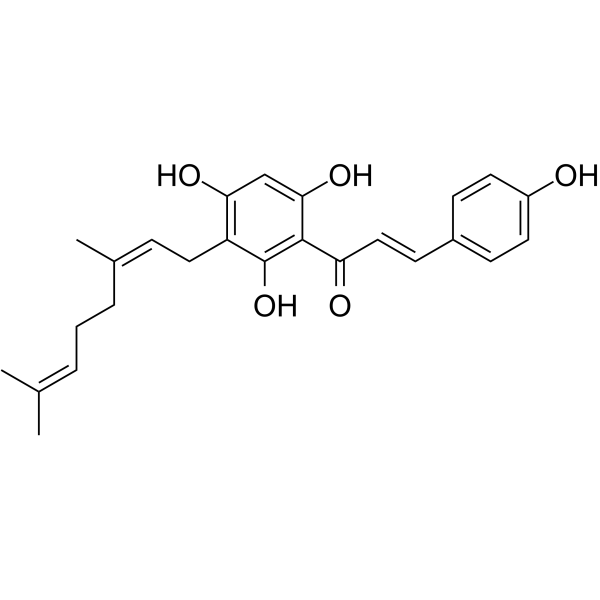
AMPK activator 6 (Compound GC) reduces lipid content and activates the AMPK pathway in HepG2 and 3T3-L1 cells. AMPK activator 6 significantly suppresses the increase in triglyceride (TG) , total cholesterol (TC), low-density lipoprotein-C (LDL-C), and other biochemical indices in blood serum. AMPK activator 6 can be used for the research of non-alcoholic fatty liver disease (NAFLD) and metabolic syndrome.
Nur für Forschungszwecke. Wir verkaufen nicht an Patienten.
- CAS. Nr.: 189299-03-4
- Formel: C25H28O5
- Molecular Weight:408.49
-
Speicherung:
Please store the product under the recommended conditions in the Certificate of Analysis.

To place orders, for customer services and technical support, please contact: MedChemExpress USA
Tel: 609-228-6898 E-mail: [email protected] [email protected]


-
 Biologische Aktivität
-
Chemical Information
- Protokoll
- Reinheit & Dokumentation
- Verweise
-
 Help & FAQs


Alle AMPK Isoform-spezifische Produkte anzeigen
More

Biologische Aktivität
Beschreibung
Cellular Effect
|
Cell Line

|
Type | Value | Description | References |
|---|---|---|---|---|
| HeLa | IC50 |
18.2 μM
Compound: 3, 3'-geranylchalconaringenin
|
Cytotoxicity against human HeLa cells by MTT assay after 72 hrs
Cytotoxicity against human HeLa cells by MTT assay after 72 hrs
|
[PMID: 18611049] |


Chemical Information
-
CAS. Nr. 189299-03-4
-
Molecular Weight 408.49
-
Formel C25H28O5
-
SMILES
C/C(C)=C\CC/C(C)=C\CC1=C(C=C(C(C(/C=C/C2=CC=C(C=C2)O)=O)=C1O)O)O
-
Versand
Room temperature in continental US; may vary elsewhere.
-
Speicherung
Please store the product under the recommended conditions in the Certificate of Analysis.


Reinheit & Dokumentation
Verweise

Calculators
Konzentration (Stammlösung) × Volumen (Stammlösung) = Konzentration (Ziellösung) × Volumen (Ziellösung)


AMPK activator 6 Related Classifications
HY-146398 Related Classifications
 Powered by Bioz