



AMY-101 acetate
Based on 8 publication(s) in Google Scholar
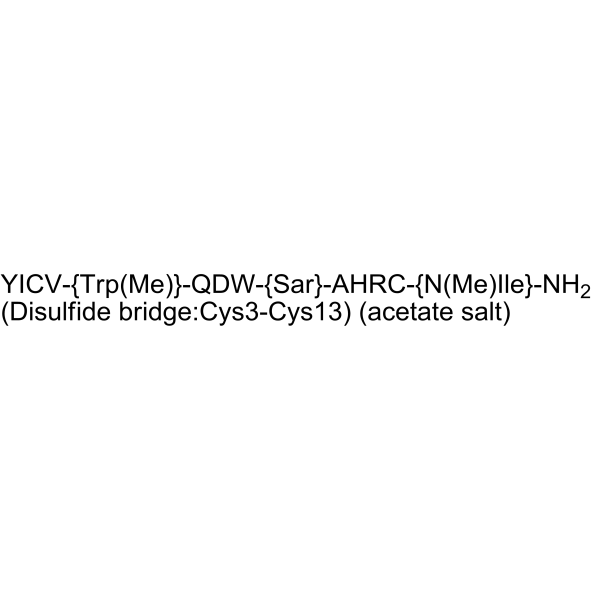
AMY-101 acetate (Cp40 acetate), a peptidic inhibitor of the central complement component C3 (KD = 0.5 nM), inhibits naturally occurring periodontitis in non-human primates (NHPs). AMY-101 acetate (Cp40 acetate) exhibits a favorable anti-inflammatory activity in models with COVID-19 severe pneumonia with systemic hyper inflammation.
Nos produits utilisent uniquement pour la recherche. Nous ne vendons pas aux patients.
- Pureté : 99.70%
- Formule: C83H117N23O18S2.xC2H4O2
- Masse moléculaire:1789.09 (free base)
-
Stockage:
Sealed storage, away from moisture and light.
Powder -80°C, 2 years , -20°C, 1 year* In solvent : -80°C, 6 months; -20°C, 1 month (sealed storage, away from moisture and light)

To place orders, for customer services and technical support, please contact: MedChemExpress USA
Tel: 609-228-6898 E-mail: [email protected] [email protected]


-
 Activité biologique
-
Chemical Information
-
Solvant et solubilité
- Protocole
- Pureté et documentation
- Références
-
 Help & FAQs



Publications Citing Use of MedChemExpress (MCE) AMY-101 acetate
More- Cell. 2025 May 29;188(11):3013-3029.e19. [Abstract]
- Nucleic Acids Res. 2021 Jan 8;49(D1):D1113-D1121. [Abstract]
- Virulence. 2025 Dec;16(1):2580104. [Abstract]
- mBio. 2026 Feb 13:e0170925. [Abstract]
- Ann Med. 2026 Dec;58(1):2705007.
- iScience. 2025 Dec 28.
- bioRxiv. 2025 May 23.
- Sci Total Environ. 2024 May 10:924:171681. [Abstract]


Activité biologique
Description
IC50 & Target
KD: 0.5 nM (C3)[1].
In Vivo
AMY-101 can induce a long-lasting anti-inflammatory effect[1].
AMY-101 (4 mg/kg bodyweight, subcutaneous injection. once per 24 hr for a total of 28 days) causes a significant and long-lasting reduction in PPD, an index that measures tissue destruction[1].
AMY-101 (Cp40, 1 mg/kg, sc, injection every 12 h, daily, 7 or 14 days) attenuates fibrosis and infiltration of inflammatory cells in UUO-induced renal fibrosis[3].
MedChemExpress (MCE) has not independently confirmed the accuracy of these methods. They are for reference only.
-
Animal Model:Fifteen adult male cynomolgus monkeys (Macaca fascicularis) (7-15 years old; 5.0-7.6 kg body weight)[1].
-
Dosage:0.1 mg/site; 50 μL of 2 mg/mL solution.
-
Administration:Injected locally. (Either three times per week or once a week for 6 weeks followed by a 6-week follow-up period without treatment.)
-
Result:Does not cause irritation in healthy gingiva.
-
Animal Model:UUO and sham-operated mice[3].
-
Dosage:1 mg/kg.
-
Administration:Subcutaneous injection every 12 h, daily, 7 or 14 days.
-
Result:1 mg/kg Cp40 had much less severe interstitial fibrosis than control peptide-injected mice.


Chemical Information
-
Appearance Solid
-
Masse moléculaire 1789.09 (free base)
-
Formule C83H117N23O18S2.xC2H4O2
-
Color White to off-white
-
Synonyms
Cp40 acetate
-
Sequence
{D-Tyr}-Ile-Cys-Val-{Trp(Me)}-Gln-Asp-Trp-{Sar}-Ala-His-Arg-Cys-{N(Me)Ile}-NH2 (Disulfide bridge:Cys3-Cys13)
-
Sequence Shortening
{D-Tyr}-ICV-{Trp(Me)}-QDW-{Sar}-AHRC-{N(Me)Ile}-NH2 (Disulfide bridge:Cys3-Cys13)
-
Livraison
Room temperature in continental US; may vary elsewhere.
-
Stockage
Sealed storage, away from moisture and light
Powder -80°C 2 years -20°C 1 year * In solvent : -80°C, 6 months; -20°C, 1 month (sealed storage, away from moisture and light)


Publications (8)
-
Journal Impact Factor
-
Most Recent
-
Cell
2025 May 29;188(11):3013-3029.e19. PMID: 40252640 -
Nucleic Acids Res
COVID19 Drug Repository: text-mining the literature in search of putative COVID19 therapeutics. [Abstract]2021 Jan 8;49(D1):D1113-D1121. PMID: 33166390 -
Virulence
Neutrophil extracellular trap-borne C3-driven endothelial dysfunction in Klebsiella pneumoniae liver abscess. [Abstract]2025 Dec;16(1):2580104. PMID: 41146461 -
mBio
Monoclonal IgM antibodies mediate potent complement neutralization by targeting cell-derived epitopes on enveloped viruses. [Abstract]2026 Feb 13:e0170925. PMID: 41685933 -
-
-
-
Sci Total Environ
Neurotoxic effects of polystyrene nanoplastics on memory and microglial activation: Insights from in vivo and in vitro studies. [Abstract]2024 May 10:924:171681. PMID: 38490422


Solvant et solubilité
In Vitro:
DMSO : 100 mg/mL (Need ultrasonic; Hygroscopic DMSO has a significant impact on the solubility of product, please use newly opened DMSO)
H2O : 50 mg/mL (Need ultrasonic)
In Vivo:
Select the appropriate dissolution method based on your experimental animal and administration route.
- For the following dissolution methods, please ensure to first prepare a clear stock solution using an In Vitro approach and then sequentially add co-solvents:
- To ensure reliable experimental results, the clarified stock solution can be appropriately stored based on storage conditions. As for the working solution for In Vivo experiments, it is recommended to prepare freshly and use it on the same day.
- The percentages shown for the solvents indicate their volumetric ratio in the final prepared solution. If precipitation or phase separation occurs during preparation, heat and/or sonication can be used to aid dissolution.
Add each solvent one by one: 10% DMSO 40% PEG300 5% Tween-80 45% Saline
Solubility: ≥ 2.5 mg/mL; Clear solution
This protocol yields a clear solution of ≥ 2.5 mg/mL (saturation unknown).
Taking 1 mL working solution as an example, add 100 μL DMSO stock solution (25.0 mg/mL) to 400 μL PEG300, and mix evenly; then add 50 μL Tween-80 and mix evenly; then add 450 μL Saline to adjust the volume to 1 mL.
Preparation of Saline: Dissolve 0.9 g sodium chloride in ddH₂O and dilute to 100 mL to obtain a clear Saline solution.
Add each solvent one by one: 10% DMSO 90% (20% SBE-β-CD in Saline)
Solubility: 2.5 mg/mL; Suspended solution; Need ultrasonic
This protocol yields a suspended solution of 2.5 mg/mL. Suspended solution can be used for oral and intraperitoneal injection.
Taking 1 mL working solution as an example, add 100 μL DMSO stock solution (25.0 mg/mL) to 900 μL 20% SBE-β-CD in Saline, and mix evenly.
Preparation of 20% SBE-β-CD in Saline (4°C, storage for one week): 2 g SBE-β-CD powder is dissolved in 10 mL Saline, completely dissolve until clear.
In Vivo Dissolution Calculator
Please enter the basic information of animal experiments:
-
-
-
-
Recommended: Prepare an additional quantity of animals to account for potential losses during experiments.
Working solution concentration: 0.22 mg/mL
This product has good water solubility, please refer to the measured solubility data in water/PBS/Saline for details.


Pureté et documentation
-
Fiche technique (285 KB)
-
SDS (254 KB)
- English - EN (254 KB)
- Français - FR (254 KB)
- Deutsch - DE (254 KB)
- Norwegian - NO (254 KB)
- Español - ES (254 KB)
- Swedish - SV (254 KB)
- Italian - IT (254 KB)
- Korean - KR (254 KB)
- Portuguese - PT (254 KB)
-
Instruction de manipulation (2659 KB)
Références
[1]. Kajikawa T, et al. Safety and Efficacy of the Complement Inhibitor AMY-101 in a Natural Model of Periodontitis in Non-human Primates. Mol Ther Methods Clin Dev. 2017 Aug 18;6:207-215. [Content Brief]
[2]. Mastaglio S, et al. The first case of COVID-19 treated with the complement C3 inhibitor AMY-101. Clin Immunol. 2020 Apr 29:108450. [Content Brief]
[3]. 1 mg/kg Cp40 had much less severe interstitial fibrosis than control peptide-injected mice. [Content Brief]

Calculators
Concentration (start) × Volume (start) = Concentration (final) × Volume (final)


AMY-101 acetate Related Classifications
HY-P1717B Related Classifications
 Powered by Bioz