



Tempo-d18
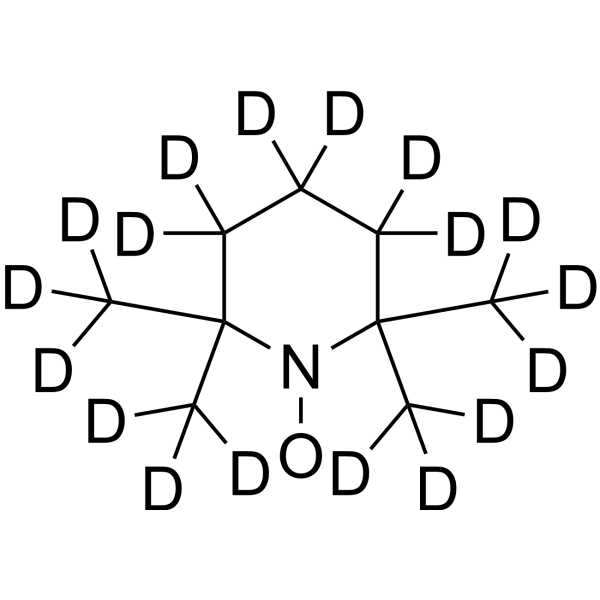
Tempo-d18 is the deuterium labeled Tempo. Tempo is a classic nitroxide radical and is a selective scavenger of ROS that dismutases superoxide in the catalytic cycle. Tempo induces DNA-strand breakage. Tempo can be used as an organocatalyst for the oxidation of primary alcohols to aldehydes. Tempo has mutagenic and antioxidant effects.
Nur für Forschungszwecke. Wir verkaufen nicht an Patienten.
- CAS. Nr.: 205679-68-1
- Formel: C9D18NO
- Molecular Weight:174.36
-
Speicherung:Powder -20°C, 3 years , 4°C, 2 years ; In solvent -80°C, 6 months , -20°C, 1 month

To place orders, for customer services and technical support, please contact: MedChemExpress USA
Tel: 609-228-6898 E-mail: [email protected] [email protected]


-
 Biologische Aktivität
-
Chemical Information
- Protokoll
- Reinheit & Dokumentation
- Verweise
-
 Help & FAQs


Alle DNA/RNA Synthesis Isoform-spezifische Produkte anzeigen
More

Biologische Aktivität
Beschreibung
Cellular Effect
|
Cell Line

|
Type | Value | Description | References |
|---|---|---|---|---|
| A-431 | IC50 |
>300 μM
Compound: TEMPO
|
Cytotoxicity against human A431 cells after 72 hrs by MTT assay
Cytotoxicity against human A431 cells after 72 hrs by MTT assay
|
[PMID: 22309911] |
In Vitro
Stable heavy isotopes of hydrogen, carbon, and other elements have been incorporated into drug molecules, largely as tracers for quantitation during the drug development process. Deuteration has gained attention because of its potential to affect the pharmacokinetic and metabolic profiles of drugs[1].
MedChemExpress (MCE) has not independently confirmed the accuracy of these methods. They are for reference only.
Anwendung
1. This compound can be used as a tracer
2. This compound can be used as an internal standard for quantitative analysis by NMR, GC-MS, or LC-MS.


Chemical Information
-
CAS. Nr. 205679-68-1
-
Unlabeled CAS 2564-83-2
-
Appearance Solid
-
Molecular Weight 174.36
-
Formel C9D18NO
-
Color Pink to red
-
SMILES
[O]N1C(C([2H])([2H])[2H])(C([2H])([2H])C([2H])([2H])C([2H])([2H])C1(C([2H])([2H])[2H])C([2H])([2H])[2H])C([2H])([2H])[2H]
-
Versand
Room temperature in continental US; may vary elsewhere.
-
Speicherung
Powder -20°C 3 years 4°C 2 years In solvent -80°C 6 months -20°C 1 month


Reinheit & Dokumentation
-
Data Sheet (279 KB)
-
SDS (393 KB)
- English - EN (393 KB)
- Français - FR (393 KB)
- Deutsch - DE (393 KB)
- Norwegian - NO (393 KB)
- Español - ES (393 KB)
- Swedish - SV (393 KB)
- Italian - IT (393 KB)
- Korean - KR (393 KB)
- Portuguese - PT (393 KB)
-
Handling Instructions (2659 KB)
Verweise
[1]. Russak EM, et al. Impact of Deuterium Substitution on the Pharmacokinetics of Pharmaceuticals. Ann Pharmacother. 2019 Feb;53(2):211-216. [Content Brief]
[2]. Du K, et al. Mitochondria-targeted antioxidant Mito-Tempo protects against acetaminophen hepatotoxicity. Arch Toxicol. 2017 Feb;91(2):761-773. [Content Brief]
[3]. Guo X, et al. Comparative Genotoxicity of TEMPO and 3 of Its Derivatives in Mouse Lymphoma Cells. Toxicol Sci. 2018 May 1163(1):214-225. [Content Brief]
[4]. Lv H, et al. TEMPO catalyzed oxidative dehydrogenation of hydrazobenzenes to azobenzenes. Org Biomol Chem. 2020 Apr 22. [Content Brief]
[5]. Chen X, et al. Isocitrate dehydrogenase 2 contributes to radiation resistance of oesophageal squamous cell carcinoma via regulating mitochondrial function and ROS/pAKT signalling. Br J Cancer. 2020 May 5. [Content Brief]

Calculators
Konzentration (Stammlösung) × Volumen (Stammlösung) = Konzentration (Ziellösung) × Volumen (Ziellösung)


Tempo-d18 Related Classifications
HY-W001187S Related Classifications
 Powered by Bioz