



Tanruprubart
Based on 6 publication(s) in Google Scholar
Tanruprubart (ANX005) is a C1q inhibitor and C1q depleter. Tanruprubart inhibits the classical complement pathway. The IC50 of Tanruprubart is 346 ng/mL for humans and 259 ng/mL for rats; its EC50 is 3.8 ng/mL for humans, 5.2 ng/mL for rats, and 9.9 ng/mL for mice. Tanruprubart is applicable to the research of Guillain-Barré syndrome and Alzheimer's disease. For the isotype control of Tanruprubart, refer to Human IgG4 kappa, Isotype Control (HY-P99003).
For research use only. We do not sell to patients.
- Purity : 99.34%
- CAS No.: 2065212-40-8
- Molecular Weight:145.78 kDa
-
Storage:Shipping with dry ice
Please store the product under the recommended conditions in the Certificate of Analysis.


To place orders, for customer services and technical support, please contact: MedChemExpress USA
Tel: 609-228-6898 E-mail: [email protected] [email protected]


-
 Biological Activity
-
Chemical Information
- Protocols
- Purity & Documentation
- References
-
 Help & FAQs


-

HY-P99965
CrovalimabAnti-C5 Recycling Antibody -
HY-127105
IptacopanFactor B Inhibitor -

HY-P99050
SutimlimabC1s Inhibitor -

HY-P99365
RavulizumabAnti-C5 Antibody -
HY-P9914
EculizumabComplement C5 Antibody -
HY-P99001
Human IgG1 kappa, Isotype ControlIgG1κ Isotype Control -

HY-P990025
EmpasiprubartAnti-complement C2 Antibody -

HY-P99376
NarsoplimabAnti-MASP-2 Antibody -

HY-P990091
RiliprubartActivated C1s Inhibitor -

HY-P990637
NGM-621Complement C3 Antibody


Biological Activity
Description
IC50 & Target
C1q
In Vitro
Tanruprubart (ANX005) (Titered concentrations) binds with high, comparable affinity to serum-derived C1q from human, cynomolgus monkey, rhesus monkey, dog, and rat, has lower affinity for mouse C1q, and does not bind rabbit C1q[1].
Tanruprubart (Titered concentrations; 1 h) potently inhibits classical complement-mediated hemolysis in human, cynomolgus monkey, rhesus monkey, dog, and rat serum, with an average IC50 of ~350 ng/mL, and does not inhibit hemolysis in rabbit serum[1].
MedChemExpress (MCE) has not independently confirmed the accuracy of these methods. They are for reference only.
In Vivo
Tanruprubart (ANX005) (10-200 mg/kg; i.v.; single bolus dose; once weekly; 4 weeks) administered to cynomolgus monkeys (as single doses or weekly doses for 4 weeks) produces dose-dependent serum and CSF exposures, fully depletes free serum C1q and inhibits complement-mediated hemolysis at measurable reagent levels, fully occupies CSF C1q at higher doses, and shows no treatment-related toxicity at doses up to 200 mg/kg, resulting in a no observed adverse effect level (NOAEL) of 100 mg/kg[1].
MedChemExpress (MCE) has not independently confirmed the accuracy of these methods. They are for reference only.
-
Animal Model:Sprague Dawley rats (male and female, young adult, 8-9 weeks old)[1]
-
Dosage:10 mg/kg; 50 mg/kg; 100 mg/kg; 200 mg/kg
-
Administration:i.v.; once weekly; 4 weeks
-
Result:Depleted free C1q in rat serum at measurable reagent levels.\nShowed dose-proportional increases in serum Cmax; AUC increased greater than dose-proportionally between lower doses, and dose-proportionally between 100 and 200 mg/kg.\nIncreased mean CSF concentrations in a greater-than-dose-proportional manner, with CSF levels representing 0.1% to 0.2% of serum levels on days 38 and 50 of the GLP study.\nExhibited no treatment-related changes in clinical signs, body weight, food consumption, clinical pathology, gross pathology, organ weight, or histopathology at any dose tested.\nAchieved a no observed adverse effect level (NOAEL) of 200 mg/kg.
-
Animal Model:Cynomolgus monkeys (male and female, 2-4 years old)[1]
-
Dosage:15 mg/kg (single bolus); 100 mg/kg (single bolus); 10 mg/kg (weekly x4); 50 mg/kg (weekly x4); 100 mg/kg (weekly x4); 200 mg/kg (weekly x4)
-
Administration:i.v.; single bolus dose; once weekly; 4 weeks
-
Result:Depleted free C1q in monkey serum at measurable reagent levels, with free C1q returning to baseline only when reagent levels dropped below detection.\nInhibited ex vivo complement-mediated hemolysis completely at measurable reagent serum levels, with hemolysis activity returning to baseline when reagent levels declined.\nShowed dose-dependent increases in serum concentrations, with trough levels accumulating over weekly doses in the 50, 100, and 200 mg/kg groups (excluding animals with anti-drug antibody responses).\nIncreased mean CSF concentrations with dose, with CSF levels representing 0.04% to 0.11% of serum levels in the non-GLP study, and 0.02% to 0.13% of serum levels in the GLP study on day 29; these CSF levels fully occupied C1q in the CSF at 100 and 200 mg/kg doses on day 29.\nExhibited no treatment-related changes in clinical signs, body weight, food consumption, clinical pathology, gross pathology, organ weight, histopathology, ophthalmic findings, neurologic exams, vital signs, or electrocardiograms at any dose tested.\nAchieved a no observed adverse effect level (NOAEL) of 200 mg/kg.
Application
ELISA, FACS, Functional assay
Verified Bioactivity
-
 Immobilized C1q Protein (HY-NP0194) can bind ANX005. The EC50 for this effect is 2.56 ng/mL.


Product Details
-
CAS No. 2065212-40-8
-
Accession P02745
-
Synonyms ANX005
-
Molecular Weight 145.78 kDa
-
Species Reactivity
Human
-
Conjugated
Unconjugated
-
Isotype
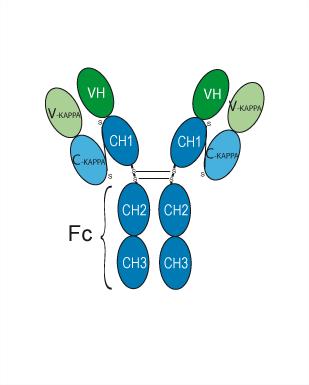
Human IgG4 kappa
-
Recommend Isotype Controls
-
Format
-
IgG4-kappa
-
Product Properties
-
Appearance
Liquid
-
Formulation
Please refer to the lot-specific COA for specific buffer information.
-
Purity
99.34%
-
Reconstitution
The product can be reconstituted/diluted with sterile PBS or saline.
-
Storage & Stability
Please store the product under the recommended conditions in the Certificate of Analysis.
-
Shipping
Shipping with dry ice.


Publications (6)
-
Journal Impact Factor
-
Most Recent
-
J Adv Res
Tocilizumab-loaded nanoparticles block IL-6R and reduce edema after intracerebral hemorrhage. [Abstract]2026 Feb 16:S2090-1232(26)00158-X. PMID: 41707962 -
Neuron
2025 Nov 18:S0896-6273(25)00803-7. PMID: 41260217 -
Alzheimers Dement
Gut-derived bacterial vesicles carrying lipopolysaccharide promote microglia-mediated synaptic pruning. [Abstract]2025 Aug;21(8):e70331. PMID: 40731189
Tanruprubart purchased from MedChemExpress. Usage Cited in: Alzheimers Dement. 2025 Aug;21(8):e70331. [Abstract]
The role of C1q in bEV‐induced synaptic pruning was further confirmed in vitro with a primary neuron and microglia cocultured system, where inhibiting C1q by ANX005 (Tanruprubart, 1 ng/mL) reversed the bEV‐induced reduction in PSD95 density.

Tanruprubart purchased from MedChemExpress. Usage Cited in: Alzheimers Dement. 2025 Aug;21(8):e70331. [Abstract]
The role of C1q in bEV-induced synaptic pruning was further confirmed in vitro with a primary neuron and microglia cocultured system, where inhibiting C1q by ANX005 (Tanruprubart, 1 ng/mL) reversed the bEV-induced reduction in PSD95 density.
-
J Neuroinflammation
Intravitreal delivery of NMO-IgG causes primary retinal damage in the absence of optic nerve injury. [Abstract]2025 Mar 7;22(1):69. PMID: 40055743 -
-
Int Immunopharmacol
Piezo1 participates in sevoflurane-induced developmental neurotoxicity via neuroinflammation and synaptic damage in the hippocampus. [Abstract]2025 Oct 10:163:115284. PMID: 40716188
Tanruprubart purchased from MedChemExpress. Usage Cited in: Int Immunopharmacol. 2025 Oct 10:163:115284. [Abstract]
We employed the C1q antagonist ANX005 (Tanruprubart, 20 mg/kg in 5% DMSO, 5 μL/g, ip) to Yoda1-treated sevoflurane-induced mice to examine synaptic and cognitive rescue.

Tanruprubart purchased from MedChemExpress. Usage Cited in: Int Immunopharmacol. 2025 Oct 10:163:115284. [Abstract]
We employed the C1q antagonist ANX005 (Tanruprubart, 20 mg/kg in 5% DMSO, 5 μL/g, ip) to Yoda1-treated sevoflurane-induced mice to examine synaptic and cognitive rescue. Representative Western blot bands and quantitative analysis of mouse hippocampal MAP2 protein.

Tanruprubart purchased from MedChemExpress. Usage Cited in: Int Immunopharmacol. 2025 Oct 10:163:115284. [Abstract]
We employed the C1q antagonist ANX005 (Tanruprubart, 20 mg/kg in 5% DMSO, 5 μL/g, ip) to Yoda1-treated sevoflurane-induced mice to examine synaptic and cognitive rescue. Representative Western blot bands and quantitative analysis of mouse hippocampal PSD95 protein.
Purity & Documentation


References

Calculators
Concentration (start) × Volume (start) = Concentration (final) × Volume (final)


Tanruprubart Related Classifications
HY-P990545 Related Classifications
 Powered by Bioz