



MN551
Based on 1 publication(s) in Google Scholar
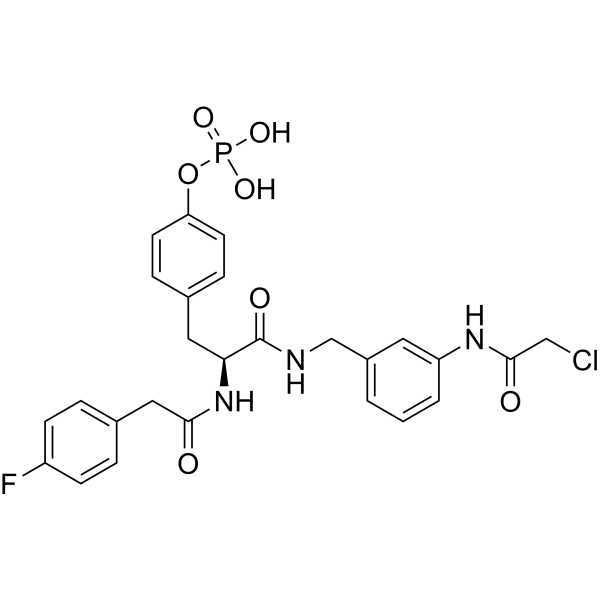
MN551 is a covalent modulator of SOCS2 and CISH, with selectivity for SOCS2 and CISH over SOCS4. MN551 covalently modifies Cys111 in the SH2 domain of SOCS2 and Cys144 in the EF loop of the CISH SH2 domain, while only minimally modifying Cys471 in the BG loop of the SOCS6 SH2 domain. MN551 increases the thermal stability of the recombinant SOCS2-ElonginB-ElonginC complex and competitively blocks the binding of SOCS2 to its substrate; when delivered via the prodrug MN714, it blocks the intracellular recruitment of substrates by SOCS2. MN551 can serve as a chemical probe for investigating the biological functions of SOCS2 and its CRL5 complex, and also act as an E3 ligase-binding module in proteolysis-targeting chimeras (PROTACs).
For research use only. We do not sell to patients.
- Purity : 98.01%
- CAS No.: 3044099-90-0
- Formula: C26H26ClFN3O7P
- Molecular Weight:577.93
-
Storage:Powder -20°C, 3 years , 4°C, 2 years ; In solvent -80°C, 6 months , -20°C, 1 month

To place orders, for customer services and technical support, please contact: MedChemExpress USA
Tel: 609-228-6898 E-mail: [email protected] [email protected]


-
 Biological Activity
-
Chemical Information
-
Solvent & Solubility
- Purity & Documentation
- References
-
 Help & FAQs


Publications Citing Use of MedChemExpress (MCE) MN551
More

Biological Activity
Description
IC50 & Target
cysteine-directed electrophilic covalent[1]
In Vitro
MN551 (0.5 mM; 16 h) forms a specific covalent bond with Cys111 of recombinant SOCS2 in the SBC2 complex, as visualized by X-ray crystallography[1].
MN551 (1 mM; 2 h) binds recombinant SBC2 with a reversible Kd of 2.18 µM and covalently blocks binding of the native SOCS2 substrate GHRpY595 peptide[1].
MN551 (100 mM-sub-micromolar; over time) acts as a covalent inhibitor of recombinant SBC2 with a covalent efficiency of 58 M-1 s-1, an initial reversible Ki of 1.1 µM, a kinact of 2.1 × 10⁻⁴ s-1, and a Ki of 3.6 µM[1].
MN551 (32-500000 nM; 20 h) engages HiBiT-SOCS2 in permeabilised HeLa cells with an EC50 of 1 µM, but shows low cell permeability in live HeLa cells[1].
MN551 (40 µM; up to 120 min) covalently modifies wild-type recombinant SOCS2 (SBC2) and CISH to full occupancy within 2 h, does not modify SBC4, and minimally modifies SBC6, with strict dependence on SOCS2 Cys111 for reactivity[1].
MN551 enhances the thermal stability of recombinant SBC2 by 6 °C, confirming direct binding to the complex[1].
MedChemExpress (MCE) has not independently confirmed the accuracy of these methods. They are for reference only.


Chemical Information
-
CAS No. 3044099-90-0
-
Appearance Solid
-
Molecular Weight 577.93
-
Formula C26H26ClFN3O7P
-
Color White to off-white
-
SMILES
FC1=CC=C(CC(N[C@@H](CC2=CC=C(OP(O)(O)=O)C=C2)C(NCC3=CC=CC(NC(CCl)=O)=C3)=O)=O)C=C1
-
Shipping
Room temperature in continental US; may vary elsewhere.
-
Storage
Powder -20°C 3 years 4°C 2 years In solvent -80°C 6 months -20°C 1 month


Publications (1)
-
Journal Impact Factor
-
Most Recent


Solvent & Solubility
In Vitro:
DMSO : 100 mg/mL (173.03 mM; Need ultrasonic; Hygroscopic DMSO has a significant impact on the solubility of product, please use newly opened DMSO)
Please refer to the solubility information to select the appropriate solvent. Once prepared, please aliquot and store the solution to prevent product inactivation from repeated freeze-thaw cycles.
Storage method and period of stock solution: -80°C, 6 months; -20°C, 1 month. When stored at -80°C, please use it within 6 months. When stored at -20°C, please use it within 1 month.
Please refer to the solubility information to select the appropriate solvent. Once prepared, please aliquot and store the solution to prevent product inactivation from repeated freeze-thaw cycles.
Storage method and period of stock solution: -80°C, 6 months; -20°C, 1 month. When stored at -80°C, please use it within 6 months. When stored at -20°C, please use it within 1 month.
Concentration (start) × Volume (start) = Concentration (final) × Volume (final)
In Vivo:
Select the appropriate dissolution method based on your experimental animal and administration route.
- For the following dissolution methods, please ensure to first prepare a clear stock solution using an In Vitro approach and then sequentially add co-solvents:
- To ensure reliable experimental results, the clarified stock solution can be appropriately stored based on storage conditions. As for the working solution for In Vivo experiments, it is recommended to prepare freshly and use it on the same day.
- The percentages shown for the solvents indicate their volumetric ratio in the final prepared solution. If precipitation or phase separation occurs during preparation, heat and/or sonication can be used to aid dissolution.
Add each solvent one by one: 10% DMSO 40% PEG300 5% Tween-80 45% Saline
Solubility: ≥ 2.5 mg/mL (4.33 mM); Clear solution
This protocol yields a clear solution of ≥ 2.5 mg/mL (saturation unknown).
Taking 1 mL working solution as an example, add 100 μL DMSO stock solution (25.0 mg/mL) to 400 μL PEG300, and mix evenly; then add 50 μL Tween-80 and mix evenly; then add 450 μL Saline to adjust the volume to 1 mL.
Preparation of Saline: Dissolve 0.9 g sodium chloride in ddH₂O and dilute to 100 mL to obtain a clear Saline solution.
Add each solvent one by one: 10% DMSO 90% (20% SBE-β-CD in Saline)
Solubility: ≥ 2.5 mg/mL (4.33 mM); Clear solution
This protocol yields a clear solution of ≥ 2.5 mg/mL (saturation unknown).
Taking 1 mL working solution as an example, add 100 μL DMSO stock solution (25.0 mg/mL) to 900 μL 20% SBE-β-CD in Saline, and mix evenly.
Preparation of 20% SBE-β-CD in Saline (4°C, storage for one week): 2 g SBE-β-CD powder is dissolved in 10 mL Saline, completely dissolve until clear.
In Vivo Dissolution Calculator
Please enter the basic information of animal experiments:
-
-
-
-
Recommended: Prepare an additional quantity of animals to account for potential losses during experiments.
Please enter your animal formula composition:
-
%DMSO +
Recommended: Keep the proportion of DMSO in working solution below 2% if your animal is weak.
-
%+
-
+%Tween-80 + +
-
%Saline +
The co-solvents required include: DMSO, . All of co-solvents are available by MedChemExpress (MCE). , Tween 80. All of co-solvents are available by MedChemExpress (MCE).
Working solution concentration: 0.22 mg/mL
Method for preparing stock solution: mg drug dissolved in μL DMSO. Stock solution concentration: mg/mL.
1. Take μL DMSO stock solution;
2. Add μL .
μL , mix evenly;
3. Then add μL Tween 80, mix evenly;
4. Then add μL
Please ensure that the stock solution in the first step is dissolved to a clear state, and add co-solvents in sequence. You can use ultrasonic heating (ultrasonic cleaner, recommended frequency 20-40 kHz), vortexing, etc. to assist dissolution.


Purity & Documentation
-
Data Sheet (284 KB)
-
SDS (254 KB)
- English - EN (254 KB)
- Français - FR (254 KB)
- Deutsch - DE (254 KB)
- Norwegian - NO (254 KB)
- Español - ES (254 KB)
- Swedish - SV (254 KB)
- Italian - IT (254 KB)
- Korean - KR (254 KB)
- Portuguese - PT (254 KB)
-
Handling Instructions (2659 KB)
References


Complete Stock Solution Preparation Table
Please refer to the solubility information to select the appropriate solvent. Once prepared, please aliquot and store the solution to prevent product inactivation from repeated freeze-thaw cycles.
Storage method and period of stock solution: -80°C, 6 months; -20°C, 1 month. When stored at -80°C, please use it within 6 months. When stored at -20°C, please use it within 1 month.
| Optional Solvent | Concentration Solvent Mass | 1 mg | 5 mg | 10 mg | 25 mg |
|---|---|---|---|---|---|
| DMSO | 1 mM | 1.7303 mL | 8.6516 mL | 17.3031 mL | 43.2578 mL |
| 5 mM | 0.3461 mL | 1.7303 mL | 3.4606 mL | 8.6516 mL | |
| 10 mM | 0.1730 mL | 0.8652 mL | 1.7303 mL | 4.3258 mL | |
| 15 mM | 0.1154 mL | 0.5768 mL | 1.1535 mL | 2.8839 mL | |
| 20 mM | 0.0865 mL | 0.4326 mL | 0.8652 mL | 2.1629 mL | |
| 25 mM | 0.0692 mL | 0.3461 mL | 0.6921 mL | 1.7303 mL | |
| 30 mM | 0.0577 mL | 0.2884 mL | 0.5768 mL | 1.4419 mL | |
| 40 mM | 0.0433 mL | 0.2163 mL | 0.4326 mL | 1.0814 mL | |
| 50 mM | 0.0346 mL | 0.1730 mL | 0.3461 mL | 0.8652 mL | |
| 60 mM | 0.0288 mL | 0.1442 mL | 0.2884 mL | 0.7210 mL | |
| 80 mM | 0.0216 mL | 0.1081 mL | 0.2163 mL | 0.5407 mL | |
| 100 mM | 0.0173 mL | 0.0865 mL | 0.1730 mL | 0.4326 mL |


MN551 Related Classifications
HY-156395 Related Classifications
 Powered by Bioz