



BLI-489 hydrate

Based on 1 Customer Validation
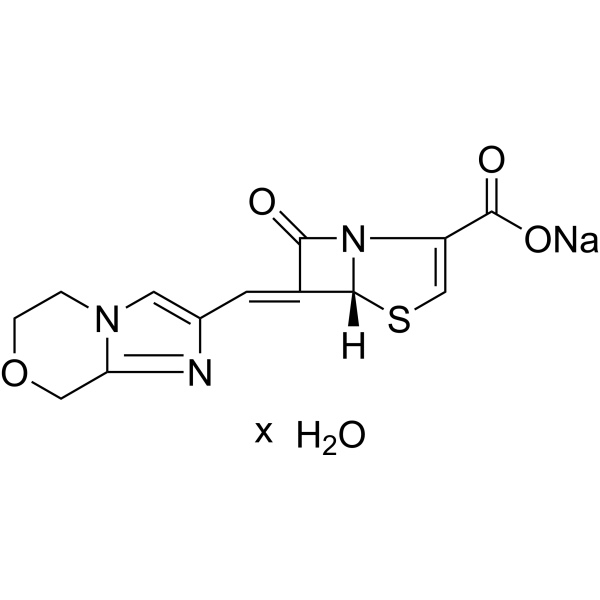
BLI-489 hydrate is a Beta-lactamase inhibitor. BLI-489 hydrate is an antibacterial adjuvant that significantly enhances the antibacterial efficacy of β-lactam antibiotics. BLI-489 hydrate blocks the hydrolytic activity of the enzyme by forming a stable intermediate in serine Beta-lactamase, or by coordinating with the binuclear Zn2+ through an oxygen atom in metallo-Beta-lactamase. BLI-489 hydrate can be used for research on bacterial infections.
For research use only. We do not sell to patients.
- Purity : 99.0%
- CAS No.: 2580120-08-5
- Formula: C13H12N3NaO5S.xH2O
-
Storage:
4°C, sealed storage, away from moisture
* In solvent : -80°C, 6 months; -20°C, 1 month (sealed storage, away from moisture)

To place orders, for customer services and technical support, please contact: MedChemExpress USA
Tel: 609-228-6898 E-mail: [email protected] [email protected]


-
 Biological Activity
-
Chemical Information
-
Solvent & Solubility
- Protocols
- Purity & Documentation
- References
-
 Help & FAQs


All Beta-lactamase Isoforms
More

Biological Activity
Description
|
NDM-1 |
AmpC |
In Vitro
BLI-489 (2-4 μg/mL; 18-22 h) hydrate enhances the antibacterial activity of Piperacillin (HY-B1923) against various predicted panels of Gram-negative and Gram-positive bacteria and clinical isolates[1].
BLI-489 (up to 64 µg/mL; 24 h) hydrate exhibits synergistic growth inhibition with Ceftriaxone (HY-B0712) in NDM-producing NDM-Kp, with an MIC of 8 μg/mL and an MBC of 16 μg/mL[4].
BLI-489 (4-16 μg/mL; 4-24 h) hydrate inhibits biofilm formation in NDM-Kp, does not cause bacterial cell membrane protein leakage, reduces bacterial load, and maintains the integrity of cell surface morphology[4].
BLI-489 (8 mg/L; 24 h) hydrate exhibits synergistic antibacterial activity with Imipenem (HY-B1369A) in CRAb strains producing CHDLs and MBLs[2].
BLI-489 (8 mg/L; 6-24 h) hydrate in combination with Imipenem shows synergy against OXA-24-like, OXA-51-like, and OXA-58-producing CRAb isolates, but does not show synergy against OXA-23-producing CRAb isolates after 24 h[2].
BLI-489 (4-64 μg/mL; 4 h) hydrate exhibits low hemolytic activity and high biocompatibility in red blood cells (RBCs)[4].
MedChemExpress (MCE) has not independently confirmed the accuracy of these methods. They are for reference only. Further protocols information, click here.
-
Cell Line:NDM-producing Klebsiella pneumoniae
-
Concentration:4 μg/mL, 8 μg/mL
-
Incubation Time:24 h
-
Result:Significantly reduced the number of bacterial colonies within 24 hours and continuously inhibited the regrowth of the bacteria in combination with Ceftriaxone.
In Vivo
BLI-489 (ED50 dose in combination with Piperacillin ranges from 8.5-69 mg/kg; s.c.; administered at 30 min and 150 min post-infection, 1-2 doses total; observed for 7 days after the first day of dosing) hydrate significantly improves survival rates and restores the in vivo efficacy of Piperacillin in CD-1 mouse acute lethal systemic infection models caused by various β-lactamase-producing pathogenic bacteria[3].
BLI-489 (8 mg/L; administered in agar medium; single administration; 24 h) hydrate synergizes with Imipenem to improve nematode survival in the CRAb-infected C. elegans model[2].
MedChemExpress (MCE) has not independently confirmed the accuracy of these methods. They are for reference only.
-
Animal Model:BALB/c (female, 6-7 weeks old, 20-25 g)[2]
-
Dosage:25 mg/kg (alone); 25 mg/kg (combination with Imipenem 25 mg/kg)
-
Administration:i.p.; every 8 h; 3 days
-
Result:Rescued 76.7% of mice from CRAb pneumonia in combination with Imipenem.
BLI-489 alone resulted in significantly higher activity against AbTVGH-908 than Imipenem alone.


Chemical Information
-
CAS No. 2580120-08-5
-
Appearance Solid
-
Formula C13H12N3NaO5S.xH2O
-
Color Light yellow to yellow
-
SMILES
O=C(C1=CS[C@@](/C2=C/C3=CN4C(COCC4)=N3)([H])N1C2=O)O[Na].[x].O
-
Shipping
Room temperature in continental US; may vary elsewhere.
-
Storage
4°C, sealed storage, away from moisture
* In solvent : -80°C, 6 months; -20°C, 1 month (sealed storage, away from moisture)


Solvent & Solubility
In Vitro:
DMSO : 24 mg/mL (Need ultrasonic; Hygroscopic DMSO has a significant impact on the solubility of product, please use newly opened DMSO)
H2O : 20 mg/mL (Need ultrasonic and warming)

Protocols
-
Research Protocol for Infectious Diseases
Infectious-disease experiments test how pathogens interact with host barriers, innate immune receptors, inflammatory signaling, pathogen replication, and tissue injury; pattern-recognition receptors such as TLRs, RIG-I-like receptors, NOD-like receptors, and inflammasomes detect microbial molecules and activate NF-κB, interferon, and cytokine responses. The central hypothesis is that infection severity reflects the balance between pathogen burden and host response: protective inflammation restricts pathogen growth, whereas excessive or mislocalized inflammation contributes to tissue damage and disease phenotype. Unresolved questions include which host pathways are protective versus pathogenic, why some infection models fail to translate to human disease, and which combined readouts best predict clinically relevant infection outcomes.


Purity & Documentation
-
Data Sheet (282 KB)
-
SDS (252 KB)
- English - EN (252 KB)
- Français - FR (252 KB)
- Deutsch - DE (252 KB)
- Norwegian - NO (252 KB)
- Español - ES (252 KB)
- Swedish - SV (252 KB)
- Italian - IT (252 KB)
- Korean - KR (252 KB)
- Portuguese - PT (252 KB)
-
Handling Instructions (2659 KB)
References
[1]. Petersen PJ, et al. Establishment of in vitro susceptibility testing methodologies and comparative activities of piperacillin in combination with the penem {beta}-lactamase inhibitor BLI-489. Antimicrobial agents and chemotherapy. 2009 Feb;53(2):370-84. [Content Brief]
[2]. Wang YC, et al. In vitro and in vivo activities of imipenem combined with BLI-489 against class D β-lactamase-producing Acinetobacter baumannii. The Journal of antimicrobial chemotherapy. 2021 Jan 19;76(2):451-459. [Content Brief]
[3]. Petersen PJ, et al. Efficacy of piperacillin combined with the Penem beta-lactamase inhibitor BLI-489 in murine models of systemic infection. Antimicrobial agents and chemotherapy. 2009 Apr;53(4):1698-700. [Content Brief]

Calculators
Concentration (start) × Volume (start) = Concentration (final) × Volume (final)


BLI-489 hydrate Related Classifications
HY-108062A Related Classifications
 Powered by Bioz
Keywords
- BLI-489
- 2580120-08-5
- BLI489
- BLI 489
- Beta-lactamase
- Bacterial
- OXA-24-like and OXA-58-like β-lactamases
- New Delhi metallo-β-lactamase
- Klebsiella pneumoniae
- methicillin-susceptible staphylococci
- class A
- class C
- and class D β-lactamases
- penem β-lactamase inhibitor
- Cys208
- His250
- and Asp124
- Acinetobacter baumannii
- biofilm formation
- carbapenemase-producing isolates
- Inhibitor
- inhibitor
- inhibit