



Antimalarial agent 19
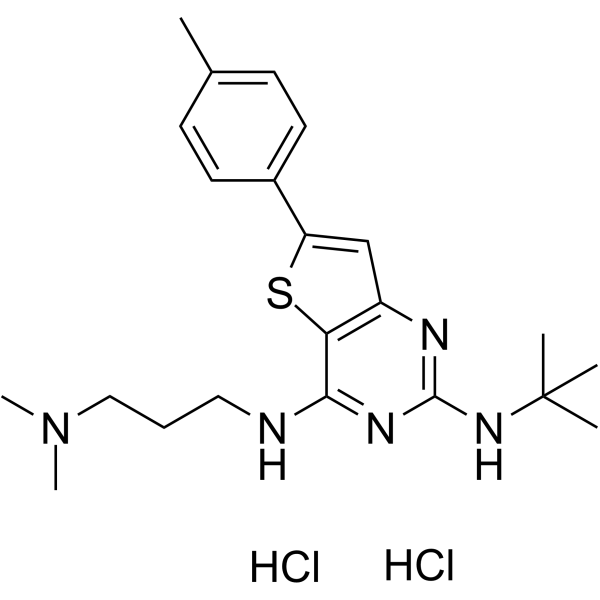
Antimalarial agent 19 (compound 6e) is an antimalarial active agent. Antimalarial agent 19 has antimalarial activity for the blood stage of P. falciparum K1 and P. berghei with EC50 values of 0.3 µM, 15.3 µM, respectively. Antimalarial agent 19 has good aqueous solubility, intestinal permeability and microsomal stability compared to gamhepathiopine.
Nos produits utilisent uniquement pour la recherche. Nous ne vendons pas aux patients.
- CAS No.: 2897630-89-4
- Formule: C22H33Cl2N5S
- Masse moléculaire:470.50
-
Stockage:
Please store the product under the recommended conditions in the Certificate of Analysis.

To place orders, for customer services and technical support, please contact: MedChemExpress USA
Tel: 609-228-6898 E-mail: [email protected] [email protected]


-
 Activité biologique
-
Chemical Information
- Protocole
- Pureté et documentation
- Références
-
 Help & FAQs


Voir tous les produits spécifiques à Isoform Parasite
More

Activité biologique
Description
Cellular Effect
|
Cell Line

|
Type | Value | Description | References |
|---|---|---|---|---|
| Hepatocyte | CC50 |
35.5 μM
Compound: 6e.2HCl
|
Cytotoxicity against cynomolgus monkey Primary hepatocyte assessed as cell viability
Cytotoxicity against cynomolgus monkey Primary hepatocyte assessed as cell viability
|
[PMID: 36680984] |


Chemical Information
-
CAS No. 2897630-89-4
-
Masse moléculaire 470.50
-
Formule C22H33Cl2N5S
-
SMILES
CC1=CC=C(C=C1)C2=CC3=C(C(NCCCN(C)C)=NC(NC(C)(C)C)=N3)S2.Cl.Cl
-
Livraison
Room temperature in continental US; may vary elsewhere.
-
Stockage
Please store the product under the recommended conditions in the Certificate of Analysis.

Protocole
-
Transepithelial/transendothelial electrical resistance assay
TEER measures electrical resistance across epithelial or endothelial monolayers cultured on permeable supports, and the readout reflects ionic conductance through the cell barrier, especially the paracellular pathway regulated by junctional integrity. TEER can be measured without destroying the monolayer and is commonly used before or during transport, permeability, barrier-disruption, and barrier-maturation experiments. TEER values are influenced by biological maturation and technical conditions; reported factors include temperature, medium formulation, passage number, electrode geometry, membrane properties, and junctional length during early monolayer maturation. Therefore, TEER should be interpreted with blank-insert subtraction, area normalization, repeated readings, and, when possible, orthogonal barrier readouts such as FITC-dextran flux or tight-junction staining.


Pureté et documentation
Références

Calculators
Concentration (start) × Volume (start) = Concentration (final) × Volume (final)


Antimalarial agent 19 Related Classifications
HY-152614 Related Classifications
 Powered by Bioz