



DAF-FM DA (solution)

Based on 1 Customer Validation
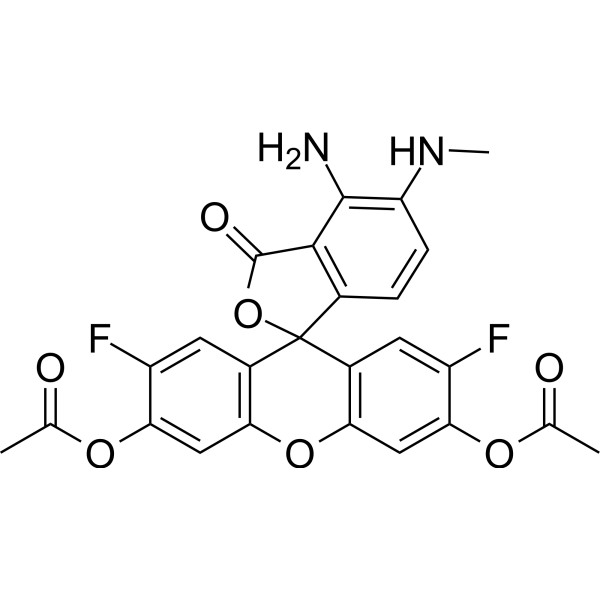
DAF-FM DA (Diaminofluorescein-FM diacetate) (solution) is a fluorescent probe for the detection and bioimaging of nitric oxide (NO). DAF-FM DA spontaneously crosses the plasma membrane and is subsequently cleaved by esterases to generate intracellular DAF-FM (Ex/Em=495/515 nm) .
Solvent and concentration: DMSO: 2 mM
Nos produits utilisent uniquement pour la recherche. Nous ne vendons pas aux patients.
- CAS No.: 254109-22-3
- Formule: C25H18F2N2O7
- Masse moléculaire:496.42
-
Stockage:
Please store the product under the recommended conditions in the Certificate of Analysis.


To place orders, for customer services and technical support, please contact: MedChemExpress USA
Tel: 609-228-6898 E-mail: [email protected] [email protected]


-
 Activité biologique
-
Chemical Information
- Pureté et documentation
- Références
-
 Help & FAQs




Activité biologique
Description
Solvent and concentration: DMSO: 2 mM
In Vitro
Guide (The following is our recommended protocol. This protocol is only a guide and should be modified according to your specific needs).
1. Preparation of stock solution[2]
It is recommended that the DAF-FM DA stock solution be stored at -20°C or -80°C in the dark after aliquoting.
2. Preparation of working solution
Dilute the stock solution with Hank’s buffer or serum-free medium. The corresponding stock solution can be diluted according to the actual situation. Note that if the solvent is DMSO, the cytotoxicity of DMSO must be considered, and a solvent control should be prepared; if the solvent is pure water, the working solution needs to be filtered and sterilized before adding cells.
Note: Please adjust the concentration of DAF-FM DA working solution according to actual conditions and prepare it before use.
3. Staining steps
3.1 Seed cells in a 6-well plate.
3.2 Aspirate the culture medium.
3.3 Add 5 μM DAF-FM DA working solution to each well and incubate at 37°C in the dark for 30 min to allow the probe to enter the cells.
3.4 Replace with fresh Hank’s buffer and continue incubation for 20 min to complete the deesterification reaction.
3.5 Counterstain the cell nucleus with Hoechst dye.
3.6 Quantify the fluorescence intensity using a microplate reader at 495 nm excitation and 515 nm emission, and normalize to the number of cells stained with Hoechst.
MedChemExpress (MCE) has not independently confirmed the accuracy of these methods. They are for reference only. .
In Vivo
MedChemExpress (MCE) has not independently confirmed the accuracy of these methods. They are for reference only.


Chemical Information
-
CAS No. 254109-22-3
-
Appearance Liquid (Density: 1.560±0.10 g/cm3)
-
Masse moléculaire 496.42
-
Formule C25H18F2N2O7
-
Color Colorless to light yellow
-
SMILES
O=C1OC2(C3=C(OC4=C2C=C(F)C(OC(C)=O)=C4)C=C(OC(C)=O)C(F)=C3)C5=C1C(N)=C(NC)C=C5
-
Livraison
Room temperature in continental US; may vary elsewhere.
-
Stockage
Please store the product under the recommended conditions in the Certificate of Analysis.


Pureté et documentation
-
Fiche technique (276 KB)
-
SDS (252 KB)
- English - EN (252 KB)
- Français - FR (252 KB)
- Deutsch - DE (252 KB)
- Norwegian - NO (252 KB)
- Español - ES (252 KB)
- Swedish - SV (252 KB)
- Italian - IT (252 KB)
- Korean - KR (252 KB)
- Portuguese - PT (252 KB)
-
Instruction de manipulation (2659 KB)
Références
[1]. Zhi Xu, et al. RelB-activated GPX4 inhibits ferroptosis and confers tamoxifen resistance in breast cancer. Redox Biol. 2023 Dec:68:102952. [Content Brief]
[2]. Ann Huysseune, et al. Bone Formation in Zebrafish: The Significance of DAF-FM DA Staining for Nitric Oxide Detection. Biomolecules. 2023 Dec 12;13(12):1780. [Content Brief]

Calculators
Concentration (start) × Volume (start) = Concentration (final) × Volume (final)


DAF-FM DA (solution) Related Classifications
HY-DY1048 Related Classifications
 Powered by Bioz