



Moexipril
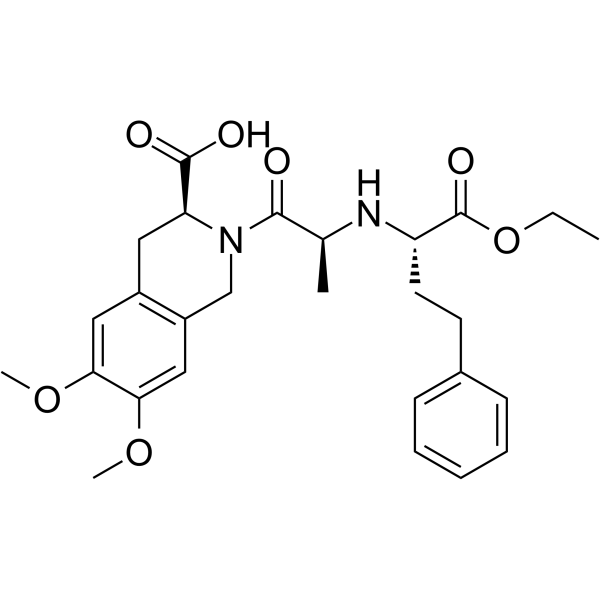
Moexipril is an orally active inhibitor of angiotensin-converting enzyme (ACE), and becomes effective by being hydrolyzed to moexiprila (hydrochloride). Moexipril exhibits antihypertensive and neuroprotective effects-.
At equivalent molar concentrations, both the salt and free forms of a compound exhibit comparable biological activity. Nevertheless, the salt form (Moexipril hydrochloride) usually boasts enhanced water solubility and stability.
Nos produits utilisent uniquement pour la recherche. Nous ne vendons pas aux patients.
- CAS No.: 103775-10-6
- Formule: C27H34N2O7
- Masse moléculaire:498.57
-
Stockage:
Please store the product under the recommended conditions in the Certificate of Analysis.

To place orders, for customer services and technical support, please contact: MedChemExpress USA
Tel: 609-228-6898 E-mail: [email protected] [email protected]
Other In-stock Forms of Moexipril


-
 Activité biologique
-
Chemical Information
- Pureté et documentation
- Références
-
 Help & FAQs




Activité biologique
Description
IC50 & Target
IC50: 2.1 nM (purified ACE from rabbit lung), 1.75 nM (ACE in rat plasma)[3]
In Vitro
Moexipril is devoid of anti-inflammatory properties and has no effect on platelet function[2].
Moexipril hydrolyzes to Moexiprilat, and Moexiprilat inhibits ACE in guinea pig serum as well as on purified ACE from rabbit lung with IC50s of 2.6 nM and 4.9 nM, respectively[2].
Moexipril (0.01 nM-0.1 mM) exhibits high potency against both ACE in rats plasma and purified ACE from rabbit lung, with IC50s of 1.75 nM and 2.1 nM, respectively[3].
Moexipril (0-100 μM, 24 h) significantly reduced the percentage of damaged neurons in a dose-dependent manner[4].
Moexipril (0-100 μM, 24 h) significantly attenuates Fe2+/3+-induced neurotoxicity[4].
Moexipril dose not cause significant changes in the percentage of apoptotic neurons[4].
MedChemExpress (MCE) has not independently confirmed the accuracy of these methods. They are for reference only.
In Vivo
Moexipril (3 mg/kg, 30 mg/kg and 10 mg/kg; p.o.; once daily; 5 days) exhibits a dose-dependent and antihypertensive effects in renal hypertensive rats, spontaneously hypertensive rats and perinephritic hypertensive dogs, respectively[3].
Moexipril (0.3 mg/kg, i.p.) significantly reduces the infarct area on the mouse brain surface in NMRI mice[4].
Moexipril (0.1 mg/kg, i.p.) significantly attenuates the cortical infarct volume in Long-Evans rats[4].
MedChemExpress (MCE) has not independently confirmed the accuracy of these methods. They are for reference only.
-
Animal Model:Spontaneously hypertensive rats[3]
-
Dosage:30 mg/kg
-
Administration:Oral gavage; once daily; 5 days
-
Result:Caused a progressive lowering of mean blood pressure from pretreatment values of 180 +/- 7 mmHg to a trough on day 4 of 127 +/- 4 mmHg.
Dose-dependently decreased arterial blood pressure, and inhibited plasma and tissue ACE activity.
-
Animal Model:Renal hypertensive rats[3]
-
Dosage:0.03-10 mg/kg
-
Administration:Oral gavage; once daily; 5 days
-
Result:Caused a dose-dependent decrease in blood pressure with a threshold dose of 0.3 mg/kg.
Lowered mean blood pressure by about 70 mmHg of 3 mg/kg.
-
Animal Model:Perinephritic hypertensive dogs[3]
-
Dosage:10 mg/kg
-
Administration:Oral gavage; once daily; 5 days
-
Result:Caused a drop of mean blood pressure by 25 mmHg from pre-treatment control, which persisted for 24 h, by a rapid onset and a long duration of action.
-
Animal Model:NMRI mice (male, Permanent focal ischemia)[4]
-
Dosage:0, 0.03, 0.3, and 3 mg/kg
-
Administration:Intraperitoneal injection (1 h before middle cerebral artery occlusion)
-
Result:Significantly reduced the infarct area on the mouse brain surface with a dose of 0.3 mg/kg, and other doses were not effective.
-
Animal Model:Long-Evans rats (male, Permanent focal ischemia)[4]
-
Dosage:0, 0.01, 0.1 mg/kg
-
Administration:Intraperitoneal injection (1 h before middle cerebral artery occlusion)
-
Result:Significantly attenuated the cortical infarct volume from 114.4 to 98.2 mm as compared to non-treated animals in a dose of 0.01 mg/kg, without reducing the infarct volume of the rat brain at dosages >0.01 mg/kg.
Essai clinique
| NCT Number | Sponsor | Condition | Start Date |
Phase

|
|---|---|---|---|---|
| NCT01329991 | 2011-05 | PHASE1 |


Chemical Information
-
CAS No. 103775-10-6
-
Masse moléculaire 498.57
-
Formule C27H34N2O7
-
SMILES
O=C([C@H]1N(C([C@@H](N[C@H](C(OCC)=O)CCC2=CC=CC=C2)C)=O)CC3=C(C=C(OC)C(OC)=C3)C1)O
-
Livraison
Room temperature in continental US; may vary elsewhere.
-
Stockage
Please store the product under the recommended conditions in the Certificate of Analysis.


Pureté et documentation


Références
[1]. Chrysant, S.G. and G.S. Chrysant, Pharmacological and clinical profile of moexipril: a concise review. J Clin Pharmacol, 2004. 44(8): p. 827-36. [Content Brief]
[2]. Friehe H, et al. Pharmacological and toxicological studies of the new angiotensin converting enzyme inhibitor moexipril hydrochloride. Arzneimittelforschung. 1997 Feb. 47(2):132-44. [Content Brief]
[3]. Edling O, et al. Moexipril, a new angiotensin-converting enzyme (ACE) inhibitor: pharmacological characterization and comparison with enalapril. J Pharmacol Exp Ther. 1995 Nov;275(2):854-63. [Content Brief]
[4]. Ravati A, et al. Enalapril and moexipril protect from free radical-induced neuronal damage in vitro and reduce ischemic brain injury in mice and rats. Eur J Pharmacol. 1999 May 28;373(1):21-33. [Content Brief]

Calculators
Concentration (start) × Volume (start) = Concentration (final) × Volume (final)


Moexipril Related Classifications
HY-117281 Related Classifications
 Powered by Bioz